What Is DCIM? Data Center Infrastructure Management Explained

Data center infrastructure management (DCIM) is the convergence of IT and facilities management within a data center — software that monitors, measures, and manages servers, power systems, cooling, and physical space from a single platform. Accurate DCIM data enables capacity planning, fault detection, and change management across the physical layer of the IT environment. The underlying asset inventory determines whether that data is reliable enough to act on.
Data center managers face a persistent challenge: the physical environment housing IT infrastructure changes faster than any manual audit can track. Equipment gets added, moved, or decommissioned. Power loads shift. Cooling demands increase as server density rises — AI workloads are now pushing rack power densities from under 10kW to over 100kW in some facilities, a tenfold shift that makes real-time environmental data critical. When no single system connects these moving parts, capacity decisions get made on stale data, and incidents take longer to resolve than they should.
What is DCIM? Data center infrastructure management explained
What is DCIM?
Data center infrastructure management (DCIM) is a software category that unifies IT equipment monitoring and physical facilities management — covering power, cooling, space, and asset inventory — within a single centralized platform. Operations teams use DCIM data to monitor equipment health, plan capacity, manage changes, and respond to faults before service disruptions occur.
How does DCIM software work?
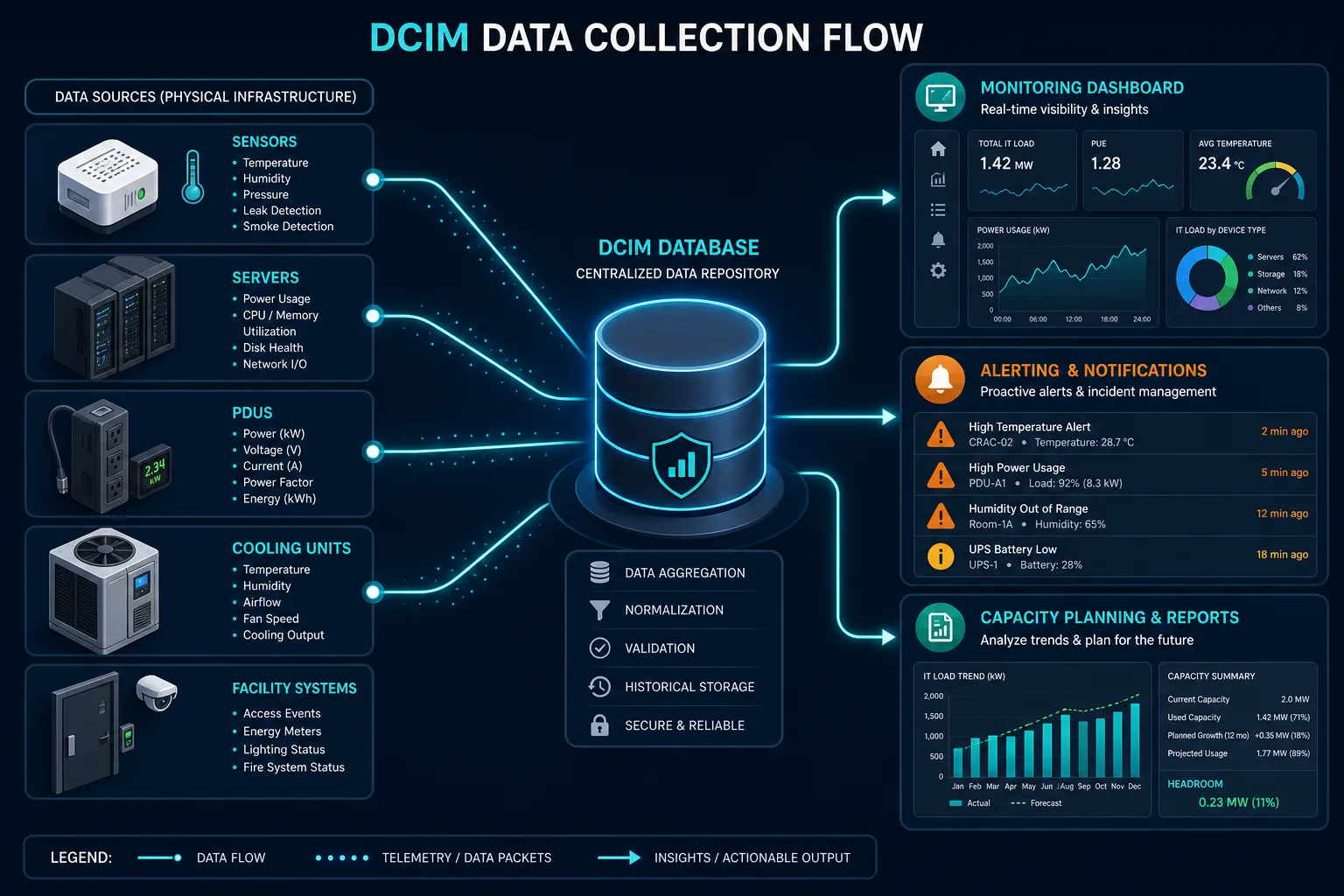
The software collects data from every managed component in the data center environment: servers, storage systems, network switches, power distribution units (PDUs), cooling units, and environmental sensors. Each device feeds performance, health, and configuration data into a central repository. That repository becomes the foundation for monitoring, capacity planning, and change management.
The platform surfaces this data through a dashboard interface where operators can see power consumption, thermal conditions, and space utilization in one place. Most platforms support automated alerting so the operations team receives notifications when thresholds are breached before a problem escalates into an outage.
Software connectors — typically APIs or vendor-provided modules — extend visibility to equipment that cannot communicate natively with the management platform. The scope of any deployment depends on how many device types the platform integrates with and how accurately the underlying asset inventory reflects the real environment.
How does DCIM software work?
DCIM software collects performance, environmental, and configuration data from every managed device in a data center: servers, storage arrays, PDUs, cooling units, and environmental sensors. Data flows into a central repository and surfaces through dashboards and alerting modules. Software APIs and vendor connectors extend visibility to equipment that cannot communicate natively with the platform.
Core components of data center infrastructure management
A functioning DCIM program depends on four elements working together.
Asset inventory database. This is a record of every device, system, and infrastructure component in the facility: servers, storage arrays, network equipment, PDUs, cooling units, and environmental sensors. Sound IT asset management practice starts here. If the inventory is incomplete or stale, everything built on top of it will be too.
Monitoring and telemetry layer. Sensors and software agents collect power draw, temperature, humidity, and utilization data at defined intervals. This layer converts a static asset list into an active operational picture.
Analytics and capacity planning engine. The software processes collected data to identify trends, model future scenarios, and surface capacity decisions before they become emergencies. Without this layer, raw sensor readings have limited operational value.
Integrations and connectors. The platform needs connections to existing IT management tools — ITSM platforms, network management systems, and CMDB solutions. These integrations prevent operational data from staying siloed in a separate tool. For teams on ServiceNow, Virima’s no-code ServiceNow integration routes discovery-sourced asset data directly into existing ITSM workflows without displacing the platform already in use.
Key benefits of DCIM
Organizations deploy DCIM primarily for visibility, but the downstream benefits extend into energy management, compliance, and operational resilience.
Improved uptime. Centralized equipment health data and active alerting allow operators to identify failing components before they cause service disruptions. Accurate capacity data also prevents overprovisioning errors that create thermal failures in high-density rack environments.
Energy management. The platform enables measurement of power usage effectiveness (PUE) — a ratio of total data center power to IT equipment power — across all IT-related equipment. According to Mordor Intelligence (March 2026), the global DCIM market is valued at $4.28 billion in 2026 and growing at 18.25% CAGR — driven in part by pressure to reduce energy consumption in AI-intensive data center environments.
Capacity planning. With accurate utilization data across space, power, and cooling, teams can model expansion scenarios before committing hardware spend. This prevents both wasted capacity and last-minute procurement that adds risk to change windows.
Change management support. The platform maintains change records for configuration changes, work orders, and equipment replacements, supporting operational governance and reducing manual effort during audit cycles.
What are the benefits of DCIM?
DCIM improves data center uptime by monitoring equipment health and alerting operators to faults before outages occur. It supports energy management through PUE tracking, enables accurate capacity planning from utilization data, and maintains change records for compliance. These capabilities reduce operational costs and support faster incident response.
Why DCIM deployments stall — and how to prevent it
Four failure modes account for most DCIM programs that never deliver expected operational value.
Stale or incomplete asset data. A platform fed by outdated inventory generates misleading capacity reports, triggers alerts on incorrectly catalogued equipment, and produces change records that diverge from the real environment. This is the most common root cause of implementation failure — and the least visible before deployment begins.
Integration gaps. When the platform has no defined connection to the ITSM tool, network management system, or CMDB, operational data stays siloed. Alerts fire without the context needed to route work orders correctly. Capacity decisions get made without dependency data.
Sensor and metering retrofits. Older facilities often lack rack-level PDU metering or temperature sensors. Without that hardware, the platform has no source data for power and thermal monitoring — and the investment to retrofit can be significant before meaningful readings are possible.
Training and process alignment. These platforms require staff training and process updates to be effective. Change management workflows that don’t route through the system from day one create gaps in the change record that are difficult to backfill.
According to Sunbird’s State of DCIM Software 2026 report, native DCIM discovery running at 85% accuracy — which sounds high — still means reconciling one in seven devices manually. In large facilities, that can cost four hours per asset (Sunbird DCIM). The gap between “close enough” and operationally trustworthy is narrower than most teams expect before deployment.
A discovery-driven approach addresses the asset accuracy failure mode at the source. When a discovery engine scans the environment through agentless and agent-based methods, it populates the asset database from what actually exists in the network. High-frequency discovery cycles keep that data current without manual intervention. See: IT discovery.
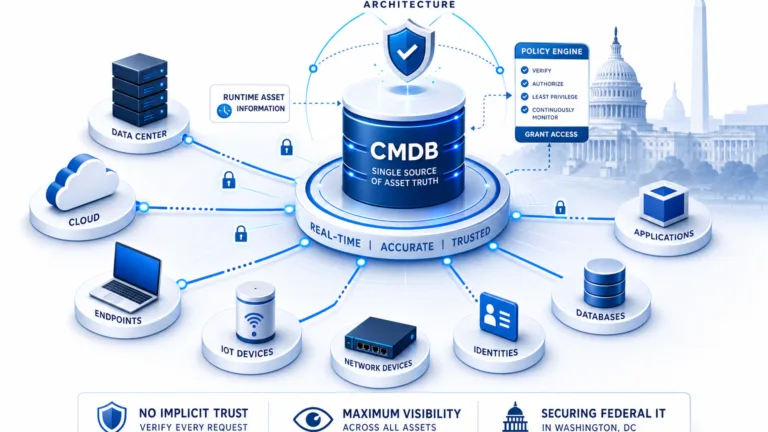
For organizations running a separate ITSM platform, connecting asset data to a CMDB closes another gap. The CMDB holds configuration item (CI) relationships, owner data, and change history. The asset management layer holds physical location, power draw, and environmental data. Together, they give the operations team a complete picture: what exists, how it is connected, who owns it, and what has changed.
Explore how Virima delivers discovery-sourced Trusted Runtime Truth across your infrastructure →
DCIM security: protecting your infrastructure data
DCIM security demands attention because these platforms connect multiple critical systems: power infrastructure, cooling controls, network management, and physical location records. Each integration point is also a potential exposure point.
Three requirements stand out for any infrastructure security program in this area:
Access control. These dashboards expose sensitive infrastructure data. Role-based access controls ensure that only authorized personnel can view or modify configuration and monitoring records.
Network segmentation. The management network used for device communication should be isolated from general corporate traffic. Segmentation limits the impact of any security incident that reaches the management plane.
Data integrity. Configuration records and change logs should be protected from unauthorized modification. Tampered change records undermine compliance posture and complicate incident investigations.
When operational data flows into the broader IT environment through integrations, those security requirements extend to every receiving system. A CMDB receiving data from this source needs the same access control rigor applied upstream.
What to evaluate before choosing DCIM software
Before selecting a platform, teams should assess the current state of their environment against four requirements. A deployment is only as strong as the foundation it manages.
Asset baseline. The software cannot monitor what it does not know exists. Teams that attempt deployment without a prior active vs passive IT asset discovery effort typically find the initial configuration phase takes far longer than planned.
Sensor and metering coverage. The platform depends on environmental sensors for power and thermal data. Older facilities often lack rack-level PDU metering or temperature sensors, requiring infrastructure investment before meaningful readings are possible.
Integration readiness. The most value comes when the platform connects to the ITSM tool, network management system, and CMDB. Without defined integration paths before purchase, operational data stays siloed rather than enriching the broader environment.
Skills and process alignment. These platforms require staff training and process updates to be effective. Change management workflows need to route work orders through the system from day one, or the change record will be incomplete.
See how Virima’s discovery engine gives your DCIM program an accurate asset foundation →
DCIM vs. data center management: understanding the distinction
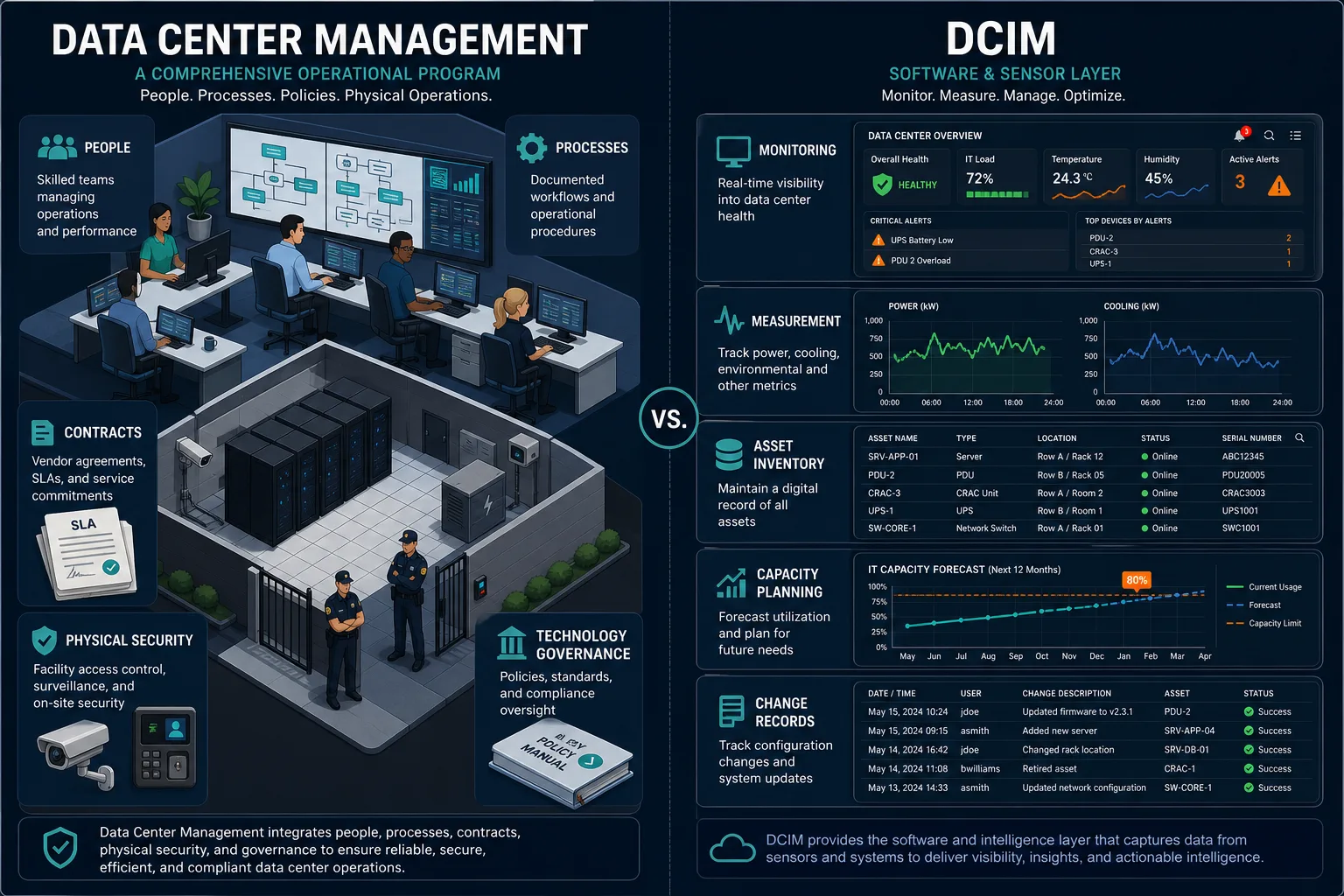
“Data center management” covers the full scope of processes, people, and tools that keep a data center operational: capacity planning, vendor contracts, physical security, power procurement, staffing, and technology governance. DCIM is one component within that broader program.
The term specifically refers to the software and sensor layer that tracks, measures, and reports on physical and logical infrastructure. Organizations sometimes use the two terms interchangeably, but the distinction matters when scoping a technology investment. A software platform does not automatically improve the broader management program if the underlying asset data remains inaccurate.
From DCIM data to discovery-driven IT operations
Accurate, discovery-sourced asset data improves operational visibility — and it’s what makes autonomous IT operations safe to pursue.
Gartner’s 2025 Hype Cycle for Data Center Infrastructure Technologies confirms that DCIM is no longer experimental — it is a mature, mainstream platform that delivers consistent operational and financial value. The question for most organizations has shifted from “should we deploy DCIM?” to “how do we make the asset data behind it trustworthy enough to act on?”
When the asset inventory reflects the actual environment, capacity planning decisions are grounded in fact. Change management workflows have accurate dependency data to evaluate blast radius. Security and compliance teams have an audit-ready record of every configuration item. As organizations move toward agentic IT operations, AI agents execute infrastructure decisions without a human approval step. The quality of the underlying data determines whether those decisions are safe.
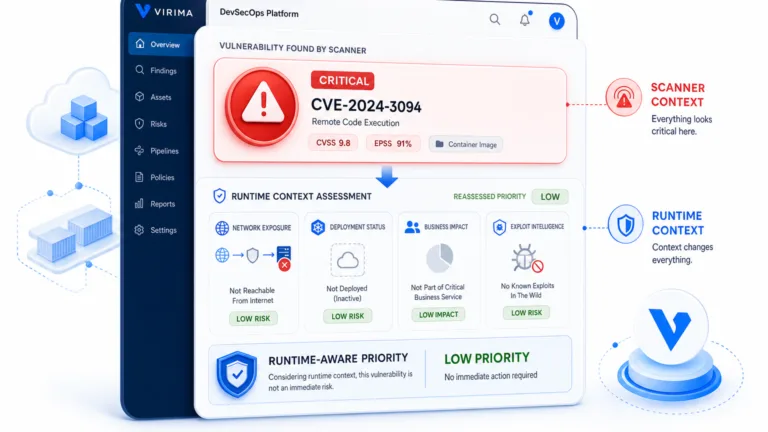
Connecting operational data to a discovery-sourced CMDB creates what Virima calls Trusted Runtime Truth. That’s a live, explainable, governed record of what exists, how it connects, what has changed, and what the blast radius of any action would be. ViVID™ service maps extend this visibility from individual assets to full service dependency context. Teams looking to build a CMDB from their existing asset data have a direct integration path through Virima’s hybrid discovery engine.
See how Virima builds discovery-sourced operational context for data center environments →
Frequently asked questions about DCIM
What does DCIM stand for and what does it cover?
DCIM stands for Data Center Infrastructure Management. It refers to both the discipline of managing IT equipment, power, cooling, and physical space in a data center, and the software category that supports that management through centralized monitoring, asset tracking, and capacity planning.
What is the difference between DCIM and a CMDB?
DCIM monitors physical and environmental data: power consumption, thermal conditions, rack space, and equipment health. A CMDB tracks configuration items, their dependencies, ownership, and change history. The first answers what is installed and consuming resources. The CMDB answers how those assets connect to services and who is responsible for them.
What is the difference between DCIM and a CMDB?
DCIM monitors physical infrastructure: power consumption, thermal conditions, rack space utilization, and equipment health. A CMDB tracks configuration items, their dependencies, change history, and ownership. DCIM answers what is installed and consuming resources. The CMDB answers how those assets connect to services and who owns them. Organizations benefit most when both systems share a common, discovery-sourced asset foundation.
Why do data center infrastructure management implementations stall?
Implementations most often stall because of stale or incomplete asset data. When the underlying inventory comes from outdated spreadsheets, the platform generates inaccurate capacity reports, misleading alerts, and change records that diverge from reality. Addressing discovery before deployment — through agent-based vs agentless discovery methods suited to the environment — prevents this common failure mode.
How does Virima support data center infrastructure management?
Virima discovers and inventories physical and virtual assets through agentless and agent-based scanning across on-premises environments and cloud platforms (AWS and Azure). The platform populates a discovery-sourced CMDB and surfaces dependency context through ViVID™ service maps, giving any data center management program an accurate, continuously refreshed asset foundation. Schedule a demo to see how Virima fits your environment.