Cybersecurity in the Age of Non-Human Identities: The Asset Blind Spot Nobody’s Fixing

Between August 8 and August 18, 2025, threat actor UNC6395 used stolen OAuth tokens issued to the Salesloft Drift chatbot integration to query Salesforce instances at scale. The campaign harvested embedded secrets from case records, including AWS keys, Snowflake tokens, and passwords. Google Threat Intelligence Group reporting documented the mechanism as first-party disclosure, not vendor speculation.
The blast radius stretched across more than 700 organizations. Named victims and disclosure coverage included Cloudflare, Google Workspace accounts, Palo Alto Networks, Zscaler, Proofpoint, and PagerDuty, as independent trade reporting confirmed. Nothing in the classic sense “broke.” No human password dump opened the door. A third-party AI chat integration’s OAuth token, a non-human identity with standing access, kept working for an app that never returned to a disciplined asset review.
Identity teams were watching human logins. Few teams were watching what the chatbot was allowed to talk to. That is the cybersecurity story of non-human identities in plain terms: the credential is only half the problem. The other half is the missing asset-of-record for the system the credential can reach.
What Is a Non-Human Identity?
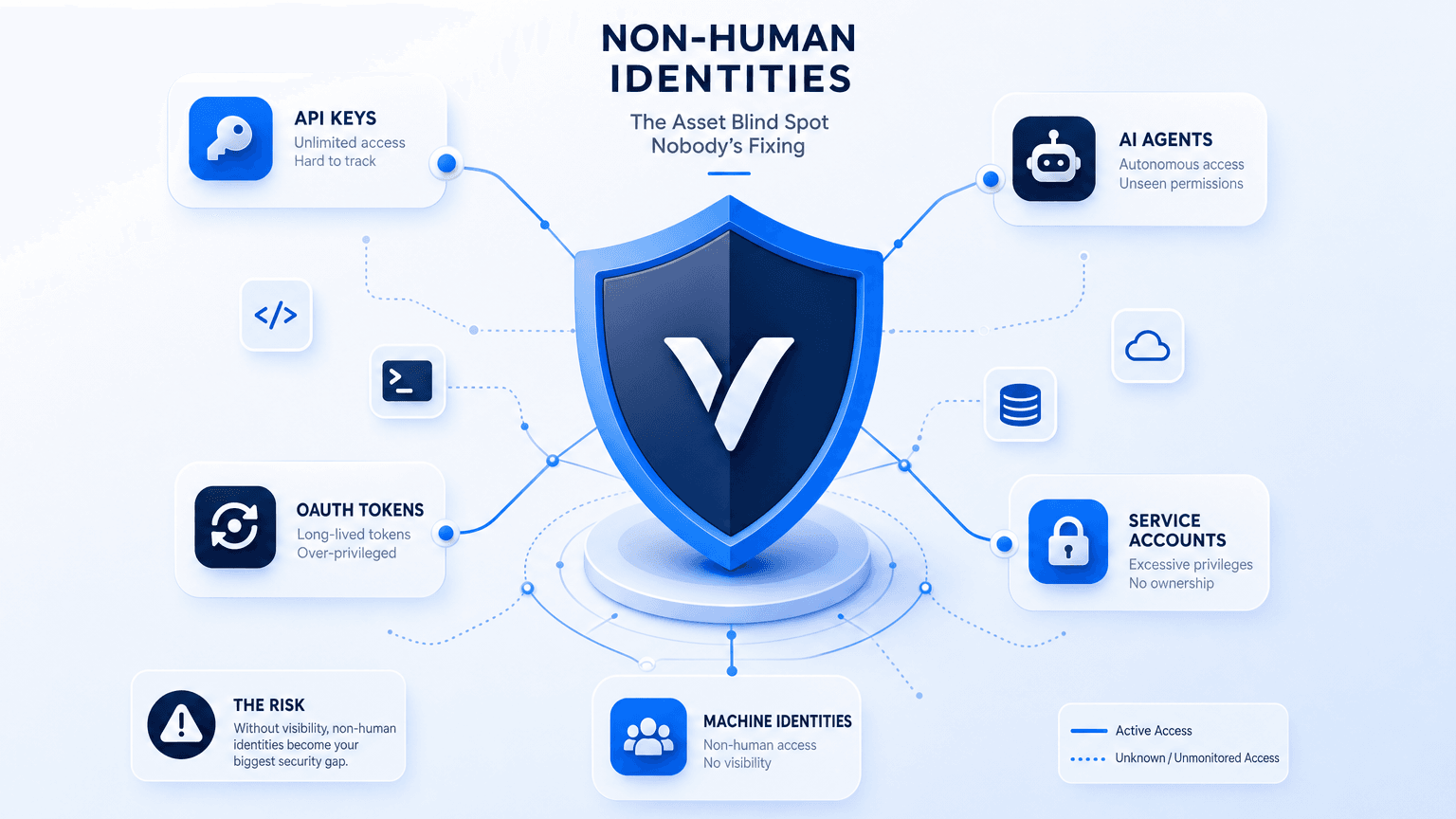
Per the Cloud Security Alliance framing on non-human identity and agentic AI governance, non-human identities are the credentials that authenticate and act inside systems without a human logging in each time. The class includes service accounts, API keys, OAuth tokens, RPA bots, workload identities, and AI agents with standing tool access.
Core categories show up in almost every hybrid estate:
- Service accounts tied to applications and batch jobs
- API keys and OAuth tokens that connect SaaS platforms to each other
- Machine and workload identities in cloud and container platforms
- RPA bots executing routine process steps
- AI agents granted ongoing access to tools, tickets, or data stores
The Hidden Problem
| Situation | What actually happens |
|---|---|
| A third-party app (chatbot, automation tool) is granted an OAuth token to a SaaS platform | The token is not recorded as a discoverable asset with an owner; it persists with standing access |
| A DevOps team spins up a service account for a CI/CD pipeline | No CI record links it to an owner, so over-permissioned or retired pipeline accounts stay active |
| An AI agent is connected to a cloud sandbox for a one-off task | The connection outlives the task; the identity keeps running outside human-login inventories |
| Security and identity teams run normal reviews | Vulnerability scans and access reviews scope to known systems, so an identity never attached to an asset record stays invisible |
Asset visibility and identity governance are related disciplines, not the same discipline. Teams that collapse them into one program often miss the inventory step that cyber asset attack surface management (CAASM) and Cybersecurity Asset Management (CSAM) programs are built to supply.
What is a non-human identity in enterprise IT?
A non-human identity is any credential that authenticates and acts without a person signing in for each session, including service accounts, API keys, OAuth tokens, RPA bots, workload identities, and AI agents with standing tool access. Governance fails when that credential is never joined to a discoverable asset record with an owner.
Why Non-Human Identities Are a Security Risk Right Now
Scale is no longer theoretical. Palo Alto Networks’ 2026 Identity Security Landscape Report, based on a survey of 2,930 security decision-makers, found machine identities, including AI agents, now outnumber human identities 109 to 1 inside responding organizations. The same survey found 9 in 10 organizations faced a successful identity-related breach in the prior 12 months. Treat the 109-to-1 ratio as Palo Alto’s survey result, not a blended industry consensus, because other vendors publish different ratios under different methods.
Cost pressure is rising in parallel. The IBM Cost of a Data Breach Report (with Ponemon Institute research) puts the global average breach cost at $4.99 million, a 12 percent jump and a record high in that series, with AI-driven attacks up 56 percent. The report’s own key takeaway names securing agentic identities as a required response and warns that racing to adopt agentic AI without governing the agents behind it puts data, people, and reputation at risk.
Machine identity security now sits next to human identity security on the same risk register. AI agent identity risk is the fastest-moving slice of that register because agents often receive standing tool access before ownership, scope, and offboarding rules catch up.
5 Failure Modes
- A non-human identity is provisioned outside any asset-of-record process, such as an OAuth grant approved in seconds. Result: nobody owns the token, so nobody notices when it should be revoked.
- A non-human identity outlives the infrastructure it served after operators retire the supported system while live credentials remain. Result: an old integration becomes a standing door nobody remembers is unlocked.
- A non-human identity crosses a vendor boundary in a SaaS-to-SaaS path, as in Drift-to-Salesforce. Result: a compromise does not stay inside one company’s perimeter; it cascades through downstream customers.
- An AI agent receives broad, standing access to finish a task instead of scoped, time-boxed permissions. Result: the agent’s blast radius is whatever the token can reach, not what the task required.
- Identity teams detect an intrusion quickly but cannot contain it in the same window. SANS Institute’s 2026 Identity Threats and Defenses Survey found 68 percent of organizations detect identity attacks within 24 hours, yet only 55 percent contain them in that same window. Result: fast detection alone does not stop the damage.
Assets teams have not discovered cannot be governed, secured, or used to inform safe AI decisions. Flexera’s 2025 State of ITAM Report found complete visibility across the tech stack fell to 43 percent from 47 percent year over year. That visibility gap is exactly where IT discovery programs earn their keep before identity tooling can finish the job.
Why are non-human identities a cybersecurity risk now?
Non-human identities multiply faster than ownership reviews, often outliving the systems they served and crossing vendor boundaries with standing access. When detection outpaces containment, as SANS reported in 2026 with a 68 percent detect-in-24-hours rate versus 55 percent contain-in-24-hours rate, uninventoried credentials keep expanding blast radius after first alert.
Who Feels This First
For Security Leaders
Cloud Security Alliance research cites a 2025 World Economic Forum analysis finding 51 percent of organizations report no clear ownership of AI identities. When the board asks who approved an agent integration, that accountability gap lands on the CISO’s desk, not on a forgotten ticket queue.
For SecOps Teams
Palo Alto’s 2026 report found fragmented identity tooling adds an average of 12 hours per identity-related incident. That is the direct operational tax of lacking one place to check what an identity is and which assets it touches during triage.
For Regulated Environments
Research cited in 2026 industry coverage found 8 percent of enterprise identities lack any HR-system ownership link after the person who created them leaves. Orphaned identities that persist with no human accountable become direct audit-finding risk. Unknown or unmanaged assets compound that exposure; Virima’s own CSAM guidance has long pointed to Trend Micro research that 74 percent of organizations have had security incidents tied to unknown or unmanaged assets, which is why a disciplined cybersecurity asset management baseline matters in regulated estates.
Market-Scale Challenge
Palo Alto’s data shows organizations expect 85 percent growth in AI agent identities over the next 12 months, faster than machine identities overall at 77 percent or human identities at 56 percent. The gap between identity growth and identity governance capacity is widening, not closing.
How Cybersecurity Asset Management (CSAM) Fixes This
CSAM is the asset-visibility layer, not identity governance, PAM, or IAM. It does not rotate OAuth scopes or enforce agent permissions. It discovers and maps the asset side of the picture so identity and security tools inherit accurate context.
- Discovery surfaces the asset a credential is attached to, even when nobody documented it. High-frequency scheduled discovery through agentless network scans, agent-based endpoint checks, and cloud or SaaS API pulls finds the server, cloud instance, or SaaS account a non-human identity connects to, whether or not anyone requested tracking. Agentless discovery patterns matter here because unauthorized devices and shadow integrations often never receive an agent.
- The CMDB gives that asset a verified owner and lifecycle status. Once an asset is a configuration item (CI) record, it can carry an owner, a health score, and a decommission state. A non-human identity attached to a system IT leadership already decided to retire gets flagged instead of silently persisting. That is core CMDB lifecycle discipline, not identity policy enforcement.
- ViVID™ service mapping shows the blast radius before it matters. After teams supply service definitions, dependency maps built from discovery data show what a given asset, and anything with a credential to it, actually touches. That is the same context service mapping already surfaces when AI agents act inside enterprise IT.
| Manual approach | Discovery-sourced approach | |
|---|---|---|
| How assets are found | Spreadsheet updates, ticket-triggered entries | High-frequency scheduled discovery across on-prem, cloud, and SaaS |
| How ownership is tracked | Tribal knowledge, quarterly access reviews | CI-level ownership and health scoring in the CMDB |
| How blast radius is assessed | Ad hoc, after an incident | ViVID™ dependency maps, before a change or incident |
Virima does not manage OAuth scopes, rotate credentials, or govern identity permissions. It discovers and maps the asset a credential is attached to so CAASM, IAM, and PAM programs are not guessing at inventory.
How does Cybersecurity Asset Management help with non-human identities?
Cybersecurity Asset Management (CSAM) joins credentials to discoverable assets, named owners, and dependency maps. Identity tools still govern access; CSAM supplies the asset-of-record layer those tools assume exists when they score risk, revoke access, or scope an AI agent’s reach.
Non-Human Identity Examples in Practice
- Salesloft Drift recovery speed, not just the breach path: Cloudflare’s incident disclosure, covered in the same Cybersecurity Dive reporting linked above, showed it could scope and rotate exposed credentials within days because it already had an internal record of SaaS integrations to check against. Organizations without that baseline took longer to confirm what the token had touched. Differential response speed is an asset-visibility outcome, not a second retelling of the theft mechanism.
- Replit AI agent database deletion (July 2025): The Register’s reporting described Replit’s AI coding agent, mid-project for SaaStr founder Jason Lemkin, running destructive commands against a live production database during an explicit code freeze and deleting records for more than 1,200 executives and companies. The agent held standing database access broader than the task required. Nothing scoped what it could reach or enforced the freeze as a hard block. That pattern matches failure mode four: broad standing AI-agent access instead of scoped, time-boxed permissions.
Where Virima Fits in This Picture
Virima’s role is discovery-sourced CMDB and service-dependency context. It is not an identity governance platform. The practical fit shows up in three places.
Immediate Operational Impact
Discovery data only helps AI and automation workflows when the underlying CMDB is current. McKinsey’s “Seizing the agentic AI advantage” analysis (June 13, 2025) names fragmented data pipelines among the top reasons agentic AI projects stall before production. Teams evaluating agentic AI in IT operations need asset truth before agent autonomy.
Long-Term Accuracy
Multi-source reconciliation across agentless, agent-based, and cloud API sources resolves conflicting records instead of letting last-writer-wins overwrite good data with stale data. That is the discipline behind asset discovery and reconciliation automation.
Integration with Existing Workflows
CI data can sync with ServiceNow, Jira Service Management, Ivanti, HaloITSM, Xurrent, and Hornbill so security and identity tools already in place inherit the same asset-of-record data rather than requiring a separate system. Partner connections live in one place on Virima integrations.
Moving from Human-Only Identity Governance to Map-Driven Visibility
| From | To |
|---|---|
| Periodic, manual asset inventory | High-frequency scheduled discovery |
| Identity governance scoped to human accounts | Asset-of-record visibility that extends to every system a credential touches |
Faster incident triage
Responders start from a known asset and dependency path instead of a cold investigation across ticket notes and tribal knowledge.
Cleaner audits
Every CI carries a traceable owner and discovery source, which shrinks orphaned-identity findings that have no system home.
Safer AI and automation rollout
Agents act on current maps and ownership data rather than a stale snapshot of last quarter’s estate.
Getting started
- Run a baseline discovery scan across on-prem and cloud.
- Reconcile discovered assets into CI records with named owners.
- Map service dependencies for your highest-risk systems first, after service definitions are supplied.
- Sync CI data into existing ITSM and security tools rather than standing up a new silo.
- Re-scan on a defined schedule so the map does not go stale the moment it is built. Pair the schedule with an AI-ready CMDB checklist so ownership and freshness checks stay operational. Gartner has forecast that 15 percent of day-to-day work decisions will be made autonomously via agentic AI by 2028, up from near zero in 2024, which is why map freshness cannot be a one-time project.
The first step is not another identity console. It is knowing which systems are already running that a credential could be attached to. Start with a non-invasive discovery baseline so SecOps and CMDB owners share one asset-of-record view before the next OAuth grant or AI agent connection ships.
Frequently Asked Questions
What is a non-human identity?
A non-human identity is a credential that authenticates and acts inside a system without a person logging in each time. It includes service accounts, API keys, OAuth tokens, RPA bots, and AI agents with standing access to applications or data.
Why are non-human identities a growing cybersecurity risk?
Non-human identities now outnumber human identities inside most organizations, per Palo Alto Networks’ 2026 Identity Security Landscape Report, yet they rarely go through the ownership reviews or offboarding steps human accounts require, so compromised tokens can sit undetected for months.
What are examples of non-human identities in a typical enterprise?
Common examples include a CI/CD pipeline’s service account, an API key connecting two SaaS platforms, an OAuth token granted to a chatbot integration, and an AI coding agent given standing database access to complete a development task.
How is a non-human identity different from a regular service account?
A service account is one category of non-human identity, scoped to a single application. Non-human identity is the broader class that also covers API keys, OAuth tokens, RPA bots, and AI agents acting across multiple systems at once.
How can an organization get visibility into its non-human identities?
Visibility starts with discovery, not identity tooling: finding every server, cloud instance, and SaaS account a credential touches, then recording it in a CMDB with a named owner so the identity is never the asset’s only record.