How Service Mapping in Aviation Stops Minor IT Glitches from Grounding Global Flights

On July 19, 2024, a defective sensor update distributed by a third-party cybersecurity platform incapacitated millions of Windows hosts across global enterprise networks. Most major air carriers managed to stabilize flights within 48 to 72 hours. Delta Air Lines experienced a severe, compounding operational collapse that persisted for nearly a week. The airline’s primary crew-tracking tool was incapacitated, unable to parse the sheer volume of cascading schedule adjustments triggered by initial flight groundings. Because restoring affected machines required manual administrative access at physical endpoints rather than a centralized automated push, recovery stalled at airports across the world.
Delta later publicly reported that the five-day disruption erased approximately $550 million in earnings, including $380 million in customer refunds and flight compensation alongside $170 million in direct emergency operational expenses, according to reporting from NBC News. More than 7,000 mainline and regional flights were cancelled, stranding 1.3 million travelers and prompting a formal investigation by the United States Department of Transportation into customer service and operational resilience.
The fundamental breakdown was not merely an endpoint security defect. The breakdown exposed an unmapped dependency chain. While rival airlines possessed architecture that allowed them to isolate, patch, and reconstitute flight operations and crew rosters rapidly, Delta found its crew management systems tied to disrupted client workstations without an accessible fallback path. American Airlines leadership subsequently pointed out that managing disruption demands granular visibility into crew location and system status before failures cascade out of control. That divergence illustrates the central reality of commercial aviation technology, proving that service mapping in aviation functions as direct flight-risk management rather than an isolated IT project.
What Is Service Mapping in Aviation?
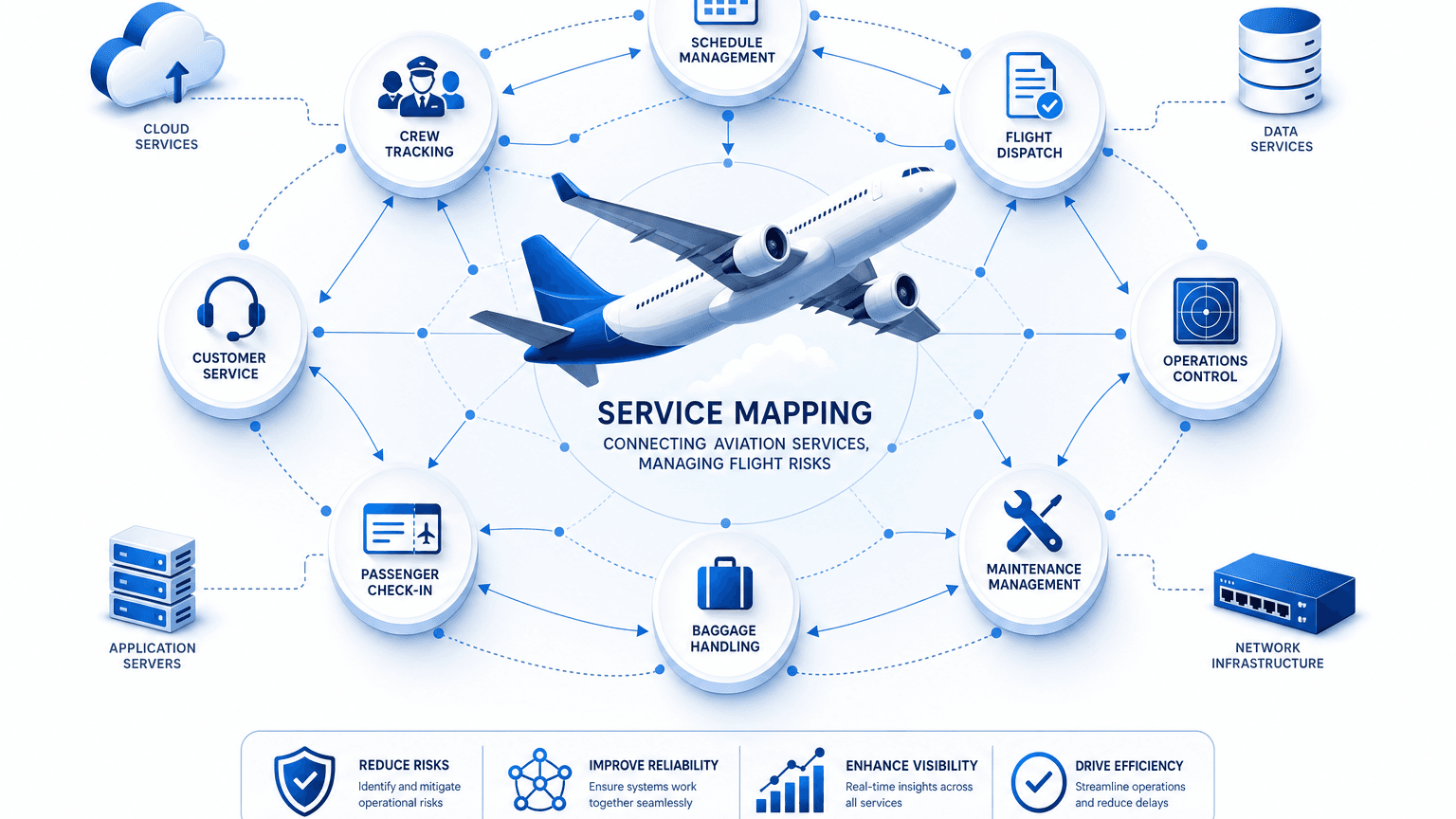
In modern enterprise IT service management standards such as ITIL 4 and ISO/IEC 20000, service mapping represents the continuous architectural practice of discovering, linking, and monitoring all underlying infrastructure components that compose a business service. In an airline ecosystem, service mapping translates technical configuration items into active aviation workflows. These configuration items include passenger service systems, flight operations dispatch, crew pairing software, baggage handling platforms, and safety data feeds.
An airline does not merely run servers, databases, and network switches. An airline operates interdependent operational capabilities where a single latency spike on a middleware cluster can delay gate departures across three continents. Typical aviation configuration items that require active topological mapping include:
- Passenger Service System (PSS) cores and Departure Control System (DCS) passenger check-in modules
- Crew scheduling, pairing, and real-time roster tracking engines
- Flight operations dispatch, weight-and-balance calculators, and flight planning tools
- Notice to Air Missions (NOTAM) ingestion engines and weather telemetry feeds
- Maintenance, Repair, and Overhaul (MRO) engineering and part-availability systems
- Automated baggage reconciliation and sorting telemetry platforms
- Ground handling and airport gate allocation integration brokers
The Hidden Problem
Most airline IT organizations manage individual platforms through dedicated technical teams. Infrastructure teams monitor physical and virtual servers while database administrators manage SQL and mainframe pools. Application owners configure crew tracking or baggage APIs. When inter-system connections remain undocumented, hidden architectural dependencies transform minor administrative events into nationwide flight groundings.
| Operational Assumption | What Actually Happens |
|---|---|
| Endpoint security management and crew-tracking software are entirely unrelated systems | A single endpoint agent update takes down administrative crew workstations, blinding flight dispatchers |
| A safety database and its designated disaster-recovery backup operate independently | Both databases suffer identical file corruption because undocumented replication scripts sync the failure instantly |
| Legacy crew-scheduling engines can absorb unlimited flight reassignments during bad weather | The scheduling software crashes from queue overflow, creating widespread regulatory duty-hour violations |
When an enterprise lacks an end-to-end operational map, engineering personnel must diagnose complex failures by assembling ad-hoc conference bridges during live operational emergencies. Understanding the structural distinction between static inventory and relational visibility is why aviation technology executives invest in service mapping and its operational criticality.
What is service mapping in aviation IT?
Service mapping in aviation is the automated process of discovering and visualizing dependencies between underlying IT infrastructure and mission-critical airline services such as crew tracking, passenger check-in, and flight dispatch. It shows how server or network failures directly jeopardize flight operations.
Why Is Service Mapping Important for Airlines?
Airlines operate on razor-thin schedules where minor delays generate millions of dollars in downstream passenger accommodation and crew overtime costs. Aviation IT benchmark surveys indicate that commercial air transport operators committed more than $50 billion to information technology modernizations in recent budgeting cycles. Yet substantial segments of that capital investment fail to produce operational resilience because architectural dependency data remains trapped inside isolated functional silos.
Industry operational surveys consistently show that nearly half of commercial carriers identify architectural inconsistency and data fragmentation as the primary barriers preventing dispatch teams from accessing a unified view across flight, crew, aircraft, and passenger systems. This friction persists even as airlines aggressively modernize operational flight software to bridge the visibility gap. The operational stakes remain severe: international airline trade analyses consistently calculate the global cost of flight delays and irregular operations at approximately $30 billion annually.
When airlines build modern digital interfaces on top of unmapped, multi-generational IT infrastructure, technical failure modes compound rapidly.
5 Failure Modes
- Undocumented dependencies between endpoint agents and operational software. IT engineering teams roll out security software or operating system patches without knowing which physical airport workstations host critical local crew-dispatch sessions. Result: uniform vendor update events generate catastrophic recovery disparities between competing carriers.
- Legacy crew-scheduling engines lacking automated dependency scaling. Severe winter storms displace hundreds of flight attendants and pilots simultaneously. Legacy scheduling engines cannot scale transaction queues, forcing manual recalculations. Result: scheduling backlogs violate Federal Aviation Administration pilot rest regulations, triggering cascading flight cancellations.
- Unvalidated replication paths between primary and standby safety infrastructure. System administrators execute configuration maintenance on live databases assuming secondary failover operates autonomously. Result: a single erroneous configuration change corrupts both operational and standby systems, taking down vital safety broadcasts.
- Data fragmentation between commercial passenger portals and physical flight dispatch. Cloud-native customer mobile applications lose connectivity to mainframe-hosted ticket reservation inventories during peak travel periods. Result: massive customer rebooking traffic crashes airport check-in desks, overwhelming terminal gate operations.
- Informal mapping across ground support and baggage tracking telemetry. Automated baggage sortation scanners depend on unmonitored switch ports and legacy message queues across partner airport authorities. Result: ground handling disconnects compound gate delays and baggage misrouting, costing major carriers billions annually while directly eroding operating margins.
Without dependable IT baseline visibility, airline technology teams cannot secure operational infrastructure or prevent unmonitored configuration drift. Deploying disciplined IT discovery programs serves as the foundational starting point for identifying active aviation assets across legacy data centers and cloud environments.
Why do airline IT outages cause flight groundings?
Airline IT outages halt operations because regulatory compliance mandates verified crew duty legality, accurate aircraft weight distribution, and real-time safety advisories before takeoff. If an unmapped dependency drops crew-tracking or dispatch systems, federal regulations forbid aircraft from departing.
What Getting This Wrong Costs Airlines
Operational failures in aviation do not quietly degrade internal productivity. They dominate global news headlines, erase quarterly profits, and trigger aggressive congressional and regulatory oversight. Different leadership stakeholders inside the airline experience this exposure through distinct operational challenges.
For Airline CIOs and IT Leaders
For airline Chief Information Officers, unmapped service architectures present existential career and enterprise balance-sheet risks. When a preventable IT disruption costs $550 million in revenue degradation and recovery fees, technology investments face intense board-level scrutiny. Federal regulatory agencies no longer treat IT outages as standard weather occurrences. Aviation regulators conduct detailed evidentiary audits into whether airline executives maintained adequate technical disaster recovery frameworks, system redundancy, and operational oversight.
For Flight Operations and Crew-Scheduling Teams
Flight operations managers and crew coordinators bear the direct emotional and operational trauma of cascading software meltdowns. During the historic December 2022 holiday disruption, Southwest Airlines was forced to cancel roughly 16,900 flights, leaving more than two million passengers stranded across the United States. While severe winter weather initiated the initial schedule disruptions, the airline’s internal crew-scheduling engine was completely overwhelmed by the volume of crew reassignments.
Southwest’s executive leadership later testified before the United States Senate Committee on Commerce, Science, and Transportation that the carrier lacked operational winter resilience, formally committing $1.3 billion toward core technology and infrastructure modernizations. When crew-scheduling software fails, dispatchers are reduced to manually calling hotels to locate available pilots, while flight crews time out under strict federal duty limitations.
For Regulated, Safety-Critical Systems
Aviation represents one of the most strictly regulated operating environments in global commerce. On January 11, 2023, the Federal Aviation Administration ordered the first nationwide ground stop of commercial air traffic since September 11, 2001. The outage incapacitated the critical Notice to Air Missions system, which transmits real-time safety hazard information directly to flight crews.
A subsequent formal statement from the FAA revealed that contract maintenance personnel unintentionally deleted critical operating files while attempting to repair synchronization between the live primary database and a secondary backup database. Because the precise transactional dependencies between the two databases were poorly isolated and inadequately mapped, administrative error crashed the primary safety feed and immediately corrupted its failover copy. Operational stability requires disciplined cybersecurity asset management baselines to govern access, monitor configuration changes, and protect safety-critical digital infrastructure.
How Service Mapping Fixes This
Solving airline infrastructure fragility requires moving beyond static network diagrams, manual spreadsheets, and tribal engineering knowledge. True service mapping bridges technical infrastructure assets and high-value aviation business operations through three core architectural mechanisms.
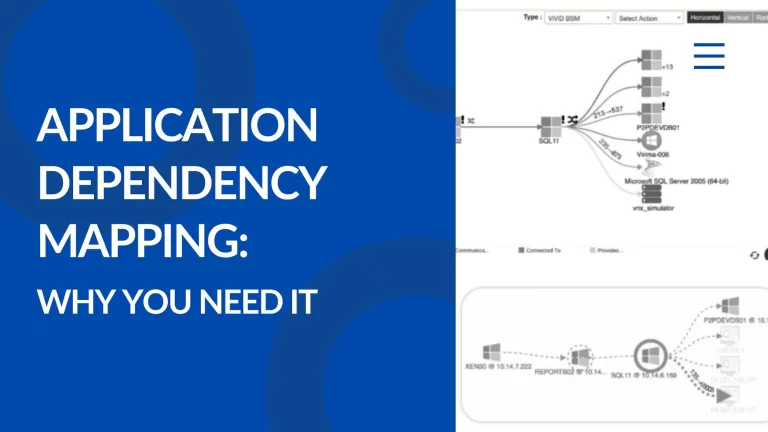
- Discovery-sourced dependency mapping replaces manual diagrams. Manual architecture schematics become obsolete the moment engineering teams deploy a cloud container or modify a network routing rule. Virima IT Discovery scans hybrid IT environments using high-frequency scheduled discovery cycles across agentless network protocols, lightweight agent endpoints, and cloud infrastructure APIs. This approach maps operational topology as systems actually run across airport terminals and private data centers.
- ITSM operational overlays inside tools airlines already operate. ViVID™ service mapping overlays live incident tickets, pending change requests, and known security vulnerabilities directly onto the service topology. ViVID™ integrates with enterprise platforms such as ServiceNow, Jira Service Management, Ivanti, and HaloITSM, providing immediate contextual awareness without forcing staff to abandon existing service desks. Airline teams can evaluate how an open ticket affects their ServiceNow ITSM architecture before an incident impacts flight departures.
- A trusted CMDB that remains accurate during live operational crises. Configuration data degrades quickly across complex airline estates that blend legacy mainframe transaction engines with microservices. Virima’s configuration management database reconciles discovery data across competing feeds using automated normalization rules. This rigor prevents stale information from misguiding engineers during outage triage, reinforcing core CMDB configuration integrity.
| Operational Dimension | Manual / Tribal-Knowledge Mapping | Discovery-Driven Service Mapping |
|---|---|---|
| Map update cadence | Infrequent ad-hoc updates when staff remember | High-frequency scheduled discovery cycles reflecting verified asset state |
| Outage incident correlation | Requires lengthy technical bridges to trace dependencies | Real-time blast radius immediately visible on the service map at the CI level |
| Coverage across hybrid estates | Fragmented documentation across mainframe and cloud teams | Consolidated multi-source discovery bridging on-prem hardware and cloud instances |
| Regulatory audit readiness | Stressful manual reconstruction of system topology | Standing, discovery-verified dependency records ready for safety auditors |
How does service mapping prevent airline dispatch failures?
Service mapping links dispatch software to specific database instances, network switches, and authentication servers. When an infrastructure alert occurs, engineers immediately visualize which flight operations services are threatened, enabling rapid remediation before flight dispatch halts.
Service Mapping Examples in Practice
Applying dependency visibility to historic aviation failures reveals how topological intelligence fundamentally alters incident response outcomes.
- Endpoint security agents tied to crew administration terminals. If operations leaders possess an accurate service map linking crew scheduling applications to local endpoint dependencies, security engineers can identify that updating security agents on airport dispatch terminals directly impacts crew sign-in workflows. That visibility allows IT teams to stage pilot rollouts rather than pushing simultaneous updates across mission-critical flight stations.
- Safety data synchronization without independent failover isolation. A detailed service map of the FAA NOTAM environment would have exposed that the standby database shared live synchronous file dependencies with the primary database. Recognizing that architectural coupling prevents technicians from performing maintenance on live replication clusters without verifying isolated failover redundancy.
- Crew scheduling platforms linked to regulatory duty-hour thresholds. Mapping crew pairing software to underlying database queue capacity demonstrates how winter storm disruptions generate compounding transaction spikes. IT planners can scale computational resources dynamically, preventing scheduling backlogs from turning bad weather into widespread crew expirations.
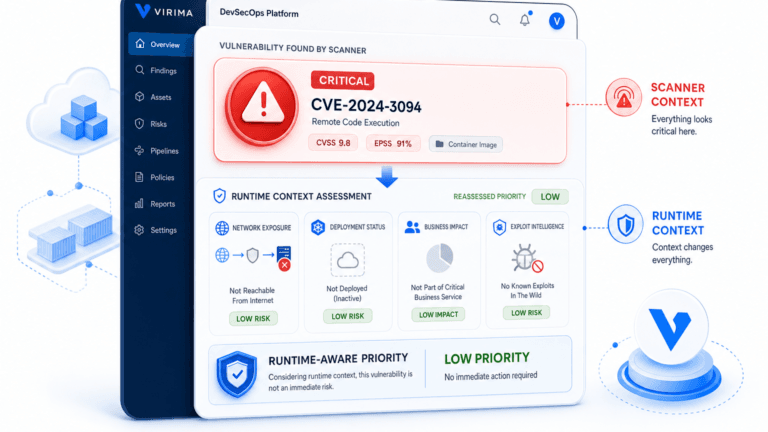
- Vulnerability remediation on passenger check-in clusters. Evaluating CVE alerts against an active dependency map allows security personnel to determine whether an unpatched library resides on an isolated development server or directly on public airport kiosks. Understanding that contextual priority is why security teams review IT discovery for vulnerability management to protect customer-facing operations.
What This Looks Like Running on Virima
Implementing discovery-driven visibility transforms how airline IT operations and security teams handle daily maintenance and unexpected system anomalies.
Immediate Operational Impact
During an unexpected infrastructure failure, triage teams no longer waste critical minutes assembling cross-functional conference calls to identify system owners. Responders access a dynamic ViVID™ map that highlights the failing configuration item alongside every upstream flight operations system and downstream passenger service it supports. By inspecting the precise dependency path, engineers isolate root causes rapidly, enabling teams to improve incident response with service mapping before flight gates experience delays.
Long-Term Accuracy Across Hybrid Estates
Commercial aviation relies heavily on mixed architectures, operating core reservation engines on durable mainframes while hosting modern customer applications in private and public clouds. Virima executes scheduled discovery across diverse on-premises hardware, virtual machines, and cloud environments. By reconciling multi-source data feeds automatically, Virima prevents configuration drift from corrupting the CMDB, ensuring architectural records reflect operational truth.
Workflow Integration Without Platform Replacement
Airlines have made extensive investments in enterprise IT service management frameworks. Virima functions as an authoritative discovery and visualization layer that synchronizes bidirectionally with platforms like ServiceNow, Jira Service Management, and Ivanti. Engineering and operations personnel continue working within their familiar service desk consoles while gaining rich, discovery-sourced service dependency insights.
Moving from Tribal Knowledge to a Map-Driven Aviation IT Operation
Transitioning from fragmented tribal knowledge to an automated service-mapped environment requires a structured modernization approach.
| Traditional Airline IT Practice | Modern Map-Driven IT Operation |
|---|---|
| Dependency intelligence resides exclusively in senior engineers’ memories | Real-time dependency data is automatically visualized and accessible to all on-call staff |
| Architecture diagrams are reviewed annually during formal documentation cycles | Service maps refresh on high-frequency discovery cycles to reflect active changes |
| Change requests are approved using subjective operational assumptions | Change risk is evaluated against automated topological blast-radius visualizations |
Faster incident triage during operational disruptions
First responders identify failing upstream and downstream dependencies immediately, bypassing manual investigation steps during critical departure windows.
Safer change management around flight schedules
Change advisory boards review automated dependency maps to verify that scheduled database maintenance will not accidentally interrupt active flight tracking or gate assignments, following proven principles of how CMDB enhances change management.
Audit-ready infrastructure records for aviation regulators
Aviation safety regulators demand documented proof of disaster recovery readiness and system resilience. Discovery-sourced service mapping delivers verifiable evidence of architectural redundancy.
Getting started in 5 steps
- Execute baseline discovery across the Passenger Service System, crew scheduling, baggage handling, and maintenance estate.
- Reconcile discovered assets into standardized configuration items with designated operational owners.
- Build targeted service maps for high-risk business services first, beginning with passenger check-in, crew assignment, and flight dispatch workflows.
- Overlay active ITSM data to display open incidents, planned maintenance changes, and vulnerability exposures directly onto the service map.
- Establish recurring discovery schedules so dependency maps continuously capture cloud scaling, software patches, and infrastructure changes as your airline grows.
Establishing operational resilience across flight-critical systems begins with architectural visibility. Explore how ViVID™ Service Mapping empowers airline IT leaders to replace tribal assumptions with dynamic, discovery-sourced dependency maps that keep aircraft moving and passengers safe.
Frequently Asked Questions
What is service mapping in aviation IT?
Service mapping in aviation discovers and illustrates connections between underlying IT components and flight operations services. It links servers, networks, and databases directly to passenger check-in, crew tracking, flight dispatch, and safety systems.
Why is service mapping important for airlines?
Service mapping prevents small technical glitches from triggering widespread flight cancellations. By exposing hidden infrastructure dependencies, airline IT teams identify failure blast radiuses early, prioritize critical outage repairs, and maintain uninterrupted flight departures.
What are examples of service mapping failures in aviation?
Notable examples include endpoint updates disabling crew-scheduling terminals during the 2024 airline disruptions, unmapped database synchronization crashing the FAA NOTAM safety system, and legacy crew software queue collapses during severe winter storms.
How is IT service mapping different from flight operations tracking?
Flight operations tracking monitors physical aircraft locations, fuel levels, and flight crew schedules. In contrast, IT service mapping monitors the underlying servers, cloud databases, software APIs, and network connections that power those flight tracking applications.
Can service mapping cover legacy mainframe passenger systems alongside cloud tools?
Modern service mapping platforms discover and correlate dependencies across hybrid enterprise estates. They successfully map legacy on-premises mainframe reservation engines alongside virtual machines, cloud microservices, and modern SaaS flight operations applications.