What is cyber asset management (CAASM)? A complete guide

Cyber asset management is the practice of maintaining a complete, continuously updated inventory of every IT, cloud, OT, and identity asset an organization owns, so security and IT teams always know what exists and what’s exposed. CAASM (Cyber Asset Attack Surface Management) is the Gartner-defined technology category that automates this by aggregating data from a CMDB, scanners, and cloud APIs into one unified view.
Most security teams can already describe what lives in their environment — a CMDB, a scanner, a few spreadsheets covering the obvious systems. Then a breach happens, and the forensic report lists three assets nobody had documented. That gap is exactly what CAASM is designed to close. This guide explains what CAASM covers, how it works, and why a well-maintained CMDB is the foundation it depends on.
What cyber asset management (CAASM) means
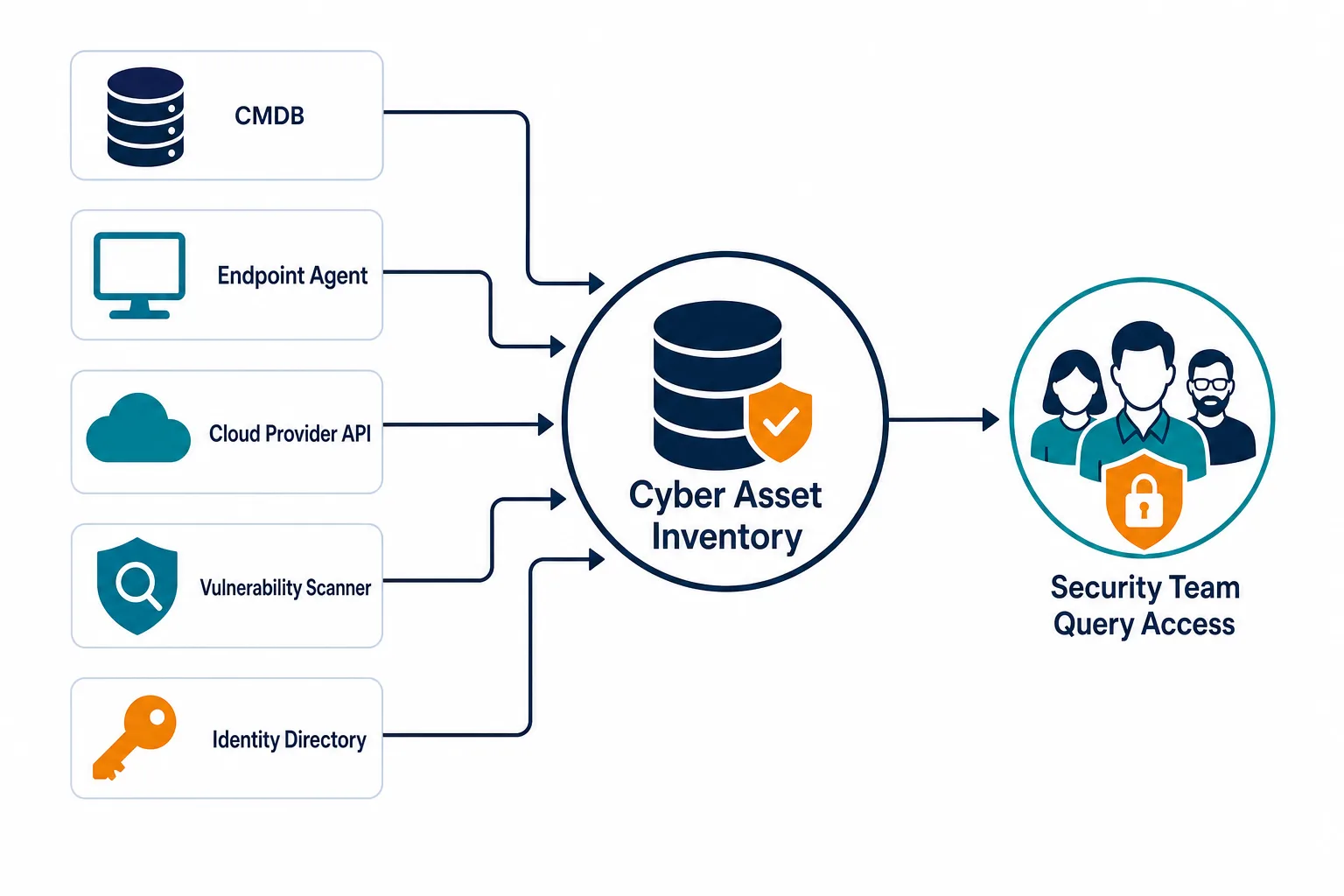
Gartner coined the term CAASM in its 2021 Hype Cycle for Security Operations to describe a distinct approach to asset visibility for security teams. The full term is Cyber Asset Attack Surface Management. It uses API-based integrations to aggregate asset data from multiple existing tools: CMDB, endpoint management, cloud providers, vulnerability scanners, and identity systems. That data is then correlated into one unified, continuously updated asset inventory.
The two parts of the name matter separately: “cyber asset” covers any digital entity that can be targeted or exploited (servers, endpoints, containers, cloud workloads, SaaS accounts, machine identities, certificates, code repositories), while “attack surface management” is the ongoing practice of knowing what is exposed, to whom, and under what conditions.
CAASM does not replace your CMDB, scanner, or ITSM platform. It sits above them, pulling data via API and normalizing it so security teams can answer the question breaches make embarrassing: what assets do we actually have? Tenable frames CAASM the same way: unifying IT asset management, CMDB, vulnerability, and cloud data into one inventory.
What is cyber asset attack surface management (CAASM)?
CAASM (Cyber Asset Attack Surface Management) is a Gartner-defined security practice that uses API integrations to aggregate asset data from multiple tools into one unified, continuously updated inventory. It gives security teams complete visibility across IT, cloud, OT, and SaaS assets to close attack surface gaps.
What CAASM covers
A CAASM program applies to four asset categories. Each presents different visibility challenges.
IT assets include servers, workstations, network devices, and virtual machines. These are the most likely to appear in a CMDB already, though stale records and unmanaged devices create gaps. IT assets form the largest surface area in most enterprises.
Cloud and SaaS assets include cloud instances, containers, serverless functions, application accounts provisioned without centralized IT approval, and BYOD devices connecting to sanctioned SaaS platforms. Shadow IT — accounts or instances provisioned outside IT approval — carries the same risk as sanctioned systems but stays invisible until surfaced.
OT and IoT assets cover industrial control systems, connected devices, and network-attached hardware outside the traditional IT perimeter. These assets are commonly absent from existing inventories and carry high-impact breach risk, since operational disruption is the consequence when they’re exploited.
Non-human identities are service accounts, API keys, OAuth tokens, machine certificates, and bot identities. They carry privilege and access, often outnumber human identities, and are rarely rotated after the project that created them ends.
Effective cyber asset management requires visibility across all four categories — missing OT or non-human identities leaves the gaps threat actors target first.
What types of assets does CAASM cover?
CAASM covers four categories: IT assets (servers, workstations, network devices), cloud and SaaS assets (instances, containers, BYOD and shadow IT accounts), OT and IoT assets (industrial systems, connected devices), and non-human identities (service accounts, API keys, OAuth tokens, machine certificates). A mature CAASM program addresses all four simultaneously.
CAASM vs. CSAM vs. EASM: key distinctions
Three similar-sounding categories create confusion in security conversations. Gartner’s attack surface management guidance treats CAASM, CSAM, and EASM as complementary practices within one exposure management program, not overlapping tools competing for the same budget.
| Category | Question it answers | Direction | Primary data source |
|---|---|---|---|
| CAASM | What exists inside our environment? | Internal | API integrations with CMDB, EDR, cloud, and identity tools |
| CSAM | Who owns each asset, and is it compliant? | Internal, full life cycle | Governance processes layered on CAASM and CMDB data |
| EASM | What’s exposed to an outside attacker? | External | Public-facing domains, certificates, leaked credentials |
CAASM is internal-first and API-driven. CSAM is the operating model CAASM feeds into — ownership, patch posture, and risk across the full asset life cycle. EASM is the outward-facing counterpart, mapping exposed domains, certificates, and leaked credentials.
Virima’s CSAM module addresses the governance dimension: continuous asset discovery, CVE mapping against the NVD, blast radius analysis, and policy-aware compliance tracking. It provides the CMDB-backed asset foundation that CAASM tools pull from via API.
What is the difference between CAASM and CSAM?
CAASM focuses on internal asset visibility for security teams, aggregating data across tools to build a unified attack surface inventory. CSAM is the broader governance discipline covering the full security asset life cycle: discovery, ownership, patch management, and risk tracking. CAASM is a core enabling capability within a CSAM program.
How CAASM works in practice
A CAASM deployment follows three stages.
Stage 1: Data ingestion. The CAASM tool connects to existing data sources via API: CMDB, endpoint detection and response (EDR), cloud provider APIs (AWS and Azure), vulnerability scanners, identity directories, and SaaS management platforms.
Stage 2: Normalization and deduplication. The same physical server may appear in four tools under different names, IP addresses, or naming conventions. CAASM tools normalize these into single entities and merge attributes from multiple sources.
Stage 3: Enrichment and querying. The unified inventory is enriched with contextual data: ownership, criticality, patch status, known vulnerabilities, exposure classification, and relationship to business services. Security teams then query against it. Which assets have unpatched CVEs above a CVSS score of 8? Which cloud instances have no owner assigned?
The value is in the query. A static inventory answers “what do we have.” A CAASM-enriched inventory answers “what do we have that is exposed, unpatched, unowned, or risky right now?” This same asset-identity baseline also underwrites zero trust initiatives: zero trust access decisions made against an incomplete inventory undermine the model before it starts.
Why your CMDB is the foundation CAASM depends on
A CMDB stores configuration items (CIs) and their relationships — what exists, how it connects, what changed — the operational record change management, incident response, and compliance teams depend on.
CAASM builds on that record, adding security-specific enrichment (vulnerability correlation, exposure analysis, attack path context) that a CMDB does not natively provide.
The dependency runs both ways. A CAASM tool is only as good as the data it ingests. When the CMDB is stale or incomplete, the CAASM layer inherits those gaps — an asset absent from discovery does not appear in attack surface analysis, and that invisible asset is exactly what threat actors find first.
Virima’s IT discovery capability uses agentless, API-based discovery across AWS and Azure to keep the CMDB current, so every discovered asset — server, cloud instance, certificate, or network device — flows in as a configuration item with relationships intact.
To see how discovery-sourced asset data creates the trusted inventory CAASM tools depend on, explore Virima’s Trusted Runtime Truth approach.
Cyber asset management best practices
Build discovery before buying an attack surface management tool. CAASM aggregates what your existing tools already know. If discovery is incomplete, the aggregation is incomplete. Solve for the inventory foundation before layering security enrichment on top; manual inventory falls behind automated discovery within weeks.
Define asset ownership at ingestion. Every asset in the inventory needs one owner. Ownership enables accountability for patch status, configuration drift, and decommission decisions. Assets without owners are risk items with no assigned remediator. One 4,200-device environment found 12% of assets had no owner assigned — a gap that took six weeks to remediate.
Integrate CAASM data into your ITSM platform. When security findings from CAASM populate tickets in ServiceNow, Jira Service Management, Ivanti, HaloITSM, Xurrent, or Hornbill, remediation teams get asset context inside the workflows they already use.
Treat non-human identities as first-class assets. Service accounts, API keys, OAuth tokens, and machine certificates carry privilege and access, and need the same discovery, ownership, and rotation governance as any physical asset.
Reconcile CAASM findings against CMDB records monthly. Assets in the CAASM inventory that are missing from the CMDB are undiscovered configuration items. Monthly reconciliation narrows the gap between what security sees and what the operations team governs.
What are the best practices for cyber asset attack surface management?
Build a complete, discovery-sourced asset inventory before deploying a CAASM tool. Assign ownership to every asset at ingestion. Integrate CAASM findings into ITSM workflows for remediation. Treat non-human identities as tracked assets. Reconcile CAASM data against your CMDB monthly to close the gap between security visibility and operational governance.
What missing cyber asset visibility costs in operations
The operational consequences of incomplete cyber asset management are well-documented.
Incident response delays. When a critical CVE is disclosed, the first question is: how many of our systems run this? Without a complete, current inventory, the answer takes days to assemble. IBM’s Cost of a Data Breach report found the average breach takes 194 days to identify; asset visibility gaps are a consistent contributing factor.
Stale change risk analysis. Every change review needs a blast radius, which is exactly what Virima’s ViVID™ service maps show before a change ships. Assets outside the CMDB are invisible to that analysis, so a change that appears low-risk may affect systems no one modeled.
Compliance and audit exposure. Regulators and auditors require evidence that organizations know what assets they hold — PCI DSS, HIPAA, and CIS Controls all require asset inventory as a foundational control. For a Director or CIO, this is the board-level version of the problem: audit findings, M&A due-diligence gaps, or cyber-insurance renewal friction, not just a slower ticket.
Virima feeds every discovered asset into a governed CMDB that CAASM tools can query. Not sure if your CMDB can support a CAASM rollout? CMDB asset management vs ITAM: Key differences explained walks through what to check before you evaluate a tool.