Agentic AI in the Enterprise: What IT Leaders Must Get Right

Enterprise AI has crossed a threshold. The conversation is no longer about whether AI can assist IT teams, it already does. The question now is whether AI can act: plan, decide, and execute multi-step tasks across complex infrastructure without waiting for human instruction at every step. That shift defines what agentic AI means in the enterprise context, and it changes the infrastructure calculus entirely.
According to Gartner, AI agents will be implemented in 60% of IT operations tools by 2028, up from less than 5% in 2024. The deployment window between now and that inflection point is compressing fast. Before any enterprise AI agent can act safely, one question demands an honest answer: what is the agent actually acting on?
What “Agentic” Actually Means for Enterprise IT
Agentic AI describes systems that operate with genuine autonomy. They receive a goal, break it into steps, call tools, gather context, and execute decisions across multiple systems with minimal human direction at each turn. In an IT context, an agent might receive an incident alert, identify the affected service, assess the blast radius, evaluate change risk, and initiate a remediation workflow without a human triggering each step manually.
The model driving the agent matters. The infrastructure feeding it matters more. An agent reasons against whatever data is available to it. When that data is stale, incomplete, or sourced from a system that has not been reconciled in weeks, the agent reasons poorly and acts on that poor reasoning at machine speed.
Why Most Enterprise AI Projects Fail Before They Start
Only 2% of enterprises have successfully deployed agentic AI at full scale, even as 82% of organizations globally plan to integrate agents within the next few years. That failure rate has nothing to do with model capability. It is a data problem.
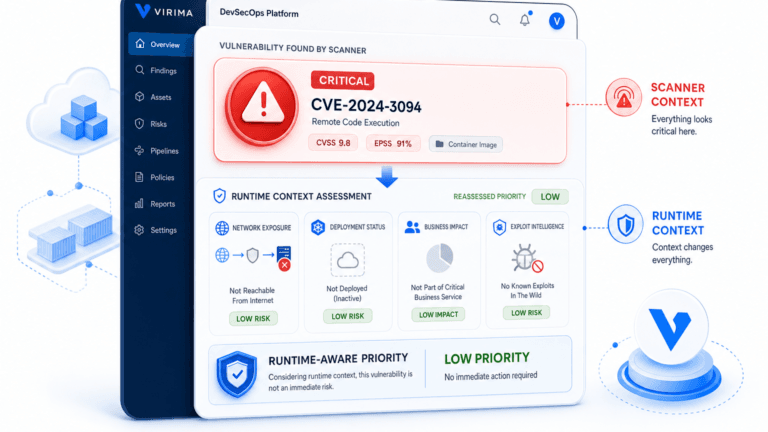
Effective IT discovery is the foundational input for any agentic IT workflow. Most organizations run discovery on infrequent schedules, creating a persistent gap between what the CMDB holds and what actually exists in the environment. Agents act on what the data says. When the data is wrong, the action compounds the error.
Three failure patterns appear consistently across enterprises. AI deployments:
- Stale configuration records. An agent acts on a CI that was decommissioned months ago. No one updated the record.
- Missing dependency context. An agent resolves an incident on one system without knowing that system feeds a critical downstream service. The downstream service fails.
- Unverifiable ownership. An agent initiates a change with no clear ownership trail. No one can confirm whether the action was authorized or who is accountable for the outcome.
None of these are edge cases. They are the norm in environments where discovery is manual, single-source, or scheduled too infrequently to reflect how fast infrastructure actually changes.
What Agentic AI Actually Needs to Work at Enterprise Scale
The technical requirements for deploying a language model are increasingly well understood. The infrastructure requirements for safe agentic IT are not. Here is what enterprise IT leaders need to build before agents go into production.
1. Authoritative Discovery Across the Entire Estate
Agents need to know what exists. That sounds straightforward until you account for how many organizations maintain three or four partially overlapping data sources, each showing a different answer for the same configuration item. Multi-source discovery with attribute-level authority resolves that conflict automatically, tracking where each attribute originated and which source takes precedence when two sources disagree.
Without this foundation, agents encounter ambiguity at the first decision point and either fail or act on whichever data surface they access first, which may not be the authoritative one. Understanding what constitutes a configuration item and where each attribute comes from is the baseline, not a nice-to-have.
2. Live Dependency and Service Context
An agent handling an incident needs more than a CI record. It needs to know what that CI connects to, what service it supports, who owns the upstream and downstream components, and what the impact of a proposed change looks like in context. A static diagram drawn at project start does not answer that question. ViVID service mapping generates near real-time dependency maps that stay current as infrastructure changes — so agents operate against the environment as it is, not as it was documented six months ago.
The gap between a diagram and near real-time dependency map is the gap between an agent that acts usefully and one that creates a broader outage while trying to resolve a smaller incident.
3. Policy-Aware Governance at the Data Level
Every action an agent takes in an enterprise environment should be traceable, explainable, and auditable. That means the data layer needs to carry governance metadata: not just what the CI is, but who can change it, under what conditions, and what policy constraints apply to any action that touches it.
Governance is a property of the data infrastructure, not the model. A well-governed agent acting on a well-governed data layer produces outcomes that compliance and security teams can verify after the fact. An agent acting on unstructured configuration data produces outcomes that no one can fully explain — which creates a different class of risk.
The Diagnostic Every IT Leader Should Run
Before deploying agentic AI across the enterprise, the right question is not which agent framework to select. The right question is: what is the state of the data that agent will act on?
A useful starting point:
- When did we last run a complete discovery scan across our full on-prem and cloud estate?
- Do our CMDB records carry source provenance, or do we accept imported data without tracking its origin?
- Can we produce an accurate blast radius for any CI in under five minutes?
- Do our records include verified ownership for every asset and service?
The EMA report on real-time discovery and CMDB maturity documents how the gap between organizations that have invested in CMDB maturity and those that haven’t is widening — precisely as AI deployment timelines accelerate. Organizations with authoritative data built on solid CMDB foundations are not just better prepared for agentic AI. They get further ahead as AI raises the stakes on data quality with every deployment cycle.
Trusted Runtime Truth: The Data Foundation Agentic IT Requires
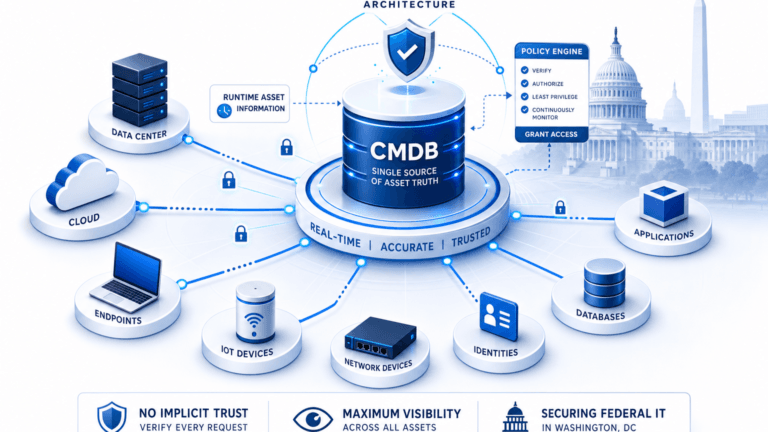
Virima provides Trusted Runtime Truth: live, explainable, discovery-sourced context covering what exists in your IT environment, how it’s connected, what changed, what could break, and who owns it. This is an active data layer, not a passive record store. It feeds authoritative context to IT workflows and to every AI agent that operates inside the environment.
Multi-source discovery populates a reconciled CMDB with attribute-level authority and full source traceability. Service maps keep dependency context current as infrastructure changes. Governance — role-based access, change approval workflows, audit trails, and policy compliance — is built into the data layer. Understanding the dependency relationships between configuration items is not optional in an agentic environment. It is the baseline every agent workflow sits on.
Virima integrates directly with ServiceNow and every major ITSM platform, feeding your agentic ai it operations existing workflows with the governed runtime truth that agents need before they act.
The Bottom Line
Agentic AI will reach enterprise IT on its own timeline. The platforms are moving fast, vendor adoption is accelerating, and the business pressure to deploy is real. What separates a deployment that works from one that creates new risk is not the model. It is the data layer underneath it.
Build an authoritative discovery foundation first. Govern the data before you automate against it. Know, with confidence, what is in your CMDB before you let an agent act on it.
Ready to see what Trusted Runtime? What does truth look like for your environment? Schedule a Demo today to learn more!