IT Discovery for PCI DSS: Identifying Assets Around the Cardholder Data Environment

A bank may know exactly which payment database holds cardholder data. That knowledge does not define the complete PCI DSS scope boundary. Payment workflows typically depend on application servers, network devices, authentication systems, logging platforms, virtualization hosts, and security tooling. Some of those systems never store a card number. Several may still belong inside PCI scope because they connect to, administer, or protect systems that do.
PCI DSS asset discovery is therefore not simply a search for databases holding card data. The first scoping question is not only where cardholder data resides. It is what technology can interact with or affect the environment protecting it.
Start With the CDE, Then Move Outward
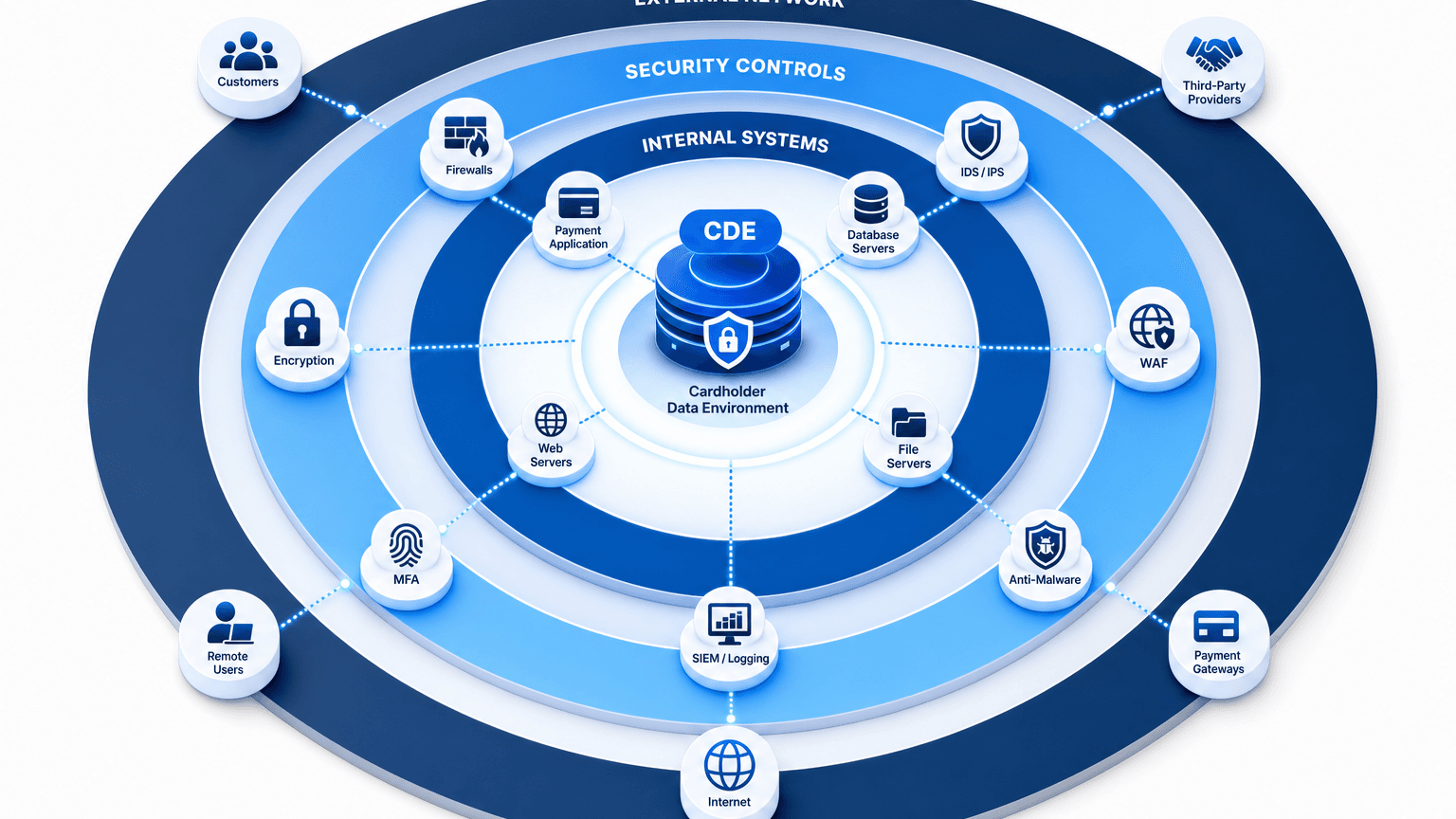
PCI DSS v4.0, published by the PCI Security Standards Council, defines the cardholder data environment (CDE) as the system components that store, process, or transmit cardholder data or sensitive authentication data, along with the network segment in which they reside. A practical scoping model starts there and moves outward in layers.
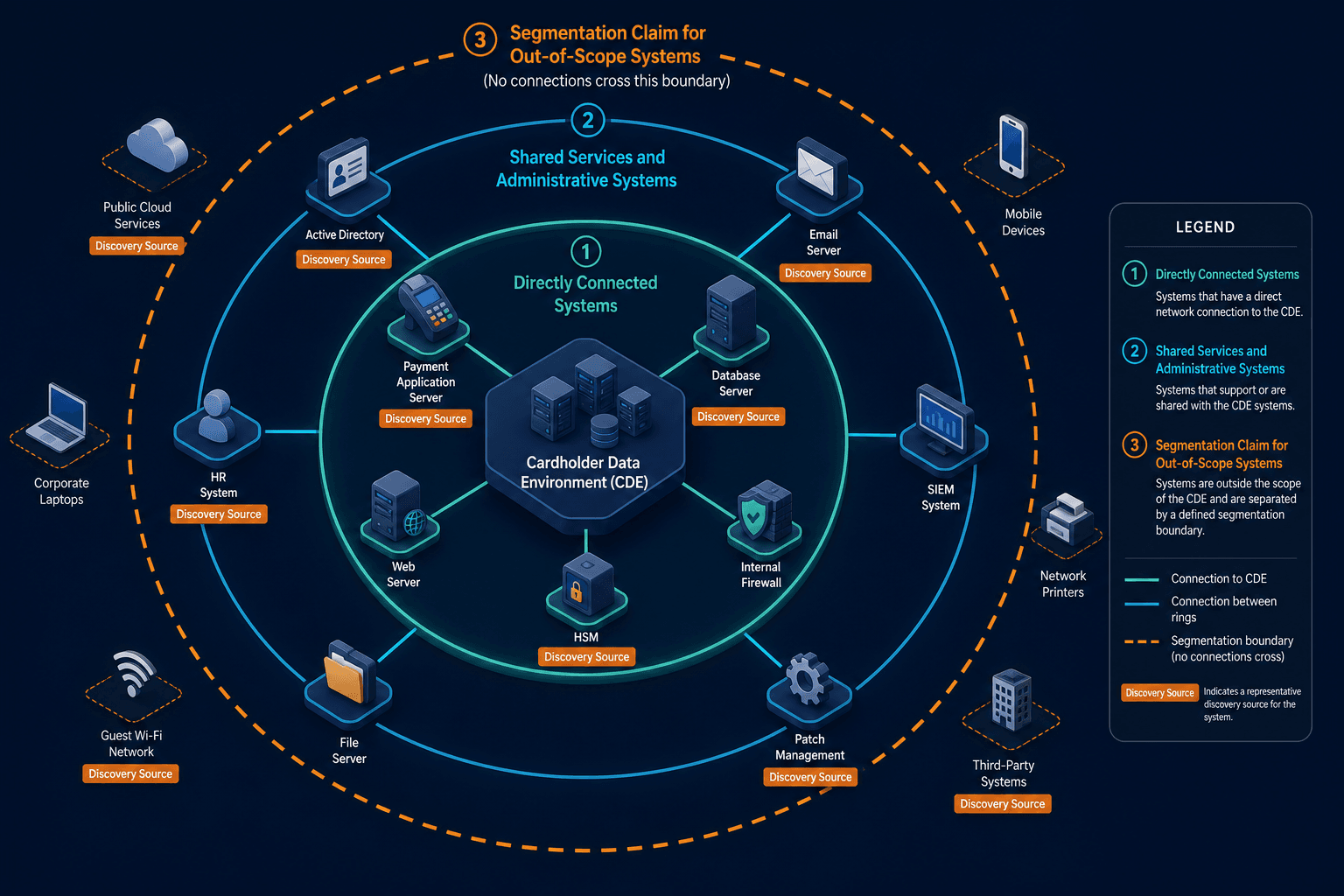
The first outer layer includes systems connected to the CDE, systems providing security controls such as firewalls and intrusion detection, and systems used to administer CDE components. Beyond those, organizations consider which systems can be excluded through segmentation, meaning those with no path to the CDE and no influence on its security. Each layer requires a different evidence basis. The innermost layer requires knowing what processes cardholder data. The outer layers require knowing what connects to, administers, or can affect what processes cardholder data.
Direct Cardholder-Data Handling Is Only One Route Into Scope
A system can enter PCI DSS scope through several paths that do not require it to store a card number. It may transmit cardholder data in transit. It may connect directly to a CDE component. It may authenticate users to a payment system. It may provide a shared service the CDE depends on. It may run a security control that protects in-scope systems. The scope decision for each path depends on PCI DSS definitions, the organization’s segmentation architecture, and the validated scoping process documented with the assessor.
The practical implication for PCI DSS asset discovery is that the inventory task extends well beyond known payment servers and databases. A financial institution that inventories only the payment application layer may leave authentication systems, network devices, and administrative workstations unreviewed at the scope-setting stage.
What makes PCI DSS scope broader than just the systems storing card numbers?
PCI DSS scope can include systems that never store cardholder data but connect to, administer, or provide security controls for systems that do. A bank’s scoping exercise must therefore cover the infrastructure surrounding the payment environment, not only the payment application itself, making the asset identification task broader than most standard inventory processes assume.
Segmentation Reduces Scope Only When the Boundary Is Real
PCI DSS permits organizations to reduce scope through segmentation. When the CDE is isolated from systems with no payment-related function, the requirements applying to the broader network can be narrowed. Segmentation is sensible in environments where payment systems represent a fraction of total infrastructure.
Segmentation is also a technical claim. An organization stating that a system sits outside PCI scope because it occupies a separate network zone is asserting that no viable path exists from that system to the CDE. That assertion may rest on firewall rules, access controls, network architecture, and shared-service dependencies. Discovery helps establish whether the observed technical reality supports the claimed boundary. A system identified in an adjacent segment with a management interface reaching the CDE becomes a scoping question that requires review, not automatic confirmation as an exclusion. The stronger the desire to reduce PCI scope, the stronger the evidence needed to support each claimed exclusion.
What can cause a PCI DSS segmentation claim to fail during an assessment?
A segmentation claim fails when a system believed to be outside the cardholder data environment (CDE) can still communicate with in-scope systems through an unreviewed network path, shared management interface, or administrative access point. Discovery surfaces those pathways by identifying assets, their configurations, and their observable technical relationships, giving security teams evidence to test whether claimed boundaries hold before an assessor does.
Unknown Assets Undermine Confident PCI Scoping
Suppose a bank has documented a CDE containing 120 servers and has segmented that environment from its corporate network. A discovery run then identifies a virtual machine in the same network segment that does not appear in any asset register. The immediately useful questions are not about compliance status. They are: what does it run, who owns it, how long has it been there, and can it communicate with CDE components?
An undocumented asset is a scoping question before it becomes a compliance finding. The mechanism is direct: unknown assets make previously documented scope boundaries harder to defend. A security team that cannot explain every host in or adjacent to the CDE cannot confidently assert that the scope model reflects the actual estate, which puts every claimed exclusion at risk.
Shared Services Make PCI Boundaries Harder Than Diagrams Suggest
Large banking environments run enterprise-wide services that simultaneously touch payment and non-payment workloads. Active Directory authenticates users across the CDE and general enterprise systems. DNS resolves names for both environments. NTP synchronizes time across all segments. Logging platforms collect from CDE and non-CDE systems alike. Backup platforms, endpoint management tools, vulnerability scanners, and privileged access systems often serve mixed populations.
When one shared service supports both the CDE and the broader enterprise, the technical boundary no longer aligns cleanly with the organizational boundary. The scoping question shifts from “is this system inside or outside the CDE” to “what relationship does this service have with CDE components, and what does that relationship require for scope?” Discovery surfaces those relationships. Classification and scope decisions remain with the security and compliance team.
Virtualization and Cloud Make Physical Location Less Useful
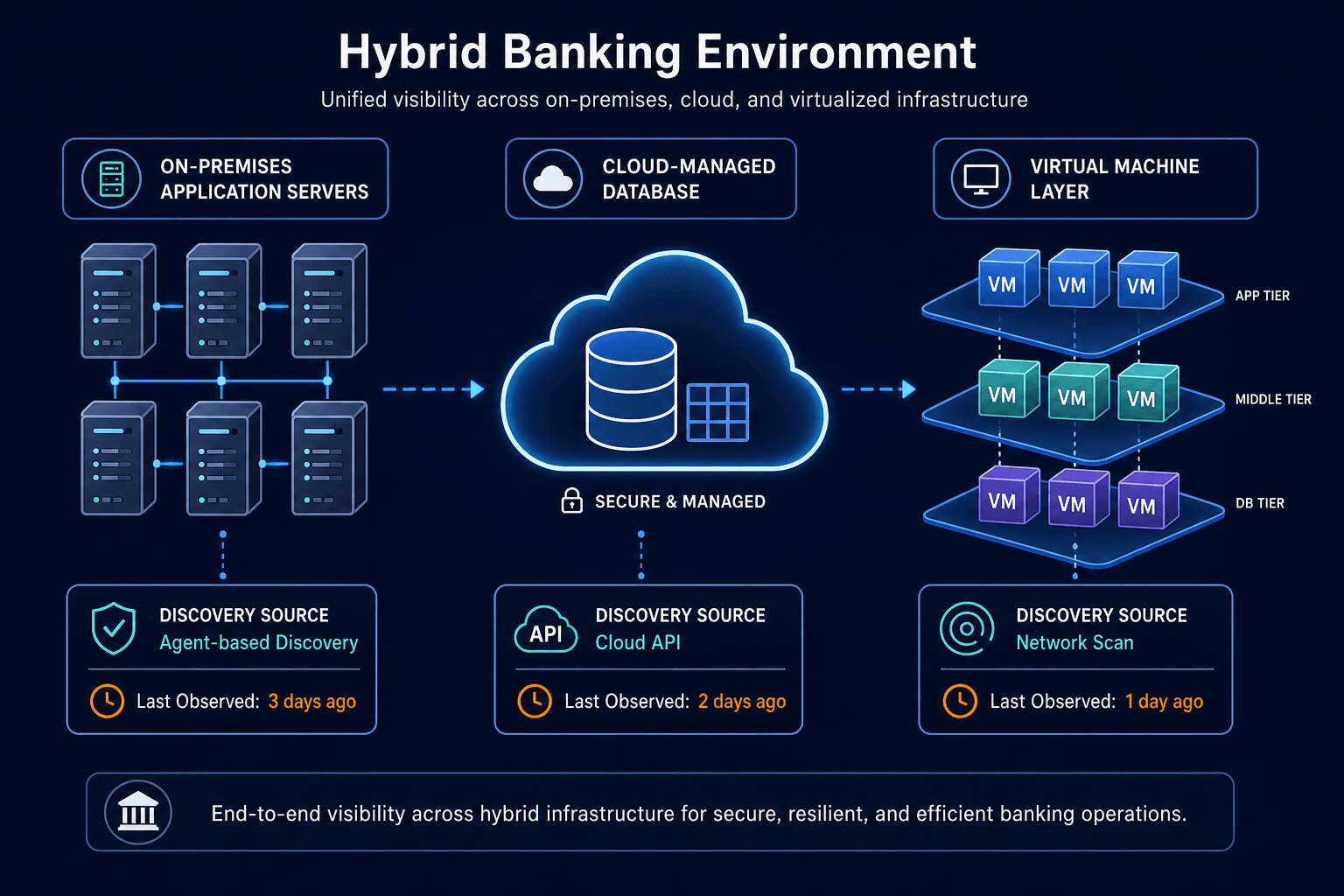
Traditional PCI scope diagrams often mapped systems to physical network zones and data center segments. Virtual infrastructure does not behave that way. A workload can move across hypervisor hosts without changing its function. A cloud instance may route through shared managed services. A hypervisor host may run both in-scope virtual machines and general-purpose workloads on the same physical hardware.
Microsoft’s Azure PCI DSS compliance documentation addresses shared responsibility boundaries in cloud environments, including how customers define and manage the technical scope of their CDE within a cloud architecture. The principle extends to any hybrid or virtualized estate: asset identity, configuration, and technical relationships matter more than rack location for determining which systems belong in a PCI scope review. Discovery should therefore cover physical, virtual, and cloud infrastructure to give the scope model current technical grounding.
A PCI Asset Inventory Should Be Evidence-Backed, Not Spreadsheet-Backed
A spreadsheet built at annual assessment time reflects what someone believed was true at the moment of writing. An evidence-backed PCI CDE asset inventory records the observed technical state with source attribution and a timestamp showing when each entry was last verified. That difference matters during an assessment, when qualified security assessors may ask how an organization knows its scope model reflects the current estate.
Virima’s IT Discovery supports agent-based, agentless, and API-based collection across physical, virtual, cloud, and network infrastructure, capturing configuration attributes, installed software, operating system detail, and technical relationships. Discovered attributes carry source information and a last-verified timestamp. When multiple sources report conflicting data for the same asset, configured authority rules can reconcile attributes into a single technical record. That foundation supports the “how do we know this boundary is current” conversation rather than requiring security teams to rely on institutional memory or last year’s assessment paperwork.
Discovery Should Challenge the Scope Model Continuously
Infrastructure in banking environments does not hold still between annual PCI assessments. Virtual machines are created and cloned. Cloud workloads are provisioned and retired. Firewall rules are modified during change windows. Shared services gain new interfaces as the application portfolio changes. Administrative access paths shift after staff transitions and vendor engagements.
A PCI scope model documented after the previous assessment may not reflect the environment security teams operate today. Discovery that runs on a regular, risk-based cadence verifies the technical estate against the documented scope model. When new assets appear in or adjacent to the CDE, teams can review them before they accumulate undetected. PCI DSS does not prescribe a universal discovery frequency. Cadence is defined by the organization based on environment change rate and risk posture. The goal is that the scope model represents the actual estate when it needs to be presented, not only at assessment time.
Discovery and Segmentation Validation Answer Different Questions
These two activities address related but distinct aspects of PCI scoping. Discovery asks what assets exist, where they are, what configurations they carry, and what technical relationships can be observed. Segmentation validation asks whether the controls separating out-of-scope systems from the CDE are actually effective in preventing access.
Discovery feeds the scoping model with technical evidence about the asset population. Segmentation validation tests whether that model holds under realistic conditions. PCI assessors typically expect both: an understanding of what is in scope and evidence that systems claimed to be outside the CDE cannot reach it. Discovery does not prove segmentation. It establishes the technical population from which segmentation validation work proceeds.
What the PCI Scoping Record Should Explain
| Question | Required context |
|---|---|
| What exists? | Server, VM, endpoint, network device, cloud asset |
| Where is it? | Network segment, site, cloud account, environment |
| What runs there? | OS, installed software, services |
| What does it connect to? | Observed technical relationships |
| Does it support the CDE? | Business or security relationship to payment systems |
| Who owns it? | Technical owner or team |
| When was it verified? | Last discovery timestamp |
| How was it observed? | Discovery source and method |
| What is its PCI status? | In scope, under review, or excluded |
| Why is it excluded? | Documented segmentation rationale or scope decision |
The last two rows are not populated by discovery. Security and compliance teams assign PCI scope status and record the rationale. Discovery populates the rows above those, giving teams current technical evidence to work from when they make those decisions.
Why is a discovery-sourced PCI asset record more defensible than a manually maintained spreadsheet?
A discovery-sourced PCI DSS asset record carries source attribution and a last-verified timestamp for each technical attribute, making it possible to show when each asset was confirmed and by what method. A manually maintained spreadsheet cannot provide that verification chain, which weakens the evidence behind any scope boundary claim when assessors ask how the organization knows its inventory is current.
A Practical Workflow for Identifying PCI-Relevant Assets
Discover. Identify enterprise infrastructure across the physical, virtual, and cloud environments that can interact with the payment environment.
Reconcile. Resolve duplicate or conflicting asset records across discovery sources into a single authoritative technical record.
Relate. Connect discovered assets with network context, service relationships, and observed connectivity to CDE components.
Classify. Security and compliance teams determine PCI DSS scope status for each asset using documented criteria and the organization’s scoping methodology.
Validate. Test claimed segmentation boundaries through appropriate controls separate from asset discovery.
Monitor. Repeat discovery as infrastructure changes so the scope model reflects the current estate.
The sequencing is important. Discovery comes before classification, not the other way around. Segmentation validation remains its own distinct control activity, not an output of the discovery scan.
Where Virima Fits in PCI Asset Discovery
Virima functions as the discovery and configuration layer that helps security teams establish the technical population around the cardholder data environment. It does not determine PCI DSS scope automatically and does not replace segmentation testing or PCI assessment.
Virima’s CMDB receives discovered assets from agent-based, agentless, and API-based collection across on-premises physical infrastructure, virtual machines, cloud resources, network devices, storage, and installed software. Discovered attributes carry source tracking and last-verified timestamps. When sources report conflicting data for the same asset, authority-based reconciliation rules produce a single CI record. CMDB relationships connect infrastructure to the applications and services it supports, giving security teams context beyond the asset list.
| Operating need | How the technical layer helps |
|---|---|
| Unknown systems near the CDE | Recurring, scheduled discovery cycles |
| Hybrid infrastructure | Agent, agentless, and API discovery across environments |
| Duplicate or conflicting inventories | Source-authority reconciliation into one CI record |
| Shared service relationships | CMDB relationship context between assets and services |
| Infrastructure change between assessments | Repeated discovery to verify current estate |
| Assessment preparation | Source attribution and freshness traceability per attribute |
Boundary. Virima provides current technical evidence that security, network, and compliance teams use when maintaining and validating their PCI scope model. It does not interpret vendor licensing terms, automate compliance determinations, or substitute for qualified PCI assessor judgment.
Keeping the Scope Model Current Enough to Defend
PCI DSS scope depends on more than where cardholder data resides. Financial institutions need current visibility into the assets surrounding and affecting the CDE before they can defend which systems belong inside or outside that boundary. Discovery establishes the technical population. Security and compliance teams determine the scope. Segmentation validation tests whether the claimed boundary holds.
When those three activities use current technical data rather than annual snapshots, the scope model reflects the estate security teams actually operate, and assessors can test claims against evidence rather than assertions.
Establish the technical population around your cardholder data environment
See how discovery-sourced Trusted Runtime Truth gives security and compliance teams current, evidence-backed asset context for PCI DSS scoping, without turning the discovery tool into the scope decision engine.
See how financial institutions use Virima for PCI asset discovery
Request a demo to see how Virima discovery, CMDB reconciliation, and relationship context support banking and financial services teams building defensible PCI scope models.
Frequently Asked Questions
What is PCI DSS asset discovery, and why does it extend beyond payment systems?
PCI DSS asset discovery is the process of identifying the technical estate around the cardholder data environment (CDE) so security teams can determine which systems fall within or affect PCI scope. The task extends beyond payment systems because PCI DSS scope can include systems that connect to, administer, provide security controls for, or could otherwise affect the security of the CDE, regardless of whether those systems directly store card data.
Does IT discovery prove that PCI segmentation is effective?
No. Discovery identifies what assets exist, where they are, and what technical relationships can be observed. Proving that segmentation is effective requires separate validation controls that test whether out-of-scope systems can actually reach the CDE. Discovery establishes the technical population that segmentation validation works from. The two activities are related but address different questions.
How should financial institutions handle shared services that support both the CDE and non-CDE systems?
Shared services that support both the CDE and broader enterprise systems require documented scoping decisions about what relationship those services have with the CDE and what that relationship means for PCI requirements. Security and compliance teams, typically working with a qualified assessor, determine how shared services are treated. Discovery surfaces those service relationships so they are visible before scoping decisions are made rather than discovered during an assessment.
Does Virima automatically determine which assets are in PCI DSS scope?
No. Virima provides current technical evidence, including asset configuration, observed relationships, source attribution, and last-verified timestamps. Security, network, and compliance teams use that evidence when maintaining and validating their PCI scope model. Scope classification, segmentation validation, and compliance determinations remain with the organization and its qualified security assessor.
How often should banks run discovery to support their PCI scope model?
PCI DSS does not prescribe a universal discovery frequency. Organizations set cadence based on environment change rate, infrastructure complexity, and risk posture. The goal is that the PCI scope model reflects the actual technical estate when it needs to be presented and defended, not only at the point of the annual assessment. Faster-changing environments typically require more frequent verification cycles.