Stop Buying ITSM Blind: A CPO–CFO Playbook for Maximizing ITSM Value with Discovery, CMDB, and Service Maps

Most organizations don’t have an ITSM problem. They have a data problem.
CPOs and CFOs approve large investments in ITSM platforms and related IT operations modules, only to discover a few years later that while tickets flow smoothly, decisions still rely on stale spreadsheets, tribal knowledge, and incomplete CMDBs. The business case promised lower incident costs, faster change, fewer audit surprises, and better license optimization, but the reality is often higher licensing, expensive add-on ITOM modules, and persistent blind spots whenever something breaks or changes.
The pattern is consistent across industries: ITSM is selected as if it were a standalone application, while the real economic engine—discovery, CMDB quality, and service mapping—is treated as an afterthought or a checkbox capability inside the same suite. Inaccurate or incomplete configuration data quietly inflates software and support contracts, prolongs outages, and forces teams to over-engineer every change because they can’t see true service dependencies.
For CPOs and CFOs, the most important ITSM-related decision is no longer which ticketing logo sits on the login screen. It’s which discovery, CMDB, and service-mapping platform you standardize on, because that layer determines how portable your ITSM choice is, how quickly you see value, and what your total cost of ownership looks like over five to seven years. The smartest strategy is to keep the ITSM platform flexible while choosing a discovery/CMDB/service-mapping control plane that makes any ITSM investment safer, cheaper, and more effective.
The value leak most ITSM programs miss
Most ITSM business cases are written around outcomes: faster incident resolution, reduced downtime, improved employee experience, and better compliance. Yet many CPOs and CFOs find that, after the initial implementation, cost and risk curves do not bend as expected because discovery, CMDB maintenance, and service mapping require more tools, more services, and more internal effort than expected.
Three patterns usually explain the gap:
- Under-realized business cases, because organizations later add discovery modules, mapping tools, or consulting services just to populate and maintain the CMDB.
- Invisible duplication and incomplete CI data, which leads to over-counting for license and support contracts and under-counting for security and compliance scope.
- Outage and change risk, because teams still lack a reliable view of upstream and downstream dependencies and fall back on manual impact analysis.
In each case, the issue is not the workflow engine. The issue is whether the organization has a current, accurate, and complete operational model of its environment.
Why discovery, CMDB, and service maps decide ROI
From a procurement and finance perspective, discovery, CMDB, and service mapping are not technical side topics. They are the real drivers behind ITSM ROI optimization and directly address the underlying ITSM data problem that many organizations face. When approached through a strong ITSM vs CMDB strategy and aligned with a clear ITSM platform strategy, these capabilities become the levers that determine whether your ITSM investment actually pays back.
First, accurate asset and service data drive commercial optimization. In any IT total cost of ownership model, understanding the ITOM vs ITSM cost comparison becomes critical, as hidden costs often sit within ITOM add-ons. Per-device, per-instance, and per-managed-CI pricing structures are common across software, support, monitoring, and security. This is where CMDB data quality and strong ITSM data management practices matter most—if the CMDB overcounts, organizations overpay, and if it under-counts, they expose themselves to audit and compliance risks.
Second, strong IT discovery and service mapping capabilities, supported by modern service mapping tools, improve service awareness, which shortens outages and stabilizes change. When teams clearly understand how infrastructure, applications, and business services connect, incident diagnosis and change impact analysis become faster and more precise. This directly reduces downtime and lowers the hidden operational costs that often inflate ITSM total cost of ownership, while also helping teams overcome common CMDB implementation challenges.
Third, good data makes ITSM portable. A clean, current, and complete CMDB, supported by effective service mapping, reduces switching costs between ITSM vendors. It also strengthens negotiating leverage at renewal time, making your overall ITSM strategy more flexible, cost-efficient, and resilient in the long run.
The stack strategy smart buyers should use
A practical way to frame this is as a three-layer stack:
1. The ITSM workflow platform, where incidents, requests, changes, and knowledge workflows live.
2. The discovery, CMDB, and service-mapping control plane, where assets and service relationships are discovered, normalized, and visualized.
3. The surrounding ecosystem, including monitoring, observability, security, and FinOps tools that consume and enrich service and configuration data.
The strategic move is to treat the second layer as an independent, long-lived control plane rather than just another module inside the ITSM suite. That leads to three practical buying principles:
- Keep the ITSM layer portable by prioritizing open integrations and external CMDB support.
- Insist on platform-agnostic discovery and mapping that can integrate with multiple ITSM tools.
- Evaluate TCO at the stack level, not the SKU level, by modeling licensing, implementation, add-on modules, and maintenance across five years.
This is exactly where Virima becomes strategically important. Virima is built as an independent discovery, CMDB, and service-mapping control plane that can improve an existing ITSM investment or influence the choice of a future platform.
How the control plane changes the economics
| Decision lens | Suite-only ITSM + ITOM | ITSM + Virima discovery/CMDB/service mapping |
| Licensing and TCO | Separate ITOM licenses for discovery and mapping, risk of escalating add-ons | Single Virima subscription for discovery, CMDB, ViVID maps, clearer five-year TCO |
| Data quality and effort | CMDB depends heavily on manual updates and limited suite discovery | Automated, continuous discovery and reconciliation keep CMDB current with less internal effort |
| Service visibility | Basic views or separate modules for mapping and impact analysis | ViVID dynamic maps with incidents, changes, and vulnerabilities overlaid for faster, clearer decisions |
| Platform flexibility | Tight coupling to one ITSM vendor and its roadmap | Platform-agnostic control plane with integrations to major ITSM tools, preserving bargaining power |
| Time to value | Longer, consulting-heavy ITOM projects | Faster SaaS deployment, lower services dependency, quicker proof of value |
Why this model points to Virima
The reason a Virima-style decision makes financial sense is simple: it combines capabilities that many organizations otherwise buy separately. Virima offers automated discovery, CMDB, service mapping, and ViVID visual service context in one SaaS model rather than forcing buyers to assemble equivalent capability through multiple modules and services.
That matters in four ways.
Transparent economics
Independent platforms with bundled discovery, CMDB, and service mapping can avoid the hidden cost escalations that come from layered ITOM licensing. Virima’s positioning is especially strong here because it packages these core capabilities together, which can materially improve five-year TCO versus suite-native approaches that require separate modules for discovery and mapping.
Faster time to value
Manual CMDB projects are expensive and fragile. Virima emphasizes automated discovery and ongoing reconciliation, which reduces internal labor, consulting dependence, and the lag between purchase and operational usefulness.
Practical examples help here. Capabilities like non-sudo Linux discovery — capturing disk capacity, last-login data, and running processes without requiring elevated credentials — remove a common security-review bottleneck that slows down enterprise rollouts. Removing friction at that level is often what determines whether time-to-value lands in weeks or quarters.
Better decision support
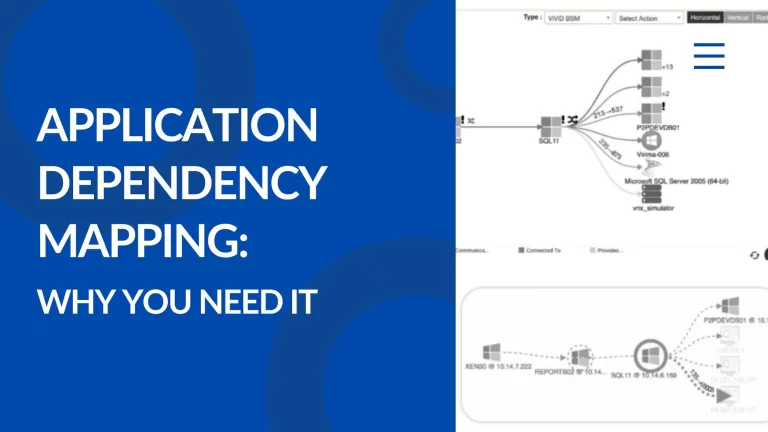
Dynamic service maps are much more valuable than static diagrams during incidents and high-risk changes. Virima’s ViVID capability overlays incidents, changes, and vulnerabilities on live service maps, giving operations and leadership teams a clearer view of impact and priority.
This is also where asset criticality CMDB data starts to compound in value. When CVSS scores are weighed against the business services each asset supports, remediation effort can be directed first at the vulnerabilities that put revenue-generating systems at risk — turning patch backlogs from a volume problem into a prioritization decision finance teams can defend.
Stronger ITSM flexibility
Because Virima integrates with existing ITSM platforms instead of requiring a wholesale replacement, organizations can preserve sunk cost in their current workflow platform while improving the quality of the data feeding it. That gives procurement more leverage and gives CIOs a cleaner path to modernization without forcing an expensive rip-and-replace motion.
A buying framework for CPOs and CFOs
The selection process should be built around economics first and software second.
Step 1: Quantify the baseline
Start by measuring the current state:
- How many tools price by CI, endpoint, instance, or similar units?
- How often are outages prolonged by poor service visibility?
- How much internal effort goes into CMDB cleanup and manual reconciliation?
- How many add-on modules or services are required just to keep configuration data usable?
Step 2: Define non-negotiables
Set requirements that directly protect TCO and strategic flexibility:
- Multi-platform ITSM integration.
- Automated discovery across on-prem and cloud estates.
- Current, accurate, and complete CMDB maintenance with normalization and deduplication.
- Dynamic service maps with operational overlays.
- Transparent bundled pricing for discovery, CMDB, and mapping.
Step 3: Run a proof of value, not just a proof of concept
A serious evaluation should answer three questions:
1. How quickly can the platform integrate with the current ITSM tool?
2. How much of the CMDB and service map can be automated with minimal manual effort?
3. What is the five-year TCO once licenses, add-ons, implementation, and maintenance are included?
Platforms that are designed for integration, automation, and service context usually stand out in this process. A modern ITSM platform that leverages the right ITSM tools not only manages processes more efficiently but also improves service desk performance and overall customer experience. By aligning with a strong configuration management database (CMDB) and reliable configuration data, these platforms help teams perform faster root cause analysis, reduce response time, and minimize service disruptions.
Virima is likely to compare well because it was built to solve exactly these problems rather than extend an already complex suite model. Its approach supports service maps, enhances knowledge bases, and enables automated workflows that help organizations continuously improve operations, reduce downtime, and support broader digital transformation initiatives.
How to run it after purchase
Buying well is only half the equation. To sustain value, organizations need governance that keeps the discovery/CMDB/service-mapping layer trusted and actively used.
Three practices matter most:
- Assign executive ownership for CMDB and service-map quality, including metrics for freshness, completeness, and business coverage.
- Make service maps part of major incident and high-risk change workflows so they are used in real decisions, not just admired in demos.
- Extend the same control plane to security, compliance, and audit teams so the investment serves multiple functions and produces broader ROI.
This is another reason the Virima model is compelling. Its discovery, CMDB, and mapping layer is useful beyond core ITSM, which improves utilization of the investment and supports a stronger long-term business case.
Closing thought
For CPOs and CFOs, the highest-leverage move in ITSM is not to focus narrowly on the ticketing interface. It is to standardize on a modern discovery, CMDB, and service-mapping control plane that improves data quality, lowers operating cost, and preserves platform flexibility. Buyers who use that lens will quickly see why a platform like Virima can maximize the value of an existing ITSM investment and often become the smarter anchor point for the next one.