CMDB for PCI DSS Compliance in Phoenix Starts With the Estate, Not the Checklist

During an annual scope review, a payment operations leadership team at a regional financial shared-services campus in Phoenix evaluates its operational boundaries. The internal review team asks which specific systems customer service agents, collections supervisors, and third-party vendors used to accept or process payment card data across the prior twelve months, alongside who verified that inventory. Greater Phoenix hosts more than 94,000 finance jobs according to the Greater Phoenix Economic Council financial industry report, reflecting a dense regional concentration of shared-services centers and customer operational facilities that expanded through corporate relocations over recent decades. These operations centers process substantial transaction volumes across layered campus facilities, distributed cloud infrastructure, and mixed internal teams.
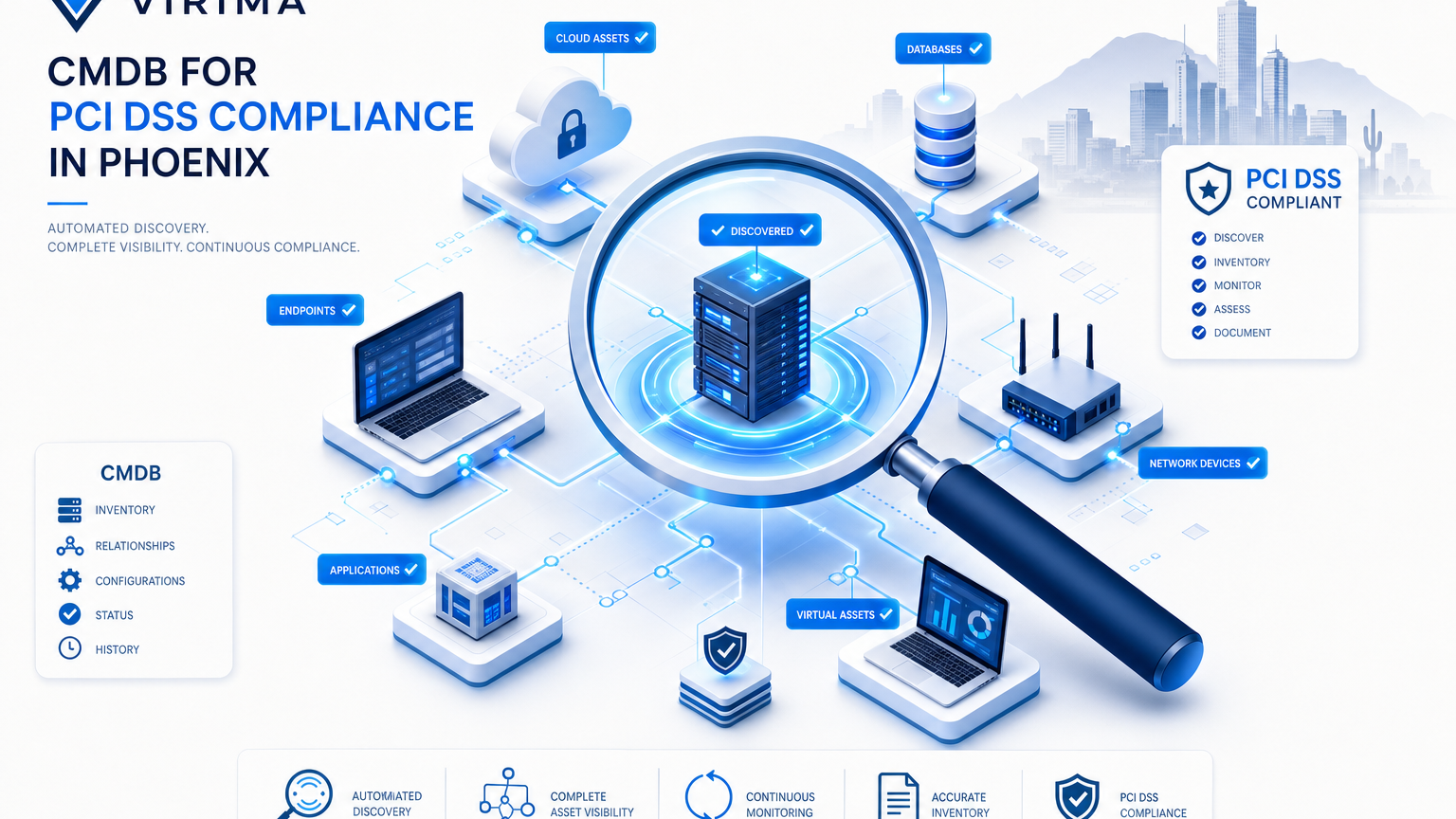
Evaluating how a CMDB for PCI DSS compliance in Phoenix establishes an accurate baseline reveals that managing scope effectively depends directly on discovering the actual technical estate rather than manually completing periodic compliance checklists. When organizations rely on static annual inventories, scope boundaries drift quietly as infrastructure expands across physical networks and remote agent endpoints. Establishing authoritative infrastructure records ensures that compliance documentation reflects actual operational reality throughout every compliance cycle.
What PCI DSS asks about estate scope
The Payment Card Industry Data Security Standard establishes explicit technical expectations regarding how organizations identify and track system components associated with the cardholder data environment. PCI DSS functions as a contractual security benchmark enforced through payment brand rules and acquiring bank agreements, establishing operational baselines for payment processors and merchants. Within the active standards published in the PCI Security Standards Council document library, organizations must maintain comprehensive visibility across every asset involved in transaction workflows. The security council noted on the PCI SSC official standards blog that 51 previously future-dated requirements in version 4.x reached mandatory enforcement status on March 31, 2025.
What Requirement 12.5 covers
Requirement 12.5.1 establishes that organizations must maintain a documented inventory of system components in scope for PCI DSS, complete with an accurate description of function for each recorded asset. Requirement 12.5.2 mandates that organizations document and confirm PCI DSS scope at least once every twelve months and following significant infrastructure modifications. For third-party service providers, Requirement 12.5.2.1 establishes that scope confirmations must occur at least once every six months. The technical scoping parameters detailed in the PCI SSC scoping and segmentation guidance clarify that systems connected to the cardholder data environment or capable of impacting its security posture fall within assessment boundaries. Understanding the baseline PCI DSS compliance technical framework requires recognizing that documentation must reflect operational systems across the enterprise. Furthermore, analyzing the structured controls outlined in the Milan IT governance operational overview illustrates how structured inventory frameworks maintain compliance audit readiness across regulated environments.
| Regulatory Source | Mandated Compliance Standard | Verification Status |
|---|---|---|
| PCI DSS Requirement 12.5.1 | Maintain documented inventory of in-scope system components with defined business function or operational use, kept current. | Active mandatory standard under PCI DSS version 4.0.1. |
| PCI DSS Requirement 12.5.2 | Document and confirm technical scope at least once every twelve months and following any significant architectural or operational change. | Active mandatory requirement across all audited merchant and service provider entities. |
| PCI DSS Requirement 12.5.2.1 | Confirm documented scope boundaries at least once every six months for third-party service provider operations. | Active mandatory standard for service providers under version 4.0.1. |
| PCI SSC Scoping Guidance | Include all systems storing, processing, or transmitting card data, systems connected to the cardholder data environment, and systems impacting security. | Official foundational scoping methodology established by the Security Standards Council. |
Why operations centers carry a scoping problem of their own
Large operations centers in metropolitan hubs face distinct technical challenges that complicate boundary tracking across physical and virtual environments. The Flexera 2026 State of ITAM report indicates that complete IT visibility dropped from 43 percent to 36 percent across surveyed enterprises, while 78 percent of asset management teams identify maintaining an accurate inventory as their foremost operational priority. While complex multi-subsidiary corporate environments face distinct governance friction as examined in the Dallas enterprise PCI compliance analysis, operations centers encounter intense scoping friction rooted in campus density, mixed-use infrastructure, and rapid staffing changes. Three primary operational patterns drive boundary drift across these specialized facilities:
Shared floors, shared subnets
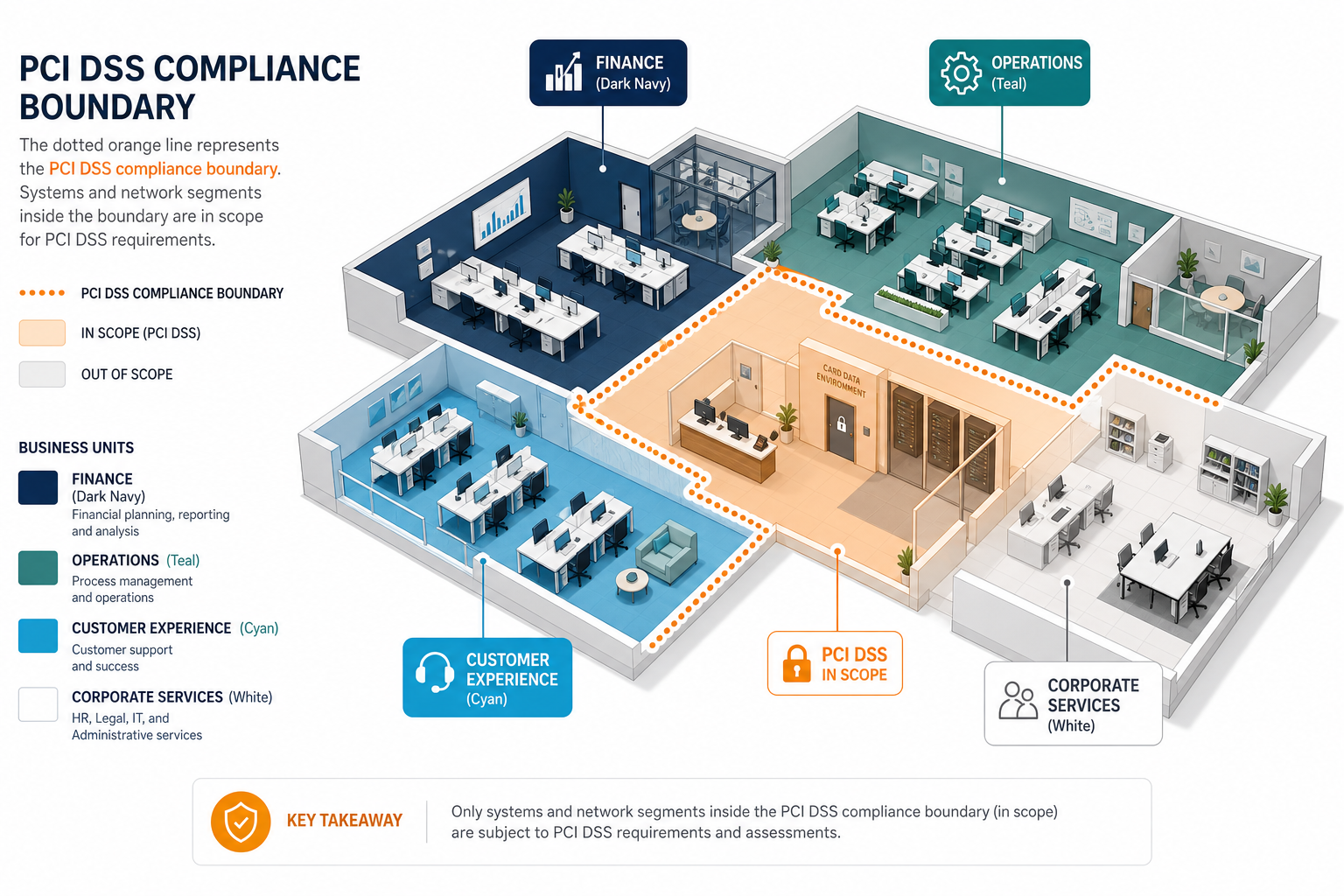
First, large regional campuses frequently share physical floors, switching gear, and subnets across divergent business units. A single facility in Tempe, Chandler, or northwest Phoenix often houses cardholder customer servicing teams alongside retail collections, auto lending, and core back-office processing units. These groups frequently operate across shared VLANs and physical networking infrastructure without rigid physical segmentation between departments.
Result: Engineering teams struggle to identify which specific server instances and desktop subnets connect directly to the cardholder data environment, causing auditors to expand assessment boundaries across broader infrastructure blocks.
Distributed hybrid staffing
Second, distributed hybrid staffing models introduce uncontrolled endpoints into payment acceptance workflows. Hybrid and remote staffing is common across Phoenix-area corporate service centers, and payment operations teams are no exception. Remote agents processing inbound payment calls utilize virtual desktop sessions, softphone applications, and call recording utilities that route audio packets containing card data. Evaluating agent-based and agentless discovery models demonstrates why mobile hardware requires specialized data collection agents to capture endpoint configurations accurately.
Result: Remote agent laptops and peripheral recording tools drift outside baseline scope records when teams rely solely on periodic campus subnet scans.
Seasonal and third-party vendor scaling
Third, regional operations centers scale seasonal staffing through business process outsourcing firms and technical vendors during peak consumer volume. External partner organizations establish direct site-to-site VPN tunnels, remote administrative sessions, and shared data feeds into operational environments to support customer volume. Technical teams regularly establish these partner integrations under aggressive operational deadlines without recording each external dependency inside central architecture diagrams.
Result: The third-party service provider inventory conflicts directly with active network connection logs during official compliance reviews, creating immediate compliance findings during annual assessor walkthroughs.
What a scoping miss puts at stake
Failing to define operational scope accurately creates severe commercial and legal liabilities that extend well beyond compliance audit delays. The IBM Cost of a Data Breach report highlights that the global average cost of a data breach reached 4.99 million dollars, representing a 12 percent increase over preceding benchmarks. Incomplete system inventories expand incident investigation timelines, allowing lateral compromise across unmonitored infrastructure components that organizations mistakenly presumed were isolated from cardholder data.
Regulatory disclosure requirements compound the financial consequences of untracked systems. The Arizona Attorney General data breach notification guidance outlines that entities experiencing a security incident must notify affected individuals within 45 days, while breaches impacting more than 1,000 Arizona residents mandate formal reporting to the Attorney General and major consumer reporting agencies under Arizona Revised Statutes Sections 18-551 and 18-552. Maintaining verified infrastructure records significantly shortens breach containment cycles by allowing response teams to identify affected hardware and software dependencies immediately.
CMDB for PCI DSS compliance in Phoenix: how discovery-fed records support scope
Deploying a discovery-fed configuration management database transforms how operations centers document, confirm, and defend their cardholder environment boundaries throughout the year. Rather than spending months manually surveying system administrators before an audit, technical teams use automated discovery to maintain authoritative technical data. Stale infrastructure records create severe audit discrepancies, an operational hazard examined in the Atlanta payment processor compliance review. Organizations establish dependable technical scope through three primary configuration management database mechanisms:
Automated discovery across the estate
The foundation rests on automated IT discovery capabilities deployed across all physical campuses, virtualization clusters, and enterprise cloud tenancies. Virima utilizes more than 140 extendable agentless discovery probes to inventory servers, network switches, hypervisors, and storage systems across regional operations centers without requiring individual software installations on core systems. For remote customer service agents and hybrid workstations roaming off corporate networks, lightweight discovery agents collect hardware specifications, installed software, and local configuration details whenever devices establish network connectivity. Cloud connectors interface directly with Amazon Web Services and Microsoft Azure APIs to capture ephemeral server instances, container nodes, and serverless infrastructure components. All administrative credentials remain securely encrypted on customer-owned discovery servers, while hardware outside protocol reach is tracked through structured manual registration procedures.
A verified system of record
Every discovered configuration item populates the central enterprise CMDB platform with an authoritative source record and an explicit verification timestamp. Instead of treating system records as static entries, the platform refreshes device data on a high-frequency scheduled cadence tailored to the organization’s targeted risk analysis schedule. Maintaining strict verification timestamps establishes objective proof for qualified security assessors, demonstrating that inventory data reflects operational reality rather than outdated procurement records as outlined in the CMDB audit compliance guide.
Dynamic dependency mapping
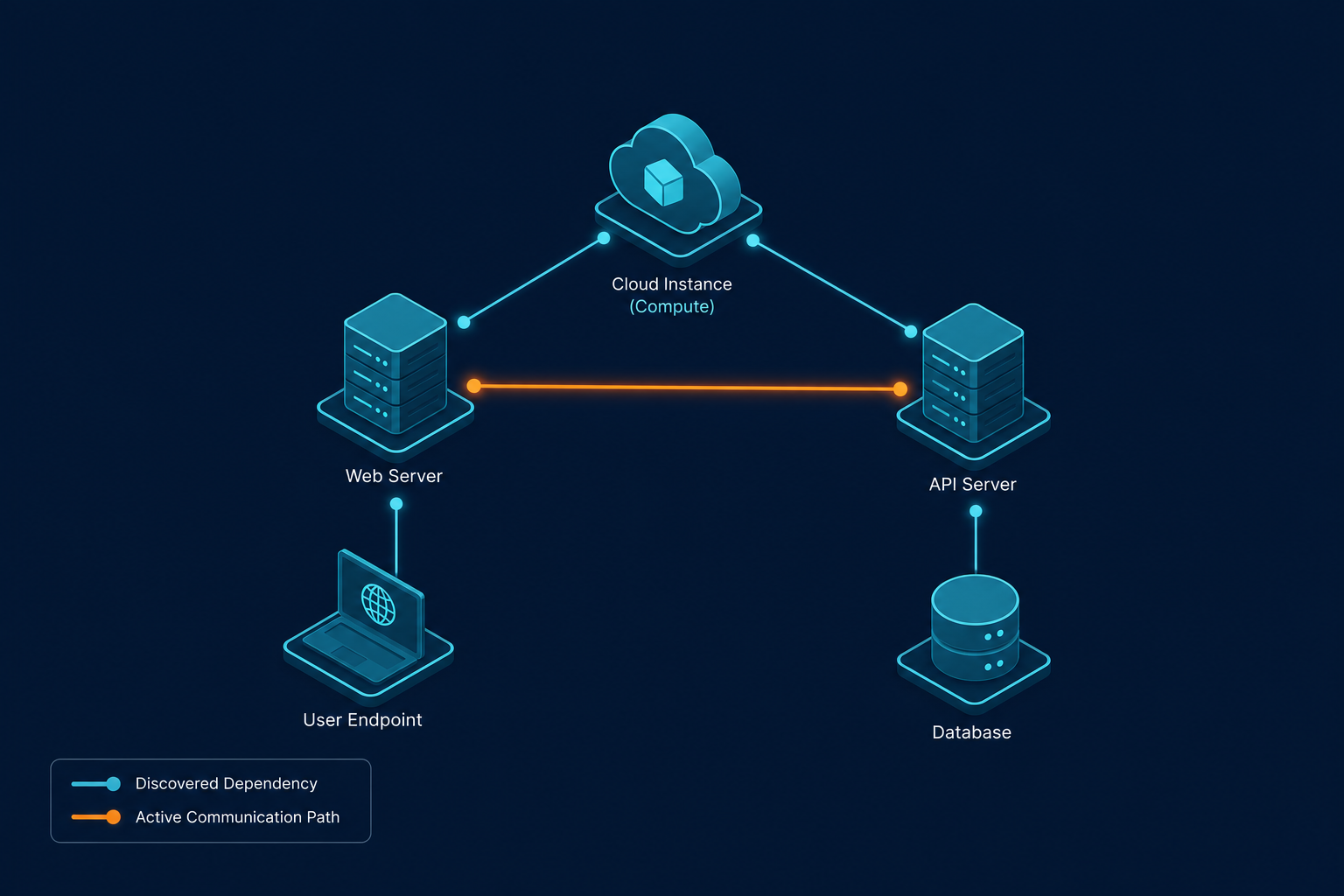
Dynamic dependency visualization provided by automated service mapping technology maps server-to-server communications by inspecting active ports and protocols across discovered systems. Virima ViVID™ visualizes communication flows across infrastructure tiers, revealing active network connections between payment processing hosts, database clusters, and supporting operational systems. Because service definitions require institutional operational context, business owners supply baseline application definitions while automated discovery maps the underlying relationships. Documenting how infrastructure tiers interact reinforces the principles detailed in the service mapping operational criticality guide, enabling teams to confirm whether auxiliary systems connect to cardholder processing environments.
| Operational Capability | Annual Spreadsheet Reconciliation Model | Discovery-Fed CMDB Operational Model |
|---|---|---|
| Inventory Generation Method | Manual outreach, self-reported department forms, and periodic static exports from disconnected hypervisors. | Automated agentless network probes, remote agent collectors, and direct public cloud API integrations. |
| Evidence of Currency | Static file modification dates and subjective email approvals from system owners. | Cryptographic discovery source logs and granular execution timestamps recorded per configuration item. |
| Remote Endpoint Tracking | Infrequent Active Directory exports that fail to record off-network software modifications. | Lightweight local agents reporting hardware and software configuration changes whenever devices connect. |
| Inter-System Connection Visibility | Static Visio diagrams based on historic architecture designs that omit subsequent network adjustments. | ViVID dynamic service mapping displaying active port and protocol communication flows across infrastructure tiers. |
| Scope Confirmation Resource Effort | Multiple months of administrative coordination, conflicting spreadsheets, and urgent pre-audit manual verification. | Scheduled review of continuous discovery baselines, verified dependency flows, and automated change logs. |
| Human Governance Requirement | Manual entry, data deduplication, and chasing system administrators for spreadsheet updates. | Defining service boundaries, analyzing boundary exceptions, and verifying third-party operational roles. |
Keeping scope current as change happens
Integrating configuration data with enterprise change management platforms ensures that infrastructure modifications update scope documentation automatically. When engineering teams implement system changes through ServiceNow, Jira Service Management, Ivanti, HaloITSM, Xurrent, or TeamDynamix as supported across Virima unified enterprise integrations, the configuration record captures technical adjustments within existing operational workflows.
What a CMDB settles, and what stays with other owners
A discovery-fed configuration management database provides essential operational clarity regarding physical and virtual infrastructure assets. Establishing precise technical boundaries requires understanding the exact capabilities of infrastructure discovery and recognizing which governance responsibilities remain with specialized security personnel. A configuration management database documents technical assets and active connections; it does not analyze card data payloads or validate firewall rules independently.
| Operational Compliance Question | Answered by the Discovery-Fed CMDB | Owned by Specialized Governance Teams |
|---|---|---|
| System Component Identification | Identifies all active physical servers, virtual machines, cloud instances, network devices, and user endpoints. | Classifies business criticality and assigns regulatory operational roles across business departments. |
| Cardholder Data Payload Flow | Maps network ports and protocols used for communication between discovered server components. | Data classification tools, application architects, and formal PCI data flow diagram owners. |
| Network Segmentation Isolation | Displays active communication flows and unexpected network connections across discovered IP ranges. | Network engineering and penetration testing teams conducting formal annual segmentation penetration testing. |
| Payment Script Integrity Controls | Discovers web servers, hosting hardware, operating system levels, and related infrastructure components. | Specialized client-side script integrity tools monitoring browser scripts under Requirements 6.4.3 and 11.6.1. |
| Formal Compliance Determination | Provides verifiable configuration logs, discovery history, asset ownership data, and dependency maps. | Internal PCI Program Director and qualified security assessors issue final compliance validation. |
For chief information officers and operations directors, this separation establishes an efficient operating model. Discovery-fed configuration records eliminate manual inventory assembly. Security assessors get verified technical data without the wait, and security teams stay focused on risk analysis and policy enforcement instead of chasing spreadsheets.
Where the efficiency and savings come from
Maintaining an automated infrastructure baseline delivers measurable operational efficiencies that reduce compliance expenses across large operations centers. Rather than inventing speculative return metrics, enterprise leaders calculate tangible financial savings across four operational categories:
First, automated inventory tracking cuts labor hours committed to annual scope confirmation under Requirement 12.5.2. In traditional environments, operations managers, systems engineers, and network administrators spend hundreds of hours reconciling disparate asset spreadsheets before annual assessments. Discovery-fed records maintain continuously updated hardware, software, and dependency baselines, allowing technical teams to complete scope validation in days instead of months. Organizations quantify these savings by multiplying reduced staff preparation hours by internal loaded labor rates across engineering and compliance departments.
Second, maintaining accurate asset inventories cuts software license spend and strengthens vendor audit defense. The same Flexera report reveals that 48 percent of enterprises faced vendor software audits within the past year, while 44 percent expended more than one million dollars managing audit settlements and related demands over a three-year period. Aligning discovery data with comprehensive ITAM capabilities enables financial institutions to detect unused software licenses on call center workstations, eliminate redundant billing, and defend against vendor audit penalties through verified hardware and software inventories. Leaders measure this impact through direct license reclamation savings and eliminated non-compliance settlements as detailed in the financial services ITAM compliance analysis.
Third, automated dependency tracking mitigates costly operational outages and minimizes assessor walkthrough inquiries. When assessors submit evidence requests regarding network segmentation or system ownership, compliance teams retrieve timestamped discovery records and ViVID dependency diagrams immediately. Rapid evidence delivery prevents prolonged assessor engagements and billable audit overages. Understanding architectural dependencies also prevents accidental outages during security patching and configuration updates. That protects daily payment processing transactions across regional customer operations.
Standing it up across a site: the first 90 days
Implementing a discovery-fed configuration management database across a Phoenix operations facility requires a structured operational roadmap that delivers incremental visibility without disrupting active financial services. Organizations establish reliable scope documentation by executing five operational phases over a ninety-day timeline:
Days 1-15: governance and stakeholders
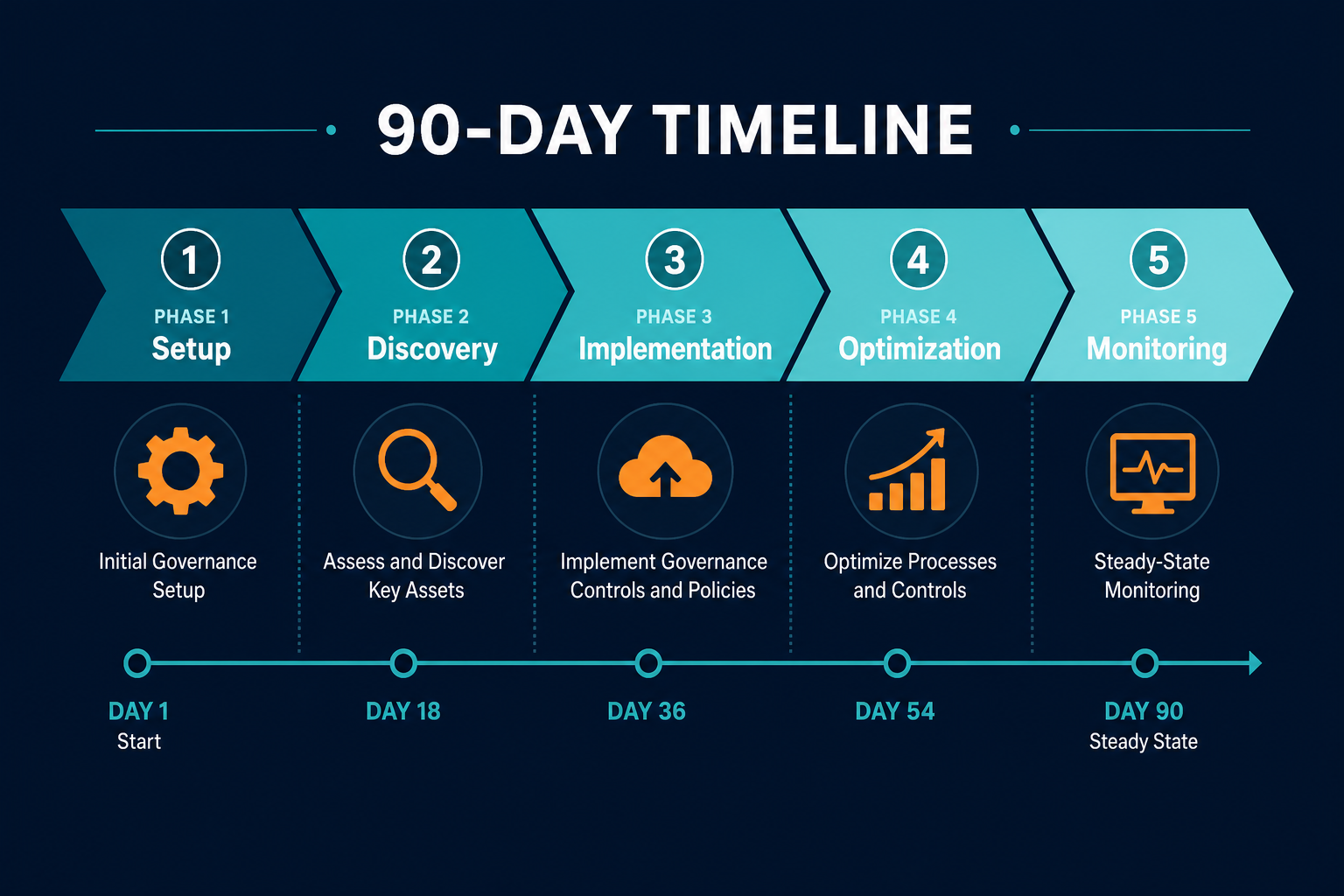
During Days 1 through 15, leadership establishes administrative governance and identifies technical stakeholders across the facility. Executive sponsors appoint a primary owner for the central PCI scope record alongside technical leads representing enterprise networking, floor operations, telephony systems, and third-party vendor management. The enterprise PCI program director reviews established cardholder boundaries, documents known payment data paths, and assigns preliminary regulatory tags within the configuration management platform.
Days 16-35: deploy discovery
During Days 16 through 35, engineering teams deploy discovery probes across operational network subnets and enterprise cloud tenancies. Technicians implement agentless discovery across campus data centers, server rooms, hypervisors, and cloud environments while distributing lightweight discovery agents across remote customer service agent laptops. Initial discovery sweeps inventory all reachable computing assets, recording operating system versions, active network interfaces, and installed software packages.
Days 36-55: reconcile and investigate
During Days 36 through 55, technical teams reconcile discovered infrastructure against existing documentation and third-party vendor rosters. Compliance personnel compare discovered device inventories against historic Requirement 12.5.1 documentation to identify unmanaged hardware, decommissioned servers still drawing network connectivity, and unauthorized vendor connections. Technicians investigate every inventory discrepancy, registering unmanaged assets or isolating rogue devices from production subnets.
Days 56-75: build dependency maps
During Days 56 through 75, application owners collaborate with technical teams to construct dynamic dependency maps using ViVID service mapping. Technical leads define core payment processing services, customer service workflows, and database transaction pathways, allowing automated mapping to chart active communication connections by port and protocol. Teams review incoming and outgoing traffic flows across cardholder boundaries to verify that active connections align with documented architectural requirements.
Days 76-90: operationalize the cadence
During Days 76 through 90, leadership finalizes scheduled operational processes to maintain inventory accuracy over time. Technical owners establish high-frequency scheduled discovery cycles aligned with the corporate targeted risk analysis framework, embed configuration updates into standard IT service management ticketing workflows, and assign formal ownership for all hardware decommissioning tasks. Using the Virima Stay Audit-Ready framework ensures that the operations center maintains defensible, audit-ready scope documentation for upcoming Qualified Security Assessor reviews.
Where to start: validating operations center scope
Operations center leaders looking to streamline annual compliance validation can initiate a focused discovery assessment across a single customer servicing floor or operational network subnet. Comparing automated discovery results directly against current spreadsheet inventories quickly highlights unmonitored endpoints, obsolete server entries, and undocumented communication flows. Exploring Virima Trusted Runtime Truth provides the operational context and verified configuration records required to defend compliance boundaries with verifiable evidence.
Frequently Asked Questions
What does PCI DSS require for an inventory of system components?
Requirement 12.5.1 mandates maintaining an accurate inventory of all in-scope system components with documented business functions. The inventory must cover all hardware, virtual machines, cloud resources, and software components associated with the cardholder data environment.
Does Virima’s CMDB require installing agents on every remote device, or can it discover them without one?
Virima combines agentless discovery for networked infrastructure with lightweight agents for remote and hybrid endpoints that roam off the corporate network. Call-center laptops and other mobile devices use the agent path, since they are not reachable through network-based scanning alone.
How often should PCI DSS scope be confirmed?
Requirement 12.5.2 requires entities to document and confirm PCI DSS scope at least once every twelve months and after significant architectural changes. Third-party service providers must confirm operational scope every six months under Requirement 12.5.2.1.
How do remote agents and telephone payments affect scope?
Remote agents taking payment card details over telephone lines bring endpoint laptops, softphones, and call recording systems into compliance scope. Lightweight discovery agents inventory remote configurations to prevent unmanaged devices from escaping annual audit reviews.
Does Virima work with ServiceNow or Jira for scope changes?
Virima integrates natively with ServiceNow, Jira Service Management, Ivanti, HaloITSM, Xurrent, and TeamDynamix. Infrastructure modifications processed through change tickets update the configuration management database automatically, ensuring scope records reflect approved technical changes.
Phoenix operations centers do not have months to spend reconciling spreadsheets before the next PCI DSS scope confirmation. CMDB for PCI DSS compliance in Phoenix means Virima’s IT discovery and ViVID™ service maps keep the asset and dependency layer current between assessments, so your next Requirement 12.5.2 review starts from one verified record instead of a dozen conflicting spreadsheets. Schedule a demo to see how it maps your own estate.