Top IT Discovery Platforms for Multi-Protocol, Multi-Source Estates

Three months before a compliance audit, an infrastructure architect ran a full asset inventory. Windows endpoints came back clean, 4,200 devices, fully reconciled. Linux servers returned about 60% of expected nodes. Network gear produced a list that disagreed with the firewall’s own routing table. Cloud workloads in AWS looked accurate; Azure did not. The CMDB held four conflicting records for the same load balancer.
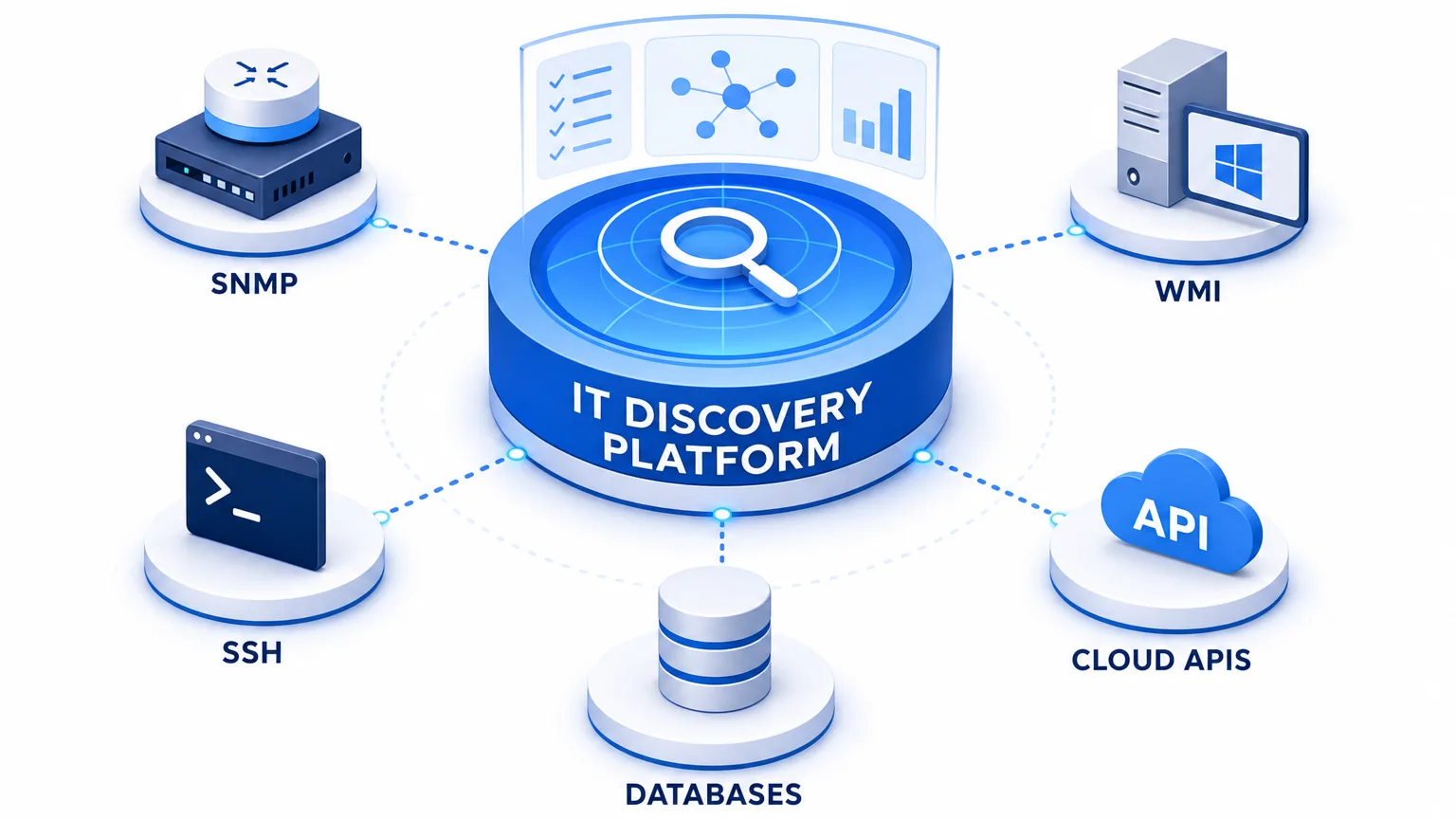
That gap between what a CMDB claims and what a network actually contains is why 43% of IT organizations no longer trust their own technology-stack visibility, down from 47% a year earlier, according to Flexera’s 2025 State of ITAM Report. Evaluating the top IT discovery platforms for multi-protocol, multi-source estates starts with recognizing why that gap opens in the first place: modern estates span on-premises data centers, multiple cloud providers, virtualization layers, OT and IoT segments, and SaaS platforms, and each layer surfaces through a different protocol. SNMP reaches network gear, WMI surfaces Windows endpoints, SSH opens Linux and Unix hosts, and REST APIs return cloud resource metadata. No single discovery method reaches all of them, and when separate tools scan overlapping segments, they produce conflicting outputs that erode CMDB accuracy with each cycle.
CISA’s Binding Operational Directive 23-01 requires federal agencies to maintain complete asset inventories updated on high-frequency schedules — a mandate that reflects a broader enterprise reality: the same completeness bar applies to any organization whose CMDB feeds change management, incident response, or audit readiness.
This 2026 comparison evaluates eight IT discovery platforms against six criteria centered on protocol breadth and multi-source reconciliation. The goal is a defensible evaluation framework for infrastructure teams at solution review stage, not a ranking by price tier or G2 score.
What makes multi-protocol, multi-source discovery different
Protocol coverage and source reconciliation are related problems that operate at different layers.
The protocol layer describes how a discovery tool reaches an asset. SNMP queries network devices — switches, routers, firewalls — and returns interface tables, ARP caches, and device identifiers. WMI accesses Windows management instrumentation data: installed software, hardware inventory, registry values, and running processes. SSH reaches Linux, Unix, and certain network appliances to return package inventories, configuration files, and process state. Cloud APIs from AWS, Azure, and GCP return resource metadata directly from each provider’s control plane. ICMP confirms reachability but returns almost no attribute data on its own.
An estate with Windows servers, Linux hosts, Cisco network gear, and AWS workloads needs all four protocol families. A tool strong on WMI but absent on SNMP leaves the network layer unmapped; a cloud-native scanner that ignores on-premises SSH hosts produces a partial estate view that compounds into CMDB blind spots over time.
The source layer describes what feeds the CMDB. Agent-based and agentless discovery operate through different access models, and most enterprise estates need both, along with API connectors for cloud platforms. When all three sources scan overlapping CIs and return slightly different values for the same attribute, the CMDB needs reconciliation logic to resolve the conflict. Without it, the last scan overwrites previous data, and accuracy degrades with each high-frequency cycle.

What is the difference between multi-protocol discovery and multi-source discovery in IT?
Multi-protocol discovery refers to the range of protocols a tool uses to reach assets: SNMP for network gear, WMI for Windows, SSH for Linux, and APIs for cloud platforms. Multi-source discovery refers to running agent-based, agentless, and API scanning in parallel. Protocol coverage determines reach; multi-source reconciliation determines how conflicting attribute values are resolved when different sources report different data for the same CI.
Six criteria for evaluating IT discovery platforms
Only 43% of IT organizations report complete visibility across their technology stack — the Flexera figure cited above — and that decline is the practical reason multi-protocol IT discovery and multi-source CMDB discovery deserve more scrutiny than a feature checklist gets in most vendor evaluations. Each platform profile below uses these six dimensions as a consistent assessment frame:
- Multi-protocol coverage — native support for SNMP, WMI, SSH, ICMP, and extensible probes
- Multi-source reconciliation — authority-rule handling of conflicting values from agent, agentless, and API sources
- Cloud and virtualization discovery — API-based discovery for AWS, Azure, GCP, VMware, Hyper-V, and containers
- Dependency mapping depth — service and relationship visualization beyond simple parent-child linkage
- CMDB and ITSM integration — native or deep connectors to ServiceNow, Jira, Ivanti, and similar platforms
- Deployment flexibility — agent-based, agentless, and API modes across on-premises and cloud targets
The platforms
ServiceNow Discovery
ServiceNow Discovery uses configurable Discovery Patterns — credential-driven probe sets covering WMI, SSH, SNMP, and cloud APIs. CMDB integration is native; discovered CIs land directly in the ServiceNow CMDB schema without a separate sync step. For organizations already standardized on ServiceNow ITSM, that coupling is the platform’s strongest argument.
Protocol coverage is broad but depends on the Discovery Pattern library at each license tier, and patterns require skilled administrators to maintain as the estate changes. MID Server topology determines how well Discovery reaches distributed or segmented network environments, and total cost of ownership — license, MID Server infrastructure, and pattern maintenance — is a material factor against purpose-built discovery platforms.
Best fit: Large enterprises standardized on ServiceNow ITSM that need discovery and CMDB in a single platform.
Lansweeper
Lansweeper scans Windows, Linux, and macOS endpoints through WMI, SSH, and SNMP, and ingests cloud assets via API connectors for AWS, Azure, and GCP. The catalog returns 100+ data points per device, and deployment is accessible — no agent required for most scan types.
Reconciliation logic is less mature for enterprises with complex multi-source overlap. Lansweeper merges records by device identity but doesn’t expose granular source-authority rules for attribute-level conflicts, so teams whose CMDB requires precise reconciliation across agent, agentless, and API inputs need additional tooling or manual process to close that gap.
Best fit: Mid-market organizations that need broad protocol coverage without heavy infrastructure investment.
Device42
Device42 is built around agentless discovery across data center infrastructure, using SNMP, WMI, and SSH to map servers, network devices, and application dependencies. Its auto-generated dependency maps between application tiers, servers, and network equipment are a genuine strength, particularly for data center migration and infrastructure rationalization projects.
For teams evaluating platforms primarily on network topology discovery and infrastructure mapping, the dependency mapping capability ranks among the stronger options in this set. Device42 was acquired by Freshworks in 2024; long-term roadmap alignment with Freshservice is a factor for organizations outside that platform. Cloud coverage for AWS, Azure, and GCP is available but isn’t the platform’s primary design focus.
Best fit: Data center-heavy organizations focused on migration planning and infrastructure dependency mapping.
BMC Discovery (Helix)
BMC Helix Discovery uses Application Dependency Mapping (ADDM) patterns to build relationship context during scanning, not just asset lists. The ADDM engine runs pattern-based discovery across on-premises infrastructure, multi-cloud environments, and containers, then maps discovered CIs to business services. Protocol coverage spans SNMP, WMI, SSH, and cloud APIs.
That depth reflects the platform’s design target — large enterprises with complex, heterogeneous estates — and carries corresponding administrative complexity and cost; smaller teams often find the overhead disproportionate to estate scale. The strongest use case is organizations already running BMC Helix ITSM that need discovery tightly coupled to their existing CMDB schema.
Best fit: Enterprises running BMC Helix ITSM that need pattern-based multi-cloud discovery integrated with the platform CMDB.
Virima
Virima’s discovery engine runs through 140+ extensible probes, as of Q3 2026, spanning SNMP, WMI, SSH, ICMP, and custom protocol extensions. The probes reach network devices, Windows and Linux servers, VMware and Hyper-V virtual infrastructure, AWS and Azure cloud workloads, and API-connected SaaS platforms within a single discovery engine. Agent-based, agentless, and API modes operate in combination across hybrid estates.
Multi-source reconciliation uses authority rules at the attribute level. When an agent, an agentless scan, and an API connector return different values for the same CI attribute, the reconciliation engine responds with configurable authority rankings — it does not default to last-scan-wins. Source attribution is retained at each attribute, so the CMDB records not only what the current value is, but which discovery method confirmed it.
ViVID™ service maps translate the reconciled CMDB into visual dependency relationships, useful for change impact scoping, blast radius analysis, and incident response. For hybrid cloud IT discovery platforms specifically, this combination of multi-protocol depth, attribute-level reconciliation, and dependency visualization addresses three criteria that most platforms treat as separate capabilities.
Virima integrates with ServiceNow, Jira, Ivanti, and other ITSM platforms through its integrations hub. For teams building a CMDB with enough accuracy to support change management and operational automation, the reconciliation architecture matters more than raw scan speed.
Best fit: Infrastructure teams that need multi-protocol breadth, authority-rule reconciliation, and service dependency maps across hybrid estates.
runZero
runZero uses unauthenticated network fingerprinting — no credentials required — to discover everything reachable on a network segment, including shadow IT assets, unmanaged IoT devices, and OT equipment that credential-based tools miss. Its scanning is fast and covers a broader range of device types at the network layer than most credential-based platforms.
The trade-off is attribute depth. Without credentials, runZero returns network-layer identity — IP address, MAC, device fingerprint — but limited application or software inventory, and service dependency mapping is absent. It is not a CMDB replacement by design: for teams that want to answer “what is on the network that we have no record of,” runZero is strong, but for full CMDB attribute population, it works best alongside a credential-based discovery engine.
Best fit: Security teams running shadow IT or unknown-asset discovery; pairs best with a credential-based platform for CMDB population.
Qualys CSAM
Qualys Cyber Security Asset Management runs four simultaneous discovery methods — agent-based, scanner-based, passive sensor, and API connector. Building CI records from all four inputs concurrently is a structural differentiator; Qualys normalizes across sources rather than running them sequentially. Discovered assets route directly into Qualys’ vulnerability management stack, making the same platform support asset inventory and CVE scanning.
ITSM integration and CMDB sync are available but aren’t the primary design focus. The strongest fit is security-first organizations that want asset completeness tied to vulnerability posture, not ITIL workflow support.
Best fit: Security organizations that need multi-source discovery integrated with vulnerability management.
Ivanti Neurons for Discovery
Ivanti Neurons applies AI-assisted normalization on top of agent and agentless discovery. The platform scans Windows, Linux, and macOS endpoints and uses machine learning to reconcile naming variations, duplicate CIs, and incomplete records before they reach the CMDB. The natural integration path is Ivanti’s own ITSM suite.
Cloud and network protocol coverage is available but less deep than purpose-built multi-protocol platforms. Organizations outside the Ivanti platform can integrate via API, though some native workflow benefits require the full Ivanti stack.
Best fit: Ivanti ITSM shops that want integrated discovery with AI-assisted normalization.
Platform comparison at a glance

| Platform | Multi-Protocol | Multi-Source Reconciliation | Cloud / Virt | Dependency Mapping | CMDB / ITSM Integration | Deployment Flexibility |
|---|---|---|---|---|---|---|
| ServiceNow Discovery | ✔ | Partial | ✔ | Partial | ✔ Native | Platform-tied |
| Lansweeper | ✔ | Partial | ✔ | Limited | Partial | ✔ |
| Device42 | ✔ | Partial | ✔ | ✔ | Partial | ✔ Agentless |
| BMC Helix Discovery | ✔ | ✔ | ✔ | ✔ | ✔ BMC Native | Platform-tied |
| Virima | ✔ 140+ probes | ✔ Authority rules | ✔ | ✔ ViVID™ | ✔ | ✔ |
| runZero | Network-layer only | Limited | Partial | Limited | Partial | ✔ |
| Qualys CSAM | ✔ 4 methods | ✔ | ✔ | Limited | Partial | ✔ |
| Ivanti Neurons | Partial | Partial (AI-assisted) | Partial | Limited | ✔ Ivanti Native | ✔ |
How to choose the right platform for your estate
How should IT teams evaluate discovery platforms for multi-protocol estates?
Start by mapping the protocols your estate requires: SNMP for network devices, WMI for Windows, SSH for Linux, APIs for cloud platforms. Any platform that lacks native support for one protocol family leaves that estate segment unmapped. After protocol coverage, assess reconciliation logic, how the platform resolves conflicts when multiple sources return different values for the same CI attribute. Last-scan-wins behavior degrades CMDB accuracy over time regardless of scan frequency.
The right platform depends on three decisions made before reviewing any vendor documentation.
First, map your estate’s protocol spread — every asset class against the protocol it requires. A platform that covers four of six protocol families leaves gaps that surface as CMDB blind spots during audits and incident response, and that mapping also tells you whether a single platform covers the estate or whether a primary discovery engine plus a complementary network scanner serves it better.
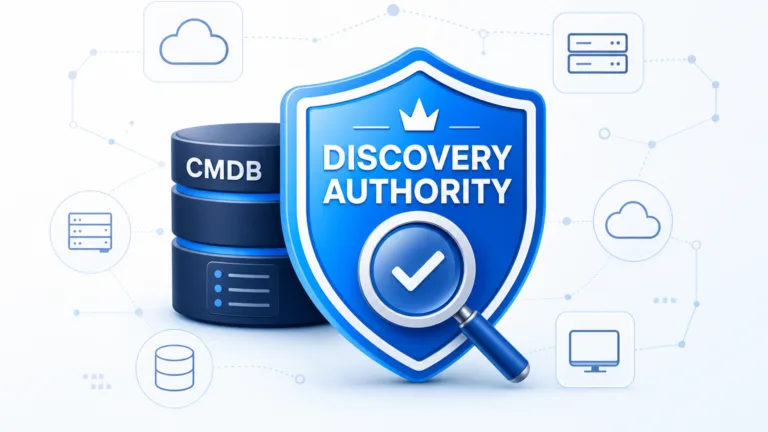
Second, define your reconciliation requirements. Among the platforms compared here, ServiceNow Discovery and Lansweeper reconcile at the CI level, Device42 reconciles primarily around dependency structure rather than per-attribute conflicts, and none of the three expose the attribute-level authority rules that a CMDB feeding automated change approvals needs. If your CMDB feeds change management, incident response, or compliance auditing, last-scan-wins is not a viable reconciliation model; authority-rule reconciliation, where each attribute has a designated trusted source, is the standard once CMDB accuracy starts driving operational decisions rather than just reporting on them.
Third, assess ITSM integration depth. Discovery data that doesn’t feed downstream workflows in your ITSM platform doesn’t improve those decisions, and native integration reduces the synchronization lag and attribute translation errors that accumulate when discovery and ITSM stay loosely coupled.
If your estate requires multi-protocol breadth, authority-rule reconciliation, and dependency mapping working together, see how Virima’s discovery engine handles all three at Trusted Runtime Truth.
Make the shortlist work
Most enterprises running fragmented discovery tools reach the same conclusion: each tool covers a segment accurately, and the segments don’t reconcile into a coherent estate view. A Windows scanner, a cloud API connector, and a network SNMP tool each return accurate data within their scope — and conflicting data at the boundaries.
A discovery platform selected for multi-protocol, multi-source estates needs to treat reconciliation as a first-class capability, not a post-processing step. Protocol breadth gets the data in; reconciliation logic determines whether the resulting CMDB is accurate enough to support the change windows, audits, and incidents that depend on it.
Frequently Asked Questions
What protocols do enterprise IT discovery platforms typically support?
Enterprise IT discovery platforms support SNMP for network devices, WMI for Windows endpoints, SSH for Linux and Unix hosts, and REST APIs for cloud platforms and SaaS applications. ICMP is used for reachability checks but returns minimal attribute data. Platforms that support all four protocol families natively cover more estate segments without requiring supplementary tools. Extensible probe frameworks allow some platforms to add support for proprietary or custom protocols beyond the standard four.
Why does multi-source reconciliation matter more than scan frequency in a CMDB?
Scan frequency determines how current the data is; reconciliation determines whether the data is accurate when multiple sources disagree. An estate scanned frequently by three tools using last-scan-wins reconciliation accumulates more conflicts with each cycle. Authority-rule reconciliation assigns a trusted source per attribute type, so the most reliable source for OS version data, for example, takes precedence over less authoritative sources regardless of scan order. Frequency without reconciliation logic produces a CMDB that is updated often but remains inaccurate.
Which asset types are hardest for discovery platforms to reach?
OT and IoT devices are difficult to reach with credential-based discovery because many do not support WMI or SSH and respond only to SNMP or proprietary protocols. Unauthenticated network scanning reaches more of these device types but returns limited attribute depth. Legacy appliances and network equipment running older firmware often expose partial SNMP MIBs. Shadow IT assets are difficult to locate because they are not registered in DNS or Active Directory, so credential-based discovery cannot find them without a network sweep that identifies unknown IP space first.
How does Virima handle conflicting data from multiple discovery sources?
Virima uses authority-rule reconciliation at the attribute level. When agent-based, agentless, and API discovery sources return different values for the same CI attribute, the reconciliation engine applies configurable rankings to determine which source holds authority for that attribute type. The source of each attribute value is retained in the CMDB record, so teams can verify which discovery method confirmed a given piece of data. This differs from last-scan-wins behavior, where the most recent scan overwrites all previous values regardless of source reliability.
Can a single IT discovery platform cover both on-premises and cloud estates?
Several platforms in this comparison cover both, but the depth varies by segment. Platforms built primarily around on-premises credential-based scanning often add cloud API connectors as secondary capabilities, while cloud-native tools frequently lack depth on on-premises network gear and legacy servers. Platforms designed for hybrid estates, with agent, agentless, and API modes operating in combination, return more consistent attribute depth across both environments. Evaluating coverage for each protocol family separately, rather than accepting “supports hybrid” as sufficient, produces a more accurate picture of where gaps will appear in practice.
Does Virima’s discovery engine require agents on every endpoint?
No. Virima combines agent-based, agentless, and API-based discovery, and most enterprise estates run agentless as the default for network gear and cloud APIs for AWS and Azure workloads, adding agents only where deeper OS-level attribute detail is needed, such as installed software inventory on endpoints without open management ports. The deployment mix is configured per estate segment rather than applied uniformly across every device.