Asset Truth Needed Before Vendor Consolidation or Renewals Still Starts With a 90-Day Clock

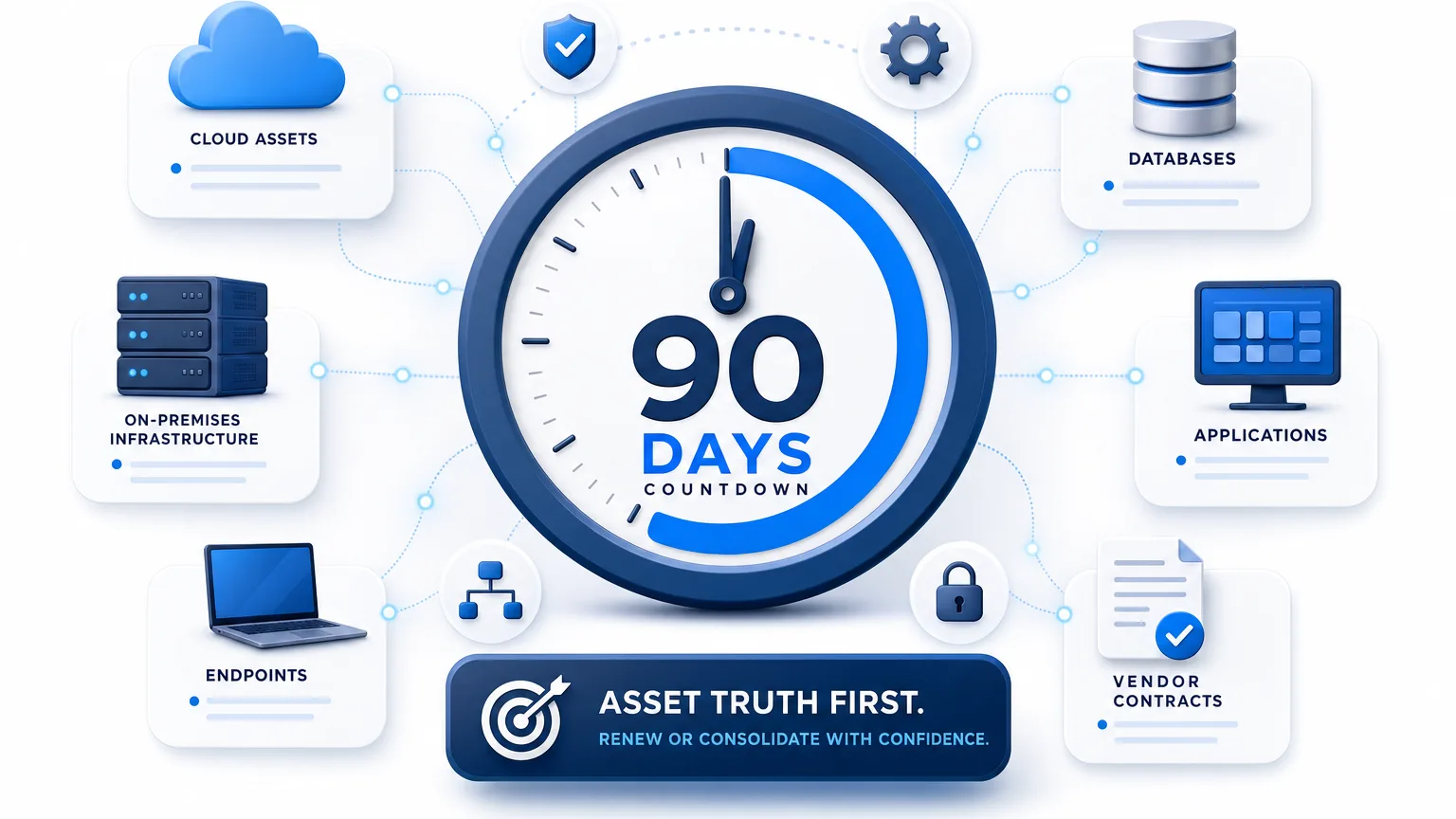
The publisher contract lands on the calendar ninety days out. Procurement wants a renewal number. Finance wants a cut. The vendor wants a multi-year expansion. Someone opens last year’s seat workbook and last quarter’s CMDB export and hopes they still match production. That is the real start of asset truth needed before vendor consolidation or renewals: not a general inventory program, but a decision window with a hard date.
Consolidation and renewals fail the same way when the clock is short. Teams negotiate on purchased rights, vendor quotes, and tribal memory. They do not negotiate on live installs, shared platforms, owners, and dependency paths that decide what you can safely drop, keep, or re-license. The gap shows up after signature as over-buy, under-license, orphaned tools, or a cut that breaks a path nobody mapped.
If you need the category frame before the renewal war room, start with Trusted Runtime Truth. This guide stays inside the pre-renewal and pre-consolidation decision point: what asset data you need in those ninety days, how to assemble it without a multi-year CMDB program, and where discovery-sourced inventory sits under procurement without replacing software asset management (SAM) or contract tools.
The 90-day question is not “do we have an inventory”
By day ninety the useful questions are narrower.
| Decision | Asset truth you need | What a stale export answers instead |
|---|---|---|
| Renew as-is | Current installs vs entitlements, active users or devices, versions in scope | Last year’s seat count and a hopeful spreadsheet |
| Right-size down | Which installs still run, which are idle, which sit on shared hosts | License keys on a PO with no install join |
| Consolidate vendors | Overlap by product family, shared CIs, services that depend on each stack | Feature matrices from sales decks |
| Exit a platform | Blast radius, owners, replacement coverage, decommission evidence | A sunset slide with no CI list |
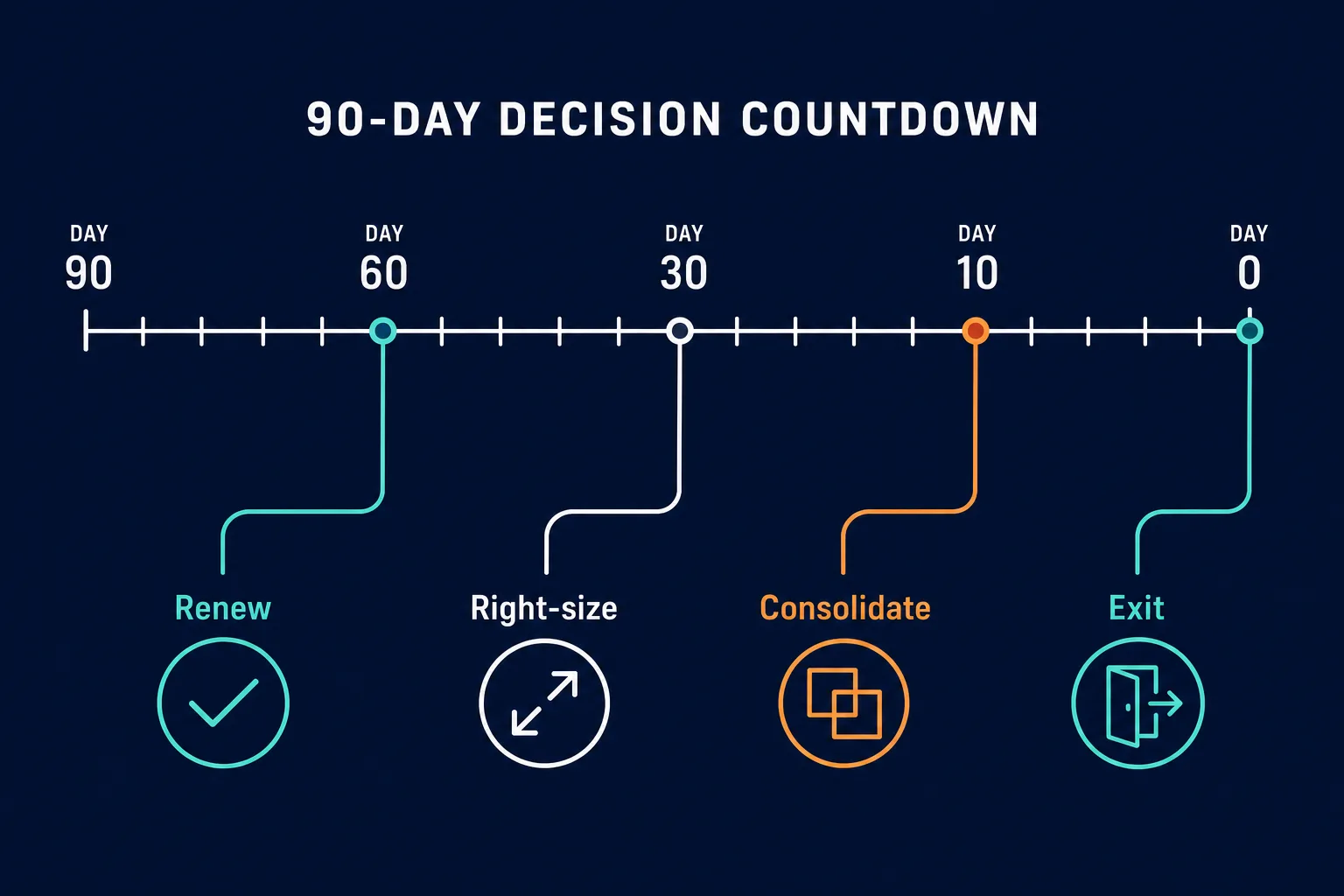
What asset data do you need before a vendor renewal or consolidation?
Before a renewal or consolidation decision, you need current installs and devices in scope, entitlement and contract keys that join to those installs, and owners with last-seen evidence. You also need overlap across product families and dependency paths for anything you plan to cut. A ninety-day clock makes freshness and join keys more important than a perfect CMDB project plan.
CISA Binding Operational Directive 23-01 pushes complete asset inventories for federal civilian agencies. Private-sector renewals inherit the same pressure without the directive on the ticket. You cannot defend a cut or a seat number you cannot inventory.
The Flexera 2026 State of ITAM report press release states that only 31 percent of organizations have visibility into AI-driven software spend as usage surges — the same install-versus-entitlement blind spot that shows up in a standard renewal, just with a newer line item. Vendor quotes do not invent missing installs for you.
That inventory gap has a commercial mirror. Gartner research on IT sourcing and procurement priorities points to vendor risk management as a recurring top concern for procurement leaders, with a lack of negotiating leverage against software and SaaS vendors landing among their top challenges. A negotiator without current install evidence shows up to that fight unarmed.
What breaks when you open the workbook at day 60
Purchased seats rarely match install truth. Entitlements look clean, but discovery shows more installs than seats, or purchased seats sitting on no live install at all — shelfware that survives because the purchase order tracks rights, not usage. Negotiators argue price while compliance risk sits unmeasured. For the structural gap, see purchased licenses versus actual installs.
Lifecycle stages that ignore last-seen. Devices marked retired still answer on the network, and software marked active hasn’t run in months — so consolidation lists include ghosts and miss live hosts.
Vendor stacks with no service path. Cutting a monitoring or middleware brand looks cheap until the payment path or a batch job still depends on it. Feature comparisons never show that edge.
Ownership gaps get exposed under time pressure. Renewal owners chase three teams for “who still uses this,” and nobody owns the shared bus — so the decision slips or defaults to renew-as-is.
Procurement that starts after the quote. Purchase orders and RFP scores arrive before inventory does. Companion detail on how procurement fails earlier than the PO sits in IT procurement fails before the purchase order. This page stays on the renewal clock.
The pre-renewal asset inventory packet (what “done” looks like at day 90)
Treat the next ninety days as a packet build, not a philosophy debate.
- Scope the vendor and product family. Name the contract lines, environments, and business units in play. Exclude the rest of the estate on purpose.
- Inventory first inside that scope. Run discovery across the hybrid paths those products actually touch: on-prem, VMware, AWS, and Azure where Virima cloud scope applies, plus SaaS usage logs where the vendor exposes them. High-frequency scheduled cycles beat a one-time spreadsheet pull.
- Normalize titles for matching. Map install strings to the publisher SKUs on the quote. Without normalization, both sides argue different names for the same product.
- Join installs to entitlements. Produce over, under, and unmatched rows. Idle installs and shadow installs both matter for right-size talks.
- Attach owners and last-seen. Every CI or install row that might be cut needs a human and a freshness signal.
- Map dependency risk for cut candidates. Shared platforms, databases, and identity hops that sit under the stack must appear before you promise savings.
- Write the decision table. Renew, right-size, consolidate, or exit, each with evidence rows attached, not with opinions alone.
Why do vendor renewals go wrong without current asset inventory?
Renewals go wrong when seat counts and feature lists replace live install, ownership, and dependency evidence. Teams sign on last year’s numbers, then discover shadow installs, idle seats, or shared platforms after the contract locks. The ninety-day window is when inventory must catch up to the quote.
Broader vendor practice framing lives in vendor management best practices and asset visibility. Keep this page on the clock and the packet.
Consolidation is a renewal problem with more blast radius
Consolidation multiplies the same asset data needs. You are not only right-sizing one publisher. You are choosing which stack dies and which stack absorbs load.
| Consolidation move | Extra asset truth | Failure without it |
|---|---|---|
| Merge two overlapping tools | Install overlap, user cohorts, shared CIs | Paying twice or cutting the wrong half |
| Standardize on one vendor | Coverage gaps, version floors, integration points | Forced exceptions that erase savings |
| Exit a platform | Service maps, owners, decommission proof | Outage after the license ends |
| Bundle into a suite | True usage of each SKU in the bundle | Shelfware inside the “discount” |
Idle and unknown assets distort cut lists. See unused software and unmanaged hardware for the waste story. Here the story is the decision date.
True-up language during renewal still needs audit-ready positioning. Pull only what the packet needs from the software license compliance audit guide.
Who owns which row before the vendor call
| Role | Owns in the packet | Fails when |
|---|---|---|
| Procurement / vendor management | Contract lines, commercial options, negotiation calendar | Quotes arrive without install evidence |
| IT asset management (ITAM) / SAM | Entitlements, metrics, reconciliation | Feed is a quarterly CSV |
| Discovery / CMDB | Install and device currency, CI keys | Scope never includes the hybrid path |
| App / service owners | Keep vs cut decisions, usage truth | Shared platforms have no owner |
| Security / GRC | In-scope risk if a cut removes a control | Inventory cannot list the control host |
| Finance | Budget band, multi-year constraints | Savings assume installs that still run |

If the next renewal still opens on last year’s seats, walk a ninety-day asset packet against live installs before you lock the number — the role table above is the starting roster for who pulls which row.
Where Virima fits inside the ninety days
Virima is the discovery-sourced inventory and CMDB layer under the renewal packet. It does not replace the contract desk, the SAM entitlement engine, or the procurement suite.
What Virima contributes before signature
- Automated discovery so installs and devices in scope are not workshop fiction
- CMDB identity and ownership signals under the rows procurement will argue
- ITAM-oriented inventory that SAM and lifecycle tools can consume
- ViVID™ service maps after service definitions exist, when cut candidates need blast radius
- Windows Server NIST NVD overlays on maps where that signal applies, without claiming full multi-OS vulnerability scanning
What Virima does not claim
- Passive continuous real-time event discovery as current product behavior
- Autonomic Social Discovery (ASD) as a go-forward capability
- A complete publisher entitlement rule engine for every SAM suite
- Instant business-service invention without a definition input
- Replacement of ServiceNow, Jira, or other ITSM and procurement workflow systems
Virima integrates with ServiceNow, Jira, Ivanti, and many more through one hub: all integrations. Keep partner names plain in the war room. For capability depth on inventory, see features/discovery and features/itam.
How should teams prepare asset inventory before a software vendor renewal?
Scope the contract lines, run discovery across the hybrid paths those products touch, then join installs to entitlements with owners and last-seen attached. Map dependencies for anything you might cut before the call, not after. Finish a written renew, right-size, consolidate, or exit table before the vendor call, not after the quote is locked.
A ninety-day run of play
Days 90-75. Freeze scope. Name product families and environments. Kick discovery cycles. Pull contracts and last reconciliation.
Days 75-45. Normalize and join. Produce over, under, unmatched, and idle lists. Flag shared platforms. Assign owners to cut candidates.
Days 45-30. Dependency and service checks on anything marked cut or consolidate. Security review on control hosts. Finance band set.
Days 30-15. Decision table locked. Negotiation brief written with evidence rows. Exceptions documented.
Days 15-0. Commercial close. Post-signature decommission or true-up plan with the same CI keys, so the next cycle does not restart from zero.
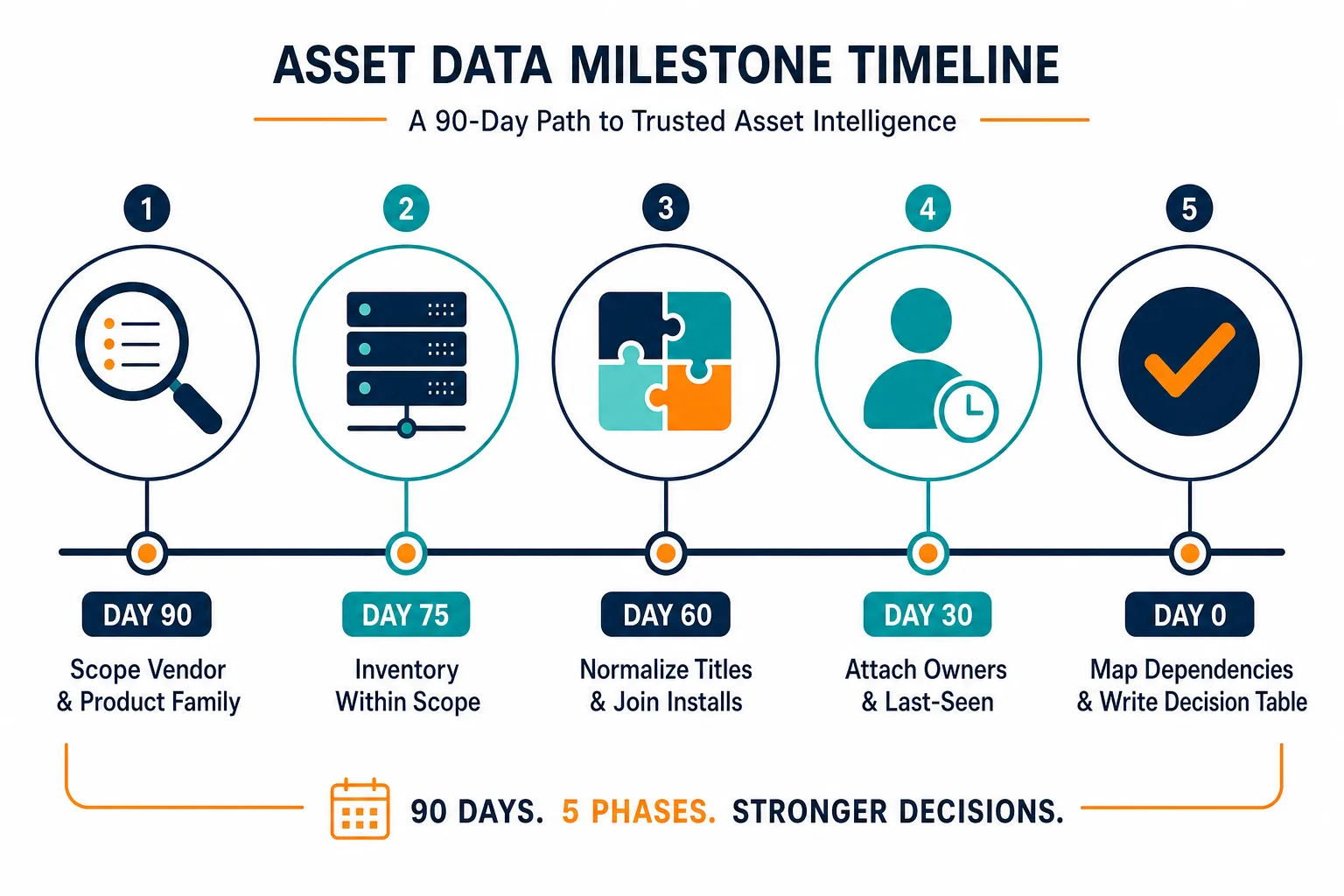
Teams that start the packet at day 30 get a quote fight. Teams that start at day 90 get a choice.
Close on the clock, not on a generic visibility slide
Asset truth needed before vendor consolidation or renewals is a timed decision problem. The contract date forces a packet: installs, entitlements, owners, last-seen, overlap, and dependency paths. Discovery-sourced inventory fills that packet under the tools you already use for SAM and procurement. Sign after the evidence rows exist, not after the deck looks neat.
When you want that packet built against production before the next ninety-day mark, schedule a demo and walk one publisher family the way the estate looks this week.
Frequently Asked Questions
When should IT start asset discovery before a vendor renewal?
Start as soon as the renewal sits inside a ninety-day window, earlier for large multi-product families. Discovery, normalization, and dependency checks need calendar time before commercial talks lock seat counts.
What is the difference between renewal prep and ongoing ITAM?
Ongoing ITAM keeps inventory and lifecycle healthy year-round. Renewal prep is a scoped packet for one contract decision: installs versus entitlements, owners, idle use, and cut risk inside a fixed date. Strong ITAM makes the packet faster. It does not replace the decision table.
Can we consolidate vendors using only feature comparison matrices?
No. Feature matrices miss install overlap, shared CIs, and service dependencies. Consolidation without those rows risks cutting a stack that still carries production traffic or paying for two tools that cover the same hosts.
Do we need a full CMDB program before the next renewal?
You need authoritative inventory and join keys for the products in scope. A multi-year CMDB program is not a prerequisite for one renewal packet, but discovery currency and stable CI identity still beat a one-time spreadsheet export.
How does Virima support pre-renewal asset truth?
Virima supplies discovery-sourced inventory and CMDB context that SAM, ITAM, and procurement teams can use inside a ninety-day packet. It does not replace entitlement engines or contract systems, and it does not claim passive continuous discovery or ASD.
Does Virima replace our SAM tool or procurement system during renewal prep?
No. Virima supplies the discovery-sourced install and CMDB evidence that feeds the packet. Your SAM tool still owns entitlement reconciliation and your procurement system still owns the contract and commercial workflow — Virima’s data joins into both rather than replacing either.