CMDB for Milan Fashion & Luxury Supply Chain IT Ops

A new collection drops in Milan flagships on a Friday morning. The flagship point-of-sale reads live inventory from an order service hosted near the distribution hub. That service pulls allocation data from a product master that an overnight change touched. The atelier team sees finished goods ready. The ecommerce team sees oversell warnings. The flagship team sees frozen screens. Nobody sees the full chain in one place.
This is the normal failure mode for a CMDB for Milan fashion and luxury supply chain IT operations that was built brand by brand. Each house holds accurate local records. The supply chain between ateliers, distribution centers, and stores has no shared service truth. This article shows how to build that shared layer from discovery-sourced data, so launch teams read the same service map before the next drop. See how enterprise teams establish Trusted Runtime Truth as the shared layer under fashion operations.
Why fashion supply chains break the single-brand CMDB model
A single-brand CMDB answers a local question well. It lists what runs in one maison IT estate or one regional warehouse. Fashion operations ask a different question. They ask which flagship promise depends on which allocation service, and which integration carries that dependency on launch morning.
The Milan luxury context concentrates that question. The Bain-Altagamma Luxury Goods Worldwide Market Study reported spending dipped in 2024 with long-term growth forecast after reinvention, in its luxury in transition analysis. Pressure to protect margins while reinventing operations lands directly on IT. Every launch window must move confirmed inventory through allocation, logistics, and store systems without a stale record breaking the chain.
When the CMDB stops at the brand boundary, a gap opens in the middle. Atelier, distribution, and flagship systems each have an owner. The integration layer between them usually doesn’t. A change to that middle layer then reads as low risk in every local register, while launch morning feels the full impact at the till.
Why does fashion retail need a shared CMDB layer?
Fashion retail links ateliers, distribution hubs, and flagships into one launch chain. A shared CMDB layer maps each store promise to the allocation service and link behind it. Local registers alone leave the middle layer without an owner, so changes there carry hidden launch-day risk.
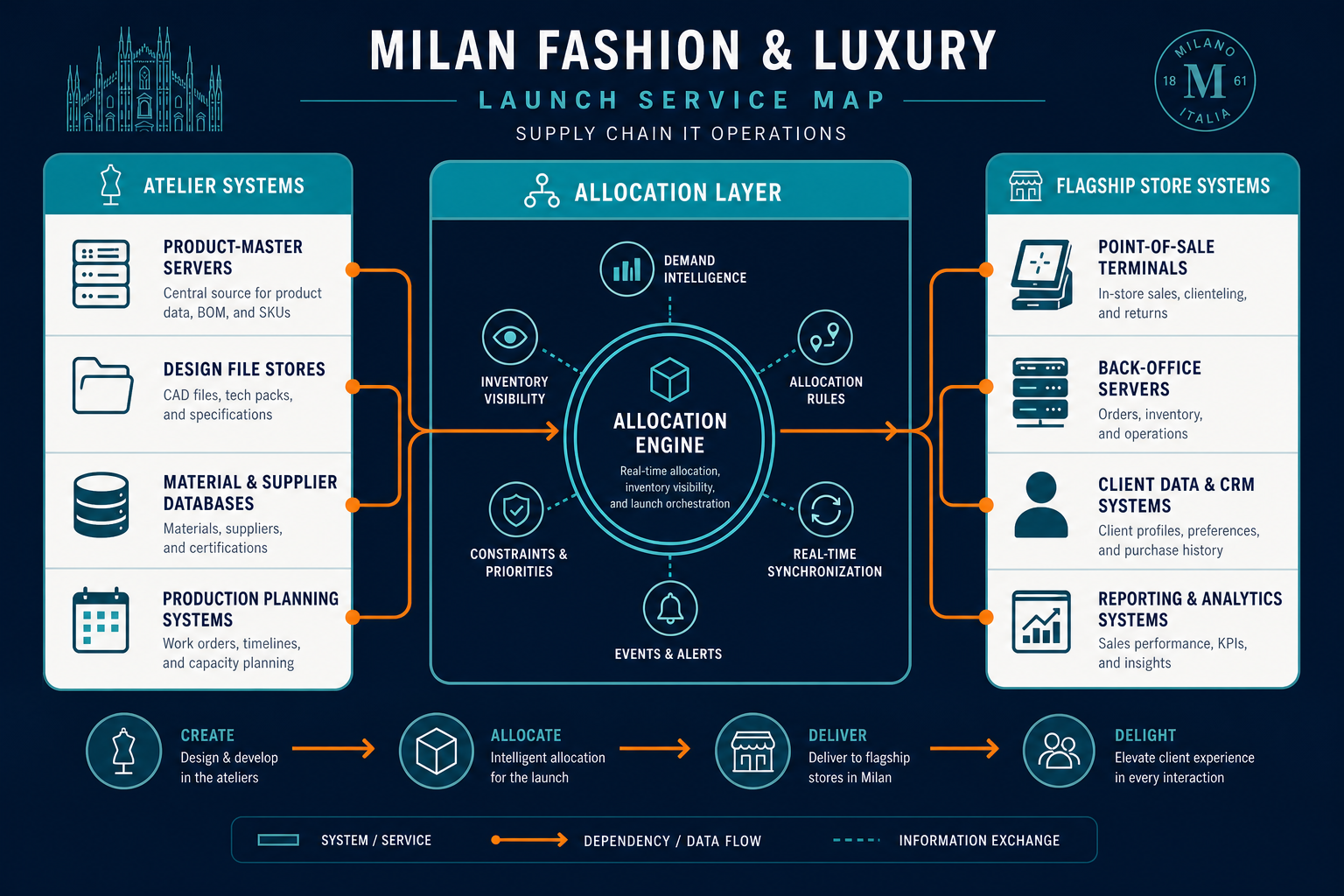
Ateliers, distribution hubs, and flagships belong in one service map
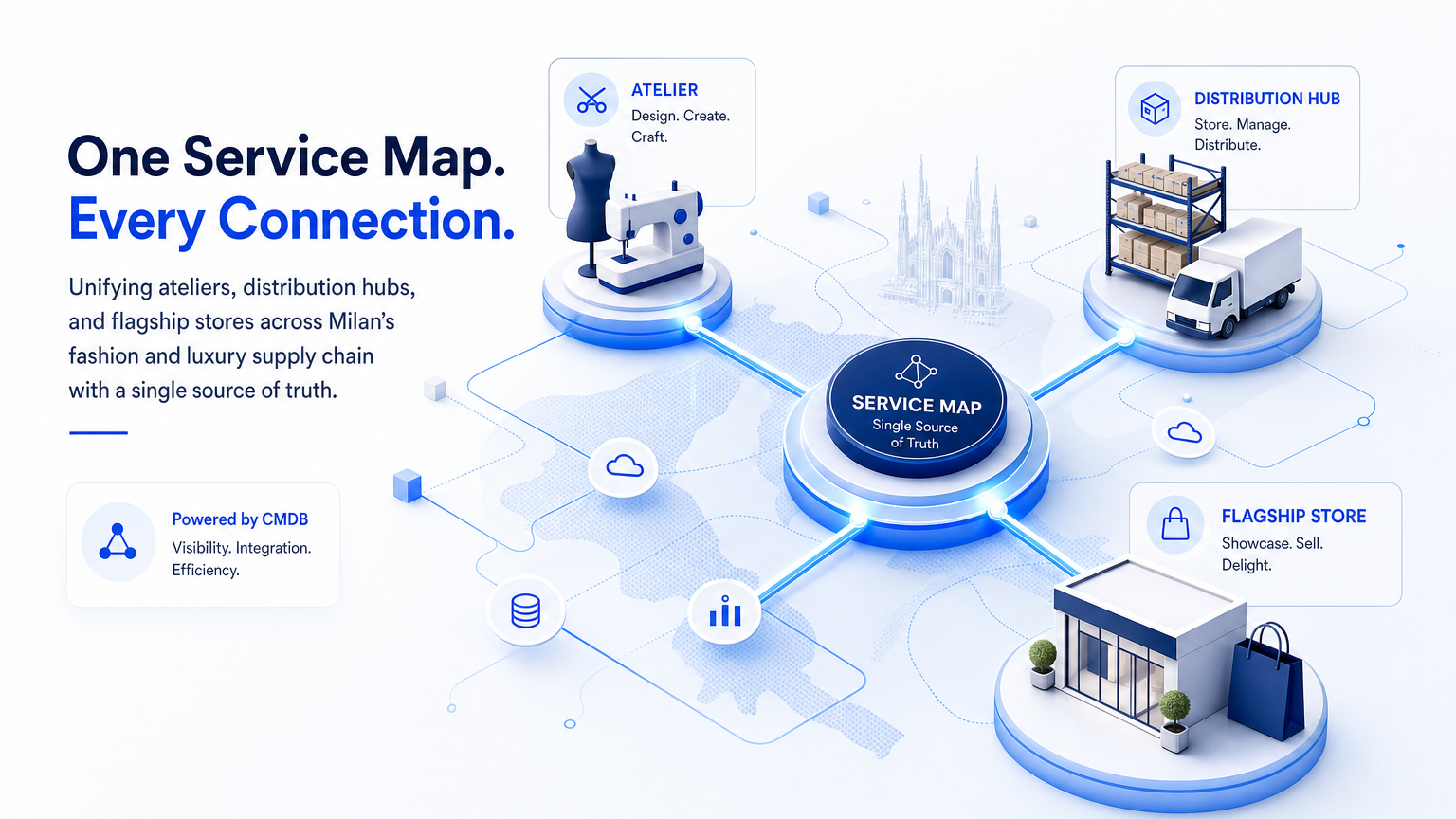
The fix is not a bigger spreadsheet. It is one ViVID™ service map with three node types, each fed by scheduled discovery, and each tied to a named business service such as collection launch fulfillment or flagship replenishment.
What each node contributes
Flagship nodes close the front-end gap with point-of-sale terminals, back-office servers, in-store network gear, and clienteling devices. Atelier nodes close the product-definition gap by surfacing product-master servers, design file stores, and quality systems. Distribution nodes close the allocation gap with warehouse management servers, allocation engines, label printers, and yard systems. Discovery finds the infrastructure. Service definitions name which pieces form one launch service.
How the map stays current
Maps hold value only when the underlying CIs refresh on a schedule. Virima reconciles multi-source discovery into one authoritative CI record, then rebuilds the service dependency map from that input as infrastructure changes. Service composition itself comes from user input through manual entry, spreadsheet import, or enterprise architecture input. The automation covers map building from those definitions, not invention of the service boundary. Italy’s fashion chamber itself pushes supply chain harmonization, as seen in the shared ESG program from Camera Nazionale della Moda Italiana. That same harmonization push is the business case for a discovery-sourced CMDB for luxury retail: process alignment across houses only holds if the infrastructure underneath it is tracked with the same discipline, not scattered across separate brand spreadsheets.
This pattern already plays out at retail scale. One fashion retailer consolidated its hardware and software records into a single CMDB with automatic population. The move cut its reliance on manually updated spreadsheets for infrastructure visibility, according to Inetum’s case study on fashion retail IT transparency. A luxury supply chain spanning ateliers, distribution, and flagships carries more node types than that single-estate example, but the underlying discipline (one authoritative record instead of several local ones) is the same.
What a Milan fashion and luxury supply chain CMDB must hold
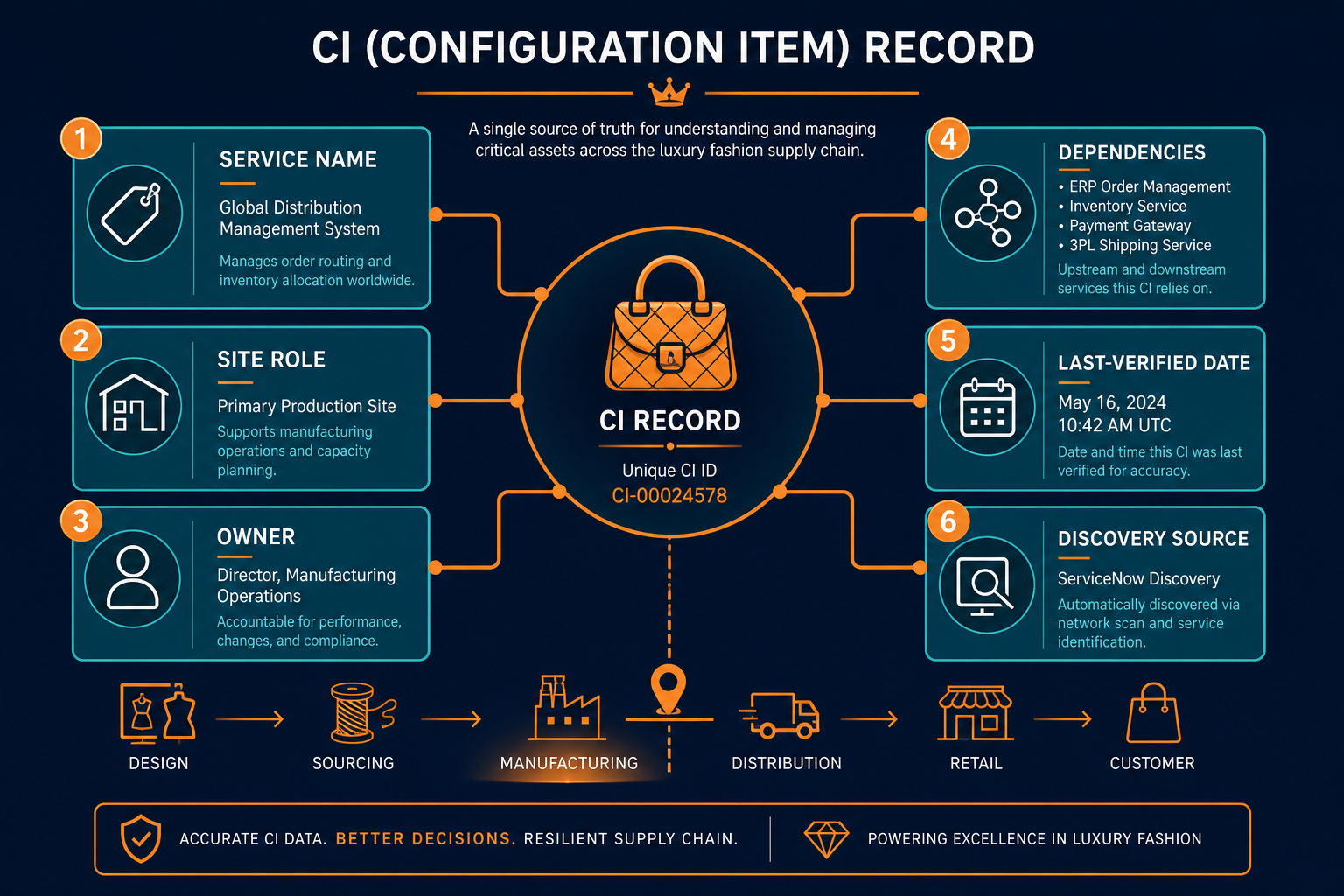
A fashion supply chain CMDB record carries more than hostname and IP address. It carries the attributes that let a change reviewer judge blast radius across the launch chain in minutes.
Hold these fields on every launch CI:
- Business service name
- Site role (atelier, distribution, flagship)
- Owning team and the change window that governs it
- Upstream and downstream dependency
- Last-verified date
- Discovery source that confirmed it
- Serial number or cloud instance ID as the durable join key, with hostname kept as supporting evidence only
This discipline pays off during incident triage. When allocation stalls on launch morning, the responder opens the service map, correlates the alert to the failing CI and the business service it supports, and names the owner without calling three houses. That path from failing CI to affected business service is the core product behavior to demand from any CMDB platform.
The stakes extend past availability. High-end retail faces targeted cyber pressure, with 2025 incidents at houses including Dior and Cartier documented in the Legal 500 analysis of cybercrime in high-end retail. A CMDB that ties each CI to its service and owner shortens both outage triage and exposure scoping.
Which CI fields matter most for luxury supply chains?
Service name, site role, owning team, dependency links, last-verified date, and discovery source matter most. A durable hardware or instance key anchors each record across renames. These fields let reviewers judge launch-chain blast radius from the map instead of assembling it by phone.
Feed the fashion CMDB into the ITSM you already run
A fashion CMDB earns trust when it shows up inside daily ITSM work — this is where fashion IT service mapping stops being a diagram and starts driving tickets. Incident tickets link to the affected CI and its service. Change requests check the dependency map before approval. Problem records reference the same service definition that the map uses.
Virima supports this pattern by syncing discovered CIs and relationships into existing ITSM workflows. Platform names stay as plain references here: ServiceNow, Jira Service Management, Ivanti, HaloITSM, Xurrent, and Hornbill teams each keep their desk while reading the same CI truth. One integration reference covers the path: the integrations hub lists the supported ITSM sync options. The same discipline behind service mapping for retail and ecommerce operations applies directly to flagship point-of-sale and allocation systems during a launch window, and the same atelier-to-shelf mechanic already runs in Virima’s own Stockholm retail supply chain and Minneapolis retail distribution coverage — different city, same dependency problem.
The stakes are not abstract. Retail outages now cost a median of $1 million per hour, per New Relic’s 2025 Observability Forecast for Retail & eCommerce, a survey of 147 retail engineering leaders. Flagship and allocation systems sit squarely inside that exposure. The luxury segment shows the same pattern at the account level: LVMH’s Australian retail operations cut incident resolution time 40% and improved first-time-fix rate 25% after consolidating fragmented regional IT support into one managed service layer, per an ASI Solutions case study published on CaseStudies.com. A closer look at where retail IT downtime costs concentrate shows why a fast, CI-level path from alert to owner matters more in retail than in most other verticals.
Keep the data flow one-directional at first. Discovery sources the CMDB, the CMDB feeds the desk, and manual edits stay fenced behind review. That order prevents launch truth from drifting back into brand-local edits within a month.
Use the CI field list above as your launch-lane CMDB checklist before the next collection drop. When you’re ready to see it mapped against your own ateliers, distribution hubs, and flagships, the Virima team can walk through it with you.
How should fashion CMDB data reach the service desk?
Sync discovered CIs and relationships into incident and change workflows so agents and approvers read the same record. Keep discovery as the source and fence manual edits behind review. One-directional flow at first prevents launch truth from drifting into conflicting local edits.
Where to start: one launch lane, then expand
Start with one launch lane. Pick one collection, one flagship cluster, and one allocation service that feeds it. Discover the full chain, define the service, map the dependencies, and run incident and change work from that map for one full cycle.
Measure three outcomes before expanding:
- Incident tickets link to the right CI on first touch
- Change reviews name cross-house impact without extra discovery calls
- The service map matches the estate at the end of the cycle
The same New Relic report puts median retail outage detection at 30 minutes and resolution at 42 minutes; a launch lane that beats those benchmarks on first-touch ticket routing is ready to expand. Expand lane by lane only when all three hold.
Teams that need a scoped walkthrough of that first lane can start a conversation through the demo request path with their launch nodes listed.
Map the chain before the next drop decides for you
Fashion calendars do not wait for CMDB cleanup projects. Collection drops, seasonal volume, and flagship events will test the Milan chain on their own timetable. The teams that read one shared service map before that window will triage faster and change with more care than teams that assemble the chain by phone. That’s the core of a luxury supply chain CMDB: one record, one map, one owner per launch service. Build it now, prove it on one lane, and expand while the map is still fresh.
Frequently Asked Questions
How is a supply chain CMDB different from a single-brand CMDB?
A single-brand CMDB lists what runs in one estate. A supply chain CMDB adds the service links between ateliers, distribution hubs, and flagships, so one map shows which store promise depends on which remote service.
Which systems belong in the first launch service map?
Start with the product master and allocation service, the distribution warehouse systems behind them, and the flagship point-of-sale they feed. Add design stores and clienteling once the first lane holds.
Does Virima’s discovery distinguish atelier, distribution, and flagship systems automatically, or do we define that mapping ourselves?
Discovery finds and classifies the infrastructure automatically. Mapping that infrastructure to atelier, distribution, or flagship roles — and to a named business service — comes from your input: manual entry, spreadsheet import, or architecture definitions. Once defined, the map updates automatically as discovered infrastructure changes.
Can the fashion CMDB feed our existing ITSM?
Yes. Discovered CIs and relationships sync into incident and change workflows so agents and approvers read the same record. Keep discovery as the source and fence manual edits behind review during rollout.
How does Virima support fashion supply chain CMDB work?
Virima reconciles multi-source discovery into authoritative CI records, builds service dependency maps from provided definitions, and syncs that context into ITSM workflows for incident and change decisions.