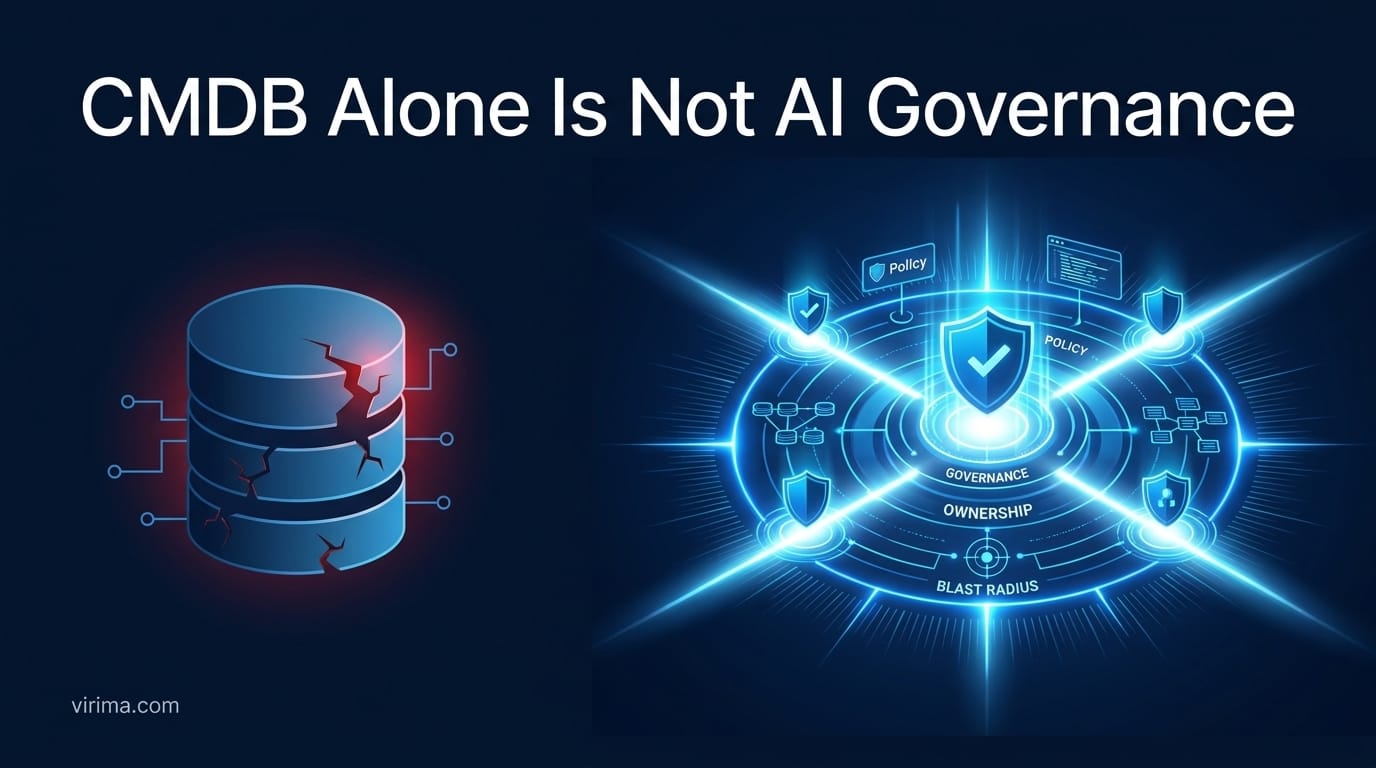
CMDB Alone Is Not AI Governance

When I speak with fellow large and medium enterprise CIOs and CTOs about making their environment AI-ready, the conversation almost always starts with the CMDB. Leaders focus on tightening coverage gaps, reconciling duplicate records, and bringing ownership details current so configuration items reflect what is running in production.
That work is foundational. It defines the floor, while governance for AI agents lives on the levels above. The organizations moving fastest into agentic IT are confronting a tougher challenge once the CMDB foundation is solid. The CMDB was designed as the record of configuration, not as the decision fabric for an autonomous agent operating in real time. When an agent reads that record and acts, the distance between what the record reports and what is true in the environment at that moment is where production incidents emerge.
That gap is the issue. It does not point to a CMDB quality problem alone. It points to the governance layer above the CMDB, and that layer is what determines whether agentic IT operates with confidence, context, and control. A well-maintained CMDB is important, but agentic IT requires more than a system of record. It requires a trusted source of runtime truth.
What a CMDB Is Built To Do
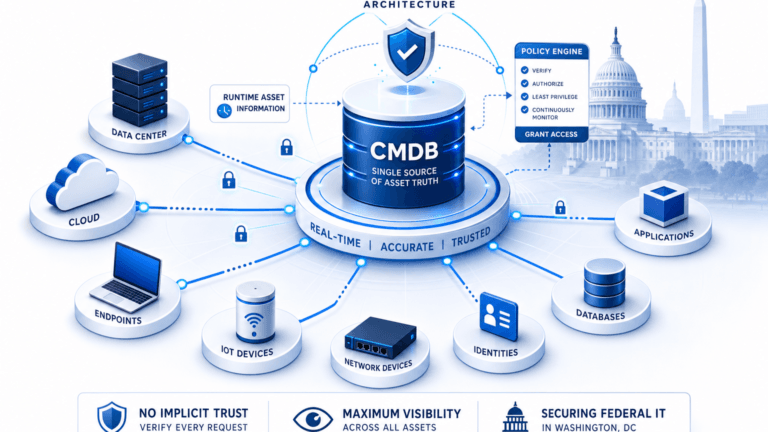
A CMDB is the authoritative record of configuration items and their relationships. At its best, it describes what assets exist, how they are classified, how they connect, who owns them, and the state they are in.
This is powerful when done well. An accurate, current, complete CMDB underpins change management, incident triage, license compliance, and continuity planning that would otherwise depend on institutional memory and manual investigation.
But the CMDB is a system of record. Its job is to store and retrieve structured configuration data. That design reaches its limit in three specific areas once AI agents start taking action based on what the CMDB returns. Those limits become far more consequential in an agentic IT model, where decisions can move from recommendation to action at machine speed.
Where CMDB Design Runs Out for AI Agents
1. No runtime signal of trustworthiness
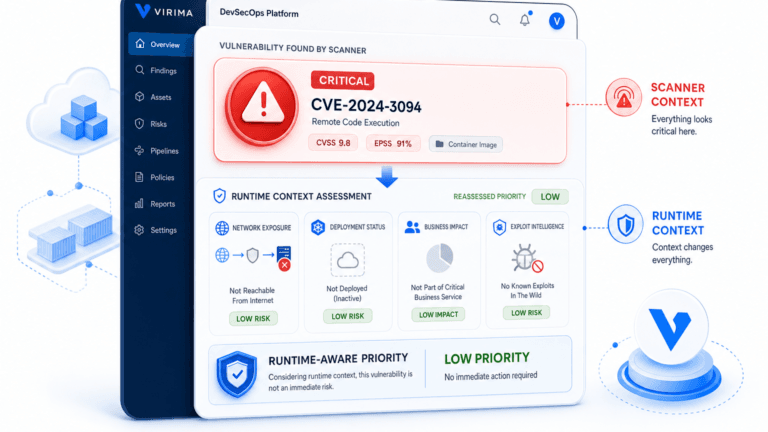
A configuration item with a last updated timestamp from six weeks ago sits in the CMDB as a valid record. Whether it still matches the asset after a cloud migration, patch cycle, or weekend deployment is not something the CMDB can determine on its own. The agent receives no inherent signal about when to trust a record and when to treat it as a suspect.
For agentic IT, that signal has to come from a trusted source of runtime truth that reflects the environment as it exists at decision time. Without that runtime truth, the agent is left to infer confidence from a record that may already be out of date.
2. Limited service and dependency context for decision making
A CMDB record describes the CI itself. It does not automatically describe the services that depend on it, the downstream items affected by a change, or the service impact of proposed actions. Standard relationship fields have value, but they do not provide the depth of dependency context that agentic IT requires.
A trusted source of runtime truth has to include current service relationships, downstream dependencies, ownership context, and business impact. An agent recommending action on a server without seeing what that action touches downstream becomes a liability for the business.
3. No explanation trail that stands up to AI governance
When an AI-assisted recommendation is challenged by a change advisory board, security, audit, or a regulator, the key questions are straightforward. What data did the agent rely on, where did that data come from, and what happened when sources disagreed. A CMDB can show what data existed at a point in time. It does not usually show which source contributed each attribute, which source won a conflict, or what context the agent acted on in a way that a machine can reconstruct as part of a decision log.
Explainability that supports autonomous agents demands a different standard than explainability for human change reviewers. As agentic IT matures, that standard will become central to governance, auditability, and executive trust.
What Happens When AI Acts Without That Layer
These gaps can look academic until they surface in incidents. The patterns in practitioner conversations are consistent.
- An AI agent recommends patching a server after a critical vulnerability scan. The CMDB records the server as a standard application host. What the CMDB does not show, because the relationship was never mapped, is that the server is middleware in the payment processing flow for three business lines. The agent cannot see the downstream impact and turns a preventative recommendation into a customer impacting outage.
- An agent routes an incident ticket to an infrastructure team based on CI ownership. The ownership record is eight months out of date after a reorganization, and the ticket sits for six hours while service degrades.
- Automated compliance logic flags a non-compliant software installation and triggers removal. The software is a licensed business application acquired outside the standard procurement path. The removal disrupts a customer-facing workflow. The compliance action aligns to policy, but the service impact remains invisible because the application was not mapped to any service.
In every scenario, the CMDB data can be accurate. The failure sits in what the CMDB cannot provide on its own. In an agentic IT environment, that missing layer is the difference between automation that scales and automation that introduces risk.
What AI Governance Requires
Closing this gap goes beyond CMDB accuracy alone. A well-maintained CMDB is a prerequisite. The strategic work now is in what you build on top of it. For agentic IT, that means establishing a trusted source of runtime truth with the context, freshness, reconciliation, and explainability an autonomous agent needs at decision time.
Any serious AI readiness evaluation should test every vendor and internal architecture against four specific governance capabilities.
1. Discovery sourced service dependency context
Dependency context cannot live as static relationships that depend on manual updates. Manually maintained service maps go stale as soon as someone forgets to update a link. Hand-built maps describe what someone once believed was connected. Discovery-sourced maps describe what is connected, on a cadence the team controls.
Automated service mapping built from discovery data is now an established capability in the market. This approach pulls dependency chains, ownership, and downstream effects from discovery itself, so the map an agent reads corresponds to the environment as it is today, not the one someone documented last quarter. For agentic IT, this is a core component of a trusted source of runtime truth.
2. Multi-source reconciliation with a defensible audit trail
Most CMDBs already integrate multiple sources. The questions for an agent and for an auditor go deeper. Which source wins on each attribute, and when that attribute was last confirmed.
Baseline reconciliation is common in enterprise CMDBs. The more demanding requirement is attribute-level source priority, comprehensive conflict logging, and an audit record that can withstand regulated change review and post-incident analysis. Many CMDBs in the market do not reach that bar today, which makes this an area to probe rigorously across every platform on the shortlist. A trusted source of runtime truth depends on how well the platform handles disagreement across sources, not just how much data it collects.
3. Continuous validation and freshness signals at read time
This is often the weakest area in the CMDB category. Most CMDBs depend on scheduled discovery. Records are refreshed periodically, not continuously validated. When an agent reads a record, it has no standard way to tell whether a given attribute is five minutes old or five weeks old, or whether it has been verified again after a recent change.
Always on freshness and source confidence signals, exposed at read time to downstream consumers, are not standard CMDB outputs today. They are key ingredients in governance for autonomous agents, and they are essential to creating a trusted source of runtime truth for agentic IT.
4. Explainability and audit trail designed for agents
When a recommendation comes into question, the response must trace which sources contributed to the context the agent used, how conflicts were resolved, and what the action relied on. Standard CMDB change logs and audit records are optimized for human configuration and compliance review. That design differs from an autonomous agent decision log, which must be machine-readable, attribute-level, and traceable through reconciliation and dependency lookups.
Bridging this gap is an open requirement for agentic IT across the industry. Without it, organizations will struggle to demonstrate that their trusted source of runtime truth can support decisions that hold up under operational, audit, and regulatory scrutiny.
The CMDB’s Role in the Governance Picture
None of this diminishes the importance of the CMDB. It sharpens how leaders should think about its role in a broader architecture that the category is still evolving toward.
The CMDB remains the authoritative record. The governance layer sits above it. That layer brings together discovery-sourced dependency context, reconciliation with an audit trail that withstands regulated review, validation, and freshness signals that agents can interpret, and explainability at the level an autonomous decision log demands. The record describes what exists. The governance layer interprets those records in the context of dependent services and the actions an agent is about to take.
For organizations pursuing agentic IT, this governance layer becomes the trusted source of runtime truth. It gives autonomous agents the context required to act with greater precision, and it gives enterprise leaders the oversight required to trust those actions.
Of the four capabilities, one is mature today. Automated service mapping grounded in discovery data is available and proven. The other three are at varying stages of maturity, and no vendor offers a complete and consistent answer across all of them. Evaluations need to be concrete and use case driven, anchored in what an agent must read at decision time for a specific class of action.
Organizations that invest in CMDB accuracy without designing this governance layer will discover that their agents are well informed but poorly supervised. The agents will act on the best data available to them, not on the best reasoning the enterprise could have provided. Agentic IT raises the stakes because those decisions can now happen with far greater speed and scale.
Why This Matters for Platform Native AI
Major ITSM platforms are embedding AI into workflows, adding service mapping modules, and building governance checks over their own data. These efforts add value, although platform native context remains bound to what that platform can see, such as tickets opened inside it, changes approved within it, and CIs updated through its processes.
This view does not automatically cover portions of the estate that the platform does not reach, and it cannot reconcile conflicting records from discovery sources outside its control. Discovery-driven governance starts from what is running in the environment across protocols, environments, and tools, then builds reconciliation and dependency context from there. That forms a distinct layer.
Platform native AI can improve workflow efficiency inside a platform boundary. Agentic IT operating across the enterprise requires more. It requires a trusted source of runtime truth across the full estate, including the assets, dependencies, and data sources that sit beyond any one platform’s line of sight.
A related piece, Why AI Agents Need Trusted Runtime Truth, Not Just Good Data, explores why platform native context falls short and why discovery driven governance is the right architecture for the whole estate.
A clean CMDB is the starting point. If your CMDB is in good shape today, the next questions belong to this governance layer. Can the agent tell which source each attribute came from, how recently it was confirmed, and what services the asset is tied to? Can it operate from a trusted source of runtime truth when decisions move from recommendation to action? These are the questions that should shape how you evaluate CMDB and discovery platforms for agentic IT.
If you want a clear view of where this layer stands in the market, what is proven, what is emerging, and what remains aspirational, let us talk. We have spent years in discovery, CMDB, and service mapping, and have specific opinions on what stands up once agents read these records in production. A candid conversation about how to evaluate a trusted source of runtime truth for agentic IT is the next logical step.