Building a Lightweight ITSM Framework Using ISO 20000

An undocumented dependency can turn a routine change into a service outage. The approved ticket may identify the server but miss the business service that relies on it.
A service desk can record the approval while leaving the supporting configuration data unresolved. An IT manager needs a way to connect the service, its owner, the change, and the evidence behind that decision.
Building a lightweight ITSM framework using ISO 20000 gives teams a structured starting point. Existing workflows can support the framework when responsibilities, service boundaries, and records are clear.
What ISO 20000 means for an ITSM framework
ISO/IEC 20000-1 specifies requirements for a service management system, often called an SMS. The system covers how an organization plans, designs, transitions, delivers, and improves services within a defined scope.
The standard applies to organizations serving internal or external customers. Teams can use it as an improvement baseline or pursue independent certification of their scoped management system.
ISO/IEC 20000-1:2018 remains the published edition, with a 2024 amendment addressing climate action. Organizations preparing for assessment should obtain the standard and its applicable amendment.
A lightweight implementation uses records and workflows that fit the organization. For certification, the organization must still address the standard’s applicable requirements across its chosen scope.
How ISO 20000 relates to ITIL
ISO 20000 and ITIL solve different problems. ISO/IEC 20000-1 sets certifiable requirements for a service management system. ITIL provides non-certifiable guidance that teams can adapt when designing their service practices.
| ISO/IEC 20000-1 | ITIL | |
|---|---|---|
| Nature | Requirements | Guidance |
| Certifiable | Yes — organization-level | No — individual qualifications only |
| Scope | The organization’s service management system | Practices teams can adapt as needed |
For example, a team can use ITIL guidance to develop an incident workflow, then assess that workflow against the relevant ISO/IEC 20000-1 requirements. That reuse-then-test sequence is the core mechanic behind most ISO 20000 implementation work.
The ITIL framework guide explains how the guidance has evolved. The service manager can use existing ITIL-aligned work as input to a gap assessment.
Who can hold ISO 20000 certification?
ISO/IEC 20000-1 certification applies to an organization’s service management system within its defined scope. A department can form part of that scope when it manages and delivers services. The certificate should identify the covered organization and services, so customers can understand its boundaries.
Define a service scope the team can support
A useful scope names the services, customers, and organization responsible for delivery. It also identifies the teams, locations, and suppliers involved in those services.
Start with a boundary that leaders can explain and staff can operate. An internal IT team might begin with employee access and collaboration services.
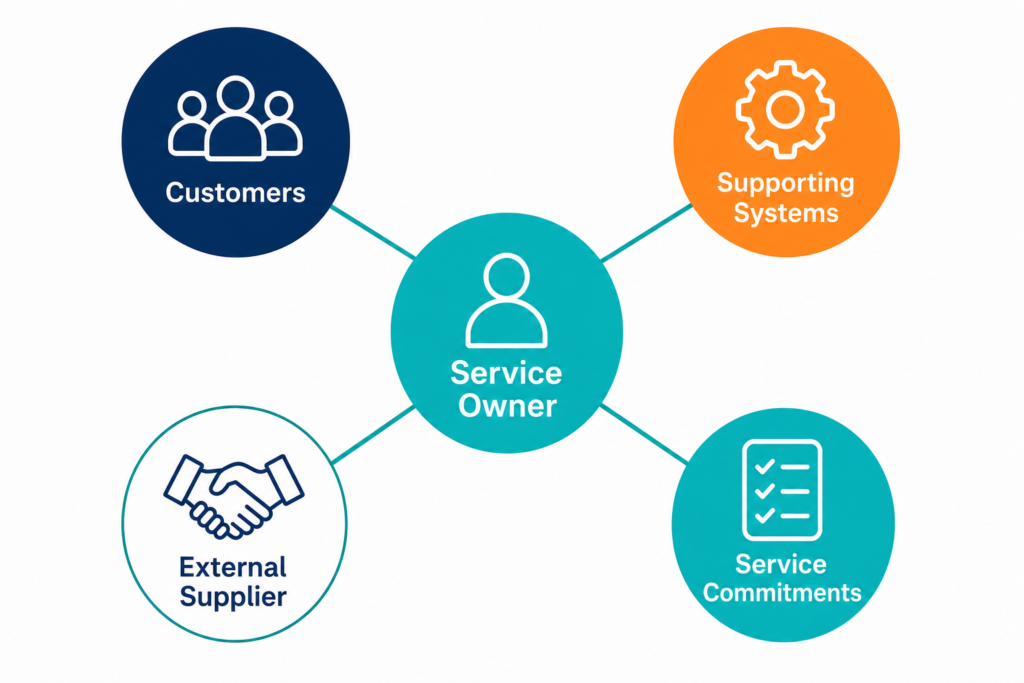
For each service, record the following information:
- Service owner: The person accountable for delivery and service decisions.
- Customer group: The people or business units receiving the service.
- Supporting components: The applications, infrastructure, and supplier services involved.
- Service commitments: Agreed targets and the method used to measure them.
- Operating boundaries: The teams, locations, and activities included in scope.
A focused scope still needs to reflect how the service is delivered. If a supplier operates an important component, document the relationship and the organization’s oversight responsibilities.
Assign responsibilities before adding procedures
A smaller team may assign several responsibilities to one person. Leaders should still document who makes decisions and how they manage conflicts.
Assign an owner for the management system and owners for operational activities. Identify who approves changes, reviews service results, and follows up with suppliers. The guide to building a RACI matrix covers a common way teams document this accountability once the service list grows beyond a handful of names.
Keep the responsibility record with the service scope. Review both when services, teams, or supplier arrangements change.
Can an outsourced service remain within an ISO 20000 scope?
An outsourced component can support a service within an ISO/IEC 20000-1 scope. The organization should identify the supplier’s responsibilities and retain oversight of the service it delivers. A supplier’s separate certificate does not establish conformity for the organization’s own management system.
Assess existing practices against the standard
A gap assessment compares current practices with the applicable requirements. It helps the service manager identify missing controls and reuse records that already serve a purpose.
Review the standard alongside existing policies, tickets, service reports, supplier agreements, and meeting records. Ensure the review covers leadership, planning, resources, operations, performance evaluation, and improvement.
For each gap, capture these fields:
- Requirement: The relevant clause or requirement reference.
- Current practice: What the team does and who performs it.
- Evidence: The record that demonstrates the activity.
- Gap and risk: What is missing and which service could be affected.
- Owner and date: Who will address the gap and when.
Prioritize gaps that affect service delivery or make records difficult to trust. Keep the full assessment visible when certification is planned.
Test evidence through a sample
Select an approved change affecting a scoped service. Follow its record from the initial request through implementation and review.
Check whether the record identifies the service, approver, affected components, and outcome. If a field is missing, determine whether the information exists elsewhere or requires a process change.
Document the gap rather than recreating a past approval. Assign an owner to improve the workflow for future changes.
Connect incident, change, and problem workflows
Most service teams already record incidents and changes. The next step is to connect those records to the services and people affected.
Record incidents and requests
Define how users report an issue or request a service. Capture the affected service, priority, assigned owner, status, and resolution.
Set an escalation route for incidents that exceed agreed thresholds. Retain customer communications and closure details in the service desk record.
Review a sample of closed incidents for missing service associations. Those gaps can distort service reporting even when the ticket itself is complete.
Assess changes against service dependencies
A change record should identify the proposed work, affected service, risk, approval, and implementation outcome. Match the approval path to the change risk and the organization’s policy.
For shared infrastructure, reviewers need more than a device name. They need the dependent services and owners who should participate in the decision.
Trusted Runtime Truth gives teams a discovery-sourced view of what exists and how components connect. It also provides context for what changed, what may be affected, and who owns the service.
Link recurring incidents to improvement actions
Link related incidents to a problem record and assign an investigation owner. Document the workaround, proposed corrective action, and review date.
A shared improvement register can hold service issues and audit findings. Each action should have an owner, a due date, and a recorded outcome.
Keep the original incident and change records connected to the action. Those links help reviewers trace the evidence without copying each record into another document.
Keep configuration data useful for service decisions
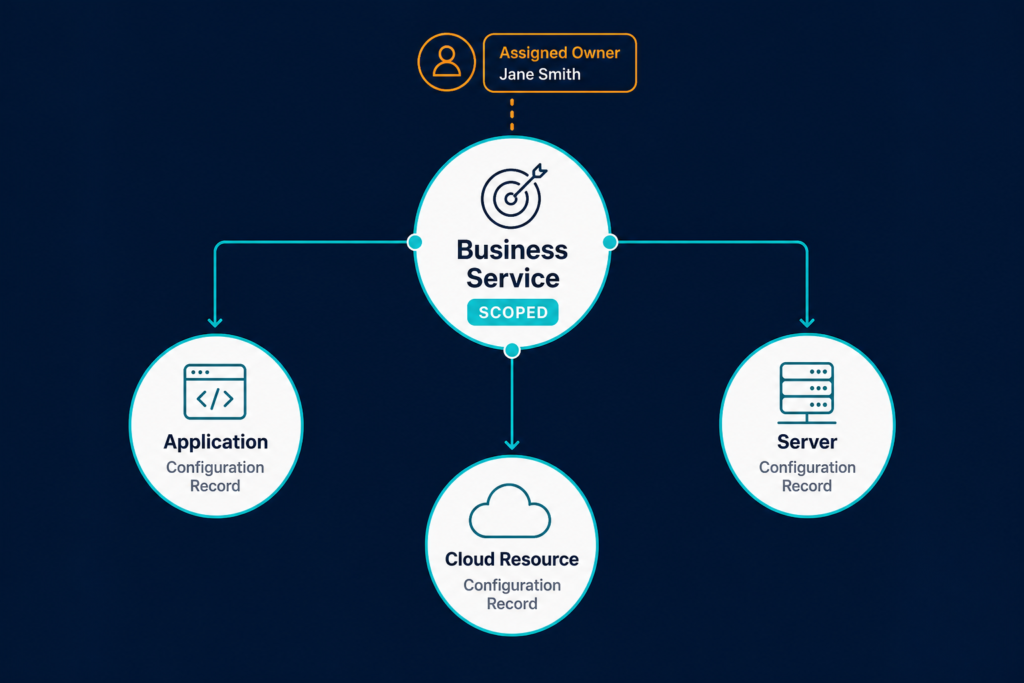
A configuration management database, or CMDB, can record the components supporting a service. It can also hold relationships between those configuration items.
Start with components needed for the scoped services. Record an owner, a suitable identifier, lifecycle status, and the service relationship.
For physical equipment, a serial number can help reconcile records across sources. For cloud resources, use a cloud instance ID when it provides the appropriate durable identifier.
The NIST configuration management guide describes security-focused configuration management practices. Its guidance supports configuration control, although it does not establish ISO/IEC 20000-1 conformity.
Scheduled discovery cycles can identify changes in the environment. Teams must still configure coverage, reconcile conflicting information, and investigate records that do not match.
Check records before relying on them
Choose a sample of important configuration items at an agreed cadence. Compare their owners, identifiers, and service relationships with the relevant source records.
Record discrepancies and assign owners for correction. Track unresolved exceptions affecting services with frequent or high-impact changes.
Virima supports scheduled discovery and multi-source reconciliation for configuration records. Its ViVID™ service maps build dependency views after teams provide service definitions.
Reviewers can use those records alongside the change request. The review should also account for discovery coverage and the time since the last relevant cycle.
What should a team do when discovery sources disagree?
When discovery sources disagree, a configuration management database (CMDB) owner should identify the conflicting attribute and its source. The owner can apply an agreed source priority or route the exception for review. Retaining the decision helps the team investigate a later discrepancy without repeating the same comparison.
Measure service performance and configuration quality
Choose measures that support decisions the service owner already makes. Define the calculation, source, reporting period, and owner before publishing a dashboard.
A practical starting set may include:
- Service levels: Results against agreed targets for the scoped service.
- Incident handling: Resolution performance and aged high-priority incidents.
- Change outcomes: Changes associated with incidents or rollback.
- Configuration quality: Sampled records with missing owners or unresolved discrepancies.
- Improvement actions: Overdue actions and the age of open findings.
Review the measures with service owners at an agreed cadence. Record decisions and follow-up actions in the meeting notes.
Configuration quality deserves its own review rather than an assumption based on ticket volume. A completed ticket can still reference an outdated component or an incomplete service relationship.
In EMA’s 2026 ITAM benchmark, 18.5% of 200 respondents rated their ITSM and CMDB asset data at 95% accuracy and completeness or higher. The survey covered North American organizations with at least 1,000 employees.
The same report found that 32.5% selected maintaining meaningful business context and relationships among their top three CMDB accuracy challenges. These figures are self-reported findings from Virima-sponsored research, not independent measurements of CMDB accuracy.
Use the findings as a prompt to test your own records. Compare an operational sample with the service definition before setting a data-quality target.
Prepare evidence during normal operations
Audit preparation becomes difficult when teams must reconstruct decisions from disconnected systems. Retain records as work happens and make their owners responsible for retrieval. The SOC 2 asset inventory evidence guide walks through this same retain-as-you-go principle for a different audit framework, and the underlying habit transfers directly to an ISO 20000 evidence index.
An evidence index can list each requirement area, its supporting record, its location, and its owner. It should also identify the organization’s retention rules and access restrictions.
Typical records may include service scope, objectives, incident histories, change approvals, and supplier reviews. Internal audit results, management reviews, and corrective actions also form part of the evidence set.
Check whether the records show both the decision and its outcome. An approved change request should lead to an implementation result and any required follow-up.
Prepare for an independent assessment
For formal certification, arrange an internal audit and management review before the external assessment. Assign corrective actions for findings and retain evidence of their resolution.
Discuss the assessment process and schedule with an accredited certification body. The body assesses the organization’s service management system within its defined scope.
Software records can support the assessment. The organization remains responsible for the practices, governance, and evidence behind those records.
Build the framework around service decisions
Start with a service scope that owners can explain and teams can operate — that’s the foundation of a lightweight ITSM framework built on ISO 20000. Use the gap assessment to decide which records and controls need attention first.
Virima brings discovery, CMDB records, ViVID™ service maps, and ITSM workflows into the service management process. Teams can review configuration and dependency data alongside incident and change records.
Frequently Asked Questions
What is the difference between ISO 20000 and ITIL?
ISO/IEC 20000-1 specifies requirements for a service management system. ITIL provides service management guidance that organizations can adapt to their needs. A team can use ITIL practices to support implementation of the standard.
Can a small IT team achieve ISO 20000 certification?
A small IT team can pursue certification with a scope appropriate to its responsibilities, often starting with a single service or team before expanding. It must address applicable requirements and demonstrate how its service management system operates. An independent certification body assesses conformity within that scope.
Which records should an ISO 20000 implementation retain?
Useful records include the service scope, objectives, operational tickets, service reports, and supplier reviews. Internal audit results and management reviews may also provide evidence. Check the standard for applicable documented information requirements and the organization’s retention obligations.
How can Virima support an ISO 20000 initiative?
Virima can support service workflows with discovery-sourced configuration records and dependency views. Its ITSM capabilities include incident, change, problem, and request management. The organization remains responsible for its management system, evidence, and certification decisions.
Can Virima identify service dependencies for change reviews?
Virima can build ViVID™ service maps after the organization provides service definitions. Teams can use those maps alongside configuration records when assessing a proposed change. Reviewers should also check ownership and data freshness before making their decision.