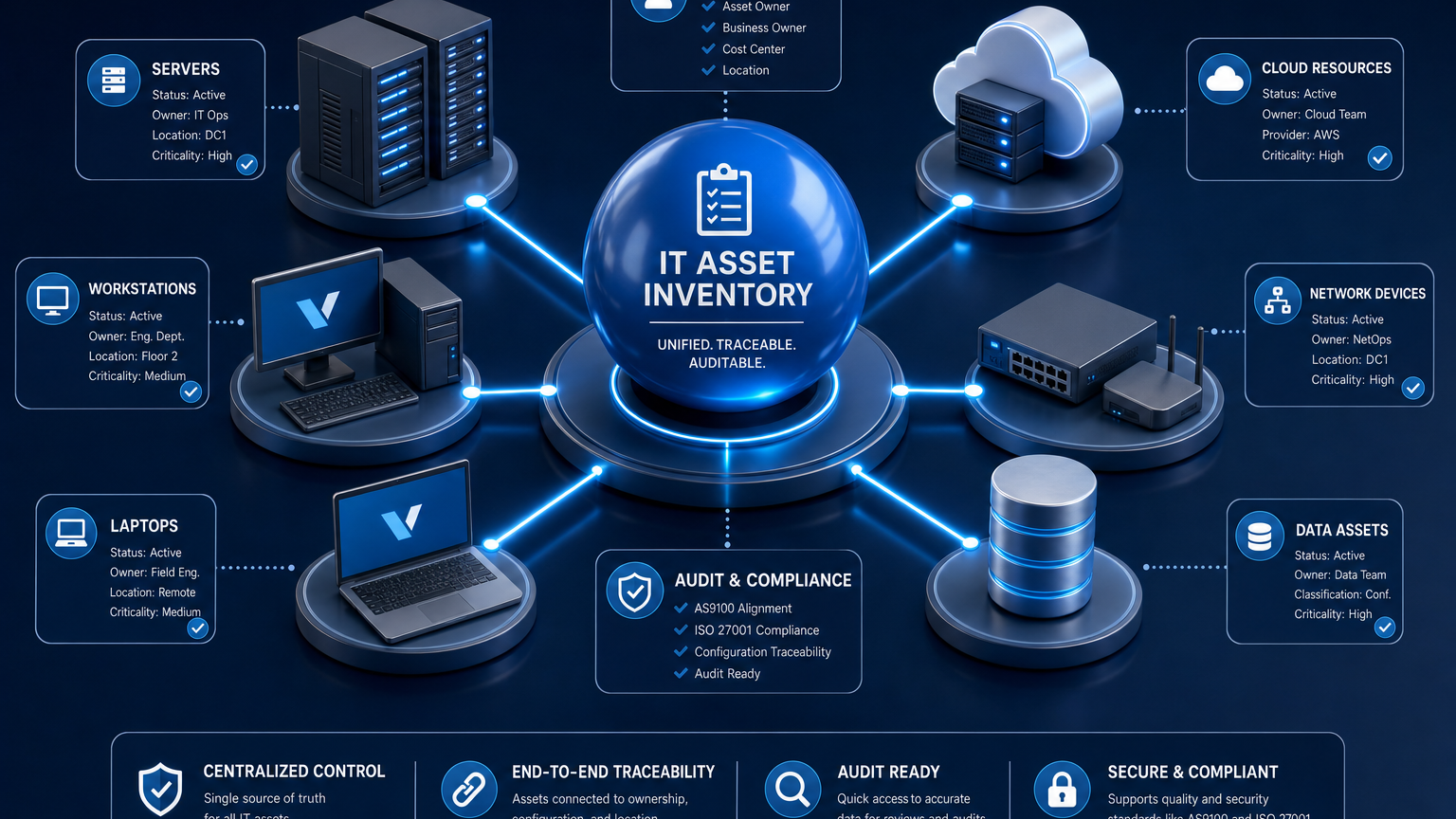
IT Asset Inventory for Regulated Manufacturers

IT asset inventory for regulated manufacturers starts failing the moment an audit request lands, and nobody can say who owns the application behind an inspection record or when it was last verified. Closing that gap means connecting asset data to AS9100 configuration management and ISO 27001 Annex A 5.9 ownership requirements — not mistaking a technology list for certification proof.
The asset manager must identify system owners, verify collection dates, and locate evidence across quality and security teams. When records disagree, a scheduled review can reveal which observation needs investigation. The resulting inventory gives auditors a traceable starting point into the quality and security evidence behind each system.
Why aerospace manufacturers need an evidence-ready inventory
Aerospace manufacturers use information systems throughout design, production, inspection, and delivery. Aerospace IT asset management has to account for all of these systems at once, not just the servers and workstations IT already tracks. Engineering repositories hold controlled drawings and specifications. Manufacturing applications distribute work instructions, while inspection systems retain measurement and release records.
Connect infrastructure to the controlled process
A quality team may own a procedure, while IT maintains its application server. Plant engineering may manage the workstation used to enter inspection results. Each group holds part of the evidence needed to explain how the process operates.
An asset record can connect the application to its owner, supporting infrastructure, and last verification date. It can also point reviewers toward the procedure or change record maintained elsewhere. The asset manager can then identify gaps before an audit sample arrives. For a broader walkthrough of this process outside aerospace-specific requirements, see Virima’s complete guide to IT asset inventory management.
Explore Trusted Runtime Truth to see how discovery-sourced records help teams understand what exists, how it connects, what changed, who owns it, and what a change could affect.
AS9100 IT asset inventory vs. ISO 27001 manufacturing asset inventory
AS9100 addresses quality management in aviation, space, and defense organizations. ISO/IEC 27001 addresses an information security management system, commonly called an ISMS. The two standards can involve shared systems, but their management objectives differ.
Separate product configuration from IT configuration
The International Aerospace Quality Group’s audit guidance covers the 9100:2016 standard, including configuration management and control of documented information. Its configuration management guidance concerns product definition and related changes.
An IT configuration management database, or CMDB, records infrastructure and its relationships. That information can support the systems used by quality processes. Product configuration decisions and controlled manufacturing records remain in the manufacturer’s quality workflows.
ISO/IEC 27001:2022 focuses on information security risks within the defined ISMS scope. Annex A control 5.9 addresses an inventory of information and associated assets, including ownership. Organizations worldwide held 96,709 valid ISO/IEC 27001 certificates in 2024, according to the ISO Survey, the official register of ISO management system certifications. The organization determines control applicability through its risk treatment and Statement of Applicability.
A controlled inspection application illustrates the distinction. The quality team may examine how inspection records are controlled and retained. The security team may examine ownership and access to the application. Both teams can begin with the same inventory record and retrieve different evidence.
| AS9100 configuration management | ISO/IEC 27001 Annex A 5.9 | |
|---|---|---|
| Governs | Product definition and controlled manufacturing changes | Inventory of information and associated assets, including ownership |
| Decision owner | Quality team, within quality workflows | Security/ISMS owner, within risk treatment and the Statement of Applicability |
| Evidence type | Product configuration records and change history | Asset ownership, access, and inventory records |
Can one asset record support both quality and security reviews?
One asset record can give quality and security reviewers a shared identifier for the same system. Each team should maintain references to its own decisions and evidence. The asset owner can then trace a review request to the appropriate procedure, access record, or change history without combining those approvals.
Define the inventory boundary around controlled processes
Begin with the processes inside the quality system and information security scope. Identify the applications and infrastructure those processes use. Then agree on which team maintains each record.
Include systems that support production evidence
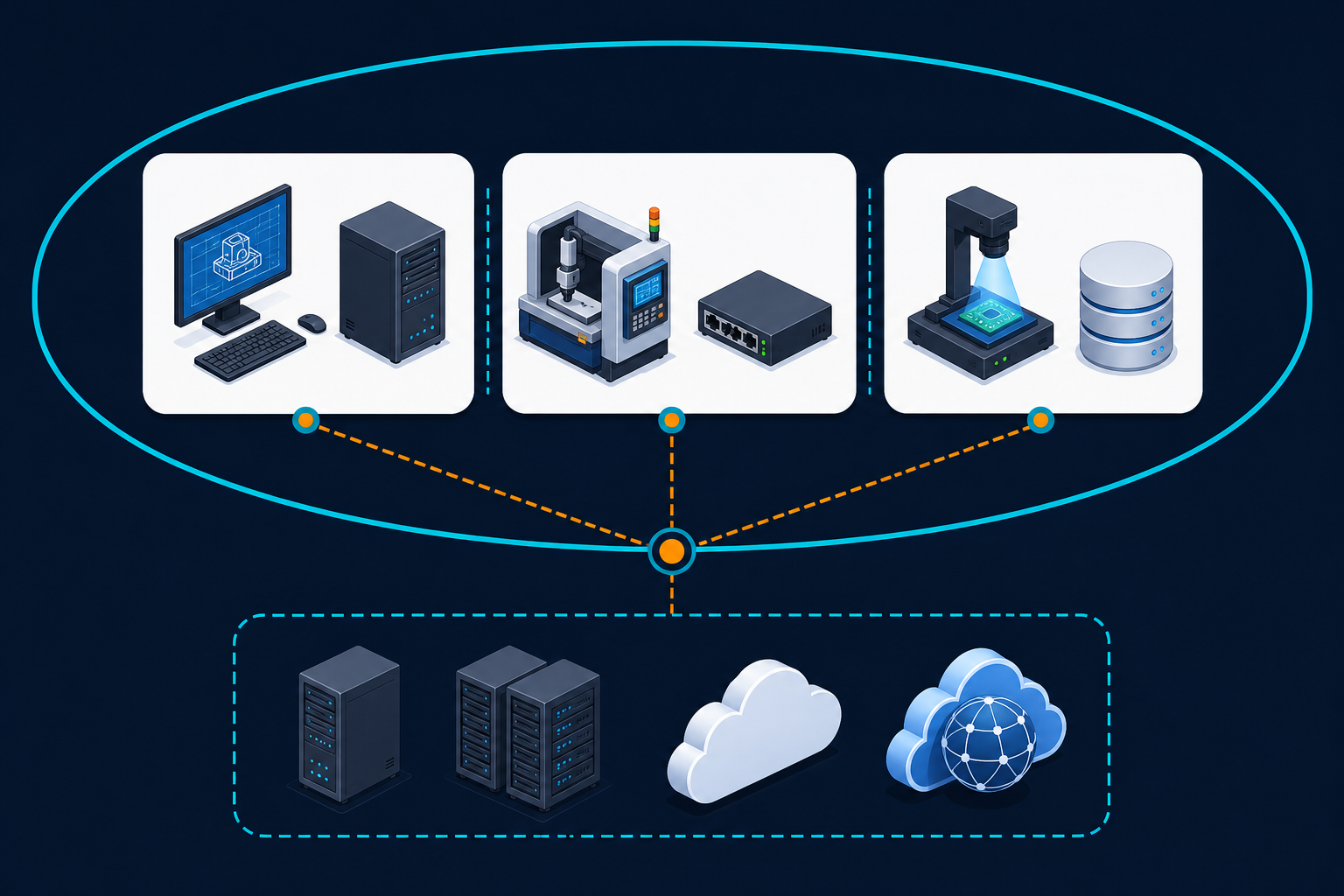
A practical inventory boundary can include these asset groups:
- Engineering systems — workstations, servers, and repositories supporting design and controlled documents.
- Production systems — manufacturing applications and infrastructure supporting scheduling and work instructions.
- Quality systems — inspection applications, databases, and workstations used to record results.
- Shared infrastructure — servers, storage, network devices, and virtualization hosts supporting those applications.
- Cloud resources — relevant AWS and Azure resources within the agreed scope.
Also record assets outside the reach of approved discovery methods. A supplier-hosted application, isolated workstation, or equipment controller may need an owner-maintained record. State why the asset is excluded and how its record will be reviewed. For more on bridging plant-floor equipment with IT inventories, see this guide to manufacturing IT asset management across converged IT/OT environments.
Quality, security, IT, and plant teams should agree on the boundary together. Customer contracts and applicable regulations may introduce obligations beyond either management standard. Keep those obligations with the relevant compliance or contract owner.
Build records that teams can trace and review
An asset record should let a reviewer identify the system and follow its connection to a process. Begin with fields that support ownership and reconciliation.
Choose identifiers and record sources
For physical systems, retain a serial number when one is available. For cloud resources, retain the cloud instance ID and account context. Hostnames can change or be reused, so they should not be the sole durable matching key.
Each in-scope record should have an accountable owner, location or environment, lifecycle status, and verification date. Record the source of important attributes when that information is available. Discovery may provide operating-system details, while an owner supplies the business purpose.
Reference supporting records where the organization maintains them. These may include an approved change, recovery plan, access review, or quality procedure. The inventory should identify the evidence location and the person responsible for retrieving it.
For an asset without an owner, open an exception and assign a review date. Keep the exception visible until the responsible team accepts the assignment. Record the decision so another reviewer can follow the resolution.
How should teams handle an asset without a reliable identifier?
An asset without a reliable identifier needs a documented reconciliation exception. The owner can compare available procurement, location, and device records before assigning a stable identifier. Preserve the reason for the decision so a later reviewer can distinguish a confirmed match from an unresolved possibility.
Reconcile discovery results with plant and quality records
Scheduled discovery provides a dated observation of assets within approved coverage. IT can compare those observations with procurement, endpoint management, and owner-maintained records.
Investigate disagreements before merging records
Match records using reliable identifiers and the relevant account or location context. When sources disagree, define which source controls each field. A discovery source may supply operating-system details, while an asset owner supplies process classification.
Review mismatches before merging or retiring records. A missing result could reflect a credential problem, an excluded segment, or a retired asset. Investigate the cause before changing the lifecycle status.
The 2026 EMA ITAM maturity benchmark provides context for this review. Among 200 respondents, 18.5% rated their IT service management and CMDB asset data at 95% accuracy and completeness or higher. Another 60.0% selected the 80% to 94% range.
These figures are self-reported ratings, not independent measurements of asset accuracy. The broader survey covered North American organizations with at least 1,000 employees. Virima sponsored the research.
Virima supports scheduled discovery and multi-source reconciliation in its CMDB, so a conflict between a discovery result and an owner-maintained record is flagged for review rather than resolved automatically in either direction. Its IT asset management capabilities also retain lifecycle, software, contract, and warranty details. Virima integrates with the ITSM platforms manufacturers already run, including ServiceNow, Jira Service Management, and Ivanti, alongside existing quality and plant systems rather than requiring a separate system of record. Teams can use those records to investigate discrepancies and prepare dated inventory extracts.
Choose verification intervals for each asset group. A shared application server may be suitable for scheduled discovery. An isolated inspection workstation may need a planned owner review. Record the collection method and review date for both.
Protect production systems during inventory collection
Operational technology, or OT, includes systems that support physical processes. Some production devices are sensitive to network traffic or difficult to restart. Plant approval should therefore precede inventory collection.
Agree on collection methods with plant engineering
The National Institute of Standards and Technology’s OT security guide discusses operational constraints and risks associated with active scanning. Manufacturers should evaluate collection methods against equipment requirements and their safety procedures.
Start with the systems and network segments approved by plant engineering. Agree on credentials, testing, scan windows, and responses to unexpected device behavior. Test the proposed method in a representative environment when practical.
For devices that cannot be queried safely, use approved engineering records or manufacturer documentation. A plant owner can validate those records during a scheduled review. Preserve the coverage gap so reviewers can distinguish observed attributes from manually supplied information.
What should a plant do after a discovery method causes unexpected behavior?
The plant team should follow its approved response procedure and stop the affected collection activity. Document the device, method, observed behavior, and decision before attempting another review. Engineering and safety owners can then assess an alternative collection method or retain a manually verified record.
Connect assets to manufacturing services and change decisions
An inventory becomes more useful when it shows which applications and processes depend on each system. Those relationships help reviewers identify the people and records relevant to a proposed change.
Review dependencies before infrastructure changes
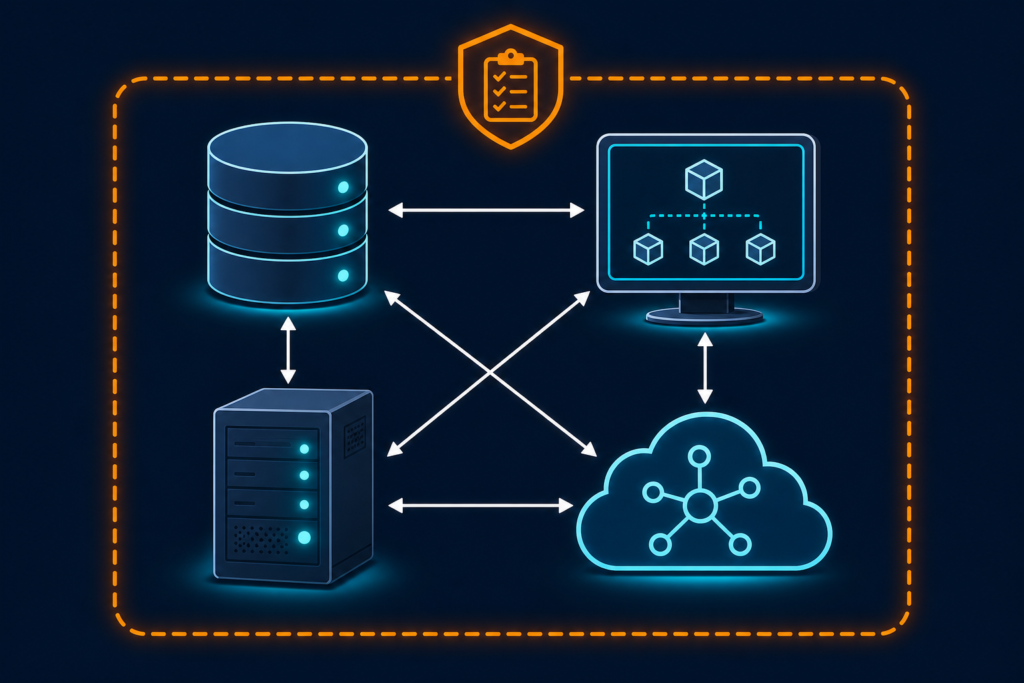
An inspection application may depend on a database, virtual machine, and shared network infrastructure. A change to the virtualization host could require the application owner to review the maintenance window. The quality team can then assess access to inspection records during the work.
Virima’s ViVID™ service maps use service definitions supplied by the organization. Once those definitions are provided, Virima builds dependency maps from available relationship data. Teams should review the map against their process knowledge and identify dependencies outside discovery coverage.
The map supports a change assessment, while the change record holds the decision. Approval, testing, and quality disposition remain within the organization’s established workflows.
Prepare a manufacturing audit evidence package
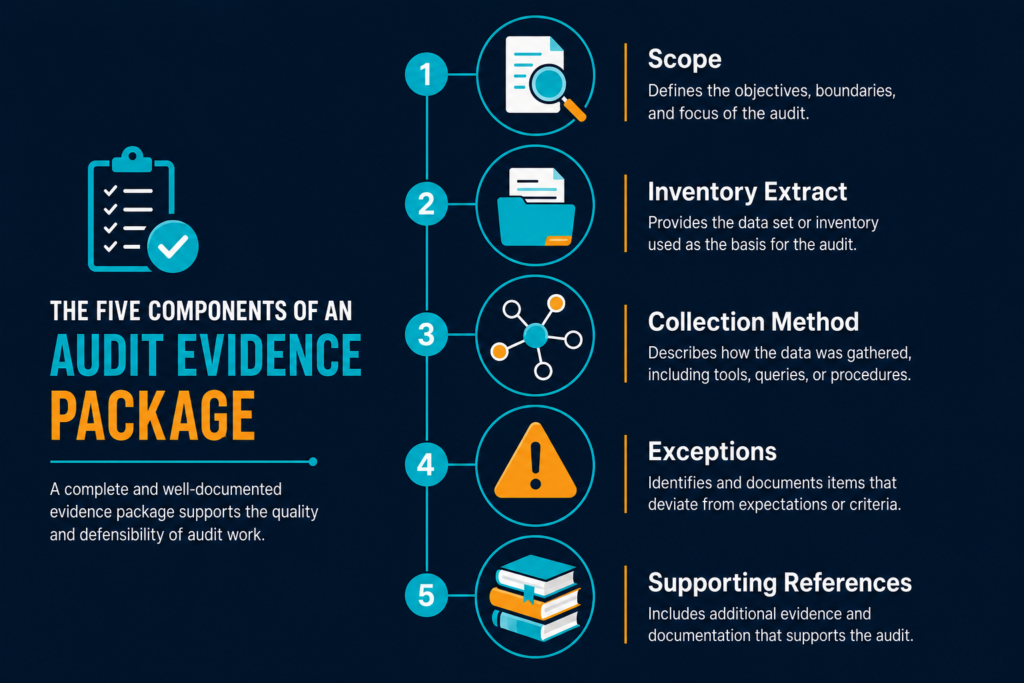
An evidence package starts with a defined scope and a dated inventory extract. It also explains how the team produced the extract and investigated exceptions.
Assemble records around the audit sample
For an audit request, the asset manager can assemble the following material:
- Scope and ownership — identify included systems, exclusions, and responsible owners.
- Inventory extract — provide asset identifiers, relevant attributes, status, and collection dates.
- Collection method — describe discovery coverage, approved manual sources, and review schedules.
- Exception register — show missing owners, conflicting records, coverage gaps, and resolution status.
- Supporting references — identify change records, access reviews, recovery evidence, and relevant quality procedures.
Ask quality and security teams to review the package before an audit. Each team can confirm whether the material addresses its own evidence requests. Retain the extract date so later updates do not obscure the audit sample. Teams managing both change and risk records may also want to review how to connect an IT risk register to change management for frameworks like SOC 2 and ISO 27001.
Test the retrieval path with a sample record. Ask the asset owner to locate the related evidence and explain any exceptions. If the record cannot be traced, assign an action and track its resolution.
Improve the IT asset inventory for regulated manufacturers
An IT asset inventory for regulated manufacturers needs assigned ownership and a repeatable way to investigate gaps. Scheduled discovery provides dated technical observations. Plant and quality teams contribute process knowledge and verify records outside discovery coverage.
Begin with one controlled manufacturing service and its supporting infrastructure. Agree on the boundary, reconcile records, and test evidence retrieval. Use the findings to refine the process before expanding coverage.
Frequently Asked Questions
What should an aerospace IT asset inventory include?
Include applications and infrastructure within the agreed quality and information security scope. Record identifiers, owners, locations, lifecycle status, and verification dates. Connect relevant systems to the processes they support, and document assets that require manual review.
How often should manufacturers review their asset inventory?
Set review intervals according to asset risk, operational constraints, and organizational procedures. Scheduled discovery may suit accessible IT infrastructure. Isolated production devices may require owner-led reviews and documented exceptions.
Can an IT asset inventory prove AS9100 or ISO 27001 compliance?
An inventory can support evidence gathering by identifying systems, owners, and related records. Certification assessments also examine applicable management processes and their implementation. The organization remains responsible for its scope, controls, and supporting evidence.
How can Virima support a manufacturing asset inventory?
Virima supports scheduled discovery, asset lifecycle records, and reconciliation across multiple data sources. Teams can associate configuration items with relationships and supply service definitions for ViVID™ dependency maps. Coverage depends on configured sources, access, and approved collection methods.
How does Virima support reviews of manufacturing system dependencies?
Virima’s ViVID™ maps show available relationships between applications and supporting infrastructure after service definitions are supplied. Reviewers can use those relationships to identify systems and owners involved in a proposed change. The organization retains responsibility for change approval and quality decisions.