Building a RACI Matrix? Here’s Why IT Teams Still End Up Chasing Ownership

Most IT teams still lose hours chasing who owns the configuration item behind a RACI row, even when the chart names a team correctly.
In May 2024, UnitedHealth Group CEO Andrew Witty told the U.S. Senate Finance Committee how the Change Healthcare ransomware campaign unfolded. Per his written testimony: compromised credentials against a Citrix remote-access portal without multi-factor authentication, then lateral movement, data exfiltration, and ransomware nine days later. The hearing was about a national-scale outage, not a RACI case study, but the operational parallel holds. When a critical access path lacks clear, current control ownership, response stretches while teams reconstruct what existed and who was supposed to own it.
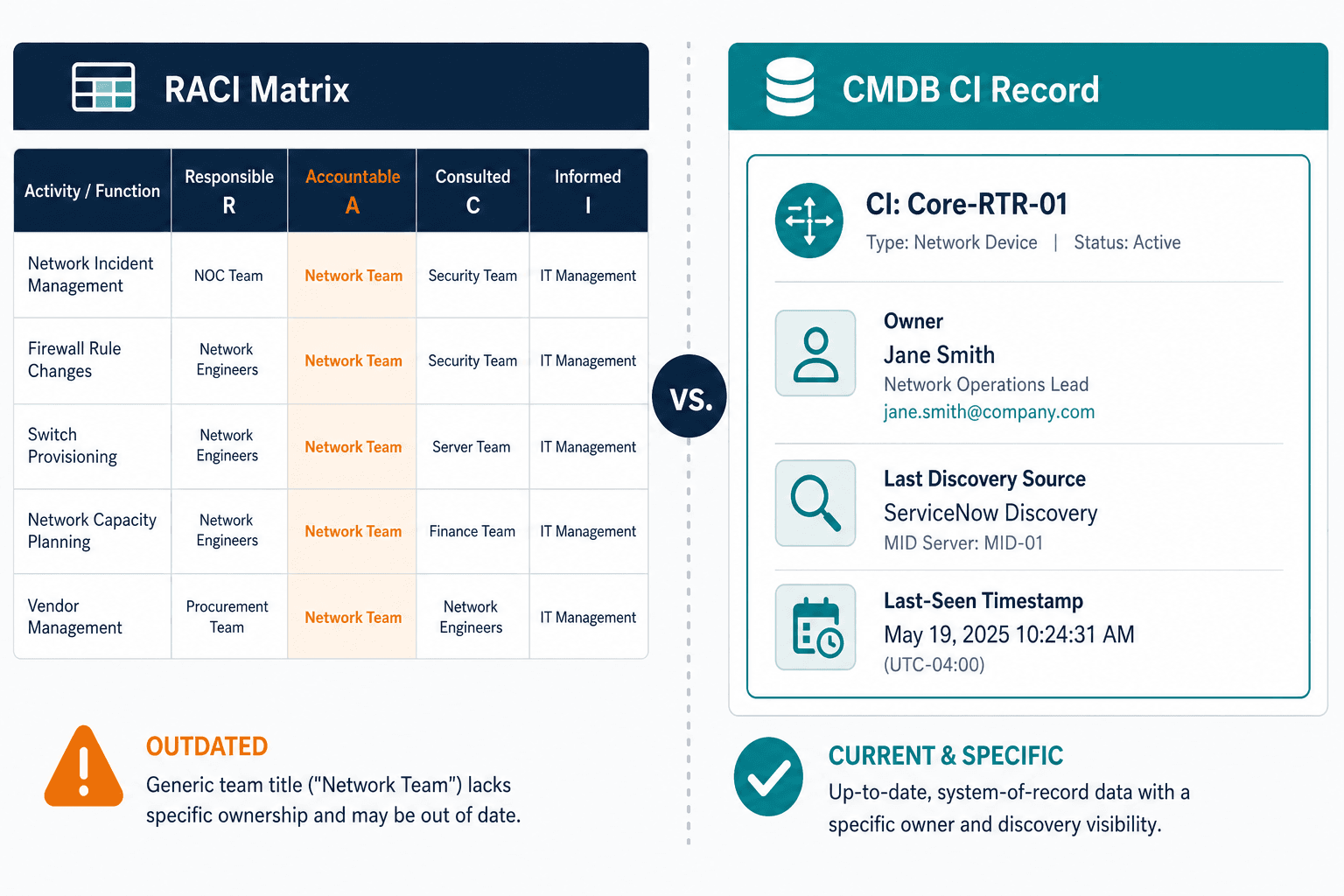
That same pattern shows up when a RACI chart names a team, and the CI under the row is stale. The chart may name a team correctly, but the asset path, control owner, and configuration state still have to be real when the ticket opens. A responsibility assignment matrix is built to prevent “someone will handle it” — it cannot invent an accurate inventory or a named steward for a CI that no longer matches last quarter’s list.
What is a RACI matrix?
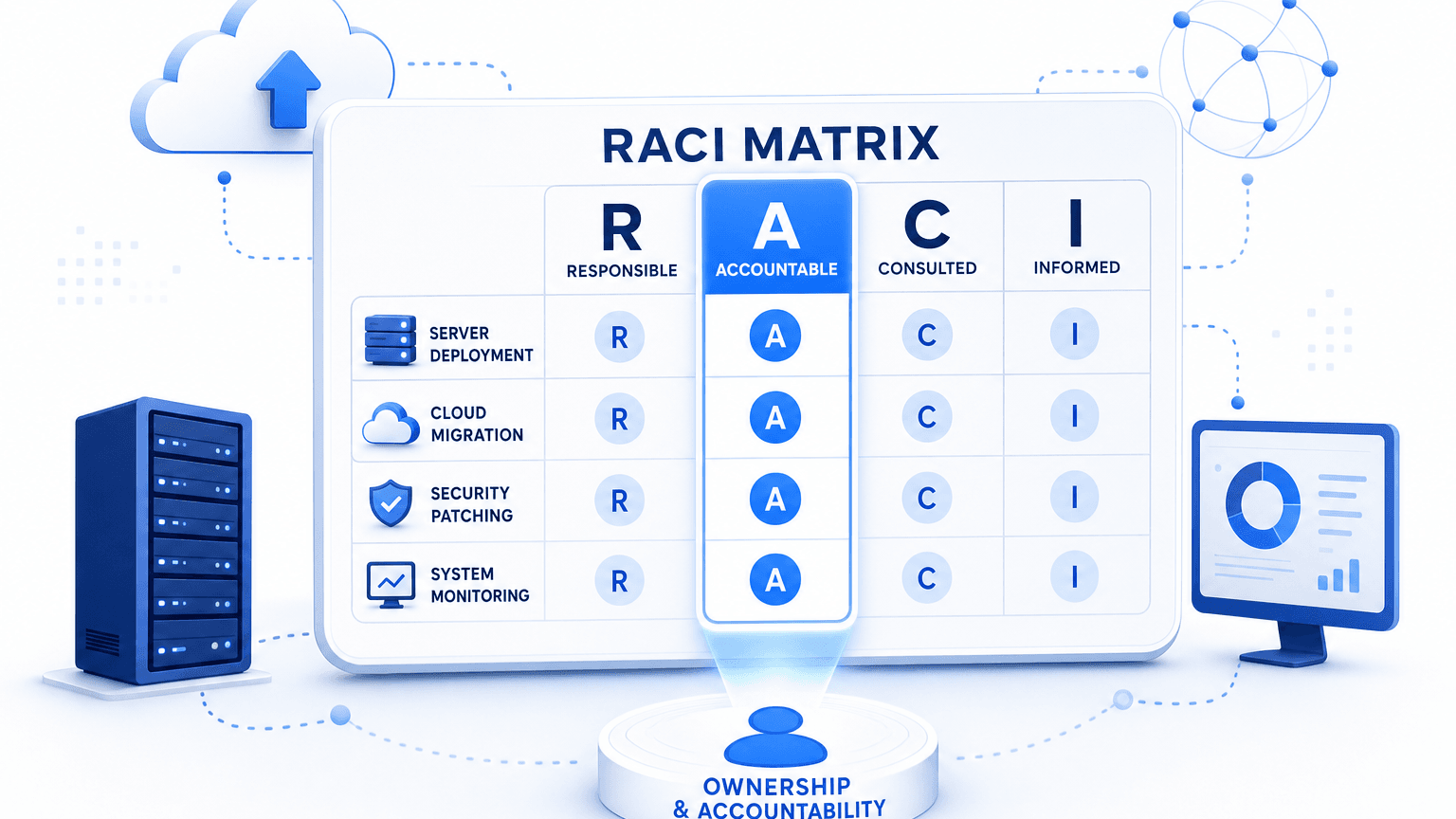
A RACI matrix is a responsibility assignment matrix: a grid that maps work items or decision rows to people or roles using four labels: Responsible, Accountable, Consulted, and Informed. Project and service teams use it so handoffs stop living only in chat threads and tribal memory. ITIL 4 service management practice work still depends on clear roles for incident, change, and problem flows, and the matrix is the common shorthand for that clarity.
The four letters mean:
- Responsible: does the work
- Accountable: owns the outcome
- Consulted: two-way input before or during the work
- Informed: kept up to date, one-way communication
The chart is simple on purpose. That simplicity is exactly why it fails operationally, and it’s not because people can’t recite R, A, C, and I, but because the rows still point at last year’s estate while the estate moved.
Most ranking guides treat the matrix as the finish line: define the letters, fill the grid, schedule a review, stop. They rarely ask whether the CI, service, or asset under each row still exists, who currently owns it, or how fast the estate changes between reviews. That is the content gap this article closes. The how-to still matters. The ownership data under the how-to is what keeps the chart enforceable.
The CI ownership gap
| Situation | What happens |
|---|---|
| RACI names “Network Team” as Accountable for a CI | Roster changes; the chart stays frozen |
| RACI is built against last year’s asset list | Assets are decommissioned, cloned, or reassigned; the chart does not move with them |
| RACI is reviewed on a fixed quarterly calendar | Infrastructure and cloud estates change on a faster clock than the review meeting |
Assigning ownership before go-live is part of CMDB implementation discipline for the same reason. A role without a current CI underneath it is a label, not an escalation path.
Why building one matters in IT operations
Incident and change work burn time whenever the first assignment is wrong. Mean time to repair, recovery, resolve, or respond only matters once the team agrees which clock they’re measuring, a point Atlassian documents on common incident KPIs. None of those clocks start cleanly when the first page goes to a team that no longer owns the box, account, or application tier.
Uptime Institute’s 2025 Annual Outage Analysis press release reports on organizations that suffered a major outage from human error over the prior three years. Among those, 85% of incidents stemmed from staff not following procedure or from flaws in the procedure itself. The same release notes that software-based and distributed resiliency can blur lines of responsibility for failures. Ownership charts that drift from the live estate create the same blur: procedures assume a named path that no longer holds.
Where RACI assignments break down operationally
- Role named, asset ownership never confirmed. The row says Accountable equals Platform, but nobody verified the CI owner field against discovery or HR — so the first assignment lands on the wrong queue.
- Matrix built once at project kickoff, never revisited. Sponsors leave, contractors rotate off, cloud accounts change hands, which means the Accountable party no longer exists in the org chart the night the change fails.
- Several people informally share “Accountable.” Everyone feels involved; no one escalates. Result: the ticket ages while peers wait for someone else to own the call.
- Consulted and Informed lists grow without a living distribution list. Noise rises; signal drops. Result: the people who needed the page miss it, and the people who did not need it ignore the next one.
How to build a RACI matrix (step-by-step)
1. List the tasks or CI classes that need ownership
Work at activity or asset-class level: “patch Windows servers in scope,” “own SaaS contract renewals for collaboration tools.” Avoid atomizing every sub-task into its own row, as too many rows become unmaintainable fast.
2. Identify roles or named individuals, not only team titles
“Infrastructure” is a mailbox. Prefer a named steward, a defined on-call rotation, or a role that HR and ITSM both recognize. When CMDB programs stick, they often start with a named data steward instead of a team title for the same reason RACI rows fail when they only say “Network.”
3. Assign R, A, C, and I
Put one Accountable on each row. Multiple Responsible people can share execution. Consulted should be short enough that input arrives before the work stalls. Informed should match real notification channels, not aspirational distribution lists.
4. Review for gaps before you socialize the chart
Check rows with no Responsible, rows with more than one Accountable, and roles mapped to people who already left. Check whether the CI or service named in the row still exists in inventory, and fix that problem before you finalize the chart.
5. Validate with stakeholders and set a review cadence tied to change rate
Stakeholder sign-off is not a one-time workshop trophy. Tie review cadence to how often discovery and HR feeds actually refresh the estate, not to an arbitrary calendar that ignores cloud and network velocity. Include decommission lists, cloud account moves, and on-call rotation changes in the same review packet, and ask each Accountable owner to confirm the CI classes still in scope before you republish the chart.
Keeping a RACI matrix accurate after it’s built
This is the gap most RACI explainers leave open. The matrix answers who. It does not answer whether the CI still exists, who currently owns it, or what depends on it. Those answers live in discovery-sourced configuration and asset data, plus service maps once service definitions are provided.
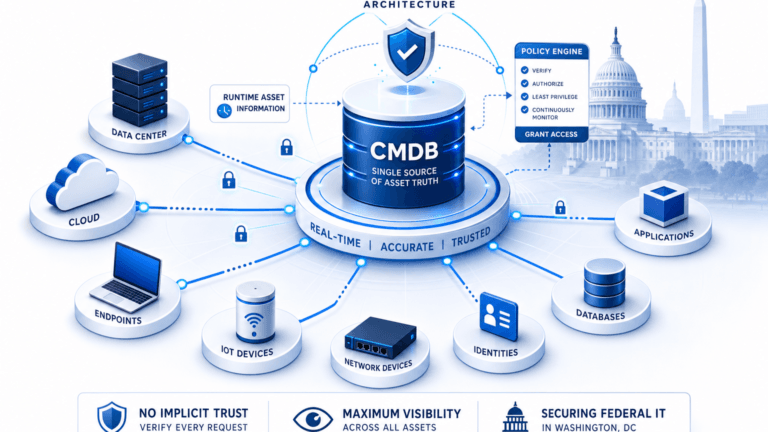
Virima does not build or replace your RACI matrix. It keeps the underlying asset and ownership data the matrix depends on from going stale between human reviews, using agentless scanning, agent-based discovery probes, and cloud APIs on high-frequency scheduled cycles. That is discovery-sourced ground truth for the estate the chart points at, not an automated accountability engine. Teams that want the category language for that layer can start with Trusted Runtime Truth: a discovery-sourced view of what exists, how it connects, and who owns it.
| Manually maintained ownership data | Discovery-sourced ownership data | |
|---|---|---|
| Update trigger | Someone remembers to edit the chart | High-frequency scheduled scans surface estate change |
| Decommissioned asset | Often surfaces during the next incident | Surfaces on the next completed scan cycle |
| Ownership attribution | Team title, often outdated | Named steward fields on the CI, when you maintain them |
| Dependency context before change | Tribal knowledge | Application-to-infrastructure maps after service definitions are provided |
CMDB governance built around named ownership is what makes RACI rows enforceable instead of decorative. For more on building that discipline before an incident forces the question, see Virima blog post on proactive CMDB governance and ownership practices.
RACI in IT operations: practice examples
- License and audit ownership. RACI names who is accountable for a software contract. ITAM install and entitlement data confirm the position that person is defending.
- SLA path clarity. SLA routing still depends on knowing who owns the CI when the clock is already running.
Partner ITSM tools such as ServiceNow, Jira Service Management, and Ivanti still need that ownership and CI context in the ticket. Discovery and map data should flow through your existing stack via Virima’s integrations hub rather than a second desk.
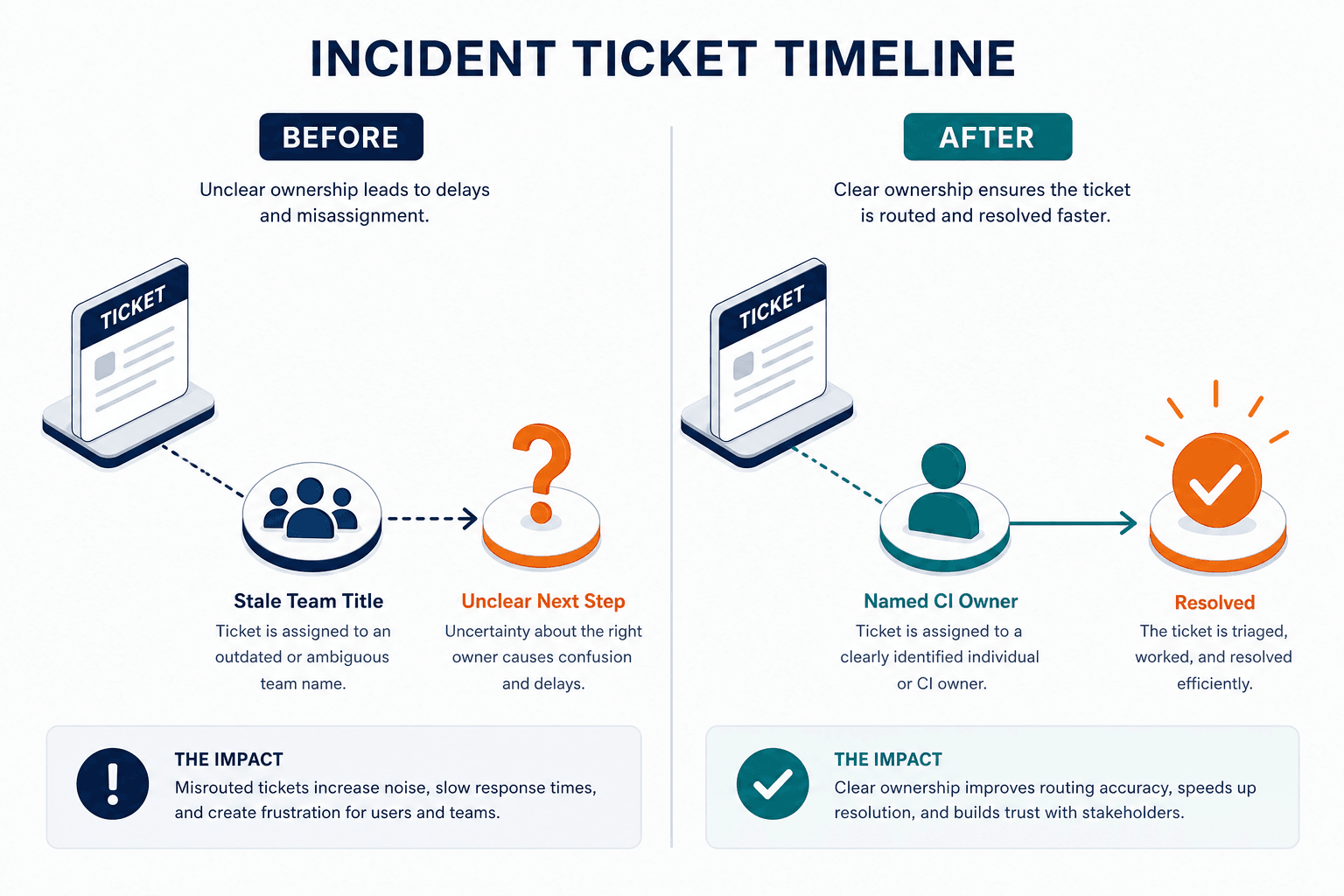
Both patterns depend on the same thing: the row is only as good as the CI and service data behind it. Keep the matrix in the governance pack and the CI owners in the systems people open during an incident, or on-call will keep bouncing tickets while the RACI slide still looks complete in the shared drive.
Beyond RACI: RAPID, DACI, and RASCI
RACI is not the only responsibility model. Compared side by side, RACI vs. RAPID vs. DACI solve different decision problems — choose the framework that matches the decision type, not just the org chart.
| Framework | Best for |
|---|---|
| RACI | Ongoing operational and task ownership across IT services |
| RAPID (Bain & Company) | High-value or high-frequency decisions with clear Recommend / Agree / Perform / Input / Decide roles |
| DACI | Product and decision-team environments (Driver, Approver, Contributors, Informed) |
| RASCI | RACI plus an explicit Support role when execution needs a dedicated helper lane |
Bain & Company’s RAPID decision-making framework is built for decision accountability, not for standing CI ownership on a hybrid estate. You can run RAPID for a major platform choice and still need RACI-style rows for patching, access reviews, and incident command afterward — the inventory problem does not disappear when you swap the acronym. Export exceptions weekly: CIs with blank owners, services with no Accountable on the matrix, and tickets reassigned more than once for ownership. Route that ownership context into ServiceNow, Jira Service Management, or Ivanti through one path, which is the integrations hub.
Making ownership stick after the workshop
- Build the RACI for the services and CI classes that actually page people.
- Require one Accountable and a named steward path, not only a team label.
- Validate each row against current inventory before you publish the chart.
- Wire ownership fields into the CMDB and ITSM tools teams already use.
- Refresh discovery on a high-frequency schedule and reopen RACI rows when owners, CI classes, or service maps change.
Workshop energy fades. The estate does not. Cloud accounts move, agents get rebuilt, and last quarter’s “Network Team” row still sits in the deck. Treat every reopen as a data problem first: does the CI class exist, is the steward still employed, and does the service map match production? Spend the next operating review on exceptions only — rows with no Accountable, CIs with no steward, and services whose maps drifted after the last release train.
A RACI matrix still matters. IT teams chase ownership when the chart outlives the estate. How discovery keeps CI ownership current is the practical starting point on the asset side. When you want the same path walked against your environment, request a demo.
Frequently Asked Questions
What is a RACI matrix?
A RACI matrix is a responsibility assignment matrix that maps each task or decision row to Responsible, Accountable, Consulted, and Informed roles so ownership is explicit instead of assumed in chat or tribal knowledge.
How do you build a RACI matrix?
List the tasks or CI classes, name roles or individuals, assign one Accountable per row with clear R, C, and I entries, remove gaps and leavers, then validate against current inventory and set a review cadence matched to how fast the estate changes.
Does Virima integrate RACI ownership data with ServiceNow, Jira Service Management, or Ivanti?
Virima works alongside ServiceNow, Jira Service Management, and Ivanti rather than replacing them. Discovery-sourced CI and ownership data flows into the ITSM tools teams already use, so RACI rows stay backed by current asset data instead of a separate ownership desk.
How often should a RACI matrix be reviewed?
Review when owners, CI classes, or service maps change, and on a cadence tied to discovery and HR refresh rates. A fixed quarterly meeting that ignores estate change leaves rows pointing at systems and people that no longer match production.
How does Virima keep CI ownership current between RACI review cycles?
Virima scans the estate on high-frequency scheduled cycles using agentless, agent-based, and API-based discovery. That surfaces decommissioned assets, reassigned cloud accounts, and stale owner fields between human reviews instead of waiting for the next scheduled workshop.