Beyond service mapping plus: a practical alternative for mid-market IT ops

If your team uses ServiceNow Service Mapping with Service Mapping Plus, you already know the maps can work. What usually hurts is not the Plus Store app itself. Service Mapping Plus is listed free on the ServiceNow Store. Cost and effort sit in ITOM Discovery, Service Mapping licenses, implementation, and ongoing map care. Not every organization needs that full stack for dependency visibility.
Virima takes a different approach. With ViVID™ (Virima Visual Impact Display), IT operations teams get dependency maps that overlay ITSM incidents, change requests, event management alerts, and NIST NVD vulnerability data directly onto infrastructure maps. Faster incident triage, clearer change impact analysis, and a service mapping tool that fits mid-market budgets without sacrificing visibility. According to Uptime Institute’s 2025 report, over 54%of organizations say their most recent major outage cost more than $100,000, highlighting the need for faster, context-rich troubleshooting.
This blog breaks down what ServiceNow service mapping plus offers, where it falls short for cost-conscious teams, and how Virima delivers comparable (and in some areas, stronger) capabilities at a lower total cost.
Verdict: ServiceNow Service Mapping Plus extends ServiceNow Service Mapping with ML-oriented suggestions, readiness checks, and mapping filters. The Store app is free; paid ITOM Discovery and Service Mapping drive most cost. Virima fits teams that need discovery-sourced dependency maps, ViVID™ impact overlays, and CMDB sync into ServiceNow or other ITSMs without buying full ITOM breadth. Keep ServiceNow-native mapping when ML suggestions inside a deep ServiceNow ITOM estate are mandatory.
What ServiceNow Service Mapping and Service Mapping Plus do
ServiceNow service mapping automates the discovery of IT services and their underlying components. It creates visual service maps, maps dependencies between configuration items (CIs), and helps teams manage incidents by showing which services are affected when something breaks.
Service Mapping Plus builds on that foundation with machine learning-based service suggestions, health checks for mapping readiness, and filters that skip already-mapped services to reduce processing overhead. Think of it as ServiceNow’s premium tier for organizations that need tighter automation around their service maps.
This matters when you’re evaluating alternatives. Some of the “plus” features (like ML-based suggestions) are ServiceNow-proprietary. Others (like dependency mapping and CMDB integration) are table stakes that any modern service mapping tool should deliver.
Service Mapping builds on discovered CIs. If you need the split between inventory and maps first, read Discovery versus Service Mapping before you weigh Plus against Virima.
What ServiceNow Service Mapping Plus adds
Service Mapping discovers IT services and the CIs behind them, then draws dependency maps for incident and change work. Service Mapping Plus extends that baseline inside the Now Platform. Typical Plus-oriented capabilities include:
- ML-oriented service suggestions from traffic and related signals
- Readiness or health checks before automated mapping runs
- Utility script hooks when CMDB structures need custom mapping logic
- Filters that skip already-mapped services to cut remapping waste
- Tighter alignment of maps to CMDB updates after discovery cycles
- Hybrid and multi-cloud dependency views inside broader ITOM programs
Some of those items (especially ML suggestions and Plus workspace behaviors) are ServiceNow-specific. Dependency maps and CMDB integration are table stakes any modern mapping stack should cover. Confirm the exact Plus version and packaging on your instance and on the ServiceNow Store before you budget.
ServiceNow leads when ML-based service suggestions, Plus readiness tooling, and native Service Mapping workspace habits are non-negotiable inside a committed ITOM program. Virima does not clone every Plus ML workflow. It competes on discovery authority, ViVID impact views, multi-ITSM CMDB feed, and total stack cost for mapping-led buyers.
If your shortlist is mapping quality, impact context, and CMDB feed without full ITOM breadth, compare that Plus stack to what Virima delivers next.
Virima as a Service Mapping Plus alternative for discovery, maps, and CMDB sync
Virima is built for IT operations teams that need IT discovery, service mapping, CMDB management, and IT Asset Management without the licensing overhead of a full ServiceNow ITOM deployment.
ViVID™: Service maps with impact overlay
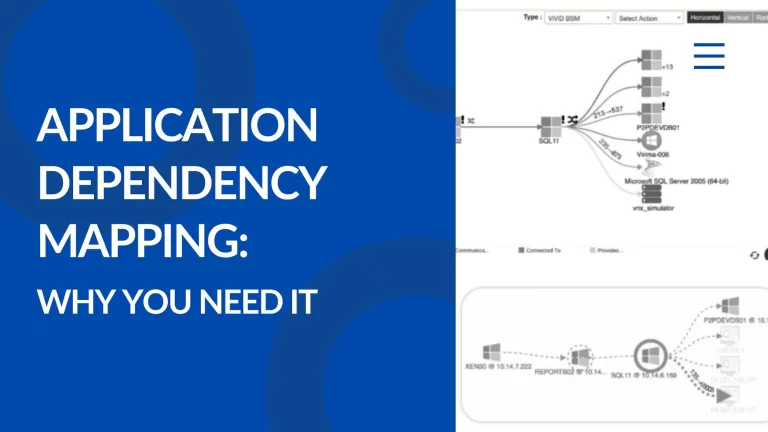
ViVID™ (Virima Visual Impact Display) goes further than standard dependency visualization. It overlays ITSM incidents, change requests, event management alerts from platforms like SolarWinds and Logic Monitor, and NIST NVD vulnerability data directly onto your infrastructure and application dependency maps.
When an incident fires, your team sees which services depend on the affected server, whether any active change requests are in play, and whether known vulnerabilities exist on connected assets. That context significantly reduces the time it takes to triage and assign the right responders.
CMDB updates from recurring scheduled scans show up in ViVID™ maps automatically, so the view your team works from always reflects the latest IT discovery data rather than a snapshot from three months ago. Business service definitions (which applications and sites make up each service) are supplied by your team, spreadsheet import, or EA integrations such as LeanIX. Virima then builds and maintains the dependency map from discovery-sourced CIs and relationships.
NIST NVD integration at no extra cost
ViVID can overlay Windows Server NIST NVD findings on dependency views so teams weigh patch urgency by asset and business service path. That overlay is not a full multi-OS vulnerability management scanner. Pair it with your dedicated VM tool for broader OS coverage. Discovery still inventories far more than Windows servers; the NVD map overlay in the product is Windows Server–scoped.
See how discovery-sourced maps and impact context support safer change and faster triage. Start with Trusted Runtime Truth.
Pre-built ITSM integrations
Virima syncs CMDB data with ServiceNow, Jira Service Management, Ivanti, HaloITSM, Xurrent, and Hornbill. ServiceNow sync is bi-directional: CIs and relationships discovered in Virima can appear in the ServiceNow CMDB, and eligible updates can flow back. Teams that already run ServiceNow ITSM keep their service desk workflows and strengthen the data underneath. Virima also offers native ITSM for organizations that want discovery, CMDB, mapping, and service management on one platform.
For teams already invested in an ITSM platform, Virima plugs into your existing workflow without replacing anything. Stronger discovery and mapping feeds into the CMDB your service desk already uses.
Virima also offers its own native ITSM capabilities for organizations that want discovery, CMDB, service mapping, and service management on a single platform without any third-party ITSM dependency.
Automated asset discovery
Virima’s IT discovery uses agentless IP-based scanning to identify assets across on-prem, AWS, and Azure environments. Scans run on configurable schedules per subnet, minimizing manual inventory work and catching configuration drift between cycles. For endpoints that agentless scans can’t fully reach — remote PCs, devices behind firewalls, or systems needing persistent monitoring — optional discovery agents for Windows, macOS, and Linux provide continuous configuration tracking and software usage metering.
Compared to manual asset tracking or spreadsheet-based approaches, this hybrid discovery approach reduces human error and gives IT operations staff more time for capacity planning and service improvement.
Use this side-by-side as a buyer checklist. Service Mapping Plus is a Store extension; usable mapping still depends on ServiceNow Discovery, CMDB quality, and ITOM licensing.
| Capability | ServiceNow Service Mapping Plus (with Service Mapping / ITOM) | Virima | Buyer note |
|---|---|---|---|
| Product shape | Store app extending ServiceNow Service Mapping | Discovery, CMDB, service mapping, ITAM in one platform; feeds external ITSMs | Plus is not a standalone CMDB |
| Store / plugin price | Service Mapping Plus listed free on ServiceNow Store | Subscription (device-based plans; quote for enterprise) | Do not confuse Plus free with ITOM cost |
| ML service suggestions | Yes (Plus focus area) | Not a like-for-like Plus ML suggestions suite | ServiceNow advantage if ML suggestions are required |
| Mapping readiness checks | Readiness / health style checks for ML mapping tasks | CMDB health and discovery hygiene; different UX | Compare workflows, not labels alone |
| Skip already-mapped services | Filters to reduce remapping overhead | Scheduled discovery and map refresh from current CIs | Both aim to cut wasteful rework |
| Service map build | Service Mapping automation inside Now Platform | Builds dependency maps after service definitions are supplied (manual, import, or EA integrations such as Lean IX) | Virima automates map build, not service naming invent |
| Impact on the map | Rich ops context via platform modules and configuration | ViVID overlays incidents, changes, and event signals on dependency views | Virima differentiator when full ITOM UX is not built out |
| Vulnerability context on maps | Typically SecOps / VR and related modules | Windows Server NIST NVD overlay weighted by asset and service path; pairs with dedicated VM scanners | Do not treat Virima as multi-OS VM replacement |
| CMDB system of record | ServiceNow CMDB native | Virima CMDB plus bi-directional ServiceNow sync when SN remains SoR | Augment path is common |
| ITSM coupling | Deepest inside ServiceNow | ServiceNow, Jira Service Management, Ivanti, HaloITSM, Xurrent, Hornbill (and native ITSM option) | Virima for multi-ITSM; SN for SN-only estates |
| Discovery model | ServiceNow Discovery and related patterns | Agentless IP scans on schedules; optional agents for Windows, macOS, Linux | Virima: high-frequency scheduled cycles, not continuous event stream |
| Cloud coverage (typical claims) | Hybrid and multi-cloud inside broader ITOM programs (often including major public clouds) | On-prem, AWS, and Azure in standard discovery narratives | Confirm GCP and other clouds against your bill of materials |
How Virima’s service mapping plus alternative improves daily IT operations
Faster incident triage
When an incident hits, ViVID™ shows every service and dependency connected to the affected component. Instead of manually tracing connections during an outage, your team sees the blast radius immediately. Faster escalation to the right owners and shorter mean time to resolution.
Root cause analysis with change context
Virima maps dependencies and tracks changes over time. When something breaks, your team can compare the current dependency map against previous states to identify what changed. Pair that with the ViVID™ overlay of recent change requests, and root cause identification moves from guesswork to evidence-based analysis.
Clearer communication across teams
Service desk, infrastructure, and application teams often work from different data sources. ViVID™ gives every team the same visual view of services, dependencies, and active incidents. Shared visibility cuts the back-and-forth that slows incident resolution and change planning.
Asset discovery feeds your CMDB automatically
Virima’s IT discovery finds assets, maps their relationships, and writes everything to your CMDB. Discovered data syncs with your ITSM platform, so service desk agents work from accurate, current CI data rather than a CMDB that was last updated during the initial implementation.
When to keep Service Mapping Plus, choose Virima, or run both
Keep ServiceNow Service Mapping Plus when ServiceNow ITOM is the standard, admins already live in Service Mapping workspaces, and ML service suggestions plus platform-native CMDB workflows matter more than multi-ITSM portability.
Choose Virima when priorities are authoritative discovery, CMDB population, ViVID dependency maps with incident, change, and alert context, and Windows Server NIST NVD signals on critical paths, including bi-directional ServiceNow CMDB sync, without paying for unused ITOM modules.
Run both when you keep ServiceNow ITSM and CMDB workflows and use Virima discovery and mapping to improve CI completeness and relationships through sync. That path avoids a false choice between ripping out ServiceNow and accepting thin maps.
For a wider ITOM capability checklist beyond mapping alone, download the ITOM feature matrix and map it to what you will actually buy and staff.
Choosing between ServiceNow service mapping plus and Virima
The choice depends on what your organization actually needs.
ServiceNow service mapping plus is the right fit if you’re already deeply invested in the ServiceNow ecosystem, need ML-based service suggestions, and have the budget for a full ITOM deployment. Its strength is breadth. Service mapping is one piece of a much larger operational suite.
Virima is the right fit if you need strong IT discovery, service mapping, CMDB management, and IT Asset Management without paying for capabilities you won’t use. ViVID™’s impact overlay, built-in NIST NVD integration, and CMDB sync with major ITSM platforms — including ServiceNow, Jira Service Management, Ivanti, Cherwell, HaloITSM, Xurrent, and Hornbill — give operations teams the visibility they need at a price point that fits mid-market budgets.
Before signing a contract, map your actual requirements against what each tool delivers. If service mapping, dependency visualization, and CMDB accuracy are your core needs, Virima handles all three with pre-built integration to your existing ITSM platform and without locking you into a single vendor’s full stack.
If Service Mapping Plus features matter less than discovery quality, ViVID blast-radius views, and CMDB sync you can afford to run, request a Virima demo.
FAQ
What is the difference between Service Mapping and Service Mapping Plus?
Service Mapping is ServiceNow’s core capability to discover and visualize the CIs that deliver a business service. Service Mapping Plus is a ServiceNow Store extension that adds capabilities such as ML-oriented service suggestions, mapping readiness checks, utility script hooks, and filters that skip already-mapped services. Plus assumes you are already operating in the ServiceNow CMDB and Service Mapping context.
Is ServiceNow Service Mapping Plus free?
On the ServiceNow Store, Service Mapping Plus is listed as free and is described as not consuming custom table count. Most commercial impact comes from ServiceNow ITOM Discovery, Service Mapping, subscription units, and implementation effort. Always confirm current Store terms and your enterprise agreement before budgeting.
What is the difference between service mapping and application dependency mapping?
Service mapping traces the infrastructure and application chain that delivers a business service, from user-facing entry points through middleware, data stores, servers, and network components. Application dependency mapping focuses on how applications talk to each other. In practice, ADM sits inside a broader service map. Strong platforms show both application-level and infrastructure-level relationships in one view.
Can Virima run alongside a ServiceNow CMDB?
Yes. Virima discovery and mapping can sync with ServiceNow so CI and relationship quality improve while ITSM stays on ServiceNow. Bi-directional patterns help discovered inventory show up in the ServiceNow CMDB your service desk already uses. Many buyers evaluate Virima as an augment to ServiceNow data quality, not only as a rip-and-replace.