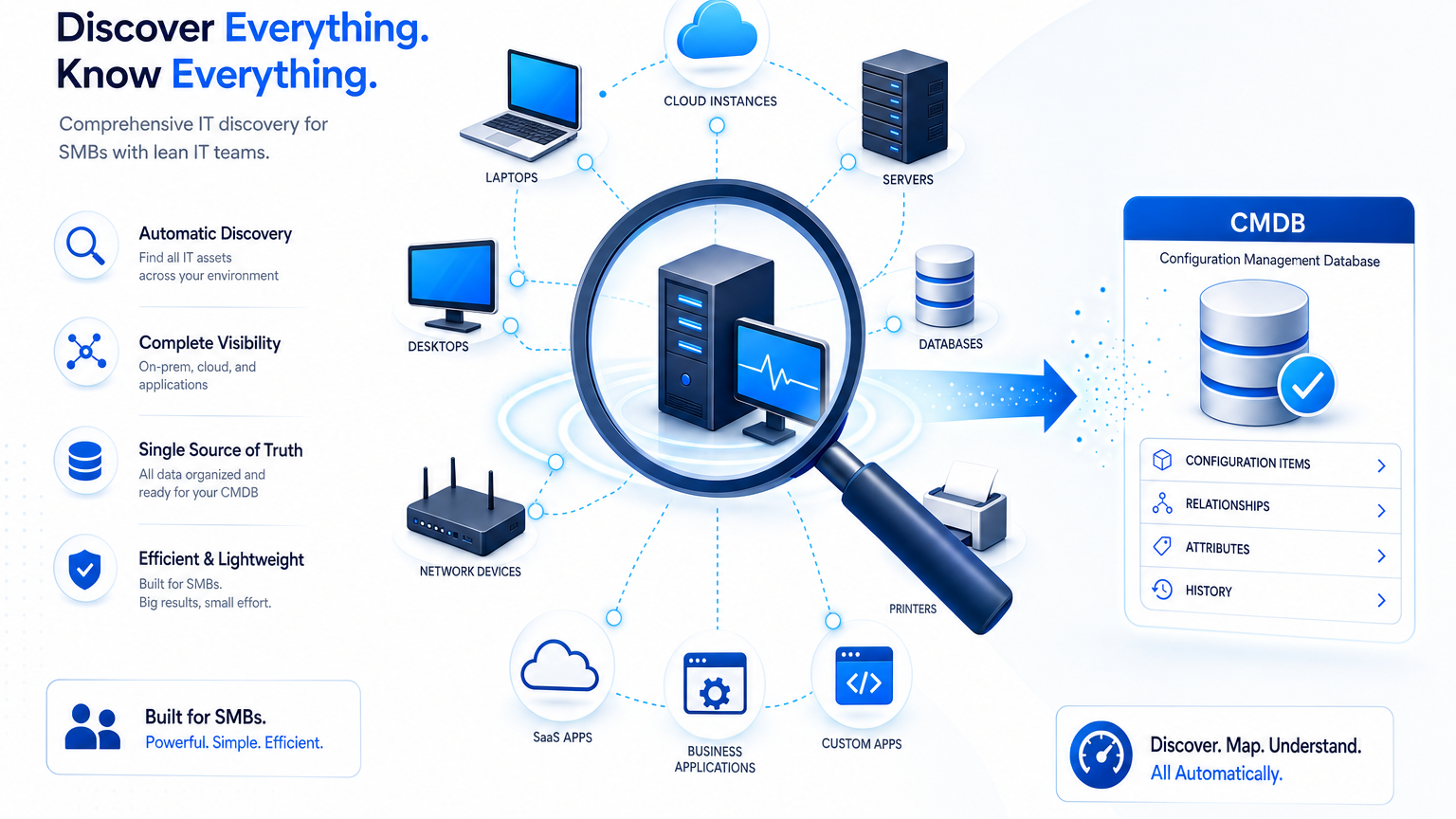
Best IT Discovery Software for Small and Medium Business: A Lean-Team Shortlist

Small and medium businesses run hybrid estates with the same failure modes as larger firms. Staffing is thinner, so the inventory tool has to finish the job without a dedicated discovery engineer.
This guide shortlists the best IT discovery software for small and medium business teams that need coverage they can run, records they can trust, and a clear path from scan data into a CMDB and service maps. It is not the multi-protocol complex-estate platform roundup. It is a fair lean-staff shortlist, including ManageEngine-class options when they belong on the table.
What best means when the team is lean
Best for a three-to-eight person IT group is not the longest feature brochure. It is the stack that stays current after the pilot week ends.
Use these bars before you rank vendors:
- Estate coverage you actually run, Servers, network gear, hypervisors, and cloud instances on AWS and Azure, not only Windows laptops.
- Collection mix a small staff can keep alive, Agent, agentless, and API paths that fit your firewalls and remote workforce without a permanent project.
- Durable identity, Serial numbers, cloud instance IDs, or equivalent keys that survive renames. Hostnames alone fail when images clone and contractors recycle names.
- A system of record after the scan, Structured CI records, not a CSV that ages by Monday.
- A path into maps and change, Once service definitions exist, dependency views that show blast radius before the window, not after the outage.
- Handoff into the desk you already use, Ticket and CMDB consumers get owned records without a second manual census.
CISA Binding Operational Directive 23-01 put asset visibility on the critical path for federal operators. Private-sector lean teams feel the same pressure when insurers, customers, or auditors ask what is online and who owns it.
Flexera’s 2026 State of ITAM Report reported complete IT visibility at 36% in 2026, down from 43% the year before. Gaps grow when discovery stops at endpoints or when inventory never becomes configuration truth.
What should small and medium businesses look for in IT discovery software?
Lean teams need multi-class coverage, agent and agentless collection they can sustain, durable device identity beyond hostnames, structured CMDB-ready records, and a path to service dependency maps for change risk without hiring a full-time discovery admin.
Shortlist: discovery software lean SMB teams actually evaluate
The options below show up repeatedly when small and medium businesses outgrow free network lists and help-desk-only asset tabs. Each row states fit, strength, and the ceiling you hit first. Partner and product names stay plain; connection paths live on the integrations hub when you need them.
Virima, discovery with a built-in path into CMDB and maps
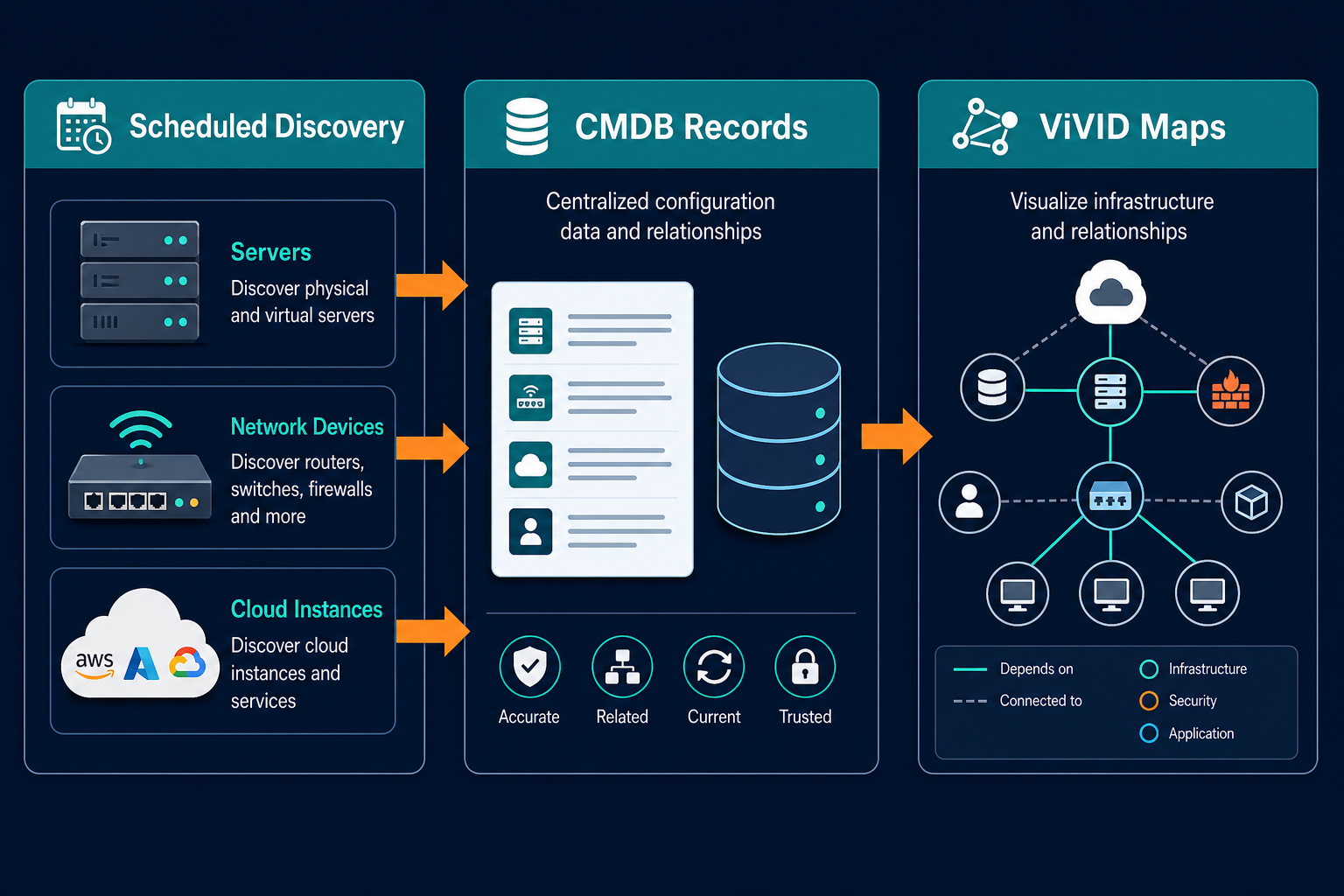
Virima runs scheduled, high-frequency discovery with agent-based, agentless, and cloud API collection, then writes results into a native CMDB. After your team supplies service definitions (manual entry, spreadsheet import, or an architecture feed), ViVID™ builds service dependency maps from that input so change and incident work see installed-on, runs-on, and related links.
Lean staffing is the operating constraint. Capability depth is not reduced to a starter map. The same platform carries ITAM attributes, relationship history, and handoff into ITSM tools such as ServiceNow, Jira, Ivanti, HaloITSM, Xurrent, and Hornbill through documented integration paths.
- Best when: You need discovery that becomes owned CI truth and map context without bolting three products together.
- Watch for: Service composition is defined by you first; map automation follows definitions, it does not invent business services from thin air.
ManageEngine AssetExplorer (and related ManageEngine discovery lanes)
ManageEngine AssetExplorer is a common ManageEngine-class choice for small and medium businesses already in the ManageEngine suite. It focuses on hardware and software inventory, barcode and ownership workflows, and help-desk adjacent asset records. Related ManageEngine discovery and endpoint modules often sit nearby for scan depth depending on what you license.
- Best when: Procurement and desk teams already standardize on ManageEngine and need inventory tied to tickets and ownership.
- Watch for: Confirm how far native relationship and hybrid cloud depth go before you assume CMDB-grade dependency maps. Suite breadth can mean several modules to keep current with a small staff.
Lansweeper
Lansweeper is widely chosen for agentless-heavy network scanning and deep hardware and software attribute collection across offices and plant floors. Many lean teams start here when the first job is find everything on the wire.
- Best when: Network and inventory reporting depth is the primary gap and ITAM reports drive the business case.
- Watch for: Structured CMDB relationships and service maps usually need another system or careful integration design. Pair or graduate when change windows demand blast-radius views, not only asset lists. See also how discovery criteria differ from RMM health tools in RMM vs CMDB discovery for growing IT teams.
Device42
Device42 targets data-center and hybrid discovery with strong topology and dependency emphasis. Mid-market teams with dense on-prem and virtual footprints evaluate it when maps and DCIM-style detail matter early.
- Best when: You have substantial server and network density and want discovery oriented toward relationships from day one.
- Watch for: Implementation and upkeep effort can outrun a two-person admin pair if scope is not tightly phased. Run a bounded pilot before a full-estate promise.
Freshservice discovery (desk-bundled)
Freshservice includes discovery agents and probes that attach assets to tickets and changes inside its service desk. Many SMB IT groups already live in the desk all day, so bundled discovery feels like the shortest path.
- Best when: Ticket context is the main win and the estate is mostly endpoints plus straightforward servers.
- Watch for: Hybrid depth and map quality vary by tier and configuration. Desk engagement and discovery authority are different jobs; keep that split clear when you design the source of truth.
Atera and similar RMM platforms
RMM platforms such as Atera discover and monitor endpoints so technicians can patch, remote in, and close tickets. They earn a place on lean shortlists because one seat often covers monitoring and inventory for Windows-heavy fleets.
- Best when: Daily endpoint operations dominate and you need technician efficiency more than configuration modeling.
- Watch for: RMM inventory answers whether the agent is healthy. It rarely replaces a CMDB built for change impact across databases, network paths, and cloud instances.
Spiceworks Inventory (free ceiling)
Spiceworks remains a starting point for very small shops that need a no-license network list and basic hardware views.
- Best when: Budget is zero and the estate is a single site of PCs and printers.
- Watch for: Cloud instances, durable multi-source identity, and service maps sit outside the free ceiling. Plan the graduation trigger before audit season, not during it.
Is ManageEngine AssetExplorer enough for SMB IT discovery?
ManageEngine AssetExplorer fits many small and medium businesses that need hardware and software inventory beside ManageEngine help desk workflows. Teams still verify hybrid coverage, durable identifiers, and whether dependency maps for change risk require additional CMDB depth beyond asset records.
Side-by-side fit for lean SMB estates
| Option | Primary job | Lean-team fit | CMDB / map path |
|---|---|---|---|
| Virima | Discovery + native CMDB + ViVID™ maps | Full depth without a dedicated discovery admin | Native; maps after service definitions |
| ManageEngine AssetExplorer | ITAM inventory in ManageEngine suite | Strong if suite is already standard | Asset-centric; confirm map depth |
| Lansweeper | Deep network and attribute discovery | Strong scan ops for small network teams | Usually integrate or add CMDB layer |
| Device42 | DC / hybrid discovery and topology | Best with phased scope | Relationship-forward by design |
| Freshservice discovery | Assets beside service desk | Low friction inside Freshservice | Desk-bound; tier-dependent depth |
| Atera (RMM class) | Endpoint monitor and inventory | High for tech seats | Not a full CMDB substitute |
| Spiceworks Inventory | Free basic network list | Micro sites only | Ceiling before hybrid and maps |
For a checklist-first read that scores tools on setup effort and coverage questions, use the companion guide on IT discovery tools for small and mid-size IT teams. This page stays on company size, staffing reality, and shortlist fit.
How lean teams should run the bake-off
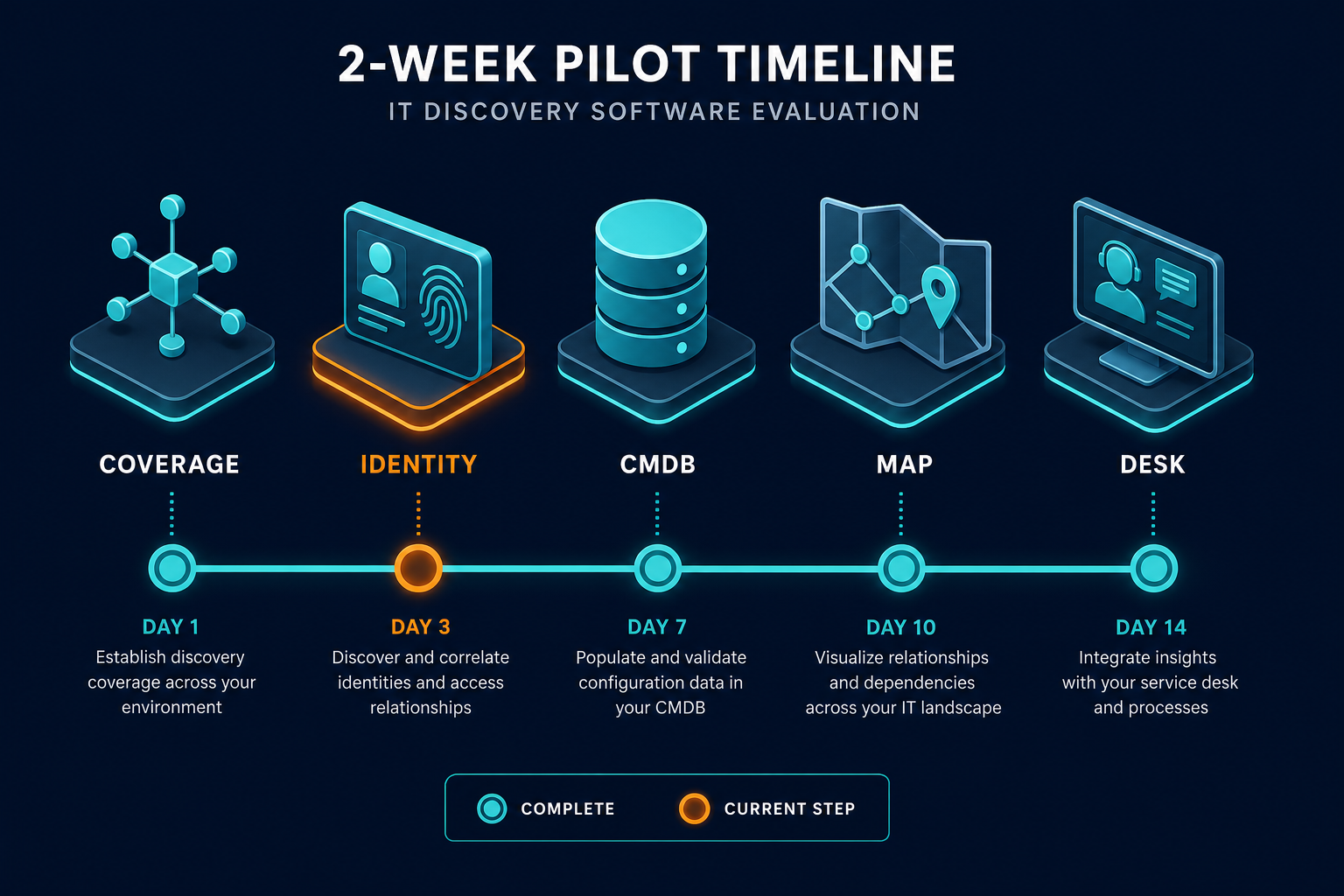
A fair pilot for the best IT discovery software for small and medium business buyers fits in two weeks and answers production questions.
- Pick one failure path, One business application, its database, and the hosts and load balancers underneath.
- Require durable keys, Export must show serial or cloud instance ID join keys, not hostname-only rows.
- Measure staff minutes, Credential setup, exception handling, and weekly reconcile time for the people you actually have.
- Test the CMDB hop, Confirm scan output becomes editable CI records with owners and relationships, not only a report.
- Test the map hop, Supply a simple service definition and confirm the map reflects infrastructure links you can defend in a change meeting.
- Test the desk hop, One incident or change record should pull the same CI the discovery platform holds.
Collection method choice still matters. Agent and agentless each cover different blind spots; the practical split is covered in agent-based vs agentless discovery. Scheduled discovery cycles keep the estate honest without pretending the network never changes between scans.
When the shortlist turns into package and estate-fit questions for a growing company, review the right-sized Business Pro path rather than guessing from a feature matrix alone.
If lean staffing is the constraint and you still need discovery that lands in a CMDB with maps for change risk, explore how Business Pro packages full platform capability for growing IT teams.
Where Virima sits on this shortlist
Virima is on the shortlist when the buying question is larger than which scanner finds printers. IT discovery feeds a living CMDB. Service maps follow once definitions exist. ITAM attributes ride the same records. That path is what lean teams miss when they stop at RMM inventory or a free IP list.
Category framing for discovery-sourced operational truth is documented under Trusted Runtime Truth: what exists, how it connects, what changed, what breaks, and who owns it. Small and medium businesses need that same chain; they simply cannot staff a platform factory to maintain it.
What is the best IT discovery software path for a lean SMB team?
Choose software that covers hybrid assets with sustained agent and agentless collection, stores durable identifiers in a CMDB, and builds service maps after you define services so change and incident work share one estate truth without a dedicated discovery engineer.
Choose the shortlist row that matches your next outage
If the next painful hour will be a missing laptop in a ticket, an RMM or desk-bundled scanner may be enough this quarter. If the next painful hour will be a reboot that takes down an unmapped application, prioritize discovery that becomes CMDB and map truth.
ManageEngine-class inventory belongs on the table when your suite and ownership workflows already live there. Lansweeper belongs when wire-level attribute depth is the gap. Device42 belongs when dense topology is the gap. Virima belongs when discovery must graduate into owned configuration and service context without adding headcount.
Put your lean estate on one discovery-to-map path
Walk a real application path through discovery, CMDB records, and maps with the people who run your Friday windows. Request a demo and bring the failure scenario you already lived once.
Frequently Asked Questions
What is the best IT discovery software for small and medium business teams?
The best fit covers hybrid servers, network, and cloud instances, keeps collection runnable for a small staff, stores durable IDs in a CMDB, and supports service maps after definitions exist. Virima, ManageEngine AssetExplorer, Lansweeper, Device42, and desk or RMM options each win different constraints on that list.
Do small businesses need a CMDB if they already have discovery?
Discovery without a system of record becomes a weekly export. A CMDB holds owned configuration items, relationships, and history so change and incident processes reuse the same truth the scanner produced.
Is ManageEngine good for SMB IT asset discovery?
ManageEngine AssetExplorer is a strong candidate when the organization already runs ManageEngine for desk and inventory workflows. Validate hybrid coverage and whether your change process needs deeper dependency maps than asset records alone provide.
How is this different from a multi-protocol discovery platform list?
Multi-protocol listicles rank scanners for complex protocol and source breadth. This shortlist ranks options by company size and lean staffing, including suite inventory and RMM ceilings, with an explicit path into CMDB and maps.
Does Virima replace our service desk?
No. Virima focuses on discovery-sourced CMDB and service mapping truth. The help desk remains the system of engagement for tickets; integrations pass CI context into tools such as ServiceNow, Jira, and other supported platforms.