Why Autonomous IT Remediation Loops Fail: Closing the Ground-Truth Gap Before AI Acts

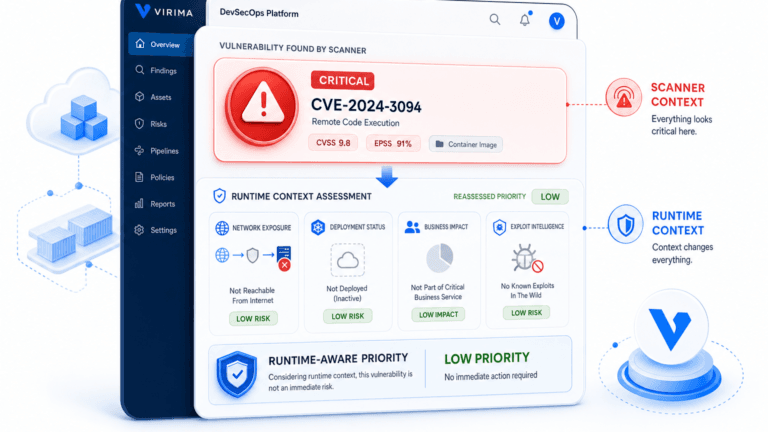
Gartner opens the IT Infrastructure, Operations & Cloud Strategies Conference (IOCS) in Las Vegas on Tuesday, 8 December 2026. The opening keynote focuses on scaling agentic artificial intelligence (AI) for autonomous IT operations. Gartner has also projected that agentic AI will make at least 15% of day-to-day work decisions autonomously by 2028, up from 0% in 2024. Infrastructure and operations (I&O) leaders are being asked to move production loops that detect, diagnose, act, and close with fewer people in the loop. Autonomous remediation runtime context, not model quality, is where that autonomy fails.
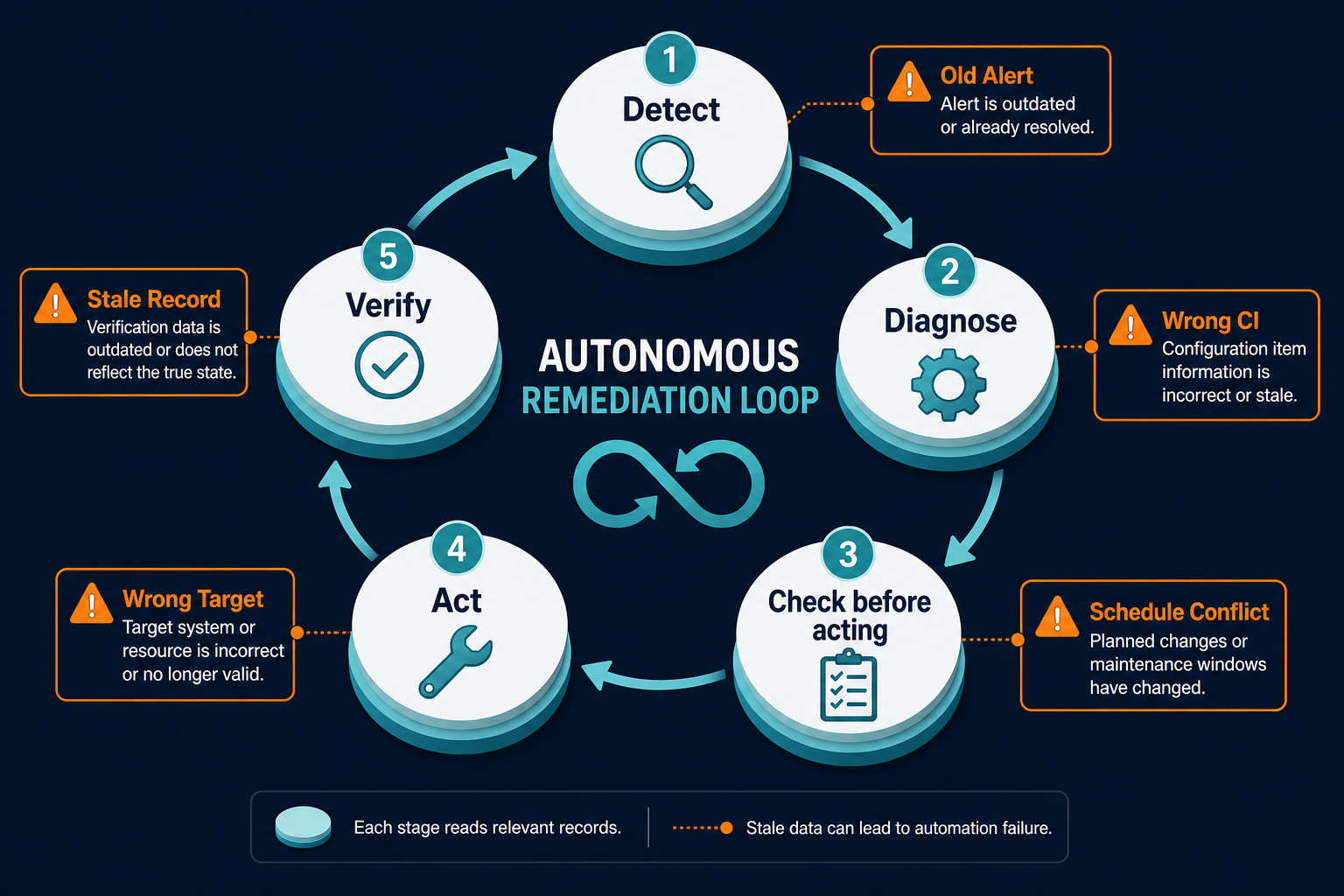
Each stage of a remediation loop trusts a record about the thing it is about to change. When that record is old, incomplete, or in conflict with what the loop observes, the fix can land on the wrong target, miss dependents, or never stop.
A documented case outside IT still shows the pattern. In the Knight Capital settlement summarized by WilmerHale (SEC order settled 16 October 2013), a trading system on 1 August 2012 sent more than 4 million orders to fill 212 small retail orders in the first 45 minutes of the open. Ninety-seven automated emails flagged the error before the open and were not reviewed. The SEC found missing controls to stop a system responding to its own aberrant behavior and to keep inactive code on servers from being activated. Knight Capital was a market-access trading incident, not an IT remediation loop, and the order is more than a decade old. It remains a clear case of automation acting on server and code state nobody had verified, with no halt. The operating question for autonomous remediation runtime context is the same: when an agent acts, which record does it read about the configuration item (CI) it is about to change?
What Gartner is asking operations teams to scale
Gartner’s public IOCS framing centers on scaling agentic AI beyond experiments — the people, team, operating-model, governance, and technology decisions needed to sustain autonomous IT operations. The opening-keynote abstract does not name data quality, configuration management databases (CMDBs), remediation runbooks, or pre-action estate checks. Those details are Virima’s reading of what a production loop requires, not claims Gartner made in the session copy.
Teams already hear “runtime context” in several places. The phrase rarely means the same thing.
| How “runtime context” is used | What it usually covers | Does it say what the target’s record shows before the action? |
|---|---|---|
| Agent session history (for example in the Autonomous Action Runtime Management preprint on arXiv) | Prior requests, tool outputs, and the agent’s own decision trail | No |
| Security attack-path or posture context | Paths, findings, and control state in a security product | No |
| Observability topology for ownership and blast radius | Maps used after detection to explain impact | No |
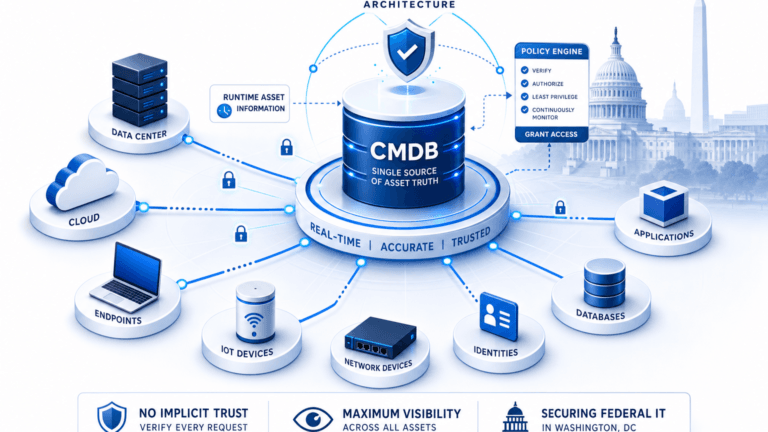
A security or observability “context engine” answers a different question than the one a remediation loop needs answered before it acts — it maps attack paths or topology, not whether the target CI’s own record is current. Autonomous remediation needs a fourth input: a CI-of-record check, read separately from whatever a context engine already surfaces. For the dependency-context layers that sit underneath that check, see the five dependency-context layers for pre-production checks.
Virima’s reading is that autonomy is a loop, and each stage trusts a record. Gartner has not framed the problem that way. If the record the loop reads about the target is wrong at decision time, governance ladders and post-action rollback sit downstream of a bad choice.
Where an autonomous fix reads the wrong record
Autonomous remediation is the five-stage loop behind what teams call self-healing IT. Each stage reads a different record about the target, and the age and source of that data decide whether the next stage is safe.
| Stage | What the loop reads | Where that data comes from | What goes wrong if it is old |
|---|---|---|---|
| Detect | An alert from monitoring | Monitoring tool | Alert names a host that has since changed role |
| Diagnose | Which CI the alert refers to, and its dependencies | CMDB record and service map | Wrong CI chosen, or dependents missing |
| Check before acting | The target’s record, owner, scheduled changes | CMDB, IT asset management (ITAM) ownership, IT service management (ITSM) change calendar | Action runs during a freeze or reaches an owner who has left |
| Act | A runbook or script | Automation tool | Script runs against the wrong target |
| Verify and close | The result, compared with the expected state | The same record read at the start | The check passes against the same stale record, or the loop retries |
The alert points at the wrong target
The operating question is simple: is this CI the one the alert names? The loop needs the record source, the last-seen date, and a named owner. Hostnames and network addresses get reused across rebuilds, so a monitoring label that still points at last quarter’s role sends diagnosis down the wrong path before any runbook starts.
The age of that record is bounded by the discovery cycle that produced it. High-frequency scheduled discovery narrows the gap; it does not remove it. Between cycles, a host can be rebuilt, re-IP’d, or reassigned. The loop should surface last-seen time at decision time so operators can decide whether the identifying data is fresh enough for an automated action. Skipping that field turns detection into a guess about identity.
The fix reaches services nobody linked to it
The operating question moves one hop out: what depends on this CI, two hops out? Dependency structure for business services comes from discovery-sourced maps once the team has defined which applications and sites make up each service. ViVID™ service maps build that structure from discovery data and those team-defined services. Service mapping is the place to understand how that structure is maintained. Scheduled and recent changes on the target also matter. A freeze window lives in the ITSM change calendar, so the loop must read the map and the calendar together. Change intelligence is one way teams keep recent and planned work visible beside the CI.
Dependencies that were never mapped stay invisible to the loop. Absence of a mapped edge is not proof that nothing depends on the target; it only means nothing in scope was linked. For a plain definition of impact paths, see what blast radius means in IT. The limit for this stage is coverage of the map plus a separate read of change freezes. The record cannot invent a freeze that only exists in the ITSM tool.
The loop never closes, or two loops fight
The operating question is control: when the record and the observed state disagree, who stops? That’s why verify often rereads the same CI fields that were wrong at diagnose time — the check can “pass” against stale expected state, or the loop can retry the same act. Two automations can also claim the same CI in one cycle and undo each other. That multi-agent conflict is a coordination problem on a shared target, not a claim that any CMDB discovers or registers AI agents.
A stop condition teams can adopt is concrete. Halt and route to a named owner when the record and the observed state differ, or when the same CI is touched twice in one cycle. The Knight Capital order, per the WilmerHale summary, stressed the lack of a control to halt a system responding to its own aberrant behavior. Stop rules live in the automation platform or ITSM workflow. The estate record supplies last-seen, owner, and dependency fields that those rules can evaluate. The record does not enforce the halt by itself.
What the loop needs underneath
An action is only as safe as the record it was chosen from. Four attributes on that record do more work than a single accuracy percentage:
- Source of the last write or discovery feed
- Last-seen date on the CI
- Named owner that is still current
- Dependency structure for services in scope
A bare accuracy score does not tell the loop whether this CI can be trusted for an automated act tonight. Two sources can disagree on the same attribute while the score still looks acceptable. Multi-source reconciliation that avoids last-scan-wins is the discipline behind visible conflicts. Write and speak in terms of what the record shows. Systems store and display fields; they do not “know” or “believe” anything.
A pre-action checklist your team can adopt
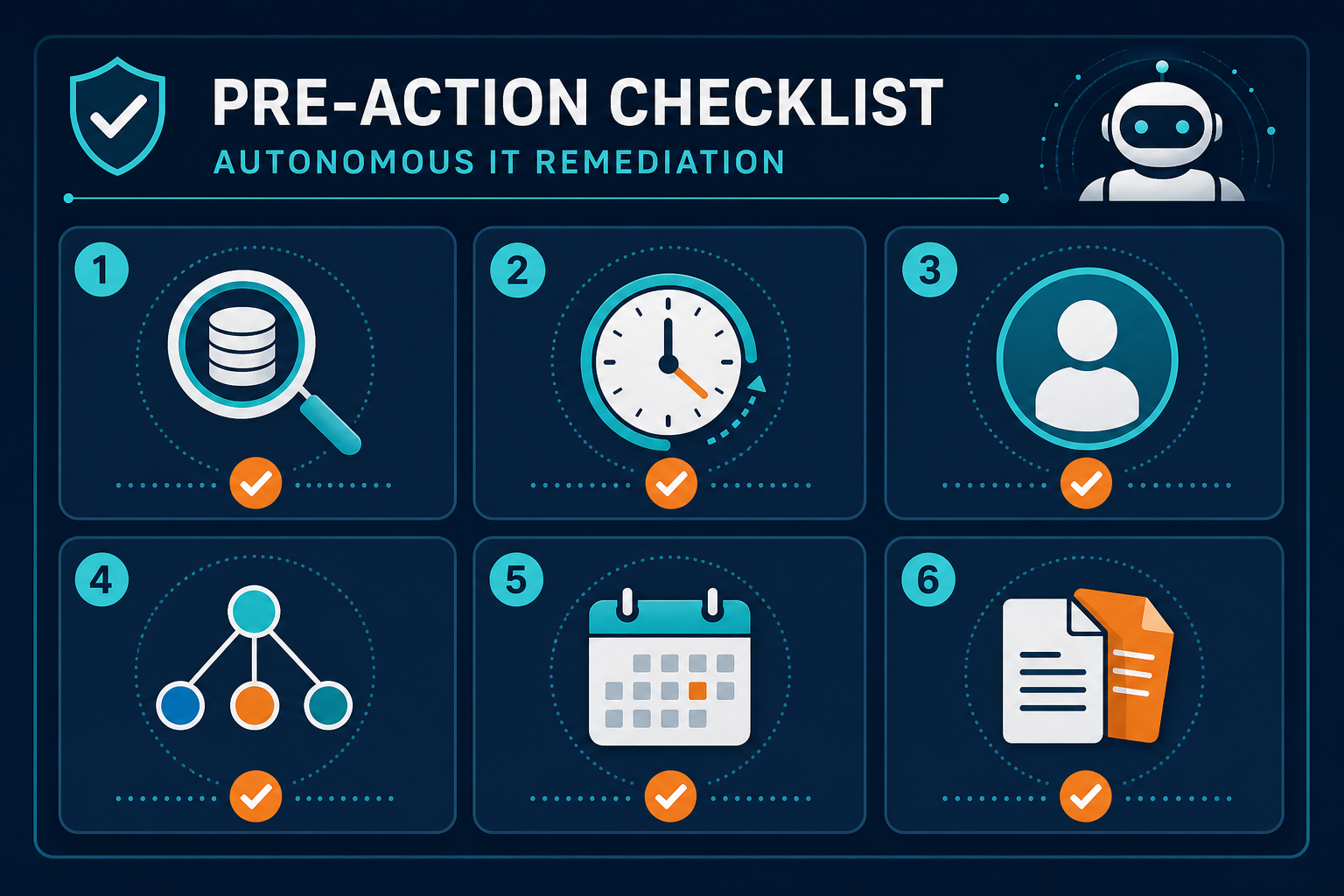
Before an agent or runbook acts inside an automation boundary, the target CI should pass a short record check centered on source, age, ownership, conflict, and stop readiness. It is not a substitute for the broader context-versus-enforcement treatment in Virima’s AI agent production safety context layer post.
| Check | Field the record needs | Where it comes from | Does Virima supply it? | Limit |
|---|---|---|---|---|
| The CI exists and matches the alert | Source, last-seen date | Discovery-sourced CMDB | Yes — high-frequency scheduled discovery | Bounded by discovery cycle age |
| A named, current owner | Ownership label | ITAM ownership data | Yes — ownership and lifecycle status labels | No automated retirement workflow for people |
| Dependent services | Dependency structure | ViVID™ maps from discovery and team-defined services | Yes — ViVID™ service maps | Unmapped edges stay invisible |
| Scheduled or recent changes on the target | Change overlay plus freeze calendar | ViVID™ overlay and ITSM change calendar | Partial — ViVID™ overlay only | Freeze itself lives in the ITSM tool |
| Two sources disagree | Visible conflict on the attribute | Multi-source reconciliation | Yes — conflict surfaced, not resolved | Team must decide which source wins |
| Record older than the team’s own limit | Last-seen versus team policy | CMDB field plus orchestrator policy | Partial — supplies the field | This post sets no numeric threshold |
One internal measure worth tracking is the share of CIs inside the automation boundary that pass all six checks — a local health signal, not an industry benchmark. Widen automation scope only after those checks hold; see trustworthy CMDB practices before you scale AI automation for controlled scope growth, and CMDB readiness for agentic AI for the fuller set of discovery-sourced requirements — source attribution, lifecycle status, and reconciliation history among them — behind agent readiness.
Virima gives the remediation loop a record to check
Virima supplies discovery-sourced records and maps the loop can read before it acts, over a REST API (JSON; GET, POST, PATCH; API key and tenant ID), plus two-way sync with ServiceNow, Jira Service Management, Ivanti, Halo, Xurrent, Hornbill, and TeamDynamix via the integrations hub. The orchestrator still owns approve, act, halt, and rollback logic.
Limits stay plain: Virima does not run, approve, block, or roll back a remediation; does not enforce policy, patch, or scan; cannot see inside an automation vendor’s platform; and does not discover or register AI agents or models. Published cloud discovery imports are Amazon Web Services and Microsoft Azure. Context from the estate record is not enforcement — the automation and ITSM tools still own the gate.
Configuration owners are asked to vouch for records an agent will now use at machine speed, often without a fresh mandate or extra headcount. The job is to make source, last-seen, owner, and dependency structure visible at decision time so the orchestrator can stop when those fields fail the team’s bar.
Questions to put to your automation vendor
Put these to the automation or agent platform, not to the CMDB alone.
| Question | What a useful answer shows |
|---|---|
| What does the agent read about the target before it acts? | Named fields, not a vague “context” label |
| Does it show the record’s source and last-seen date? | Date and source visible at decision time |
| What happens when the record and the observed state disagree? | A halt and a named owner |
| How does it read the change freeze calendar? | A direct read of the ITSM calendar |
| What stops two automations from undoing each other? | A shared lock or claim on the target CI |
Answers that only describe post-action rollback leave the pre-action record gap open. Answers that only describe the agent’s session history leave the estate record untouched.
Closing the ground-truth gap before the next autonomous act
Scale agentic AI on remediation only when each stage of the loop can show which record it trusted, how old that record was, and what happens when the record and the observed state diverge. Build the pre-action check into the orchestrator, keep discovery on a schedule the team can defend, and keep stop rules where actions actually run.
Virima will be at Gartner IOCS 2026 in Las Vegas. Register for the event to meet the team and walk the record layer behind autonomous remediation at Booth 645.
Frequently Asked Questions
What is autonomous remediation in IT operations?
Autonomous remediation in IT operations is a loop that detects an incident, diagnoses a target, acts with a runbook or script, and verifies the result with limited human steps. Infrastructure and operations teams still set the policies, freeze windows, and stop rules that bound those actions.
What is runtime context for an AI agent?
Runtime context for an artificial intelligence agent often means the agent’s own session history, prior tool outputs, and request trail. Autonomous remediation runtime context also needs the target configuration item record: source, last-seen date, owner, and dependencies, separate from that session history.
Why do automated fixes repeat or loop?
Automated fixes repeat when the verify step rereads the same stale configuration item fields used at diagnosis, so the expected state never matches observed state. Two agentic AI remediation jobs can also claim one target in the same cycle and reverse each other without a shared lock.
Can an agent check a configuration item before it acts?
An agent can read a configuration item over a representational state transfer application programming interface before it acts, including source and last-seen fields. The check logic and halt rule still live in the agent or orchestrator, not in the configuration management database alone.
Does Virima run or approve remediations?
Virima does not run or approve remediations. It supplies discovery-sourced configuration management database records, ViVID™ service maps, ownership labels, and application programming interface access for pre-action reads. Approval, execution, halt, and rollback stay in the automation and IT service management tools that run the loop.
Does Virima integrate with the ITSM tool we already use for change freezes?
Virima keeps two-way sync with the ITSM tools most teams already run — ServiceNow, Jira Service Management, Ivanti, Halo, Xurrent, Hornbill, and TeamDynamix — so change freezes and ticket status stay visible next to the CI record instead of requiring a platform switch.