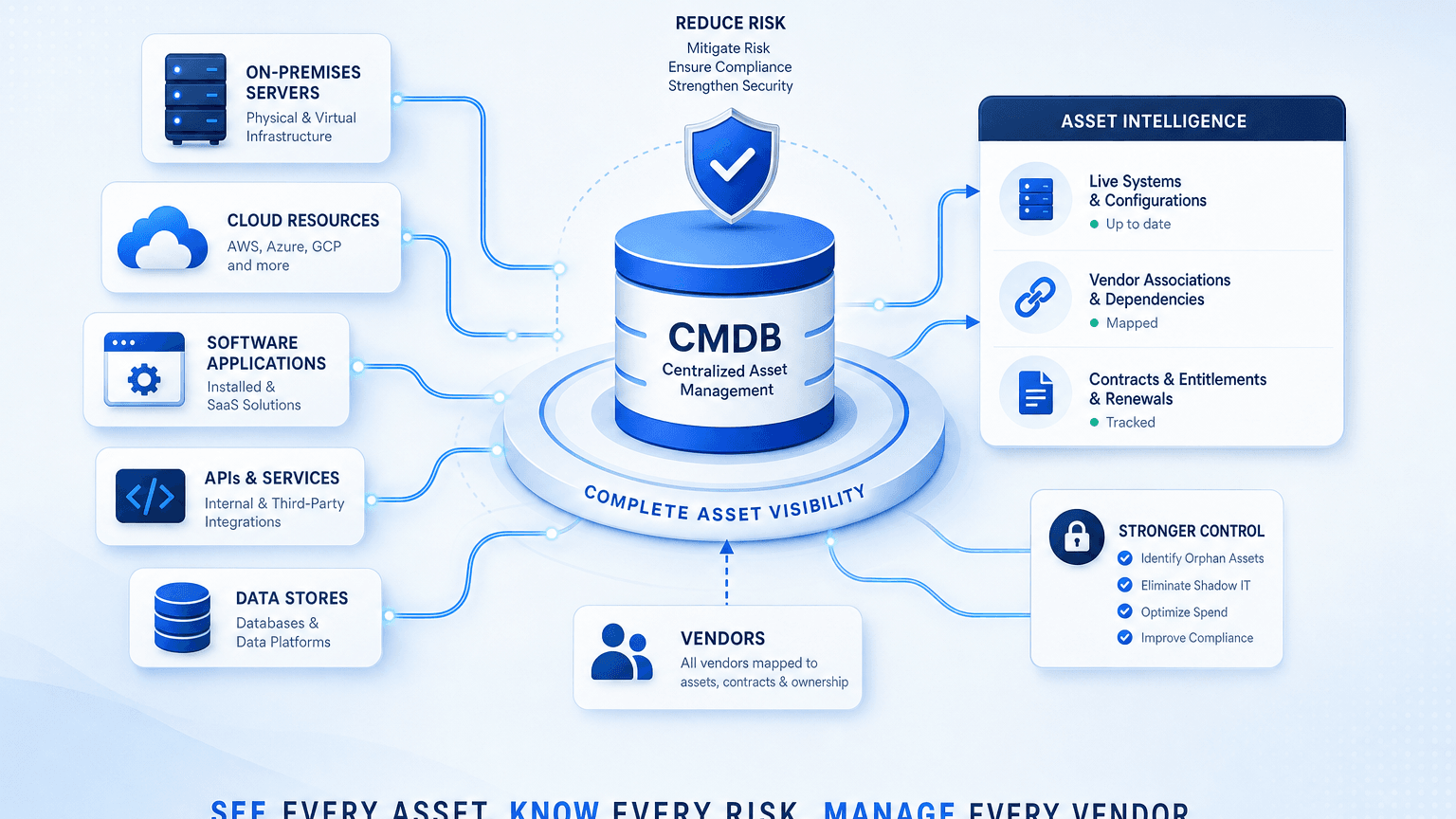
Vendor Management Best Practices Still Fail Without Asset Visibility

A vendor security notice lands at 9:14 a.m. The scorecard looks fine. The MSA is current. The quarterly review deck still says “low residual risk.” By 9:40 a.m. the real work starts: which hosts and APIs still run their code, and who owns each one. Most vendor management best practices stop one step short of that answer. They treat relationship and contract as the full program and assume you already know what that vendor touches live.
Why most vendor management advice stops one step short
Search “vendor management best practices” and the search results still center around relationship and contract discipline. Escalate when performance slips. The same articles almost never open with the join key those practices depend on: a current map from vendor identity to installs, platforms, cloud resources, and integrations. InvGate’s IT vendor management guidance still frames process, tools, and relationship quality as the core stack. Teams typically review vendors against portfolio lists that rarely match runtime installs. Contract records name products and SKUs. Estates name hostnames, images, and service accounts. Without a bridge kept current through high-frequency discovery cycles, those two systems only meet in an emergency spreadsheet session. Logging a vendor as an entity inside a CMDB is not the same as joining that vendor to live installs on a refresh cycle — that join, not the log entry, is the gap this article closes.
IT asset tracking stays useful for vendor work when publisher and product fields still match what discovery last saw.
Where do most vendor management best practices stop short?
They stop at relationship, contract, and questionnaire discipline while assuming teams already know which live systems a vendor’s software or hardware still touches. That assumption breaks when a breach notice, end-of-life bulletin, or compliance flag demands an install-level answer instead of a scorecard.
The question every vendor incident actually asks
Vendor risk gets tested on a clock. A disclosure drops. A product line goes end-of-life. A regulator or customer questionnaire flags a control gap. A breach at a supplier hits the news desk before your internal ticket queue.
What should teams map before a vendor breach happens, not during one?
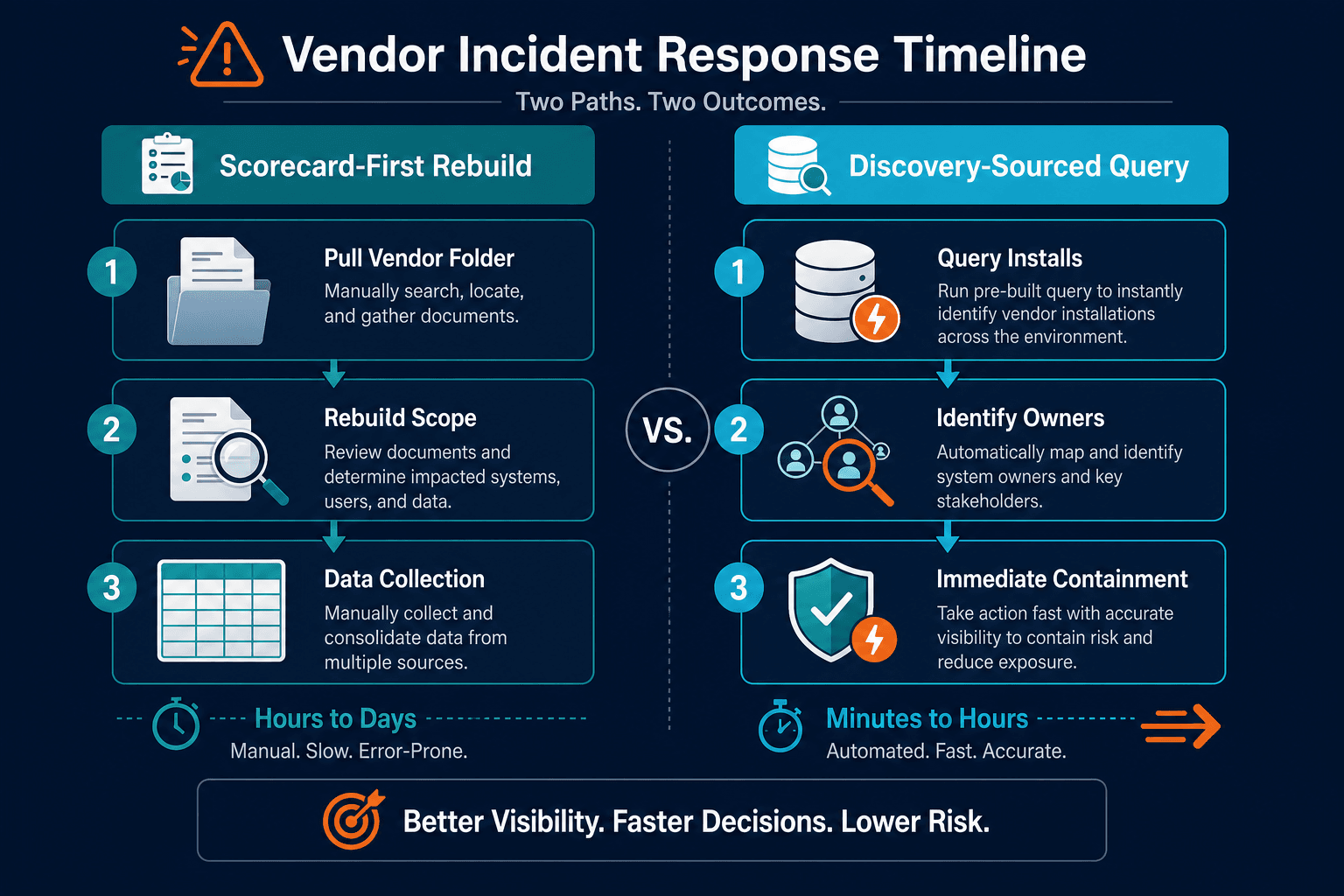
Security teams need a standing list of every system, integration, and credential tied to a vendor before a breach notice arrives — not one assembled after. Discovery-sourced CMDB relationships make that list queryable in minutes instead of a scramble across email threads.
The timed operational question is which of your systems run their software or hardware right now, and who owns each configuration item (CI). So most organizations fall back on email threads to application owners, partial CMDB exports, and last year’s software asset management (SAM) reconcile.
CISA’s SBOM program treats nested software inventories as a supply-chain control input required for modern response. An SBOM without a matching deploy inventory still leaves responders guessing where a vulnerable component runs. CISA Binding Operational Directive 23-01 pushes federal civilian agencies toward timely asset visibility for known exploited vulnerabilities. Vendor-driven exposure follows the same physics: you cannot prioritize what you cannot locate.
The difference shows up in the first hour: rooms that open with “pull the vendor folder” rebuild scope first, while rooms that open with “query installs tagged to this publisher” spend that hour on containment. The gap is whether inventory already held the publisher-to-install join.
When partial vendor lists still drive breach response, start with Trusted Runtime Truth. Pressure-test whether publisher, product, and last-seen facts still come from discovery after the last vendor review.
Best practices that depend on asset visibility
Standard vendor programs still need familiar controls. Each one depends on estate truth.
Vendor risk scoring
Risk scores weight data access, criticality, financial exposure, and control maturity — the inputs a vendor risk asset inventory is supposed to supply. Criticality collapses without knowing whether the vendor’s stack underpins a crown-jewel service or a lab VLAN. A “medium” agent score becomes “high” when discovery finds it on every payment host. That’s also the input tiering models miss when they classify a vendor once at onboarding and never re-run the classification against what discovery finds live.
SLA compliance tracking
SLA dashboards measure ticket response, uptime credits, and delivery milestones. They rarely measure whether the contracted product versions still match what discovery finds running. SLA green status can hide operational risk.
Contract renewal management
Renewal packets pull seat counts, module lists, and historical spend. They underperform when entitlement counts cannot join to actual installs and hardware platforms. Auto-renewals can lock coverage for products that already left the estate.
Security review cadence
Annual or semi-annual reviews collect SOC reports, pen-test summaries, and questionnaire answers. Reviewers still need a scope list: which internal systems process data with that vendor, which connectors hold credentials, which network paths remain open. A review that scopes only the SaaS console while appliances stay unlisted leaves residual paths open.
Security teams that align vendor scope lists with live host and software populations apply the same asset ownership and refresh rigor used in cybersecurity asset management programs.
See how discovery-sourced inventory ties each vendor’s software and hardware to live CIs, owners, and last-seen facts so the next notice opens with a system list instead of a spreadsheet hunt.
Program language without matching inventory refresh
Many playbooks say monitor vendors on a standing cadence. Questionnaire schedules differ from asset-join refresh schedules. High-frequency discovery cycles keep publisher, version, and relationship fields current enough that the next notice does not start from a stale CMDB export.
How does asset visibility change vendor risk scoring?
Risk scores gain meaning when criticality and data exposure map to discovered installs, owners, and service context for that vendor’s stack. Without that join, scores reflect contract and questionnaire quality while understating hosts and integrations that still run the product in production.
Vendor management practice vs. what it silently assumes
| Best practice | What it assumes you already know | What closes that gap |
|---|---|---|
| Vendor risk scoring | Which services and data paths the vendor’s stack still supports | Discovery-sourced CIs, installs, and service relationships tied to publisher and product |
| SLA monitoring | Which contracted versions and components still run in production | Versioned software and appliance inventory refreshed on high-frequency cycles |
| Security review | Full system, integration, and credential scope for the engagement | CMDB relationships from vendor products to hosts, accounts, and connections |
| Contract renewal | True install and platform counts vs. entitlement lines | Normalized publisher/product data joined to entitlements and owners |
| Vendor offboarding | Every residual install, agent, API client, and device still present | Authoritative inventory plus decommission checklist driven by live CI lists |
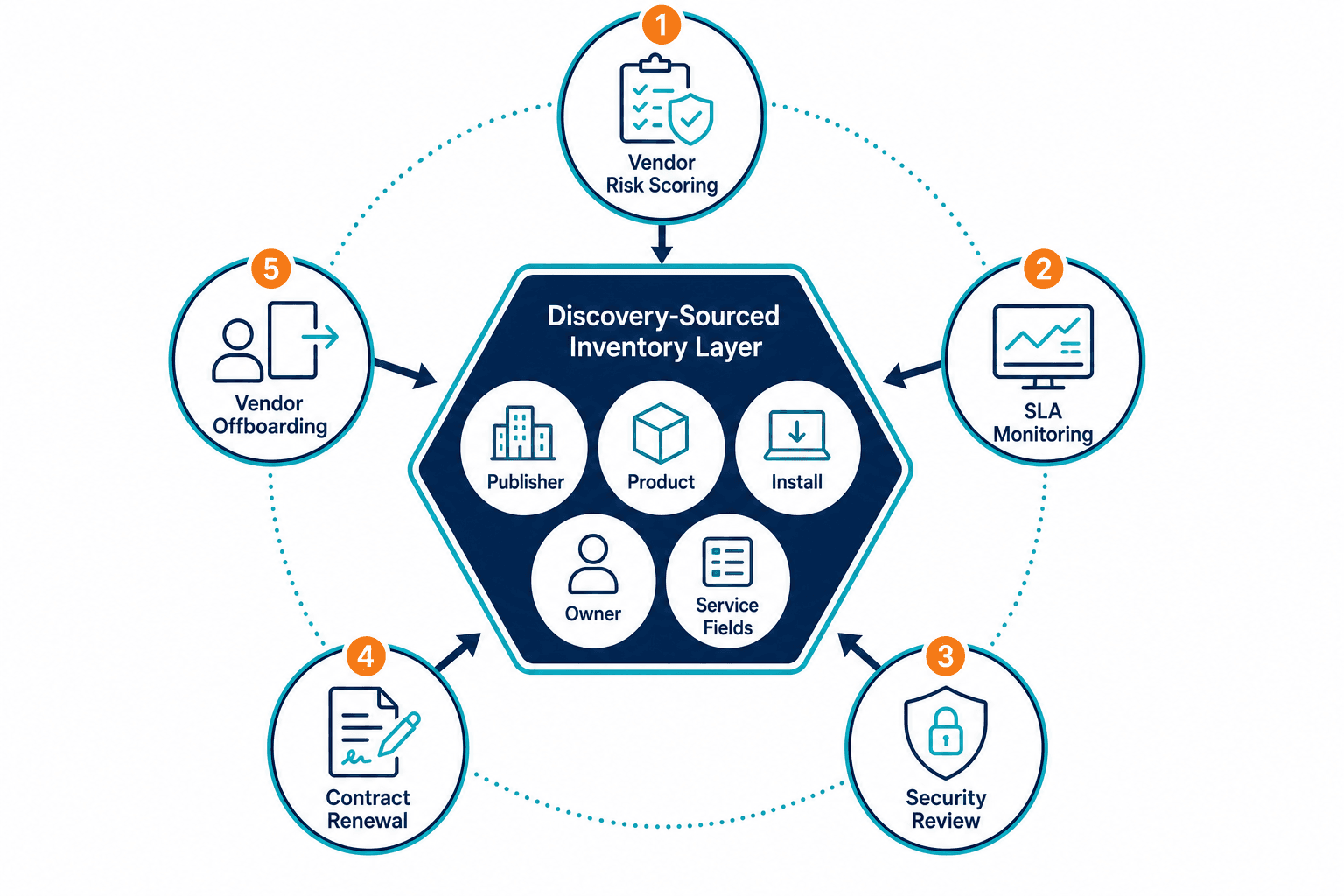
What vendor offboarding actually requires
Offboarding is the cleanest proof of the visibility gap. Contract end dates are easy. Residual technical presence takes longer to prove. A vendor offboarding systems inventory is what closes that gap.
When a vendor relationship ends, teams must identify and close more than the MSA:
- Agents and collectors on endpoints
- On-prem appliances and virtual appliances
- Cloud marketplace subscriptions and linked identities
- API clients and service accounts in identity directories
- Scheduled jobs that still call vendor endpoints
- Network allow-list entries
- Backup and DR images that reintroduce old agents after cleanup
Without a current inventory, offboarding becomes a best-effort email to remove the tool. Weeks later, discovery still finds the agent on a branch office image. Security still finds an OAuth grant. Finance still pays a small line item nobody owns. That residual footprint is vendor risk after the relationship formally ended.
For IT Operations Directors at financial services, healthcare, and MSP organizations, that residual footprint is also an audit finding waiting to happen — regulated exams ask for proof of complete vendor exit, not a best-effort email thread.
NIST’s supply-chain risk guidance in SP 800-161 Revision 1 stresses visibility into supplier-related components across the system lifecycle. Offboarding is a lifecycle event. It needs the same component-level truth onboarding claimed to establish.
Pair offboarding checklists with end-of-support discipline. When a vendor sunsets a product while some hosts still run it, the same inventory question returns under a different label. See how end-of-support asset risk shows up when support calendars and install truth diverge.
What does complete vendor offboarding require beyond ending the contract?
It requires a current list of residual installs, agents, appliances, cloud resources, API clients, service accounts, and network paths tied to that vendor, plus owners who can close each item. Contract closure without inventory-driven decommission leaves technical access and data paths active after the MSA ends.
Where this closes the loop
IT vendor management best practices stay intact when a current asset inventory sits underneath them. TPRM processes, GRC workflows, and procurement scorecards still own questionnaires, legal terms, and residual-risk decisions. Those systems need discovery-sourced install truth so scoring, SLA tracking, reviews, renewals, and offboarding can answer the system-level question without a war-room scrape.
Operators still need owners, versions, and service context on the same record the risk team uses for scoring. A discovery-sourced configuration management database (CMDB) supplies that layer — the third-party risk CMDB that ties vendor products to hosts, accounts, and connections. It carries publisher and product on software CIs, hardware platforms still under vendor support, relationships into services once service definitions exist, and owners who can act when a notice arrives. High-frequency scheduled discovery cycles (agent, agentless, and API where appropriate) keep the join current between quarterly vendor reviews. That cadence is what turns a vendor notice into a first-query report instead of an ownership chase across three spreadsheets. Procurement still owns the commercial file. Operations owns the install truth that makes that commercial file usable under pressure on day one of a notice.
Virima provides that CMDB and discovery layer and feeds the ITSM platforms teams already run, including ServiceNow, Jira SM, and Ivanti, through one hub at all integrations.
Turn vendor risk into an inventory-backed answer
Keep the scorecards and reviews. Add discovery-sourced asset visibility so risk scoring, renewals, and offboarding read the same estate the operators see. Vendor management best practices hold up when discovery-sourced asset visibility backs risk scoring, renewals, and offboarding. Request a demo to see how publisher, install, and CI truth stay current enough for the first query after a vendor notice.
Frequently Asked Questions
Why do vendor risk scores miss real exposure?
Scores often weight contract terms and questionnaire answers without a current map of installs, appliances, and integrations for that vendor. Exposure follows what still runs more than what procurement filed.
What should teams query to find out which systems a vendor breach affected?
Query discovery-backed inventory for publisher, product, version, host or cloud resource, owner, and related services. Start containment and owner outreach from that list instead of rebuilding scope from email threads.
How is vendor offboarding different from closing the contract?
Contract closure ends commercial terms. Technical offboarding removes residual agents, appliances, API clients, service accounts, network paths, and reimage sources. Inventory makes that checklist complete and auditable.
How does Virima’s CMDB tie vendor products to live systems?
Virima’s discovery-sourced CMDB links vendor publisher and product data to live hosts, cloud resources, and owners on the same high-frequency refresh cycle used for the rest of the estate — so a vendor incident starts from a system list, not a portfolio guess. It runs alongside TPRM and vendor management tools rather than replacing their relationship and assessment workflow.
What inventory fields matter most for vendor incidents?
Publisher, product, version, last-seen host or cloud resource, owner, and service relationships when service definitions exist. Those fields turn a vendor notice into a scoped containment list instead of a portfolio guess.