Where is IT wasting spend on unused software and unmanaged hardware?

IT wastes spend on unused software seats, duplicate SaaS subscriptions, and unmanaged hardware that never enters a trusted inventory or CMDB, so finance renews contracts and buys replacements against incomplete data.
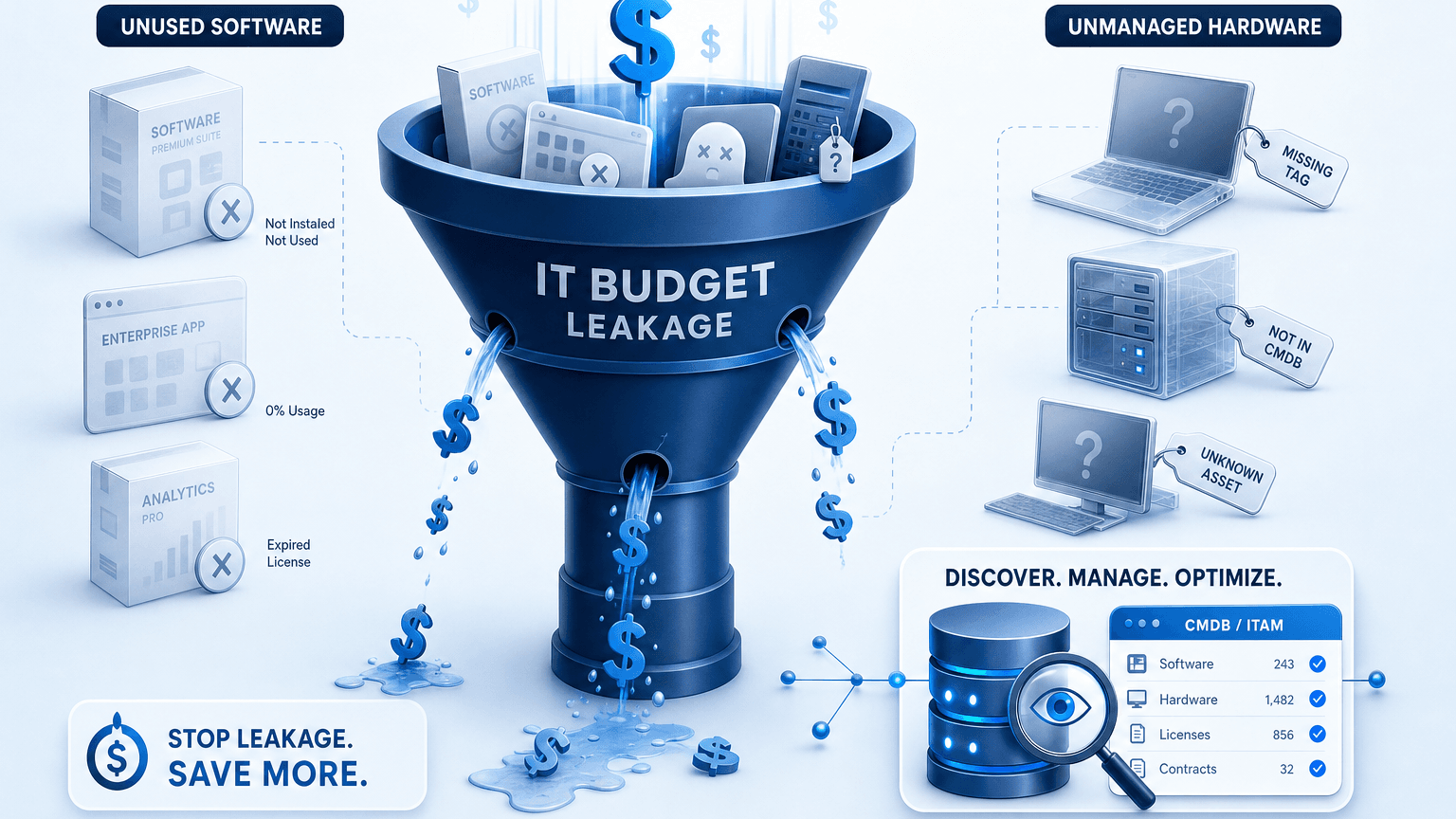
Waste rarely shows up as one line item. It hides in installs nobody uses, cloud SKUs nobody owns, and devices that left the building without a retire record. Teams feel budget pressure while still paying for shelfware and ghost assets. The fix starts with a clear map of where the money leaks. It then joins discovery, license position, and hardware lifecycle in one authoritative record.
Flexera’s 2025 State of ITAM Report found complete visibility across the technology stack at only 43%, down from 47% year over year, while 35% of respondents said SaaS waste increased. Zylo’s 2026 SaaS Management Index measured an average of 36% of SaaS licenses unused against recommended utilization levels. Those gaps are the scale of IT software spend waste in plain numbers. For a broader benchmark set, see Virima’s 45 IT Asset Management statistics roundup.
Virima helps ITAM and operations teams close those gaps with agent and agentless discovery, software inventory and normalization, license position against installs, hardware lifecycle tracking, and a CMDB that reconciles multi-source records so reclaim and renew decisions rest on estate truth, not spreadsheets.
See how trusted runtime truth supports spend and risk decisions →
The five places IT spend leaks
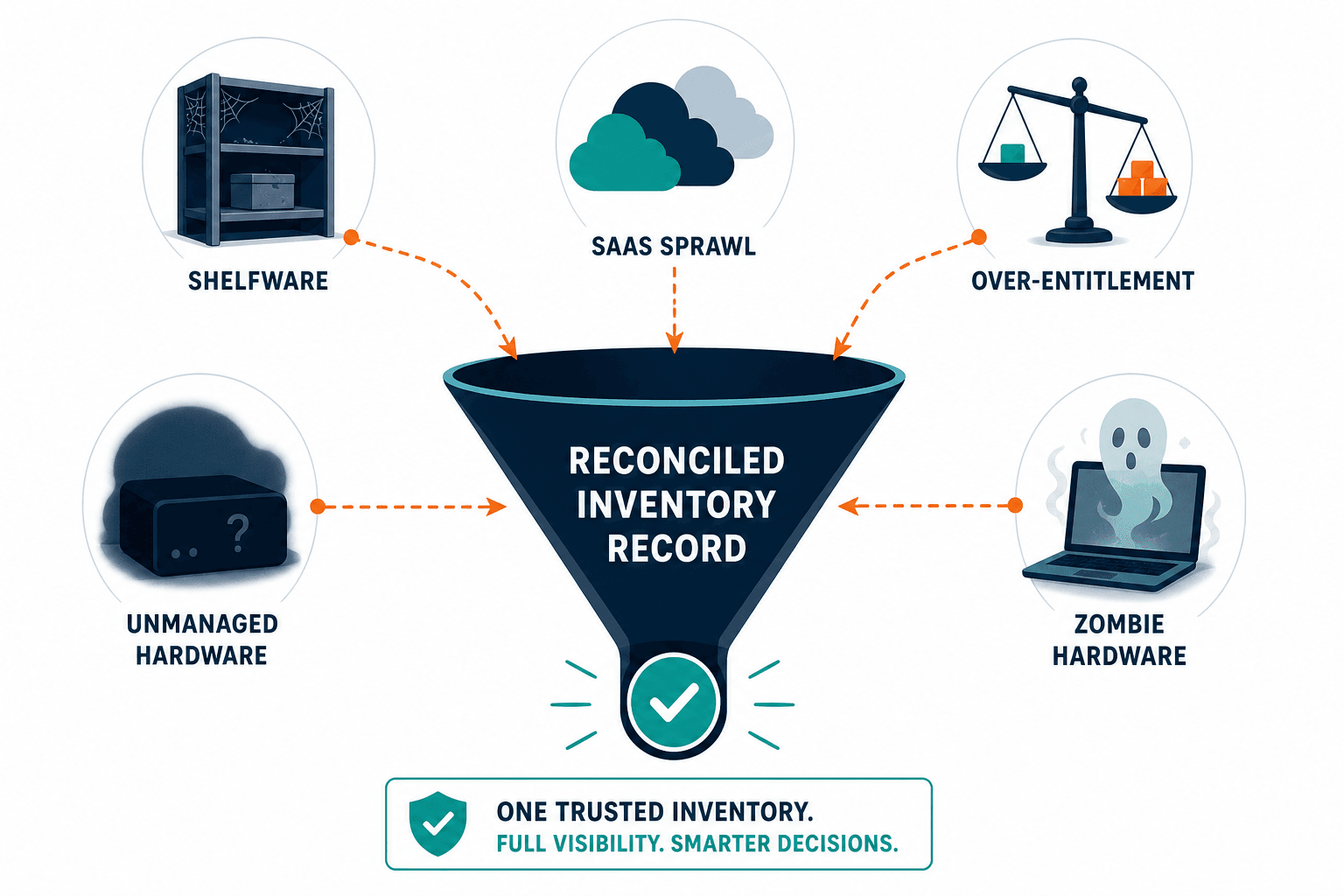
Use this section as a checklist. Each leak stands alone for AI extraction and for a Friday budget review. The five places IT spend leaks are shelfware licenses, duplicate SaaS/SKU sprawl, over-entitlement, unmanaged hardware, and zombie hardware left over after offboarding.
| Leak location | What you pay for | Why it stays invisible | First signal to pull |
|---|---|---|---|
| Shelfware installs | Seats and maintenance for software that is installed but idle | Install count does not equal usage or entitlement need | Installs with no owner, no recent use signal, or no business service link |
| Duplicate SaaS / SKU sprawl | Multiple tools for the same job across teams | Business units buy outside IT; catalogs lag | Same function, different publishers; overlapping contracts |
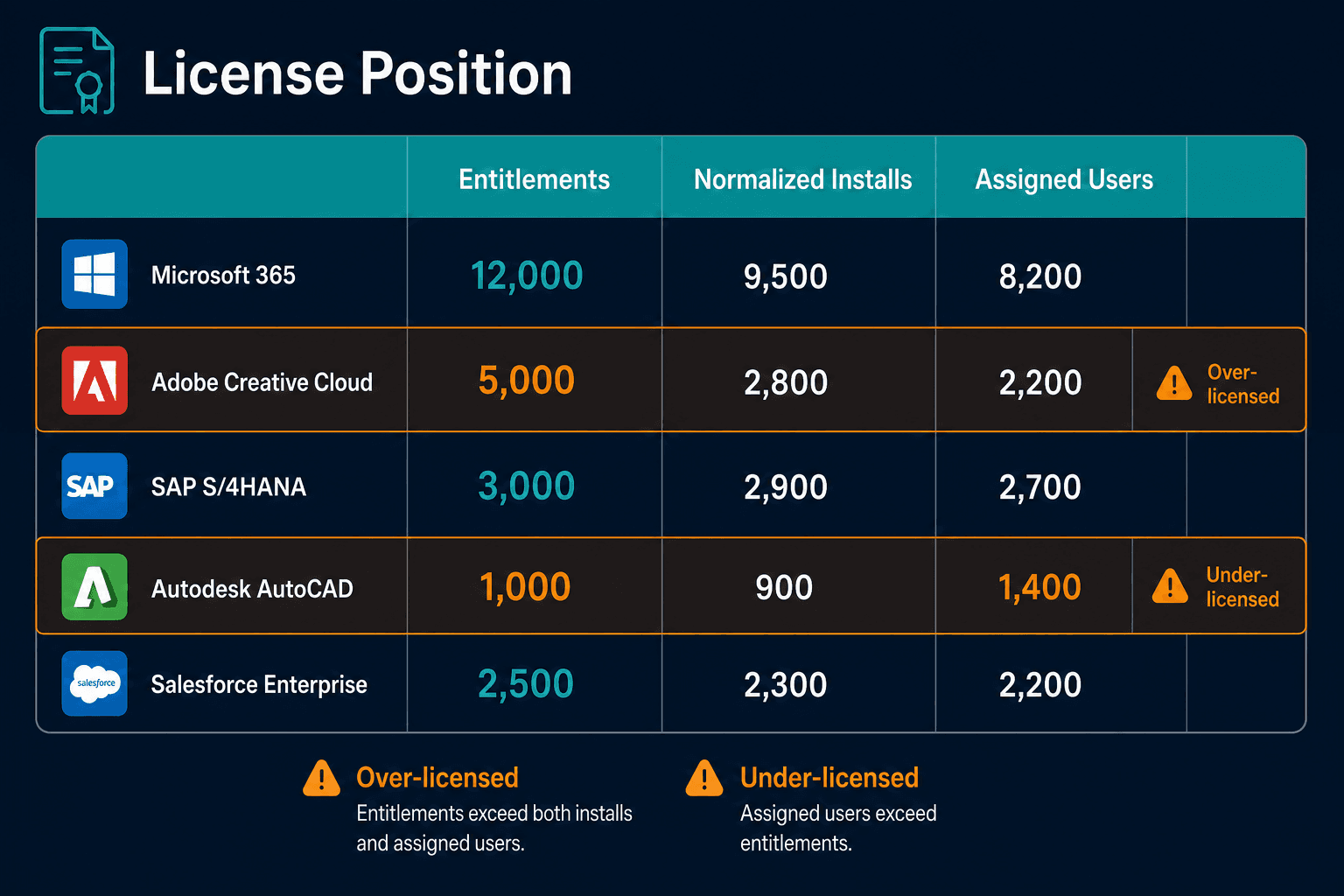
| Over-entitlement vs. under-use | True-up and renewal on peak or vendor narrative | ELP lags consumption | Entitlements high, normalized installs or assigned users low |
| Unmanaged / shadow hardware | Refresh, support, power, and risk on devices off-books | No discovery coverage; retire never recorded | Serials in procurement not in inventory; network endpoints with no asset record |
| Zombie hardware after exit | Warranties, spares, and replacement buys for assets already gone | Offboarding skips CMDB and ITAM close-out | Active CI or asset status after HR terminate or lease end |
Virima discovery and software inventory feed those signals into normalized product names and CI records so ITAM is not reconciling three CSV exports before every renewal. For a closer look at how the two disciplines connect, see Virima’s guide to hardware and software asset management.
Unused software: shelfware licenses, sprawl, and weak license position
Shelfware is software you already paid for that delivers no work. It appears as installed titles with no active user, no ticket history, and no tie to a named service. Renewal bots and vendor true-up letters still treat every install as demand.
SaaS sprawl multiplies the same problem in the cloud. Flexera reported that 59% of SAM professionals actively track SaaS usage and 56% rightsize contracts, which means a large share still operate without that discipline while waste rises. Zylo’s 36% unused-license average is the seat-level version of the same story.
Weak effective license position (ELP) is the join failure. Entitlements live in contracts. Consumption lives on devices, IdP assignments, and containers. When those layers never meet in one system of record, you over-buy to stay safe and still fail audits. Flexera noted nearly half of organizations spent more than $1 million on software audits over three years, with Microsoft the most common auditor in that window.
Product link: Virima’s ITAM module detects applications and versions, normalizes publisher and product names, and supports license compliance views that compare licenses to actual installs. That is the operational path from “we think we have 400 seats” to a defensible position before the renewal call.
What to reclaim first:
- Titles with high install count and low assignment or use evidence
- Duplicate categories (two PDF tools, three diagramming apps)
- Versions past vendor support that still burn maintenance
- Orphan installs on decommissioned or missing hardware
Unmanaged hardware: the spend you buy twice
Unmanaged hardware is any device, VM, or network asset that spends money without a complete asset and CI record — the unmanaged hardware inventory gap most audits miss. Four patterns show up most often. Procurement creates a laptop through a purchase order, but imaging never writes the serial, location, and owner back into ITAM, so the device exists in finance systems and nowhere else. BYOD devices, lab gear, and vendor kits sit on the network as shadow endpoints with no asset tag at all. Cloud instances and VMs get billed monthly with no owner or service map attached to them. And when an employee leaves, the disk gets wiped but the CMDB still shows the asset “in service,” so finance funds a replacement the next budget cycle instead of reclaiming what already exists.
You pay twice: once for the ghost, once for the replacement. You also pay audit and security tax when vulnerability and warranty programs only cover the half of the estate you can name. That’s a spend problem before it’s a security problem — most coverage of unmanaged hardware online frames it purely as risk, but the dollars leak the same way an unused license does.
Where Virima fits: agent-based and agentless IT discovery, plus cloud and VM inventory across AWS and Azure (and related environments), populates hardware fingerprints, serials, and lifecycle status. Hardware asset tracking covers procurement through disposal so “unmanaged” becomes a coverage gap you can schedule, not a permanent blind spot.
High-frequency discovery cycles on a defined schedule keep the asset book honest between audits. Multi-source reconciliation merges competing records into one authoritative CI so ITAM and CMDB stop arguing over which spreadsheet is right.
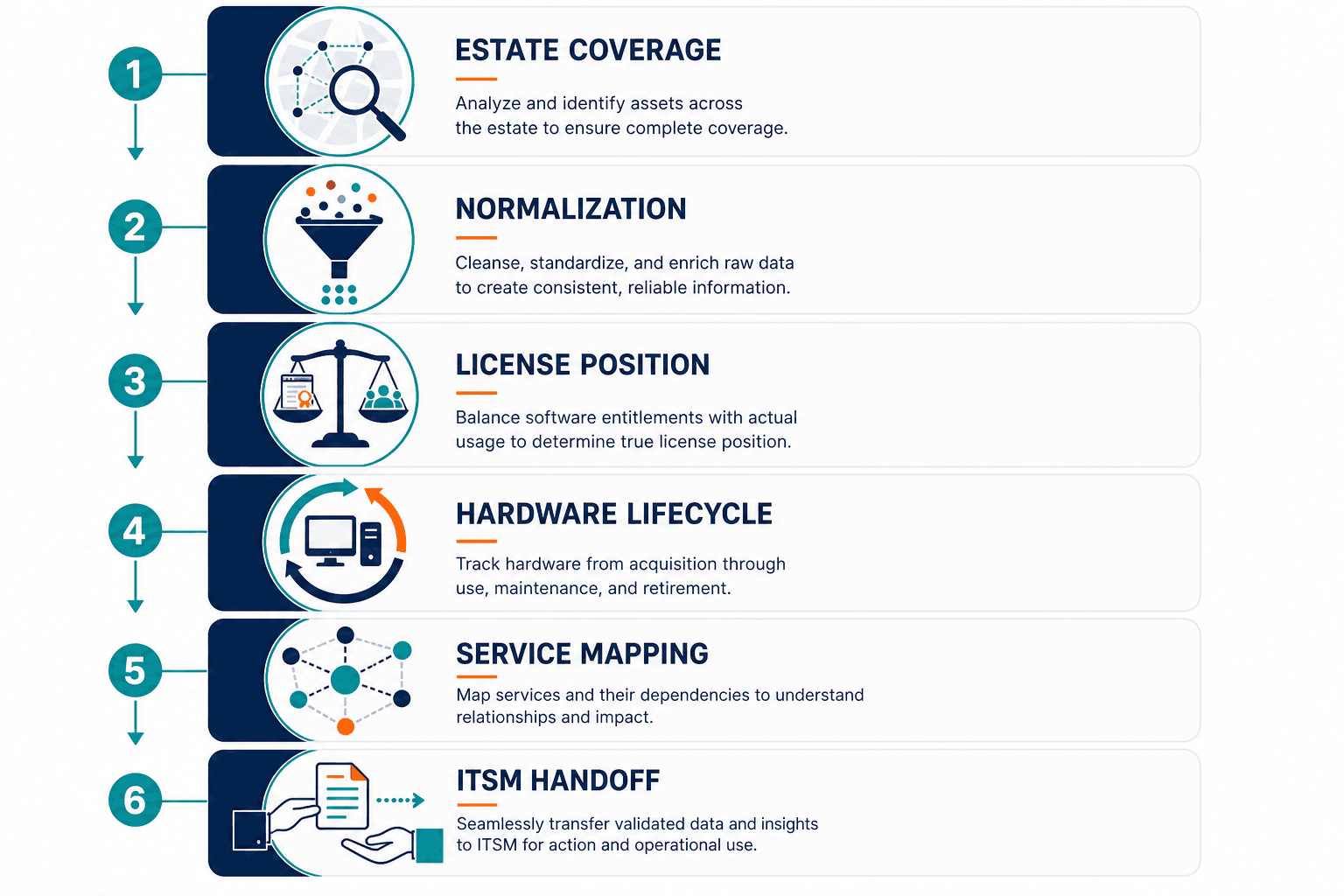
How to locate waste in one operating rhythm
This method is self-contained. Run it before major Microsoft, Adobe, or Oracle renewals and before hardware refresh waves.
Step 1: Cover the estate
Define in-scope networks, cloud accounts, and endpoint populations. Run discovery with credentials and agents where deep software detail is required. Export a coverage %: discovered vs. expected headcount and known subnets.
Step 2: Normalize software
Collapse raw install strings into publisher/product/version. Without normalization, “unused software” reports double-count the same title and miss the real shelfware pile.
Step 3: Build license position
Join entitlements to normalized installs and assignments. Flag over-licensed, under-licensed, and unknown. Unknown is often the largest dollar risk because nobody owns the cleanup.
Step 4: Mark hardware lifecycle
For each serial or instance ID, record the owner, location, status, warranty/contract end date, and last-seen timestamp. Anything “in service” with no last-seen inside policy is a reclaim or investigate candidate.
Step 5: Tie assets to services where definitions exist
When business service definitions are provided (manual, spreadsheet, or architecture tools), dependency maps show which installs and hosts still matter. Idle software on a retired service is reclaim bait. Critical software on unmanaged hosts is risk, not savings.
Virima CMDB relationship mapping and ViVID™ service maps (built after you supply service definitions) give ITAM a business filter so reclaim does not cut a license that still sits on a revenue path.
Step 6: Feed ITSM and finance
Push clean CIs and asset fields into the systems that renew and ticket. Partner platforms such as ServiceNow, Jira, Ivanti, HaloITSM, Xurrent, Hornbill, and TeamDynamix should receive one hub-fed truth rather than another side database. Use Virima’s integrations hub as the connection layer for that handoff.
Spend signals worth putting in the board pack
These six metrics turn ITAM cost optimization into board-ready numbers instead of a spreadsheet argument.
| Metric | Definition | Why it maps to waste |
|---|---|---|
| Discovery coverage % | In-scope assets found ÷ expected population | Low coverage = unmanaged hardware spend |
| Shelfware rate | Idle or unassigned installs ÷ total paid installs | Direct unused software dollars |
| SaaS unused seat % | Unassigned or idle seats ÷ purchased seats | Aligns to industry waste benchmarks |
| ELP unknown % | Entitlements with no reliable consumption join | Audit and true-up exposure |
| Ghost asset count | In-service records with no recent discovery evidence | Double-buy and warranty waste |
| Audit spend (3-year) | Soft costs + findings | Flexera-scale pressure on the same root cause |
Virima custom reporting and export help ITAM managers produce these views without a week of spreadsheet reconciliation. For a deeper dive on license reclamation workflows, see Best Software License Management Tools in 2026 (Reviewed & Ranked).
What good looks like after you close the leaks
- Renewals start from install and assignment truth, not vendor quotes alone.
- Hardware refresh lists exclude ghosts and include EOL/EOS flags.
- CMDB health improves because discovery, not manual entry, owns create and update.
- FinOps and ITAM share the same asset keys for cloud instances.
- Audit requests pull license compliance reports in hours, not a war room.
That outcome is ITAM joined to discovery-sourced CMDB data. Virima’s ITAM module covers software license management, compliance reporting, hardware lifecycle, EOL/EOS tracking, contracts and warranties, and financial fields so cost conversations cite the same record ops trusts.
Stop funding the dark corners of the estate
IT wastes spend on unused software and unmanaged hardware wherever inventory, entitlement, and lifecycle fail to meet. Visibility is still incomplete for many organizations, SaaS waste is rising for a large minority, and a large share of seats sit idle while audit bills stay high. The practical response is not another spreadsheet. It is scheduled discovery, normalized software, license position, hardware lifecycle, and service-aware context in one system finance and ITAM can defend.
Build that map once, refresh it on a reliable cycle, and reclaim before the next auto-renew. When you want that join without bolting five tools together by hand, request a Virima demo and bring one renewal and one refresh list to the session.
Frequently Asked Questions
Where does most IT software spend waste show up first?
Most software waste shows up first as shelfware installs and unused SaaS seats: titles you pay for that lack owners, assignments, or use evidence. Duplicate tools for the same job and entitlements that never join to consumption follow close behind. Start with normalized inventory plus seat assignment before you renegotiate the whole catalog.
What counts as unmanaged hardware in an ITAM program?
Unmanaged hardware is any device, VM, or network asset that incurs cost or risk without a complete asset and configuration record. Typical cases include procured laptops missing from inventory, shadow endpoints on the network, cloud instances without owners, and assets left “in service” after offboarding. Discovery coverage and lifecycle status are the fastest ways to find them.
How do I measure unused software without a perfect CMDB?
Measure unused software with three layers you can build quickly: discovery-based install inventory, software name normalization, and a join to entitlements or IdP assignments. Flag high-install, low-assignment titles and duplicate categories. Improve CMDB completeness in parallel so reclaim decisions also respect service dependency, but do not wait for a perfect CMDB to start seat recovery.
What is effective license position (ELP) and why does it matter for spend?
Effective license position (ELP) is the gap between what you’re entitled to under license contracts and what’s actually installed, assigned, or consumed. When entitlements and consumption never join in one system, ITAM either over-buys to stay audit-safe or misses shelfware quietly draining budget.
How does Virima help cut spend on unused software and unmanaged hardware?
Virima discovers hardware and software with agent and agentless methods, normalizes software titles, supports license tracking against installs, and manages hardware lifecycle in a multi-source CMDB. Optional service maps, after you define services, show which assets still support business work. Integrations can feed cleaned records into your ITSM stack from a single hub so renewals and retirements use the same truth.