How do I close the gap between purchased licenses and actual installs?

Renewal week arrives with three files open, and none of them agree on the gap between purchased licenses and actual installs. Procurement has the purchase orders. Finance has the invoice rollup. ITAM has a software list last updated after the prior cleanup. The mismatch is not a spreadsheet problem. It is an authority problem: which system wins when entitlement records and runtime installs disagree.
This guide is for ITAM managers, SAM leads, and CMDB owners at mid-to-large enterprises who already buy software at scale across ServiceNow, Jira Service Management, or similar ITSM platforms. It is scoped narrowly: not the full Software License Management: A Strategy Guide for IT Asset Managers, and not the Simplify IT Asset and Service Management with Virima. The focus is closing the entitlement-to-install gap with discovery-sourced install truth before the next renewal or vendor true-up.
The gap opens where purchase records stop and installs keep moving
Where purchase records fall behind
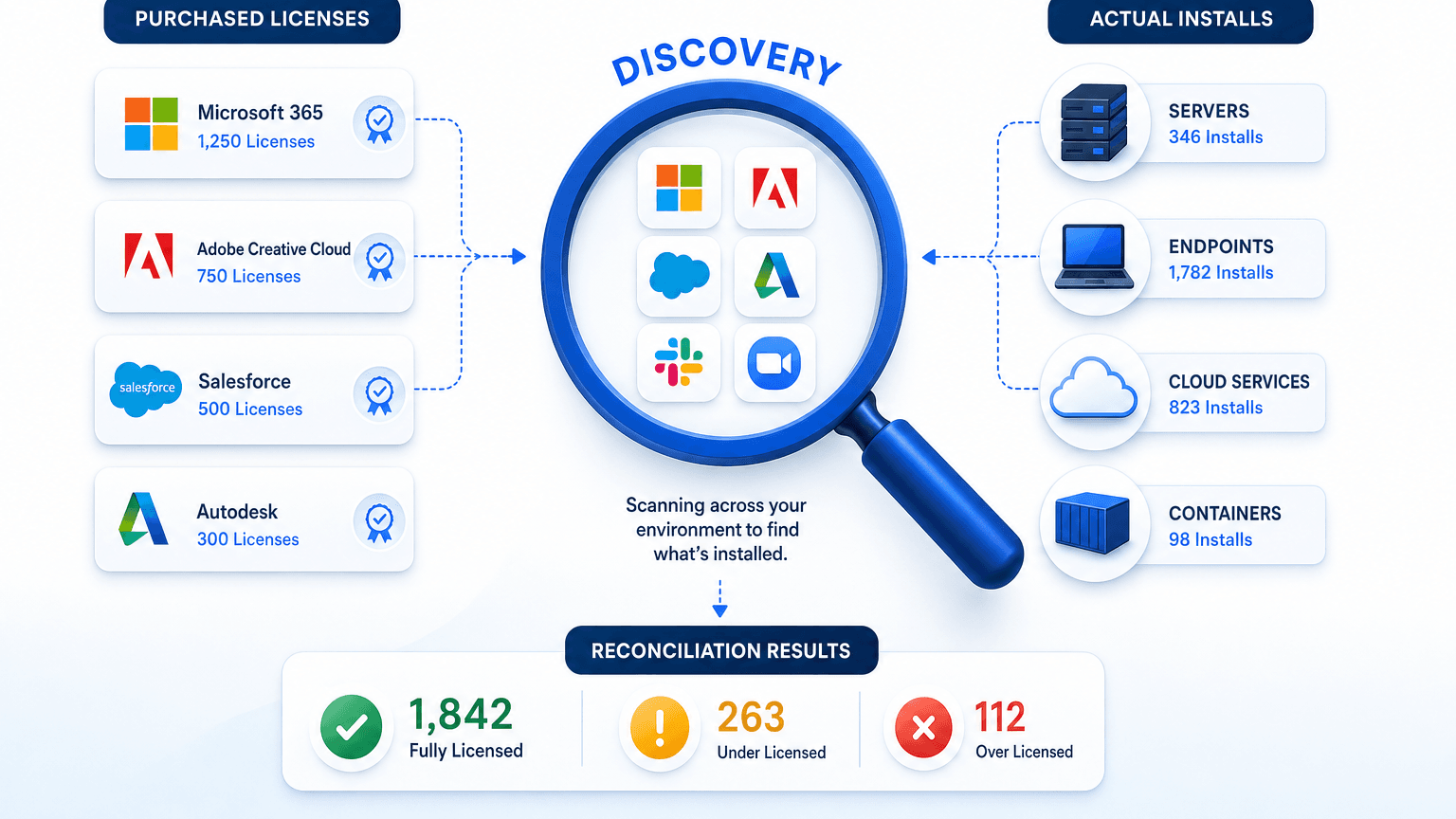
Purchased licenses live in contracts, portals, and purchase orders. Actual installs live on endpoints, servers, VMs, and cloud images that change every week. Teams try to close the gap with quarterly exports. By the time the export lands in a workbook, contractors have left, images have been cloned, and shadow installs have appeared outside the approved catalog.
That lag feels manageable until two failure modes hit at once. Over-buy shows up as shelfware nobody can prove unused. Under-buy shows up as installs that exceed entitlement and invite audit exposure. A 2025 software compliance survey found 62% of organizations were audited by a major software vendor in the past year, up from 40% in 2023. That exposure is no longer a rare event to budget for once and forget. Both start from the same root: purchase truth and install truth never share a refresh cadence or a reconciliation rule.
What an unresolved gap costs
Flexera’s 2024 State of ITAM Report keeps documenting why software audit cost and license control pressure stay high when technology intelligence stays incomplete. Teams that cannot trust what they hold pay again in true-ups, rush buys, and delayed renewals. A license list that only matched installs on purchase day becomes the same class of problem under a finance label.
When partial inventories still drive spend and compliance decisions, start with Trusted Runtime Truth. Pressure-test whether install existence still comes from discovery after the last reconciliation sprint ends.
What creates the gap between purchased licenses and actual installs?
Purchase records freeze at buy time while installs keep changing across endpoints, servers, and images. Without discovery-sourced install evidence on a written cadence, entitlement workbooks age. Finance then renews against stale counts and ITAM discovers the mismatch at audit or true-up.
Closing the gap between purchased licenses and actual installs starts with install authority, not another buy list
How do I close the gap between purchased licenses and actual installs? Treat installs as discovery-sourced facts first. Entitlements still matter. Contracts still set what you may use. The control is matching those rights to what discovery still finds, not to what a manager remembers approving.
Discover software where it runs
Agent-based discovery fits deep software inventory where agents are allowed. Credentialed agentless discovery fits ranges where agents are blocked. Cloud API pull covers instances and images that never sit on the corporate LAN. High-frequency discovery cycles on agreed scopes keep install lists closer to reality than annual true-up heroes.
Credentialed agentless discovery reaches servers and network ranges where installing an agent isn’t allowed or practical. Paired with agent-based discovery for endpoints and API pulls for cloud instances, it gives ITAM a single install count across environments an agent-only approach would miss.
Virima does not claim passive continuous event-driven discovery today. Scheduled agent, agentless, and cloud cycles on a written policy still beat manual install surveys that only run before renewals.
Normalize titles before you count seats
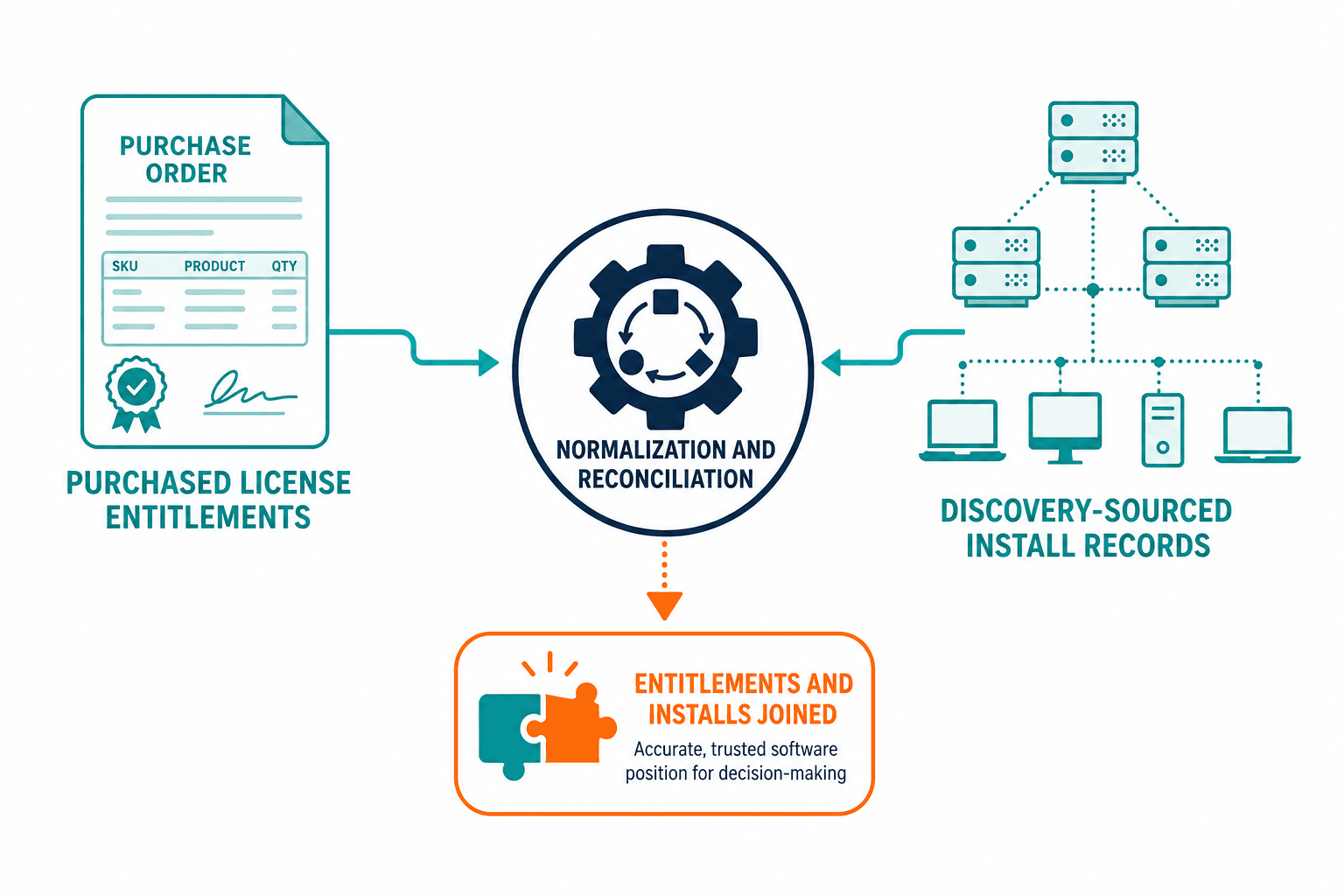
Raw install strings rarely match publisher SKUs. Without normalization, the same product appears as three names and the gap looks larger than it is. Software inventory should feed a normalized product view so entitlement rows can join on a stable key, not on free-text guesses.
Prefer recent install evidence in conflicts
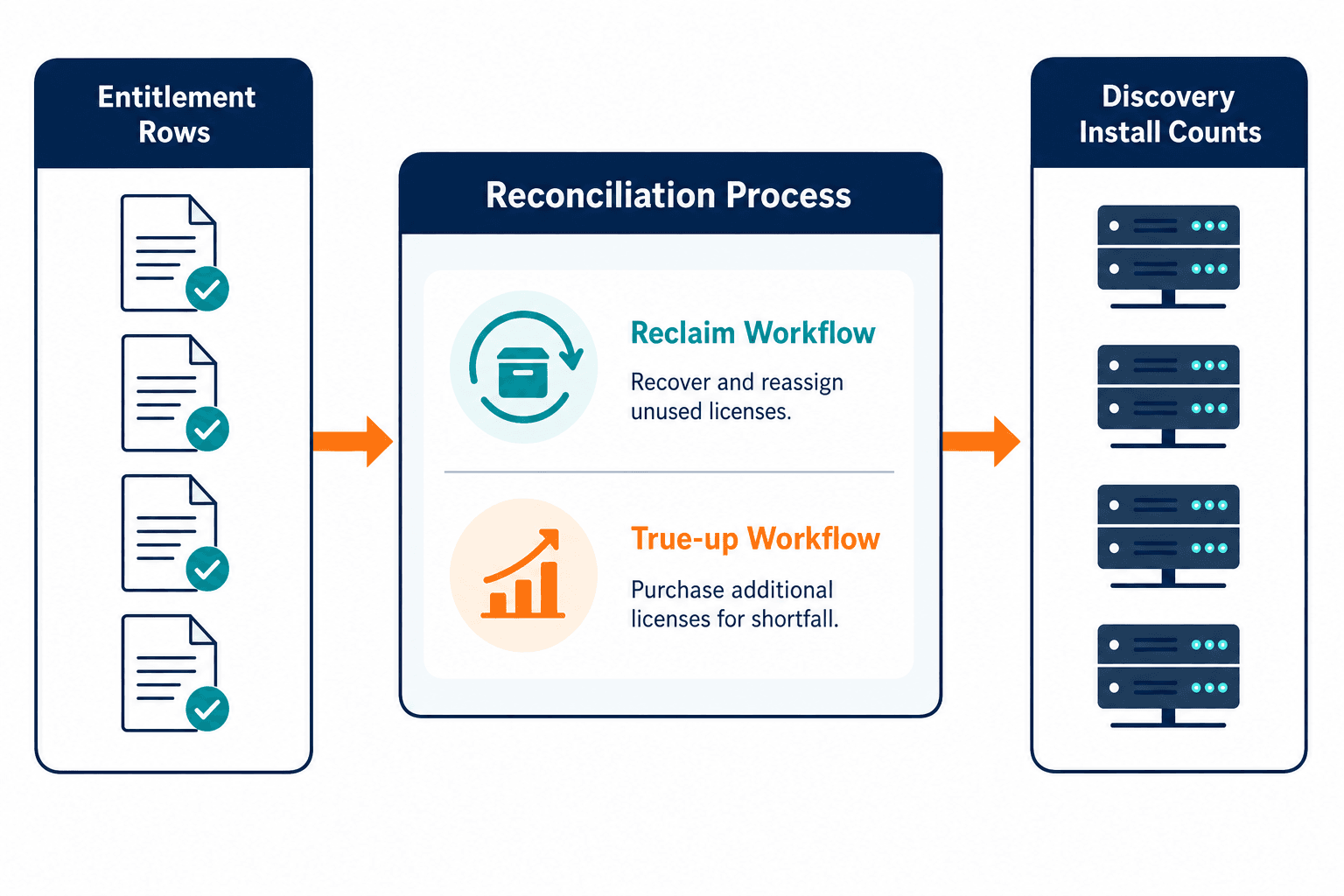
When the contract says 500 seats and discovery shows 620 installs, do not default to the purchase order. Open a workflow: reclaim, true-up, or document legitimate exception. When discovery shows 320 installs against 500 seats, do not assume 180 free seats until last-seen age and coverage scope are honest. Ghost installs and uncovered ranges both distort the gap.
Why renewal spreadsheets cannot close the gap alone
Spreadsheets are excellent for one-time math. They are weak systems of record for moving installs. Each renewal cycle reimports a snapshot, then the estate moves again. ITAM stewards become human join engines between finance, procurement, and operations. That model works until publisher catalogs, SaaS seats, and on-prem suites exceed attention.
Two lists without one authority rule
Finance trusts the invoice. Security trusts the scanner. Desktop trusts the image catalog. Without an explicit rule that install existence and last-seen facts come from discovery first, politics fills the gap. The next audit then samples whichever list looked cleanest in the deck. This is the purchased licenses vs. installs conflict in miniature: three departments, three trusted sources, and no agreed tiebreaker.
SaaS seats hide a second gap
SaaS entitlement often tracks assigned seats, not runtime use. Assigned-but-idle seats still burn budget. Zylo’s 2026 SaaS Management Index found enterprises use only 54% of the SaaS licenses they provision, wasting an average of $19.8 million a year. Seat assignment alone is not proof of real use. Install-centric discovery will not replace every SaaS admin console, yet host and agent inventory still catch thick clients and hybrid suites that finance never sees in the portal alone. Pair discovery-sourced CMDB and inventory truth with dedicated SaaS management where the risk model requires it.
Internal teams evaluating platform fit should review how Virima IT discovery combines agent-based and agentless methods with software inventory on a shared schedule. Pair that install evidence with ITAM license tracking and compliance reporting rather than forcing one tool to own every publisher negotiation.
How do teams close the gap between purchased licenses and actual installs without another cleanup sprint?
They name discovery as install authority, normalize product titles, and reconcile entitlements on a cadence short enough that stale last-seen data counts as a defect. Purchase records stay the rights source. Discovery stays the existence source. Workflows handle reclaim and true-up when the two diverge.
A practical close-the-gap operating model
Leaders can run a short operating model without waiting for a perfect SAM platform rewrite.
Scope the high-spend publishers first
Start with the suites that dominate renewal risk and audit history. Map entitlement sources and discovery coverage for those titles. Expand after the join keys work.
Write the install authority rule
State that hardware and software existence, identity, and last-seen facts come from scheduled discovery evidence first when sources conflict. Business metadata and cost centers can still come from owners and finance systems. Manual overrides stay allowed for exceptions without freezing scanner facts.
Reconcile on cadence, not only on renewal
Match entitlement counts to normalized install counts on a cycle that fits risk, not only 30 days before the invoice. Unknown or unowned installs open ownership workflows instead of remaining unlabeled until true-up week.
Keep service context when reclaim decisions matter
Reclaiming a title on a shared host can break a business path. Once service definitions exist, dependency maps can show which services sit on the hosts carrying those installs. ViVID™ service maps are built from defined services rather than inventing service composition automatically. Maps stay useful only while infrastructure and install CIs stay discovery-fresh.
Integrations can push that inventory truth into ServiceNow, Jira Service Management, Ivanti, HaloITSM, Xurrent, and Hornbill workflows. Tickets stop inventing separate software lists. Partner connections sit on the Virima integrations hub.
Score your own reconciliation program against the 5-point checklist above, then see how discovery-sourced install inventory closes the gap between purchased licenses and actual installs before the next renewal or true-up.
Score readiness before you buy another license tool
Use a five-point scorecard before funding another point product.
- Every high-spend publisher in scope has a named discovery method and a last successful software inventory cycle newer than policy allows.
- Product titles are normalized so entitlement rows can join installs.
- Multi-source reconciliation prefers recent discovery evidence for install existence.
- Reclaim and true-up workflows open when counts diverge.
- CMDB or ITAM health tracks install coverage and staleness, not only purchase completeness.
When those conditions hold, this gap becomes a measurable control instead of a renewal surprise. Flexera’s ITAM research cited above keeps showing why incomplete technology intelligence still hurts cost and audit programs. Durable spend control needs durable install truth, not another static buy list.
If your teams still reconcile licenses only in the weeks before renewal because installs never became discovery authority, the scorecard above is the place to start. Validate cadence and join keys against the estate you already run before the next renewal cycle forces the same reconciliation scramble.
Frequently Asked Questions
Is the gap between purchased licenses and actual installs only a SAM tool problem?
No. Tools help, but the core failure is authority and cadence. Purchase records and install evidence must share a reconciliation rule. Without discovery-sourced installs on a written schedule, any SAM workbook ages between renewals.
Does closing the license install gap require continuous passive scanning?
No. High-frequency scheduled discovery cycles on agreed scopes meet the need for many enterprises. Continuous passive collection on every segment is a different capability and may not sit in the stack today.
Does Virima’s discovery cover both the software audit walkthrough and the license entitlement gap?
Yes, but they solve different moments. This article owns the reconciliation-cadence problem: keeping purchase entitlements joined to discovery-sourced installs all year. The Software License Management: A Strategy Guide for IT Asset Managers owns evidence-package prep once a vendor audit is already underway. Read this one first to avoid needing the second.
Does Virima replace dedicated SaaS management platforms?
Virima supplies discovery-sourced install and CI truth plus ITAM license tracking that can enrich ITSM and finance workflows. Many teams keep dedicated SaaS admin tooling for portal seats while discovery evidence keeps on-prem and hybrid installs honest.
Where should teams start if last year’s license cleanup already faded?
Write the install authority rule and publisher scope map first. Restore discovery cadence on those titles next. Normalize product names, then open reclaim and true-up workflows when entitlement and install counts diverge.