IT Asset Tracking: Methods, Gaps, and Best Practices

IT asset tracking is the practice of recording, monitoring, and maintaining accurate records of every hardware and software asset across an organization’s IT environment, historically done with barcode, RFID, or GPS tags and increasingly done through automated discovery instead. Most teams start with a spreadsheet. By the time a failed audit or security incident exposes the gap between what the spreadsheet says and what’s actually running, the costs have already compounded: a device nobody remembers provisioning, or a license renewal for software three people stopped using a year ago. This guide covers how IT asset tracking actually works, how the main methods compare, and what breaks down as environments scale.
Why IT Asset Tracking Breaks Down at Scale
A spreadsheet works fine for 50 laptops in one office. It stops working once assets span multiple offices, a data center, and three cloud providers, because nothing updates the sheet when a server gets decommissioned or a new cloud instance spins up overnight. That’s how ghost assets accumulate: hardware and software that’s still on the books but no longer in active use, or no longer exists at all. Ghost assets carrying active depreciation charges make up an estimated 12 to 25% of fixed asset records at organizations that rely on periodic manual counts instead of continuous discovery, according to OnPoint Service’s Ghost Asset Crisis report.
That inaccuracy has a price tag attached. Twenty-three percent of organizations spent more than $5 million on software audits in 2025, according to Flexera’s 2025 State of ITAM Report, and audit costs climb fastest at organizations that can’t produce a clean, current asset record on request. This is the moment a failed audit tends to force the issue: leadership asks for a full inventory, and the team discovers the spreadsheet hasn’t matched reality for months.
Shadow IT adds another layer to the gap. Employees provisioning their own SaaS subscriptions, contractors standing up a test server, or a team spinning up cloud instances outside the formal request process all create assets that never make it into the official record at all. None of that shows up on a spreadsheet unless someone remembers to add it by hand, so the record drifts further from reality every week it goes unchecked. This is exactly the pattern that turns a routine audit into a multi-week scramble — and it’s avoidable with the right tracking method, not more manual discipline.
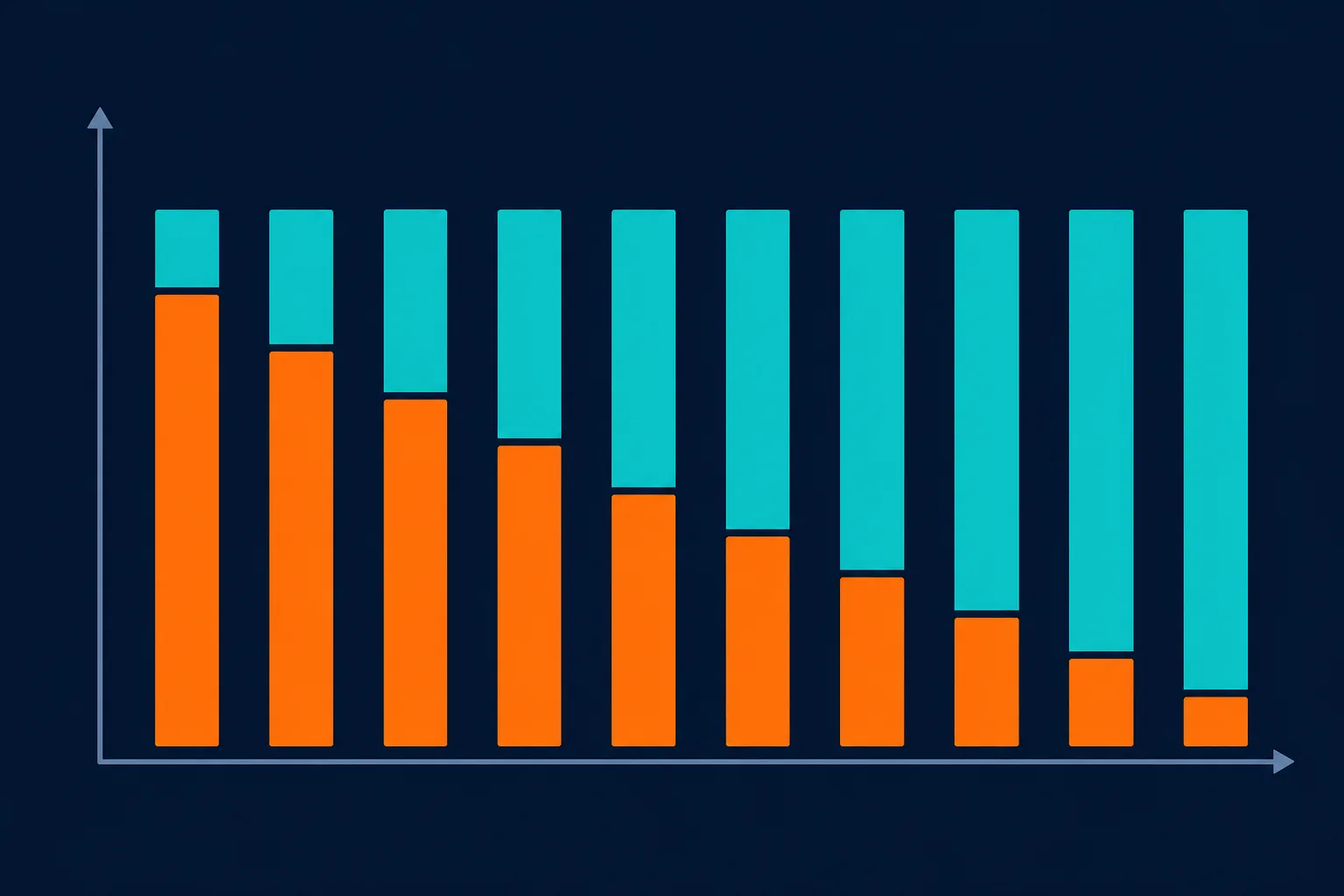
The fix isn’t a bigger spreadsheet or a stricter update policy. It’s a tracking method built to keep pace with change automatically, which is where the three core discovery methods come in.
Manual Tracking vs. Agent-Based vs. Agentless Discovery
Every IT asset tracking approach falls into one of three categories, and each has a distinct tradeoff between depth, coverage, and maintenance overhead.
Manual Tracking
Manual tracking means someone enters and updates asset records by hand, in a spreadsheet or a lightweight database. It’s the starting point for nearly every IT team, and it’s fine at small scale. But manual tracking only reflects reality at the moment someone last updated it. Nothing flags a new laptop, a retired server, or a cloud instance that spun up during a deployment. That lag is exactly what feeds the ghost asset problem covered above.
The failure mode is predictable. A new hire gets a laptop that never makes it into the spreadsheet because onboarding and asset tracking are two separate processes run by two separate people. A server gets decommissioned during a migration, but the ticket that would have triggered a record update never gets filed. Multiply either scenario across a few hundred assets a year, and the spreadsheet stops being a reliable source of truth well before anyone notices it’s happened.
Agent-Based Discovery
Agent-based discovery installs lightweight software on each endpoint that collects detailed data (hardware specs, installed software, configuration state, running services) and reports it back automatically. That depth is its strength: agent-based tools see inside a device continuously, even when it’s not on the corporate network. The tradeoff is maintenance. Every endpoint needs an agent installed, updated, and monitored, which gets heavy across thousands of devices or short-lived cloud resources that come and go before an agent could ever be deployed to them.
Agentless Discovery
Agentless discovery scans the network and queries devices remotely using existing credentials and protocols, without installing anything on the endpoint. That makes it fast to deploy across a broad environment, including devices where installing an agent isn’t practical: network switches, IoT devices, or short-lived cloud instances. The tradeoff runs the other way from agent-based tools: agentless scans typically surface less configuration depth per device, and can miss anything disconnected from the network at scan time.
API-Based Discovery for Cloud Environments
A fourth approach fills the gap the other three leave in public cloud. API-based discovery queries a cloud provider’s own management API, AWS or Azure, for example, to pull a live list of every instance, storage volume, and managed service running in that account. It doesn’t need an agent installed and it doesn’t rely on network-level scanning, so it catches ephemeral resources that spin up and tear down in minutes, well before a scheduled scan would ever see them. For hybrid environments running a mix of on-premises hardware and cloud infrastructure, API-based discovery is usually the only practical way to keep the cloud side of the record current.
| Method | Coverage | Depth | Maintenance Overhead |
|---|---|---|---|
| Manual Tracking | Whatever someone remembers to enter | Only what’s documented — no configuration detail | High — depends entirely on human process discipline |
| Agent-Based Discovery | Any endpoint with an agent installed | Deep — hardware, software, config, running services | High — install, update, and monitor an agent per device |
| Agentless Discovery | Broad network sweep — servers, switches, IoT | Moderate — surface-level config via existing credentials | Low — no per-device installation |
| API-Based Discovery | Cloud provider account (AWS, Azure, etc.) | Deep for cloud resources — instances, volumes, managed services | Low — no agent or network scan required |
Why Most Teams Need All Three
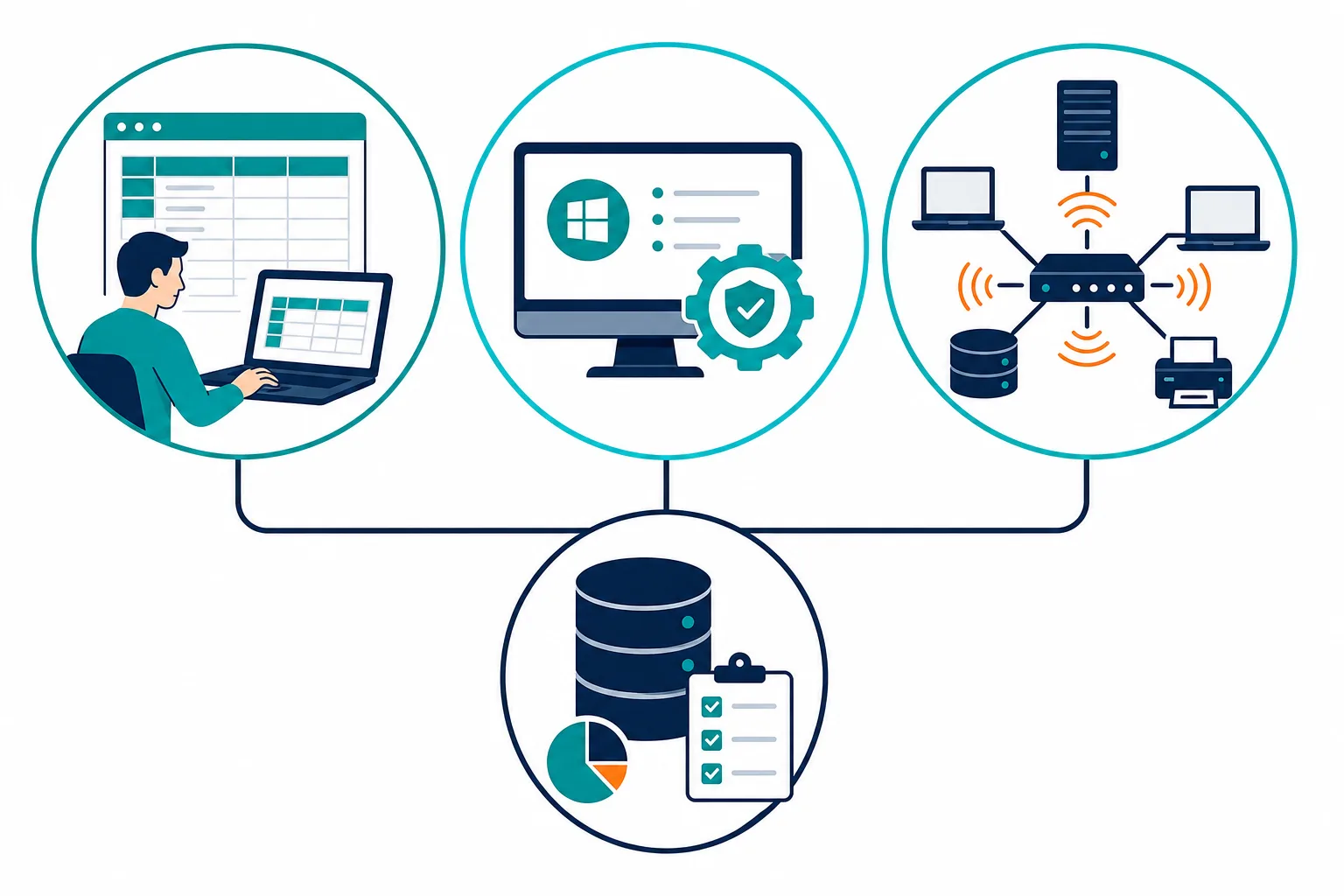
In practice, agent-based, agentless, and API-based discovery aren’t competing choices, they’re complementary. Agentless discovery covers the broad sweep, servers, network gear, and on-premises infrastructure, quickly and without installation overhead. Agent-based discovery adds depth on the endpoints and mobile devices where that level of detail matters most. API-based discovery covers the cloud resources neither of the other two methods can see cleanly. Virima’s own breakdown of agent-based versus agentless discovery walks through this tradeoff in more depth, and Virima’s comparison of automated discovery against manual inventory covers why the manual approach loses ground first. Automated, agentless IT discovery is what closes the gap manual tracking leaves open, because it updates the record continuously instead of on whatever schedule someone remembers to run an audit.
What Good IT Asset Tracking Looks Like in Practice
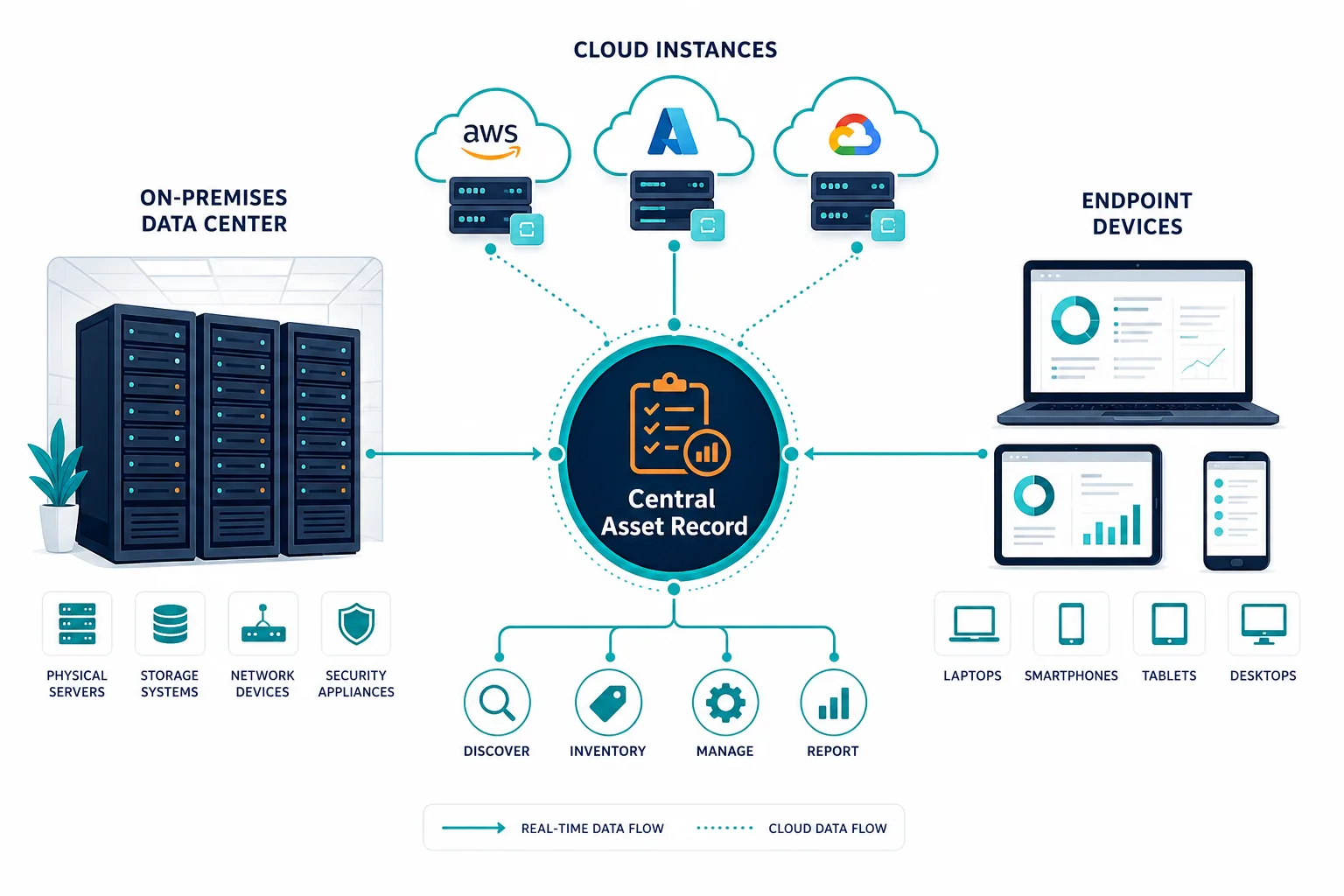
Accurate tracking isn’t a one-time project. It’s a continuous discovery process that feeds a single system of record. The CMDB, license register, and hardware inventory all draw from the same discovery-sourced operational reality instead of three different snapshots taken at three different times.
That continuity matters financially, too. Enterprises waste up to 30% of IT budgets on underutilized or redundant software licenses, per the same Flexera report cited above, and most of that waste is invisible until someone tracks actual usage against what’s licensed. A tracking process that only checks in periodically will always be a step behind that kind of drift.
Good practice looks like this: discovery runs continuously in the background, new assets get added to the record automatically as they appear, and retired assets get flagged for removal instead of lingering as ghost entries. Every asset gets an owner assigned at the point of discovery, not months later during a cleanup project, and the record reconciles against the license register and the CMDB on a set cadence rather than only when an audit forces the question. That record then becomes the foundation for a reliable CMDB, because a CMDB is only as trustworthy as the asset data feeding it. Teams that get this right walk into an audit with current data instead of a scramble, because the record was never allowed to go stale in the first place.
IT Asset Tracking vs. IT Asset Management: How They Relate
These two terms get used interchangeably, but they describe different layers of the same problem. IT asset tracking is the operational layer: discovering assets, recording what exists, and keeping that record current. IT asset management (ITAM) is the broader governance discipline built on top of it, covering lifecycle planning, license compliance, cost optimization, and audit readiness.
Tracking answers “what do we have and is this record current?” ITAM answers “what should we do about it, and are we compliant, efficient, and audit-ready as a result?” You can’t run a credible ITAM program without accurate tracking underneath it. An ITAM feature set that relies on stale or manually maintained records will produce governance decisions based on data that’s already wrong, no matter how sophisticated the policy layer on top looks. That’s also why an ITAM rollout that skips straight to policy (budgeting rules, license reconciliation, lifecycle stages) without first fixing the discovery layer underneath tends to stall. The governance rules end up applied to a record nobody fully trusts. The $5 million-plus audit costs and 30% licensing waste cited earlier aren’t policy failures — they’re tracking failures wearing a governance costume. No ITAM policy fixes a number that’s already wrong at the source.
When Small and Growing IT Teams Must Graduate to ITAM and CMDB
Lean IT teams often start with physical tags and spreadsheets to track hardware handoffs. As endpoint counts outpace IT headcount, physical labels and check-out logs reach a ceiling. Barcode labels confirm what was tagged at the desk. They do not report whether a remote laptop still joins the domain, which cloud instances spun up overnight, or who owns an unagented switch on a branch VLAN.
When physical labels and manual assignment lists no longer reflect network reality, tracking must graduate from periodic custody checks to automated discovery and CMDB visibility. Connecting high-frequency discovery cycles to your asset register keeps last-seen dates, hardware dependencies, and owner records accurate after devices leave the cage.
For small and growing teams navigating check-out ceilings, dedicated asset tracking software for small business bridges custody workflows with discovery-backed CMDB records.
If your IT team has outgrown spreadsheets and manual check-outs, explore how Virima Business Pro delivers discovery-backed CMDB and ITAM capabilities tailored for growing environments.