A comprehensive guide to IT asset lifecycle management policy

PicThe IT asset lifecycle management policyture an enterprise juggling thousands of IT assets across multiple locations, facing compliance challenges and escalating costs. A well-crafted policy ensures that every asset from procurement to disposal is accounted for. Turning policy into practice requires the right tooling, and optimizingasset lifecycle management with Virima ensures that every policy stage from procurement through disposal is backed by automated discovery, real-time tracking, and audit-ready reporting.
In this guide, we’ll break down the essential elements of an IT asset lifecycle management policy. Let’s explore how to turn asset management into a strategic advantage!
What is an IT asset lifecycle management policy?
The IT asset lifecycle management policy requires listing all IT assets, like hardware, software, and network tools. Furthermore, each asset gets tagged and tracked in a central system. HaloITSM customers can streamline this identification step through optimized Halo asset management powered by Virima’s discovery engine, which automatically identifies and tags assets across on-premises, cloud, and remote environments without relying on manual inventory collection.
What does an IT asset management checklist include?
Here’s a breakdown of what the IT asset management checklist includes. For a step-by-step operational companion to this policy framework, a detailed IT asset management checklist translates each policy element into actionable tracking and optimization steps that teams can execute immediately. The following are the key elements of the checklist.
- Asset identification
The IT asset lifecycle management policy requires listing all IT assets, like hardware, software, and network tools. Furthermore, each asset gets tagged and tracked in a central system. HaloITSM customers can streamline this identification step through optimized Halo asset management powered by Virima’s discovery engine, which automatically identifies and tags assets across on-premises, cloud, and remote environments without relying on manual inventory collection.
Virima’s IT discovery solution, utilizing agent-less probes, discovery agents, and API integrations, ensures thorough identification of assets across various devices and environments. For organizations running workloads across AWS, Azure, or hybrid infrastructure, incorporating cloud asset management software into the lifecycle policy ensures that elastic and ephemeral cloud resources are tracked with the same rigor as on-premises assets.
- Procurement and acquisition
IT asset management policy defines how to buy IT assets. This includes selecting vendors, getting approvals, and also following purchase rules.
- Deployment and usage
The IT asset lifecycle management policy gives steps for setting up IT assets. It also covers installation, configuration, and assigning assets to users or teams. Teams usingSharePoint IT asset management for deployment tracking often find that SharePoint lists lack the automated discovery and CI-level detail needed to keep deployment records accurate without manual effort as the asset base scales.
Organizations using ITSM-bundled platforms like freshservice it asset management for procurement tracking should assess whether the tool’s asset management module supports the vendor management, approval workflow, and purchase order tracking depth that a formal lifecycle policy requires.
- Maintenance and upgrades
The IT asset management checklist ensures regular maintenance and updates. Subsequently, this keeps assets running securely and efficiently.
- Risk management and compliance
It addresses security risks related to IT assets. It also ensures the organization follows legal and internal rules.
- Asset disposal
The IT asset management policy addresses security risks related to IT assets. It includes steps for protecting assets from threats and also meeting compliance standards. Large enterprises evaluating IBM IT asset management for compliance-driven ITAM should assess whether IBM’s strength in mainframe and legacy asset tracking extends to the cloud discovery, software metering, and CMDB integration depth that modern compliance frameworks demand.
- Asset performance monitoring
It includes regular checks on IT assets to ensure they perform well and also support organizational goals. Performance monitoring is most effective when asset data lives in the CMDB alongside configuration and relationship data, and CMDB asset management through the Virima-Ivanti partnership demonstrates how discovery-backed CI records enable performance tracking that accounts for dependencies, service impact, and configuration drift alongside traditional asset health metrics.
- Financial management
The IT asset management policy manages IT asset budgets, costs, and return on investment to control expenses. Enterprises with SAP investments often route financial tracking through SAP modules, but the IT-specific lifecycle capabilities of SAP IT asset management may not cover discovery, dependency mapping, and configuration tracking to the depth modern IT governance demands, requiring a complementary ITAM platform to close those gaps.
Organizations operating under tight budgets may initially turn to open source IT asset management solutions for basic inventory tracking, though the policy should account for the total cost of ownership, including internal maintenance, integration effort, and feature limitations that commercial platforms address out of the box.
- Documentation and Reporting
IT asset lifecycle management policy requires keeping detailed records of all IT assets. Later, reports are created for better decisions and tracking. Documentation-centric platforms like IT Glue asset management address this record-keeping need, though organizations with complex infrastructure often require deeper discovery and dependency mapping capabilities beyond what a documentation tool provides.
These records are only as reliable as the people maintaining them, which is why establishing well-defined IT asset management roles and responsibilities ensures accountability at every lifecycle stage from procurement through disposal.
Documentation-centric platforms like ITGlue asset management address this record-keeping need, though organizations with complex infrastructure often require deeper discovery and dependency mapping capabilities beyond what a documentation tool provides. Maintenance workflows are most effective when the asset record and the service ticket live in the same system, which is the core advantage of integrated it help desk and asset management software that links CI data to every incident and change request automatically.
- Responsibility and Accountability
The IT asset lifecycle management policy assigns clear roles for managing IT assets. Moreover, specific teams or people handle each task.
Overall, a well-structured IT asset management policy helps businesses make the most of their IT assets.
Importance of IT asset lifecycle management policy
IT asset lifecycle management policy is essential for financial savings, better operations, compliance, and informed decision-making. They are especially vital for technology-driven businesses where IT assets form the backbone of operations. Many enterprises turn to established platforms like BMC IT asset management to enforce these policies, though scalability and cost considerations often influence the final choice. Below are key reasons why the IT asset management checklist matters:
Cost savings
IT asset management policy tracks costs tied to IT assets like purchase, maintenance, and disposal. Subsequently, this helps reduce wasteful spending.
Better asset usage
ITAM shows which assets you own and how they’re used. This also ensures you make the most of existing resources. Virima’s software usage metering helps track application utilization, ensuring you maximize the value of your existing resources.
Risk reduction
ITAM minimizes risks related to compliance, security, and inefficiencies. For example, it ensures licenses are valid and equipment is secure.
Strategic planning
With ITAM, businesses get insights to plan budgets, predict future needs, and make smarter technology investments.
Regulatory compliance
Industries often require compliance with data privacy laws. IT asset management policy ensures hardware and software meet legal standards, thus, avoiding penalties.
Asset lifecycle management
IT asset management checklist covers an asset’s full journey—from purchase to disposal of IT assets. Consequently, it helps businesses upgrade or replace them at the right time.
Stronger vendor relations
ITAM gives a clear picture of your assets, thus, helping you negotiate better deals and manage warranties effectively.
Improved security
IT asset tracking identifies outdated equipment or unauthorized software. This also helps businesses maintain a secure IT environment.
Easier asset recovery
If assets are lost or stolen, ITAM simplifies recovery by keeping detailed records of locations and also user assignments.
Accurate data and reports
IT asset management checklist ensures accurate asset data for audits, reporting, and smarter decisions. Altogether, this boosts accountability and trust.
By adopting ITAM policies, businesses can enhance efficiency, strengthen security, and achieve long-term success.
Best practices to create a successful IT asset lifecycle management policy
Creating an IT asset lifecycle management policy requires thoughtful planning. Here’s a step-by-step guide:
- Set clear objectives and scope
Start by defining what you want to achieve with the IT asset management policy. Then, focus on goals like cost control, compliance, or operational efficiency. Next, clearly specify the assets covered, such as hardware, software, or digital resources.
- Identify key stakeholders
List the individuals and teams affected by the policy. Further, include IT staff, finance teams, and asset users.
- Establish an asset lifecycle framework
Outline each step in the IT asset lifecycle management:
- Procurement: Define how assets are purchased, including approval steps and vendor selection.
- Deployment: Detail processes for installing, configuring, and also assigning assets.
- Maintenance: Set rules for updates, conduct regular checks, and also support services.
- Audits: Schedule regular asset inventory reviews and also reporting.
- Disposal: Describe secure and responsible methods for asset disposal.
- Manage risks and ensure compliance
Add rules to handle risks, protect asset security, and also meet legal or regulatory requirements.
- Assign roles and responsibilities
Define who manages the policy and oversees assets. Then, clarify each team’s or individual’s duties.
- Keep records organized
Document asset details, like purchase records, licenses, warranties, and maintenance logs. Moreover, keep this data up to date.
- Monitor and review performance
Track how well assets and the ITAM process perform. Then, schedule regular policy reviews to make improvements.
- Train your team
Plan training programs to help employees understand the policy and also their specific responsibilities.
- Plan for budgeting
Include guidelines for budgeting asset purchases, maintenance, and disposal. Then, align these with overall financial goals.
- Review and improve regularly
Next, create a system to review and update the policy as technology or business needs evolve.
- Secure approval and implement
Have key stakeholders review and approve the policy. Later, communicate it clearly across the organization.
- Leverage tools and resources
Mention tools like IT asset management software or services that will simplify the process.
Overall, a well-written IT asset lifecycle management policy is simple, clear, and customized to your organization’s needs. Using a robust ITAM solution like Virima can make implementation smoother and more efficient.
Beyond IT asset lifecycle management policy: The Virima advantage
Creating an IT asset management policy is an essential first step, but it’s not enough. Using a powerful solution like Virima significantly takes your IT asset management ITAM to the next level.
Virima surpasses traditional tools by offering a feature-rich platform that simplifies every stage of the IT asset lifecycle:
- Automated discovery and tracking
IT discovery from Virima identifies and tracks IT assets, including hardware, software, and also cloud resources. This removes the need for manual updates, thus, saving time and reducing errors. Virima also strengthens the earliest stage of the lifecycle through Asset Request and Form Management, ensuring that every new asset enters the pipeline with proper approvals and documentation already in place.
- Advanced service mapping with ViVID
Virima’s service mapping and ViVID (Virima Visual Impact Display) create clear, interactive maps of IT services. These maps also reveal asset relationships and dependencies, helping you allocate resources, plan capacity, and manage changes effectively.
- Seamless ITSM and vulnerability overlays
ViVID integrates with ITSM tools like ServiceNow, Jira Service Management, HaloITSM, Ivanti, etc. It adds vulnerability overlays to service maps, thus, enabling teams to see how vulnerabilities affect services.
- Simplified vendor and contract management
Virima makes it easy to manage vendor contracts, costs, SLAs, and renewal schedules. This further helps you save time, avoid penalties, and stay organized.
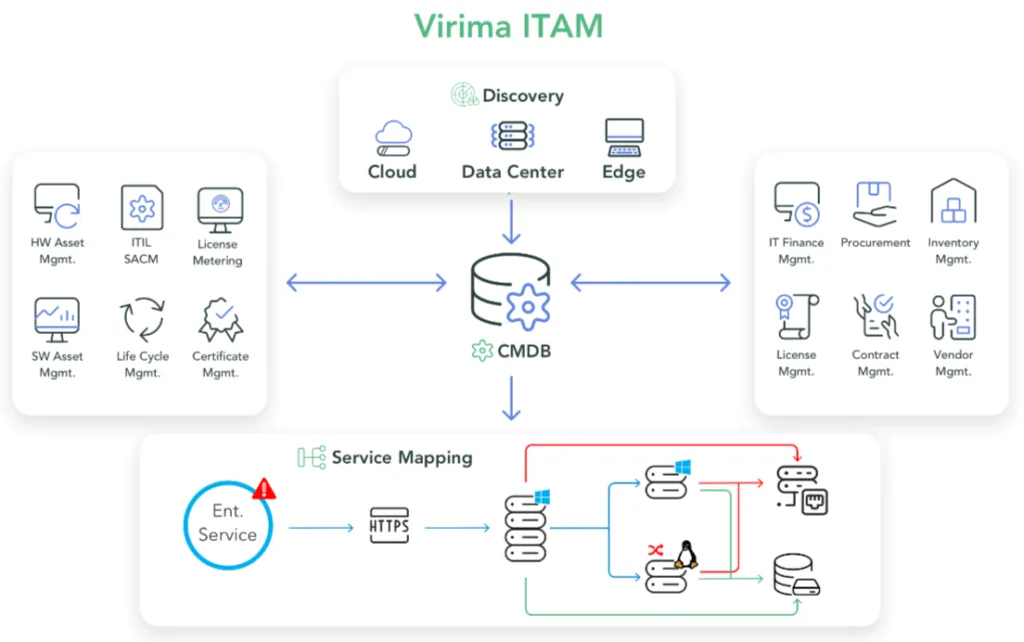
Track your entire enterprise from anywhere using Virima.
- Complete portability
Virima ensures your IT asset data stays portable. If you switch ITSM platforms, your data moves with you, therefore ensuring flexibility.
- Autonomic social discovery
Virima improves data accuracy with crowdsourced updates to your CMDB and asset management processes. Consequently, this ensures your data is always up-to-date.
- Proactive vulnerability management
Virima identifies vulnerabilities and ranks them by priority. This helps you address security risks and also reduce potential breaches.
- Efficient software license management
Virima optimizes software license management by:
- Tracking license entitlements against software installations.
- Providing device-level software usage details, also including ownership.
- Identifying underused licenses as well as reclaiming costs with the Windows Discovery Agent.
- Offering accurate usage data for software audits to avoid inflated claims.
Proper license management helps you reduce spending, avoid audits, and maintain compliance with vendor agreements.
- Faster results with Virima
Virima is user-friendly and quick to implement. Compared to complex tools, it delivers faster improvements, thus, letting you see results sooner.
With Virima, managing IT assets becomes easier, more efficient, and more secure. It’s not just a tool; it’s your partner in effective IT asset management success.
Take charge of your IT assets with an IT asset management policy and Virima
A strong IT asset management policy is key to achieving your organization’s goals. It also helps you manage IT assets better, minimize costs, and improve efficiency. However, having the right tools makes this process easier and more effective.
Virima offers IT asset management solutions designed to simplify your tasks and boost productivity. Its features include automated asset discovery, software license tracking, and near-real-time reports. These tools help you overcome challenges and make the most of your IT investments.
Discover how Virima can reshape your IT asset management strategy. Start today!