
Understanding IT asset management roles and responsibilities: A complete guide
 Summarize with ChatGPT
 Summarize with Claude
Effective IT Asset Management (ITAM) is at the heart of every successful organization’s tech strategy. It tracks and optimizes assets from procurement to retirement. However, to make the strategy work, understanding the IT asset management roles and responsibilities is essential. Each role plays a crucial part in minimizing risks and improving operations.
In this guide, we’ll break down the key ITAM roles and explain how they impact overall efficiency. Whether you’re just getting started or refining your approach, you’ll find actionable insights to help drive success.
Understanding IT asset management tools: A must for every asset manager
IT asset management process is tracking and managing an organization’s IT assets. It ensures that users utilize, maintain, upgrade, and dispose of these assets correctly throughout their lifecycle. Asset management tools rely on financial, contractual, and inventory data to make informed decisions about these resources.
The main goal of ITAM is to use IT assets efficiently and effectively. This approach reduces costs by optimizing assets in use and extending their lifespan, which helps avoid costly upgrades. A key part of IT asset lifecycle management policy is understanding the total cost of ownership (TCO). It also involves finding ways to maximize the value of each asset.
Who is an IT asset manager?
An IT asset manager, also called an IT asset management specialist, oversees all hardware and software assets in an organization. Moreover, they create and implement strategies for effective IT asset management systems. This also includes managing the procurement, deployment, maintenance, and retirement of hardware, software, and other technology resources.
In the next section, we’ll be exploring the essential skills, experience, and certifications needed to excel in this role.
What makes a great IT asset manager? Key skills for success
To excel as an IT asset manager, you need to master several key skills. These include:
- Inventory management
- Analytical thinking
- Negotiation skills
- Project management
- Technical knowledge
- Risk management
- Communication skills
- Attention to detail
- Budgeting and cost control
- Problem-solving skills
Practical experience
Hands-on experience is essential in this field. Most IT asset managers start with entry-level IT roles. Further, they gain experience by learning about IT asset management roles and responsibilities, as they progress.
Relevant certifications
Certifications can improve your skills, credibility, and career opportunities. Some important certifications for IT asset managers include:
- CITAM- Certified IT Asset Manager: Provided by IAITAM, this certification focuses on IT asset lifecycle management, compliance, and governance.
- CSAM- Certified Software Asset Manager: Ideal for managing software licenses and also ensuring compliance.
- CISSP- Certified Information Systems Security Professional: Valuable for professionals handling data security and risk management.
- CITAM- Certified Information Technology Asset Manager: Offered by ITAMF, it covers IT asset lifecycle management best practices.
Overall, building these skills and earning certifications will strengthen your expertise in IT asset management tools.
Essential IT asset management roles and responsibilities explained
Below, we’ll explore the key IT asset management roles and responsibilities. Every IT asset manager should know these to ensure smooth operations and drive organizational success.
- Asset lifecycle management: The asset lifecycle spans from purchase to asset disposition. It also covers planning, buying, maintaining, upgrading, and retiring assets.
- Asset inventory and documentation: Maintaining an up-to-date inventory of IT assets helps track hardware, software, and usage. Consequently, it prevents losses, thus, aiding informed decisions.
- Software license management: IT asset managers track software licenses to ensure legal compliance, avoiding overspending as well as penalties.
- Vendor and contract management: Managing vendor relationships and contracts ensures value, timely deliveries, and smooth renewals or terminations.
- Compliance and risk mitigation: They also ensure compliance with laws and mitigate risks to safeguard the organization.
- Strategic planning: They provide valuable insights for decisions aligning IT strategies with business goals.
Blueprint for success as an asset manager: Best practices covered
Becoming a successful asset manager requires more than just technical knowledge. It’s about understanding the broader picture and implementing strategies that maximize efficiency and value.
1. Communicate and establish asset policies
First, clearly explain asset purchasing policies. Then, help employees understand what qualifies as an asset and how managers handle it. Work with the finance and procurement teams to define budgets and further vendor options. Also, track which employees use which IT assets to justify renewals and operational needs.
2. Enforce asset policies
Ensure employees follow purchasing policies. Free software can pose risks, so requires prior approval before use. Furthermore, conduct regular audits to identify unauthorized applications. Also, use audit reports to restrict access to risky or non-compliant apps.
3. Identify and assess risks
Understanding your enterprise ecosystem is critical to spotting risks. Additionally, visibility into assets helps identify threats like data breaches or phishing. Assess risks by identifying vulnerabilities, evaluating affected assets, and further gauging the severity of potential impacts.
4. Mitigate risks
Once risks are identified, take steps to address them. Actions may include restricting access to critical apps, thus, eliminating risky software, using firewalls, or hiring experts. Moreover, continuous monitoring and real-time reporting help minimize exposure to threats.
5. Document everything
Maintain comprehensive reports to show effective asset management strategy. In addition to this, use accessible dashboards instead of static spreadsheets. Consequently, this transparency ensures stakeholders can easily view IT asset data.
6. Share metrics with teams
As a leader, keep your team aligned. Share key metrics regularly to highlight progress. For example, show how enforcing policies has saved time or improved efficiency. This also keeps the team focused on asset maintenance and improving processes.
Virima: Your ultimate solution to effectively manage your organization’s IT assets
IT asset managers handle many tasks, like improving efficiency, minimizing costs, and ensuring compliance. Virima simplifies these challenges with asset management tools that make IT asset management policy more effective.
Near real-time insights for smarter decisions
Virima provides near real-time updates on asset performance, configuration changes, and usage. These insights further help managers make better decisions and also align resources with business goals.
Simple remote asset management
Managing assets in multiple locations can be tough. Virima’s remote IT asset tracking tool monitors updates and software use on all devices. This also ensures that we maintain accurate inventories, no matter where we locate the assets.
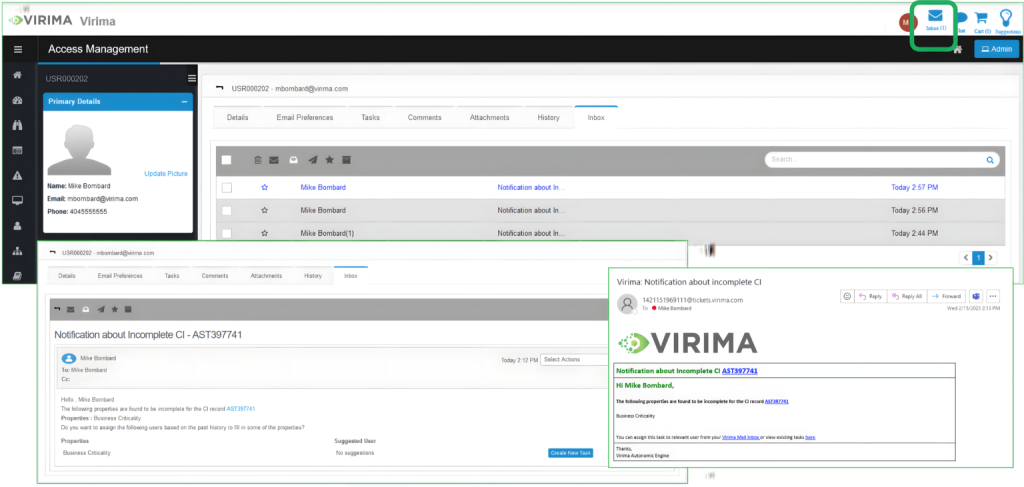
Work from Anywhere solution tracks software activity and monitors configuration changes on remote PCs over the Internet. IT asset management roles and responsibilities
One system for all asset types
IT managers need to track many types of assets. Virima makes this easy with a unified system that manages updates, usage, and lifecycle stages for all assets.
Easy license and warranty tracking
Tracking licenses and warranties can be complex. Virima automates this, thus, reducing compliance risks and keeping renewals up-to-date.
Better security with risk management
Asset managers must protect their organization’s security. Virima integrates with the National Vulnerability Database (NVD) to find vulnerabilities. Subsequently, this helps managers prioritize fixes and maintain business continuity.
Clear insights with dashboards
Virima’s dashboards offer detailed reports on asset use and network performance. Managers can find underused resources, minimize costs, and also support strategic goals.
Seamless integration with ITSM platforms
IT asset management tools work best when they connect with other systems. Virima integrates with ITSM tools like ServiceNow and Jira, making collaboration across teams easier and more effective.
Visualizing complex systems
For complex infrastructures, the Virima Visual Impact Display shows clear, interactive visuals of asset relationships. Consequently, this makes it easier to plan upgrades and changes.
Easier audit compliance
Audits can be time-consuming. Virima’s automated reports help managers show compliance easily, saving time and further reducing errors.
Master IT asset management roles and responsibilities: How Virima can help
Virima automates repetitive tasks, provides near real-time insights, and integrates seamlessly with your existing systems. It’s the perfect solution for improving efficiency, saving resources, and staying compliant with IT asset lifecycle management policy.
Ready to better understand IT asset management roles and responsibilities? Discover how Virima can help—get in touch with us today!