IBM IT asset management: Pros, cons, and alternative

IBM IT asset management provides organizations with tools to track, monitor, and optimize their IT investments. It offers features for asset discovery, lifecycle management, and compliance. However, like any solution, it has limitations that may not suit every organization’s needs.
Some businesses find IBM’s IT asset management software complex, expensive, or challenging to scale. This blog covers IBM IT asset management’s benefits and drawbacks while presenting a cost-effective alternative for asset tracking.
A change freeze lands next week, and Maximo still holds the enterprise asset story, while IT operations rebuilds server, cloud, and dependency truth in spreadsheets and side tools. That split is why IBM IT asset management can win inside a Maximo program and still leave teams shopping for an alternative when discovery-sourced CI accuracy and service impact are the missing layer.
When do teams look for an IBM IT asset management alternative?
IBM IT asset management, often delivered through Maximo Application Suite, is strongest when IT and operational assets share one enterprise asset program. Teams look past it when they need multi-method discovery, CMDB-grade CI truth, and dependency maps after service definitions for change and exposure work. Virima is an alternative when ITAM must sit on runtime inventory, not only Maximo-centered asset control.
| See how discovery-sourced inventory becomes Trusted Runtime Truth for ownership, change impact, and dependency decisions on the same CI records. Explore Trusted Runtime Truth. |
Overview of IBM IT asset management software
IBM IT asset management, offered through IBM Maximo Application Suite, delivers a comprehensive solution for managing IT assets. This platform unifies IT and operational technologies, positioning live asset tracking and advanced analytics in a single Maximo-centered system.
For IBM’s product framing, see the public IBM Maximo Application Suite overview.
Additionally, IBM provides a unified platform for IT asset management (ITAM) and IT service management (ITSM). Consequently, this platform offers the tools necessary to support infrastructure and user demands. It also helps drive digital transformation.
Features of IBM IT asset management software
IBM IT asset management offers several features that simplify IT asset management, helping organizations manage all key assets. These include:
- Comprehensive asset visibility: Gain full visibility of both physical and digital assets. Further, track hardware, software configurations, and statuses to ensure proper support and services.
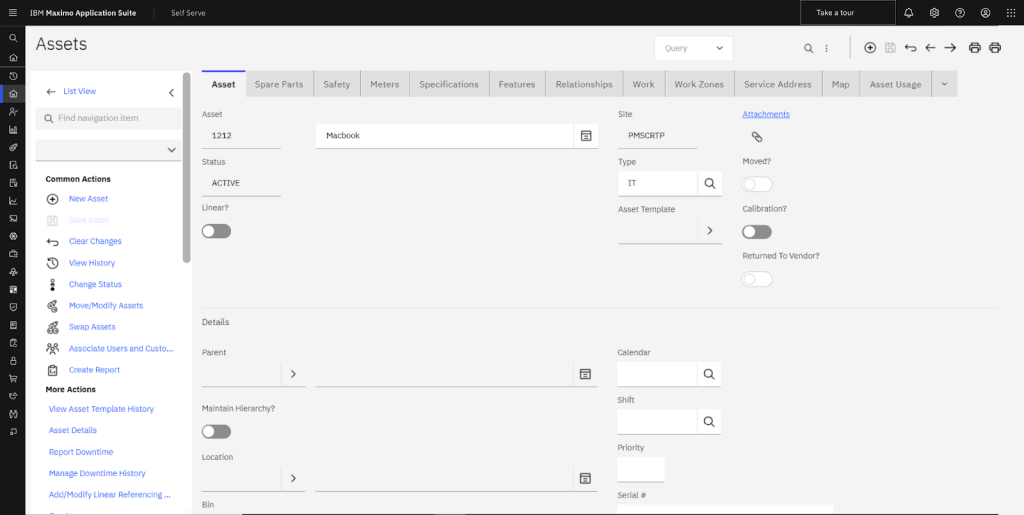
IBM IT asset management helps you oversee, track, and monitor software licenses, hardware status, contracts, and more.
- Unified ITSM and ITAM platform: Integrate asset management tools with ITSM functionalities. This also provides connected workflows for incident resolution, service requests, and change approvals.
- Self-service capabilities: Empower users to resolve common issues. They can also access services via a self-service portal, reducing service agents’ workload.
- First-call resolution support: Agents can access current asset data, troubleshooting guides, as well as best practices. Subsequently, this enables faster resolutions, improving customer service.
- Cloud-based deployment: IBM IT asset management can be deployed on-premises, as a SaaS solution, or in hybrid cloud environments. Therefore, this ensures flexibility for organizations of all sizes.
Benefits of IBM IT asset management software
IBM IT asset management system delivers many benefits, such as optimizing IT infrastructure, reducing costs, and improving efficiency. These include:
- Enhanced decision-making: Current visibility into asset utilization helps organizations make informed decisions about hardware and software investments.
- Improved efficiency: Streamlining IT asset tracking and management reduces downtime, thus, ensuring critical systems stay operational and efficient.
- Cost reduction: Centralizing IT asset data and automating service management extends asset lifecycles. As a result, it reduces operational costs.
- Stronger security and compliance: Full IT asset visibility helps businesses identify security risks and manage outdated or unauthorized assets. It also supports compliance efforts.
- Improved user experience: Self-service options and quick access to asset information empower users. This boosts satisfaction and also speeds up issue resolution.
Where does IBM Maximo IT asset management still win?
IBM Maximo still wins when enterprise asset management, OT-heavy lifecycle work, and Maximo ecosystem standards are the primary program jobs. Those strengths matter most for teams that already run Maximo as the system of record for asset work management across IT and operations technology.
Limitations of IBM IT asset management software
Although IBM IT asset management solutions offer strong capabilities, user reviews from sites like G2 highlight challenges.
Steep learning curve and usability issues
Navigating the interface of IBM IT asset management software is often not straightforward. Many modules share similar features but lack intuitive design. This often makes it difficult to understand how different functions work quickly. Mastering the platform takes time and training, consequently which can slow adoption.
High implementation and maintenance costs
The implementation and maintenance costs of IBM IT asset management solutions can be significant. In addition to software costs, setup and customization of IT asset management software require substantial financial and technical resources.
Expensive licensing and mobile limitations
IBM IT asset management licensing is often cited as expensive for mid-market teams, so affordability is a common evaluation concern. Although the platform offers many features, its cost can be difficult to justify for smaller organizations. Its mobile solutions often feel incomplete and require third-party integrations for enhanced functionality.
Resource-intensive setup and configuration
Setting up the IBM IT asset management software demands significant time and technical expertise. Organizations without dedicated IT teams may struggle to manage the system effectively. This can result in delays and inefficiencies.
IBM IT asset management is a comprehensive solution. However, its complexity, high costs, and usability challenges can hinder efficient operation. Organizations must carefully evaluate whether they have the resources to manage IBM IT asset management solutions. They should also consider if a more flexible, cost-effective alternative would better suit their needs.
| Dimension | IBM / Maximo strengths | Watch-outs teams report | Virima alternative path |
|---|---|---|---|
| Primary job | Enterprise asset and OT/IT unify in the Maximo ecosystem | IT discovery and CMDB depth may still sit elsewhere | Discovery-sourced IT inventory and ITAM fields on CMDB CIs |
| Visibility | Strong asset and work visibility inside Maximo programs | Learning curve and implementation weight | Agent, agentless, and API discovery on scheduled high-frequency cycles |
| Service impact | Not the core Maximo ITAM story for many hybrid IT buyers | Change blast radius rebuilt outside EAM | ViVID™ maps after service definitions are provided |
| ITSM join | IBM ITSM and ITAM platform story | Integration and process complexity can rise with stack size | Partner names stay plain text via the integrations hub |
| Commercial | Enterprise packaging for large programs | License and implementation cost themes on review sites | Bundled CMDB and mapping path without invented list prices |
When is Virima the better IBM ITAM alternative?
Virima fits when Maximo-centered asset control is not enough, and teams need multi-method discovery, CMDB structure, ITAM ownership fields, and dependency maps after service definitions on one operational foundation. Stay on IBM Maximo when EAM and OT lifecycle work already run well and infrastructure CI truth is solved elsewhere.
When Virima is the better ITAM path than IBM or Maximo alone
Virima offers IT asset management on discovery-sourced inventory, CMDB structure, and service dependency context for teams that need more than Maximo-centered asset control alone. IBM and Maximo programs are often strongest when enterprise asset and OT-heavy lifecycle work sit in the IBM stack. Virima is a stronger fit when multi-method discovery, CMDB-grade CI truth, and dependency maps after service definitions are the missing IT layer.
Discover more IT assets with Virima
Virima multi-method discovery is built for hybrid IT estates. It discovers data centers, cloud resources, virtual machines, hypervisors, IoT devices, and network components like firewalls and load balancers.
Virima also offers multiple discovery methods. Agentless discovery simplifies deployment, while agent-based discovery supports scheduled high-frequency inventory refresh. API integrations help extend visibility across cloud environments and IT management tools. See the integrations hub for the full partner list.
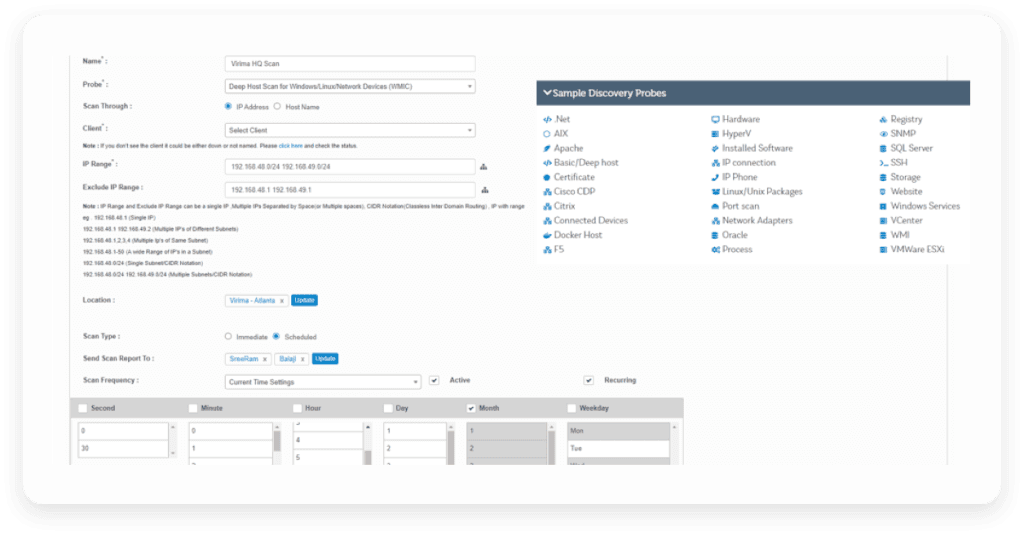
A list of sample discovery probes accessible through Virima’s dashboard.
See how IT assets connect
Virima goes beyond inventory lists by mapping relationships between devices, applications, and services after service definitions are provided. That dependency context helps IT teams assess change risk and troubleshoot faster. Maximo’s core strength is enterprise asset and OT lifecycle work, which is a different job from IT change blast-radius maps.
Once service definitions are provided, manually, by spreadsheet import, or through an enterprise architecture integration, ViVID™ service mapping builds dependency maps from that input. ViVID™ does not invent which applications form a service. Teams can overlay ITSM records such as incident tickets and change requests onto those maps to respond faster.
Stronger security and better scalability
Virima prioritizes IT security at every step. Built on AWS, it offers multi-tenant architecture with full data segregation. It encrypts discovery data in transit and never stores asset credentials in the cloud.
Virima is built to scale in large IT environments. Large Maximo programs can grow complex as asset volumes and modules expand. Virima is aimed at hybrid IT estates that need discovery and CMDB depth without assuming Maximo is the wrong system of record for EAM.
Clearer packaging for IT discovery and CMDB path
Virima includes CMDB, service mapping, and ViVID™ in a single bundle on one operational path. Business Pro packages that capability for growing IT estates, and Enterprise extends it for larger programs. Compare module packaging and total cost with vendor quotes rather than treating any single public claim as list price.
Save time with powerful automation
Virima automates IT asset management, reducing manual work and improving accuracy. Key automation features include:
- Scheduled scans to keep asset data up to date
- Automated data organization to ensure consistency
- Bi-directional CMDB syncing to keep records current
- High-frequency ITSM record updates for better service monitoring
- Auto-generated reports to support data-driven decisions
Bi-directional integrations for better IT management
Virima offers bi-directional integration with IT asset management and ITSM platforms. See the integrations hub for the full partner list. Unlike other IT asset management solutions, Virima enables high-frequency data exchange through scheduled discovery and sync cycles. IT teams can also see incident tickets and change requests directly on service maps. This feature improves issue resolution and risk assessment.
Choose your path: stay on IBM Maximo, dual-run, or move IT inventory ops to Virima
Stay on IBM Maximo ITAM if: enterprise asset management, OT-heavy lifecycle work, and Maximo ecosystem standards already solve the urgent asset program jobs, and hybrid IT CI truth plus dependency maps are covered in another system of record.
Dual-run IBM Maximo and Virima if: Maximo remains the EAM or OT system of record, while ops and security need discovery-sourced CMDB records and ViVID™ maps after service definitions for change and exposure work on the IT estate.
Move IT inventory operations onto Virima if: the program must unite hardware and software inventory, ownership, CMDB relationships, and service impact on the same CIs, and Maximo alone leaves those IT layers split.
Virima is more than an alternative to IBM IT asset management. It offers multi-method discovery, CMDB structure, and automation on scheduled high-frequency cycles. Smaller IT teams can start with Business Pro, which packages that full capability for growing estates. IT teams can manage assets more efficiently while minimizing costs.
See ownership, change impact, and dependency context share one discovery-sourced foundation as Trusted Runtime Truth before you schedule a deeper walkthrough.
See how multi-method discovery, CMDB structure, ITAM workflows, and ViVID™ maps after service definitions give Maximo-era programs an IT inventory foundation without treating enterprise asset strengths as failures.
Frequently Asked Questions
What is IBM IT asset management best at?
IBM IT asset management, often delivered through Maximo Application Suite, is best when enterprise asset management, OT-heavy lifecycle work, and Maximo ecosystem standards are the primary program jobs. Those capabilities matter most for large asset work-management programs.
When should you evaluate an IBM Maximo ITAM alternative?
Evaluate an alternative when multi-method discovery, CMDB-grade CI accuracy, and dependency maps for change or exposure work are still missing after Maximo covers enterprise asset control. The gap is usually hybrid IT runtime truth, not a single missing EAM report.
Does Virima replace IBM Maximo?
Not always. Many teams dual-run Maximo for enterprise asset and OT lifecycle work and Virima for discovery-sourced inventory, CMDB, and maps after service definitions. Full replacement of Maximo EAM is a different decision from adding IT discovery depth beside it.
How does ViVID™ relate to Maximo asset records?
Once service definitions are provided, ViVID™ builds dependency maps for IT change and incident context. Maximo remains strong for enterprise asset work management. The two jobs can coexist when teams dual-run EAM and discovery-sourced CMDB maps.
What is Trusted Runtime Truth in an IBM ITAM decision?
Trusted Runtime Truth is discovery-sourced ground truth for what exists, how it connects, what changed, what breaks, and who owns it. For IBM ITAM buyers, it means license, ownership, and change decisions can share the same runtime inventory foundation used for exposure work.