Asset Request and Form Management for Better Control and Visibility

An employee’s laptop request should not feel like sending a message into a black hole. Yet across many enterprises, that is exactly what happens. Requests arrive by email or ad-hoc form. Approvals are buried in threads. Status updates are inconsistent. This chaos highlights why Asset Request and Form Management need structure, clarity, and automation. Without it, IT teams struggle to deliver assets quickly and with compliance.
As organizations grow and face more audits, informal asset request processes become unsustainable. Delays frustrate employees and IT alike. Leaders begin to ask: Is there a better way?
This article answers that question with practical steps and tool insights grounded in current ITAM and governance benchmarks.
What is IT asset request and form management?
IT asset request and form management is a governed workflow process that captures, validates, approves, and fulfills hardware, software, and access requests using standardized digital intake forms. It replaces ad-hoc emails and spreadsheets with automated routing, audit logging, and CMDB integration to ensure compliance, visibility, and rapid asset delivery.
Key takeaways on asset request and form management: Quick answers for IT leaders
What’s the best way to manage software asset requests?
Centralize through a self-service portal with standardized forms and automated approvals.
Why do manual asset requests fail?
They rely on emails and spreadsheets, lacking validation, visibility, and governance.
How does asset request work with change management?
Complex or risky asset deployments should tie into an IT change management form for governance.
Are there tools that simplify asset request submissions?
Yes, modern ITSM and ITAM platforms with workflow automation and inventory integration do this well.
The high cost of manual asset request management
What manual processes look like today
Many organizations still rely on email chains or shared spreadsheets to manage asset requests. An employee emails their manager and IT. IT follows up, chasing approvals manually. Requesters call to check the status. Nothing is centralized.
This approach fragments data collection, loses history, and burdens teams with coordination overhead. It also makes compliance difficult to demonstrate.
The operational impact
Manual processes create real business pain:
- Delays and employee productivity loss
Teams wait on laptops, software, or access. - Incomplete or incorrect requests
Missing fields lead to back-and-forth. - Approval bottlenecks
No enforced routing rules mean approvals slip or stall. - Poor visibility
IT and stakeholders lack a live view of status.
As the volume of requests grows, so does the friction.
Compliance and risk exposure
Risk rises when approval histories are incomplete. Auditors need evidence: Who approved this request? When? According to what policy?
You cannot reliably answer these questions when requests live in disconnected systems. Worse, unauthorized request assets acquisitions might bypass IT entirely.
What is an asset request form (and what it should include)
What an asset request form really is
An asset request form is a structured way for employees to request hardware, software, or system access. It kick-starts governance and fulfillment workflows. Not all forms are of equal quality, and context matters.
Five essential fields every asset request form should have

- Requester information
(Name, department, role, so approvals align with policy) - Asset details
(Precise model, software edition, licensing details) - Business justification
(Why they need it to support prioritization) - Requested delivery date
(To aid fulfillment planning) - Assigned cost center
(Financial accountability and accountability)
All asset requests should enter one system, no emails, no side channels. This ensures consistency and collects necessary data upfront.
A centralized service catalog with tailored forms for hardware, software, and services ensures completeness and relevance. It also enables reporting and auditing down the line. For how governed intake supports trusted runtime truth across the asset life cycle, start there before you expand automation.
An effective IT asset request form should capture requester identity, precise asset or license details, business justification, needed-by date, and cost center. Conditional fields and required validation cut incomplete submissions and align each request with policy before approval routing starts.
Other fields can help with compliance or context, like environment specifics or approvals required.
What fields should an IT asset request form include?
An effective IT asset request form requires requester identification, precise asset configuration details, business justification, required fulfillment date, and cost center assignment. Including conditional logic and mandatory validation fields prevents incomplete submissions and aligns requests with financial and security policies before approval routing begins.
Form usability drives adoption
Good form design is a core part of Form Management. Use dropdowns for common asset types. Use conditional fields to reduce clutter.
Require key fields to avoid incomplete submissions. The more intuitive the form, the more compliant users become.
Best practices for asset request and form management
Modern organizations treat asset requests not as tickets, but as governed workflows. Use the principles below to transform the process.
Standardize and centralize the process
All asset requests should enter one system, no emails, no side channels. This ensures consistency and collects necessary data upfront.
A centralized service catalog with tailored forms for hardware, software, and services ensures completeness and relevance. It also enables reporting and auditing down the line.
Automate workflows and approvals end-to-end
Automation removes manual handoffs and bottlenecks:
- Digital request submission triggers routing rules
- Approvers receive notifications and reminders
- Fulfillment tasks are created automatically
- Requesters see live status updates
- Every step is logged for traceability
Automation drives speed and reduces errors. It also enforces governance so that no approvals slip through accidentally.
Implement a self-service request portal
A self-service portal empowers employees and reduces helpdesk overhead. Users can browse common requests, access guidance/FAQs, and submit structured requests.
They see status tracking without emailing IT. This improves satisfaction and predictability.
Embed policy and compliance checks
Not all requests are equal. High-risk or sensitive requests may need additional reviews, for example, tying them to an IT change management form if they affect production systems.
Built-in compliance checks ensure only authorized requests proceed. Every policy acknowledgement and approval is logged automatically.
Measure and continuously improve
Track key KPIs like fulfillment time, approval cycle save time, and request volume. Use analytics to find bottlenecks. For example, if approvals are slow at a certain stage, adjust routing rules or thresholds.
The end-to-end asset request lifecycle (from submission to audit)
Effective Asset Request and Form Management is not just about collecting requests. It is about managing the full IT asset life cycle from first submission through long-term audit evidence.
A mature lifecycle follows a predictable, governed flow.
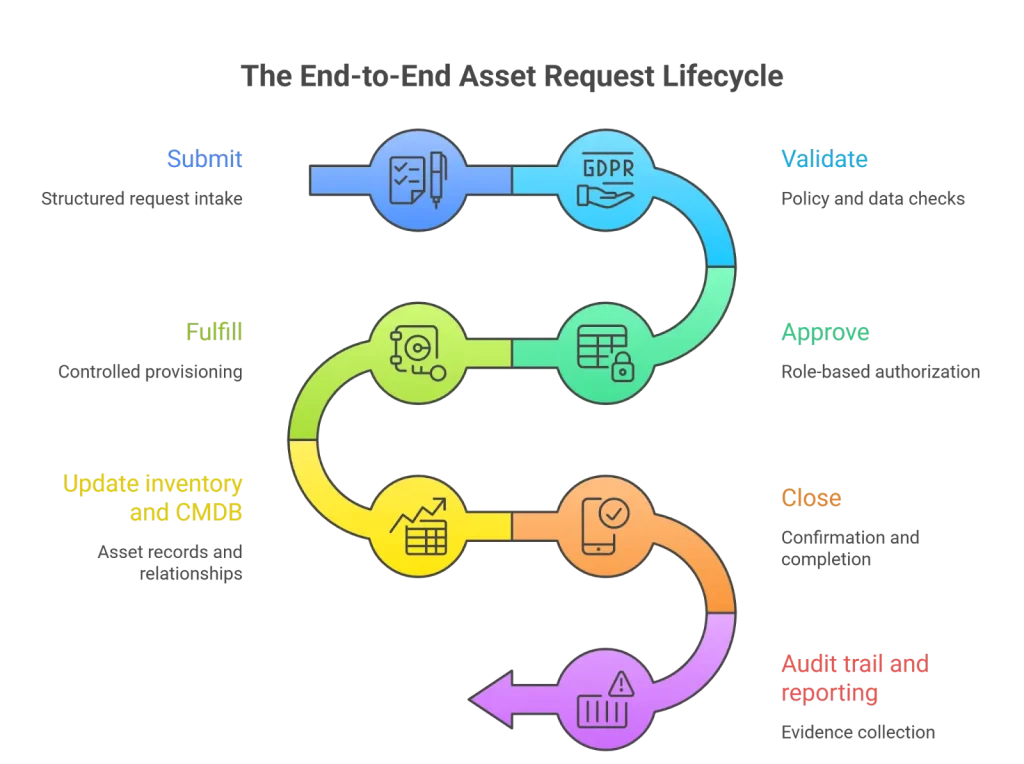
Asset Request Lifecycle at a Glance
1. Submit – Structured intake
Requests start with a standardized form that enforces required fields and adapts based on asset type. This stops incomplete requests early.
2. Validate – Policy and data checks
Requests are checked for missing information, policy alignment, and duplicates before approvals begin, reducing rework later.
3. Approve – Role-based authorization
Managers, finance, and compliance teams review requests based on risk and cost. Every decision is logged automatically.
4. Fulfill – Controlled provisioning
Approved assets are provisioned in a tracked manner, whether hardware, software, or access.
5. Update – Inventory and CMDB
Asset records, ownership, and relationships are updated immediately to maintain data accuracy. That handoff is where asset management and configuration management must stay aligned.
6. Close – Confirmation and completion
Requests close only after delivery, record updates, and requester confirmation.
7. Audit – Evidence and reporting
Each step generates an audit trail, enabling proactive reporting and compliance readiness.
Hardware, software, and access requests: Why one form is not enough for asset request and form management
Different asset types require different logic. Treating them the same creates gaps.
| Request type | Form focus | Typical extra controls |
|---|---|---|
| Hardware | Model, location, accessories, tagging | Cost and procurement approval |
| Software | License type, quantity, target user or device | Entitlement and overage checks |
| Access | Role justification, start and end dates | Security or compliance approval |
Hardware requests
Hardware forms typically require:
- Model or configuration selection
- Shipping or location details
- Accessories or peripherals
- Asset tagging requirements
Approvals often involve cost and procurement checks.
Software requests
Software requests introduce additional complexity:
- License type and quantity
- Target device or user
- Compatibility or OS details
- Renewal or expiration awareness
These forms often need checks to prevent license overages.
Access requests
Access requests are usually the most sensitive.
They often require:
- Role-based access justification
- Time-bound access (start/end dates)
- Security or compliance approvals
Conditional logic is critical here to avoid over-permissioning.
When asset requests trigger IT change management forms
Not every asset request is a simple fulfillment task.
Some requests introduce operational risk and must link to an IT change management form.
Examples include:
- Deploying new servers or network equipment
- Installing software that alters production systems
- Making configuration changes during asset deployment
- Applying patches or firmware updates
In these cases:
- The asset request initiates a change record
- CAB review may be required
- Scheduling and rollback plans are documented
- The asset, change, and configuration updates remain linked
This connection ensures traceability and reduces audit risk.
How does an asset request differ from an IT change management form?
An IT asset request focuses on individual provisioning and cost approval, whereas an IT change management form evaluates the operational risk and service impact of deploying that asset into production infrastructure. High-risk asset deployments, such as new servers or system-wide software updates, trigger change records to ensure CAB review and rollback planning.
How does an asset request differ from an IT change management form?
An IT asset request focuses on provisioning and cost approval for hardware, software, or access. An IT change management form evaluates operational risk and service impact when that asset touches production. High-risk deployments, such as new servers or production software, should open a change record with CAB review and rollback planning.
Common failure points in asset request management
Even with tools in place, weaknesses appear when processes lack discipline.
Frequent breakdown areas
- Missing fields
Requests move forward without justification or cost ownership. - Approval bottlenecks
Approvers miss emails or delay decisions. - Shadow IT procurement
Users bypass IT to avoid slow processes. - Duplicate requests
Multiple submissions for the same asset waste time and budget. - License overages
Software is deployed without entitlement checks. - Lost audit evidence
Approval history is incomplete or scattered.
Each failure point increases operational and compliance risk.
What “good” looks like: Benchmarks for mature teams
High-performing organizations measure their asset request process.
What are the industry benchmarks for automated IT asset request fulfillment?
Mature IT organizations achieve standard request approvals within 1 to 2 business days and fulfill digital software or access requests in hours. Utilizing rule-based auto-approvals for low-risk items allows high-performing teams to automate 40% to 70% of routine requests while maintaining 100% audit log completeness.
Operational benchmarks
- Time to approve:
Standard requests are approved within 1–2 business days - Time to fulfill:
Hardware delivered in under 5 business days
Software and access are fulfilled within hours or the same day - Policy-based auto-approval:
40–70% of low-risk requests are auto-approved
Governance benchmarks
- Audit log completeness:
100% of requests have recorded approvals and timestamps - Inventory accuracy:
Asset records updated at fulfillment, not weeks later - Change linkage:
All risk-impacting asset deployments tied to a change record
When teams reach these benchmarks, asset request management stops being a bottleneck and becomes a control mechanism.
What benchmarks mark a mature IT asset request process?
Mature teams often approve standard requests in one to two business days and fulfill software or access in hours. Many auto-approve 40 to 70 percent of low-risk requests while keeping full approval timestamps. Inventory updates at fulfillment and change linkage on risk-impacting deploys complete the control picture.
Manual vs automated asset request process
| Criteria | Manual Process | Automated Process |
| Fulfillment Time | Slow & inconsistent | Faster & predictable |
| Transparency | Limited | High |
| Errors | Higher | Reduced |
| Traceability | Weak | Strong |
| Compliance readiness | Reactive | Built-in |
Automated processes not only improve efficiency, but they also strengthen audit readiness.
Tools and solutions to simplify asset request and form management
Modern IT management platforms can simplify asset request submissions, automate approvals, and preserve audit trails.
When evaluating solutions, consider these core capabilities:
- Customizable request/form builder – so forms capture necessary data and enforce policy rules.
- Automated workflow engine – for routing approvals, escalations, reminders, and fulfillment triggers.
- Integration with asset inventory – to automatically update asset records once a request is completed.
- Audit logs and reporting – showing who requested what, who approved it, and when.
- Easy admin configuration – so workflows and forms can adapt as policies evolve.
These features ensure that submitting an asset request is not just submitted, it’s governed, validated, tracked, and logged for compliance.
Virima’s platform: Meeting these criteria
Virima, for example, offers an IT Asset Management platform with tightly integrated asset request and form logic.
With Virima, the moment a request is approved, the asset can be automatically created or updated in the system, and its entire lifecycle is visible for compliance reporting.
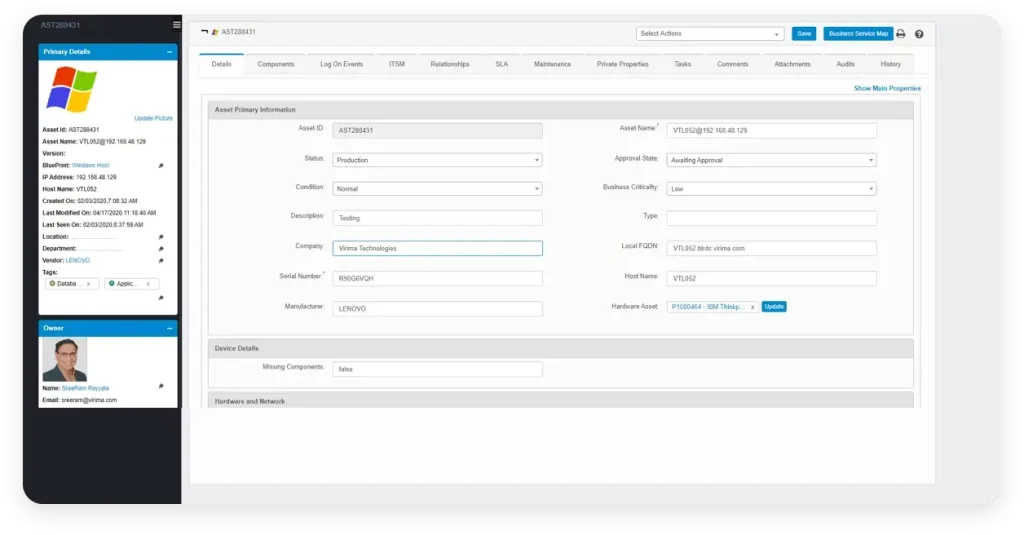
Virima combines:
- A full-lifecycle ITAM platform for hardware, software, and hybrid assets
- A robust ITSM workflow engine for request fulfillment and change management
- A dynamic CMDB and service mapping layer
- Out-of-the-box integrations with systems like Service Now, Jira Service Management, Ivanti, and HaloITSM
This means requests aren’t just collected, they’re acted upon and linked to real-time visibility configuration, compliance, and governance data.
Likewise, IT change management forms can be managed by similar workflow logic. For asset deployments that require change review, such as adding servers, restructuring networks, or deploying critical software.
The platform can tie the asset request to a change management system form and capture the entire change history in one traceable digital thread. This holistic view reduces risk and keeps auditors satisfied.
Market trends that support ITAM improvements
Industry momentum is strong for improving asset workflows:
- Analysts highlight ITAM trends for 2025, including automation, AI-driven processes, and unified platforms. All of it aligns with the need for better request and form management. (Techpilot.AI)
- Market analysis shows the ITAM market to be around USD 2.09 billion in 2025, with ongoing growth as enterprises invest in mature asset practices. ( Morder Intelligence).
- Forrester’s 2025 SAM report benchmarks the evolution of software and asset management tools, stressing visibility and optimization. It is a key enabler for automated fulfillment. (squalio)
These trends reinforce that requesting and tracking assets correctly is no longer “nice to have. It is expected that by 2025, digital governance standards.
How asset request and change management intersect
Some asset deployments impact services or infrastructure. For these cases, an IT change management form is vital. Tying asset requests to change logs ensures that approvals consider risk, scheduling, and downstream impacts. This integration keeps compliance strong and minimizes operational risk.
Toward efficient and accountable asset management
Asset request and form management must evolve from email and spreadsheets to governed, automated workflows. Doing so improves fulfillment speed, transparency, and compliance readiness.
Having a unified system with structured forms, approvals, and audit tracking positions IT teams for success.
Modern ITAM solutions reflect broader industry trends toward automation and integrated governance. When tools align with process best practices, IT leaders can confidently support business goals with less rework, fewer audit surprises, and more predictable service delivery.
If you’re evaluating how to modernize your asset request workflows, consider exploring a solution that unifies request intake with inventory, approvals, and audit outcomes.
That clarity transforms asset management from a cost center into a foundation of operational excellence.
Turning asset requests into governed, auditable workflows
Achieving this level of efficiency and access controls might sound daunting at first. However, it does not require building complex workflows from scratch or stitching together disconnected tools.
Virima’s IT Asset Management software platform was designed to address exactly these challenges. From intuitive asset request forms to automated approval workflows, it helps organizations replace email-driven processes with structured, auditable workflows.
Every request, approval, and fulfillment step is tracked, giving IT leaders confidence that assets are issued quickly, correctly, and in line with policy.
Because asset requests are linked directly to asset records and related processes such as IT change, the hardware asset management process forms teams gain end-to-end visibility.
This reduces follow-ups, improves compliance, and simplifies audit preparation without adding operational overhead.
If streamlining asset requests and ensuring full accountability are on the agenda, it may be worth exploring how Virima can support those goals.
A short walkthrough can show how standardized forms, automated workflows, and integrated asset data come together in practice.
Request a personalized Virima demo to see standardized forms, automated approvals, and inventory-linked fulfillment in one workflow.
FAQs
What’s the best way to handle asset requests at scale?
Use a centralized portal with structured forms and automated workflows that update asset records at fulfillment.
How can I automate the IT asset request process?
By routing digital forms through rule-based workflows with approvals, notifications, and fulfillment tracking.
Do IT asset request portals improve compliance?
Yes. They enforce approvals, embed policy checks, and store timestamps and decision history for audit readiness.
What should an asset request form include?
Requester info, asset details, business justification, needed-by date, and cost center, plus conditional fields by asset type.
How is asset request management different from change management forms?
Asset requests focus on provisioning and ownership. Change forms govern risk and impact when deployments affect production services.