5 Common IT Operations Challenges: Strategies To Overcome Them For Modern Enterprises

IT operations covers a lot of ground: managing infrastructure, responding to incidents, tackling problems, handling change, and releasing. The scope shifts depending on your industry, org size, and how complex your tech stack has gotten. For many teams, IT operations also means running a service desk, managing IT assets, and keeping security and compliance in check.
That breadth creates real IT operations challenges. Whether you’re a decision-maker trying to optimize performance or a system admin keeping things running, the obstacles tend to look the same.
This blog covers the five most common IT operations challenges modern enterprises face, along with practical strategies to overcome each one.
1. Distributed infrastructure and data silos: The need for centralization
Modern enterprises are adopting multi-cloud architecture at scale. According to the Flexera 2025 State of the Cloud Report, 70% of organizations are using hybrid cloud strategies (combining public and private clouds), reflecting the growing complexity of distributed environments. But that adoption creates a familiar problem: distributed infrastructure and data silos.
Flexera’s 2025 report found that 84% of organizations identify managing cloud spend as their top challenge, highlighting how complexity directly impacts operations. The result is duplicated data, inconsistent processes, and limited visibility across the organization.
Without centralized visibility, IT teams struggle to support services and manage infrastructure efficiently. If you’re supporting 40+ vendor applications, you need a single hub where every detail about those applications is accessible the moment an incident hits. That’s why a centralized IT operations management system matters.
How Virima’s CMDB tackles distributed infrastructure
Virima’s CMDB acts as a single source of truth for all hardware and software asset information. Organizations can set up a central CMDB for organization-wide control, plus divisional CMDBs for each line of business. Each department manages its part of the IT infrastructure under the same policies and procedures, with granular business rules to automate CMDB maintenance tasks.
The follow-up question is always the same: how do you keep those CMDBs current when changes happen constantly across a hybrid infrastructure?
That’s what Virima’s IT discovery solves. Agentless IP-based discovery scans across multi-cloud, on-premises, and hybrid environments to find every IT asset, from servers and workstations to software. Discovery also automatically maps relationships and dependencies through machine learning, so the CMDB stays current without manual data entry.
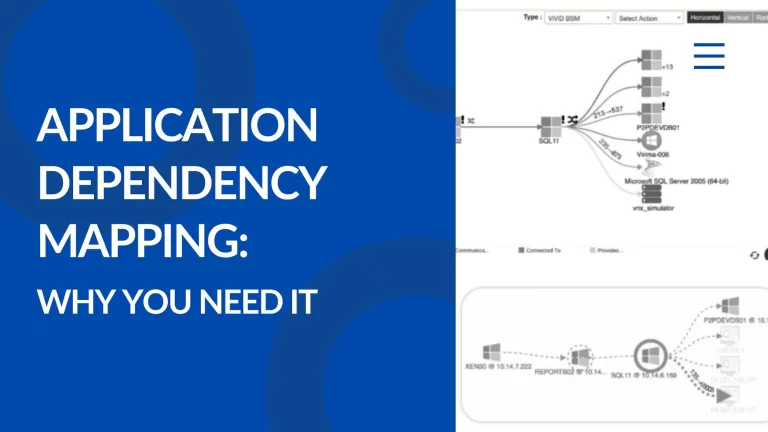
Raw CMDB data alone doesn’t drive fast decisions, though. You need that data visualized. Virima’s service maps turn CI data into interactive, dynamic maps that show how assets and services depend on each other — including infrastructure relationships, application dependencies, and host-to-host communications. IT teams can identify critical assets, trace dependencies, and act on what they actually see rather than what they assume.
2. Lack of cybersecurity and vulnerability remediation prioritization
This IT operations challenge goes straight to the integrity of your data and systems. With hybrid deployments so common, [IBM’s 2023 Cost of a Data Breach Report](suggested: IBM annual breach report) found that 82% of breaches involve data stored in the cloud. The causes: limited visibility across hybrid environments and weak data protection as information moves across databases, clouds, services, and applications.
Tackling this means managing cybersecurity across your entire digital footprint. But many organizations fall short because they lack consolidated asset and threat information, don’t have a system to rate vulnerabilities, and have gaps in their reporting.
How Virima helps with cybersecurity in three steps
Step 1: Asset and threat information consolidation
Virima’s discovery capabilities, combined with the Discovery Agent (supporting Windows, macOS, and Linux), ensure no assets go unaccounted for. That makes Virima an effective cybersecurity asset management platform for hybrid IT environments. Recurring scheduled scans keep asset records current and flag changes, incidents, and threats with each discovery cycle.
Virima’s CMDB consolidates all this asset information in one place, giving teams a centralized view for change planning, incident response, and vulnerability prioritization. All discovery data is automatically checked against NIST’s National Vulnerability Database (NVD) for known CPE and CVE entries, at no extra cost.
Step 2: Criticality rating of vulnerabilities
NVD vulnerabilities are overlaid on service maps through Virima’s ViVID™ feature, alongside ITSM incidents, recent changes, and event management alerts. These visual overlays show potential threats in context, so you can rate each vulnerability based on its severity and perceived impact.
ViVID service mapping makes it easier to prioritize remediation based on each asset’s criticality to the business. By understanding which applications and services carry the most risk, teams can focus vulnerability remediation where it matters most.
Step 3: Setting the stage for cybersecurity actions
Detailed vulnerability reports help stakeholders take informed action. Virima reports on your organization’s vulnerability management efforts and highlights gaps in cybersecurity risk management. Share these with the right people, and your team can address vulnerabilities quickly and strengthen your security posture.
3. Cross-team collaboration for IT operations
Among IT operations challenges, meeting evolving customer demand while keeping pace with technological change is one of the hardest. It demands close collaboration between central IT and business units to manage varied operations together.
Many organizations still struggle with miscommunication-driven delays in incident response and poor collaboration between IT and business teams. According to a [Deloitte survey](suggested: Deloitte IT collaboration survey), 93% of companies acknowledge they need moderate to full collaboration between central IT and other lines of business.
Virima’s service mapping and Autonomic Social Discovery are built to close these collaboration gaps.
Virima service maps for shared understanding
Effective collaboration depends on a shared view of asset relationships, service dependencies, and the links between applications and services. Virima’s service maps provide exactly that: a shared, visual understanding of how IT assets, applications, and services connect.
These maps let teams visualize the impact of incidents and changes across the entire IT ecosystem. That shared view drives better cross-divisional collaboration and faster decision-making, especially as organizations take a more modular approach to IT infrastructure.
Because these maps are generated automatically from updated CI details in both the central and divisional CMDBs, they stay current without manual effort.
Virima ASD for knowledge gap filling
Virima’s Autonomic Social Discovery module automates human intelligence gathering for information that standard discovery probes and agents can’t capture: ownership details, lifecycle status, business criticality, policies, and SLAs across central and divisional CMDBs. Any CI property can be marked for ASD integrity checks, and the system learns from prior responses to improve over time.
By breaking down divisional silos, ASD helps teams collaborate effectively and tap into collective expertise for better IT operations.
4. The need for effective change management
Change management is a pain point across every industry. An effective process ensures that changes to IT infrastructure and services happen smoothly with minimal disruption. Organizations with a structured approach to change management are 93% more likely to exceed their objectives.
Virima’s change management process is one of six PinkVERIFY ITIL 4-certified practices, alongside SACM, incident, problem, request fulfillment, and knowledge management.
Despite that, many organizations face delays and errors because they lack the right tools in their change management processes.
How Virima brings efficiency to change management
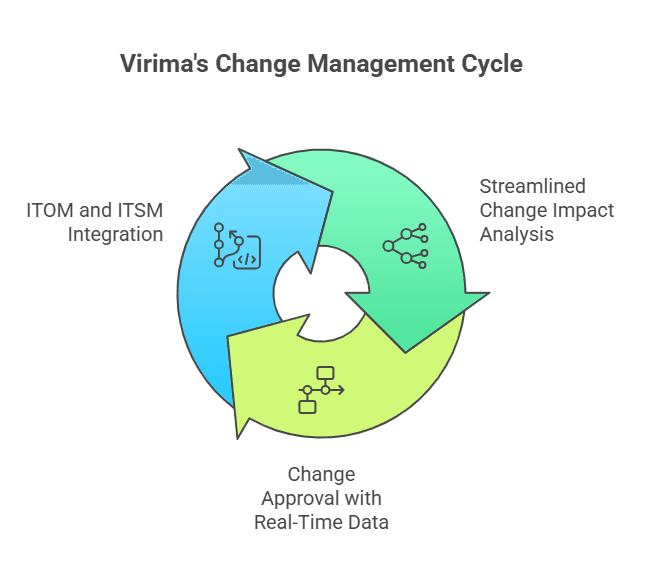
Streamlined change impact analysis
Virima’s application dependency mapping provides a dynamic, interactive view of application relationships, infrastructure dependencies, and business services. Change managers can see the impact of proposed changes before they go to the change approval board. This cuts the time for change request evaluation on normal changes and improves the success rate of emergency changes.
Change approval with near-real-time data
Once you understand the potential impact, you need current ITSM data to evaluate the request. Virima’s ViVID™ feature provides near-real-time change, incident, and NVD vulnerability data overlays on service maps. Stakeholders can quickly answer: “Who will be impacted?” “What changed?” “Which assets have risks?”
5. Challenges in scaling IT infrastructure and operations
As organizations grow, scaling IT infrastructure becomes a key IT operations challenge. The goal is agility and efficiency in deployment without dropping service quality.
Structured automation brings that flexibility. But only with the right tools can organizations overcome scalability hurdles while maintaining IT service delivery.
Maintain IT service delivery levels with ITSM integrations
Virima’s integration with major ITSM platforms keeps IT service delivery consistent as organizations scale. Integrations with ServiceNow, Jira Service Management, and Ivanti support bi-directional sync of accurate asset information between Virima’s CMDB and the ITSM platform.
Asset information stays current. Since accurate asset details are the backbone of IT service delivery, the integration ensures services are delivered efficiently at scale. And because Virima’s discovery, CMDB, and service mapping are portable across ITSM platforms, organizations aren’t locked into a single vendor as they grow.
Visibility and control over multi-cloud environments
As organizations deploy in multi-cloud environments like AWS and Azure, Virima gives them control over all asset information. Track assets and visualize relationships through service maps.
Rule-based CMDB updates mean asset information refreshes automatically as changes occur. During scaling, you stay in control of every change.
Overcoming IT operations challenges starts with the right visibility
Every IT operations challenge in this list traces back to the same root cause: incomplete visibility. You can’t centralize what you can’t see. You can’t prioritize vulnerabilities without knowing what’s exposed. You can’t collaborate without a shared view of dependencies. And you can’t manage change or scale operations without accurate, current asset data.
Virima’s platform gives IT operations teams that visibility, from discovery through CMDB, service mapping, and ITSM integration, so you can plan better for change and respond faster when things go wrong. That same foundation of accurate, real-time asset data is also what makes AI agents in IT operations viable, because autonomous systems can only act safely when they have a trustworthy picture of the environment they’re operating in.
Book a demo today to see how it works for your environment.
FAQ
What is the role of service mapping in IT operations?
Service mapping shows how IT assets, applications, and infrastructure components connect and depend on each other. Without it, teams make changes, respond to incidents, and plan capacity based on incomplete information.
When a server goes down, service mapping tells you which business services are affected and who to notify. When a change request comes in, it shows the blast radius before you approve. Virima’s service maps are generated automatically from discovered CI data and update as your environment changes, so the picture stays accurate without anyone manually maintaining it.
What is the difference between ITOM and ITSM?
ITOM (IT operations management) focuses on managing the infrastructure itself: discovery, monitoring, event management, and automation of the physical and virtual assets that keep services running. ITSM (IT service management) focuses on delivering and supporting IT services to end users through incident management, request fulfillment, change management, and service catalog management.
In practice, they work together. ITOM provides the data layer (what exists, how it’s connected, what’s happening) and ITSM provides the process layer (how to respond, who to notify, what to approve). Virima bridges both by combining its native ITOM capabilities (discovery, CMDB, service mapping, ITAM, and ViVID) with direct integrations into ITSM platforms like ServiceNow, Jira Service Management, and Ivanti. Assets discovered by Virima feed directly into ITSM workflows through these integrations.
How do you scale IT operations without losing control?
Scaling infrastructure is one thing. Scaling the operational processes around it is harder. The organizations that do it well tend to share a few practices: they centralize asset data in a single CMDB, automate discovery so the CMDB never goes stale, map service dependencies so every change and incident gets triaged with full context, and integrate their discovery data with their ITSM platform, so workflows run on accurate information rather than manual spreadsheets.
Virima’s platform brings these together: IT discovery, CMDB, service mapping, IT Asset Management, and ITSM integrations.