Why Cloud Security Posture Management Tools Keep Missing the Same Assets

In July 2025, security researchers discovered an open Azure Blob storage container belonging to talent acquisition platform TalentHook. According to IT Pro, the misconfigured cloud storage left approximately 26 million job applicant resumes exposed online, complete with phone numbers, home addresses, and employment histories. There was no zero-day exploit involved, no sophisticated credential harvesting, and no breached perimeter defense. The incident stemmed from a public-read access setting on an unattached cloud container that nobody had assigned to an active operational team.
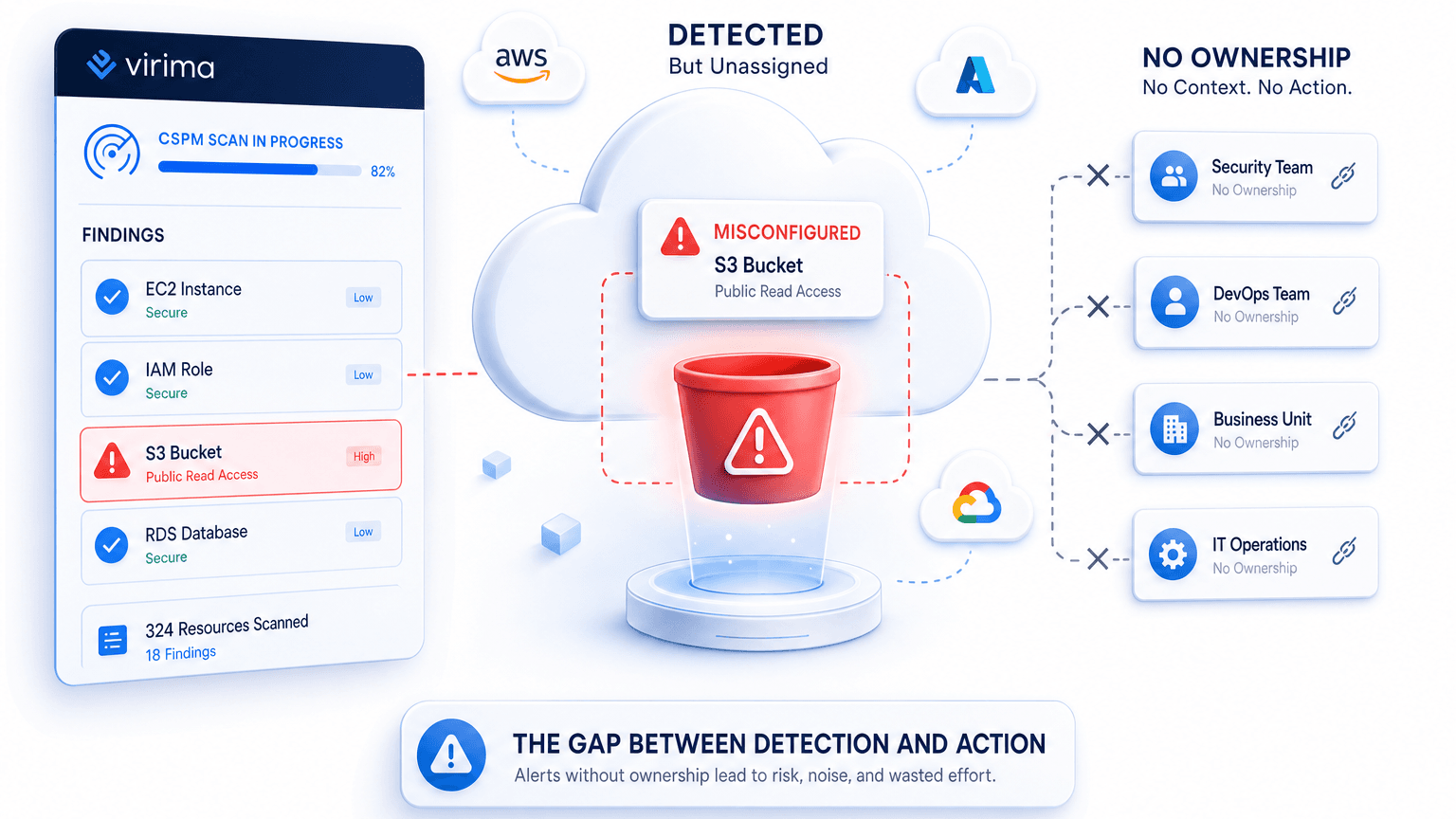
A modern Cloud Security Posture Management (CSPM) tool would have flagged that storage bucket within minutes. That is what these configuration scanners do. They query cloud APIs, check resource settings against policy baselines, and calculate exposure scores. The open question a scanner cannot resolve on its own is who owns the resource, which business service depends on it, and whether it was supposed to be decommissioned six months ago.
This is where the operational limits of Cloud Security Posture Management tools become visible in day-to-day operations. Scanners excel at identifying misconfigurations, but when the underlying asset inventory is incomplete or unmapped, the resulting findings sit unassigned in a queue. Security teams are left triaging alerts against cloud resources that lack clear ownership, service context, or operational history.
What is Cloud Security Posture Management?
To understand why security findings stall, it helps to examine what Cloud Security Posture Management tools are designed to do in connected cloud accounts. As defined in the National Institute of Standards and Technology (NIST) Cybersecurity Framework and mapped across control families like NIST SP 800-53 (specifically CM-8 for System Component Inventory and RA-5 for Vulnerability Monitoring), CSPM is a security discipline focused on compliance and risk identification across cloud environments.
At its core, a CSPM solution performs four primary functions. It runs API-based configuration scanning, inspecting IaaS, PaaS, and SaaS environments against predefined security benchmarks like CIS Controls or NIST guidelines on a scheduled cadence. It handles compliance monitoring, evaluating cloud infrastructure against regulatory frameworks, including HIPAA, PCI-DSS, and SOC 2, the same NIST-aligned baselines referenced above, applied to a specific regulation. It performs drift detection, identifying when a cloud resource’s running configuration deviates from its established infrastructure-as-code (IaC) baseline or security policy. It applies risk prioritization, assigning severity scores to misconfigurations based on public accessibility, privilege levels, and exposure paths.
This is distinct from CNAPP (Cloud-Native Application Protection Platform), which combines CSPM with cloud workload protection and cloud infrastructure entitlement management in one broader platform.
Where the definition runs out
While CSPM tools scan connected cloud accounts on a scheduled cadence, their effectiveness depends on the accuracy of the CSPM asset inventory they inspect. When a scanner detects a policy violation, its job ends at the alert. It cannot determine who built the resource, which application uses it, or whether shutting it down will break a revenue-generating production service.
| Operational Situation | What the CSPM Tool Reports | What Happens in Operations |
|---|---|---|
| Orphaned storage bucket | High-severity alert: storage bucket has public read permissions enabled. | The ticket sits unassigned for weeks because the creator left the company and no owner tag exists. |
| Shadow cloud account | Zero alerts generated for the account or its hosted workloads. | A department spins up a project using a corporate credit card. The CSPM tool never scans it because the account was never onboarded. |
| Stale staging workload | Medium-severity alert: outdated OS image running on a cloud instance. | Engineers hesitate to terminate the instance because they cannot verify whether an active microservice still calls it. |
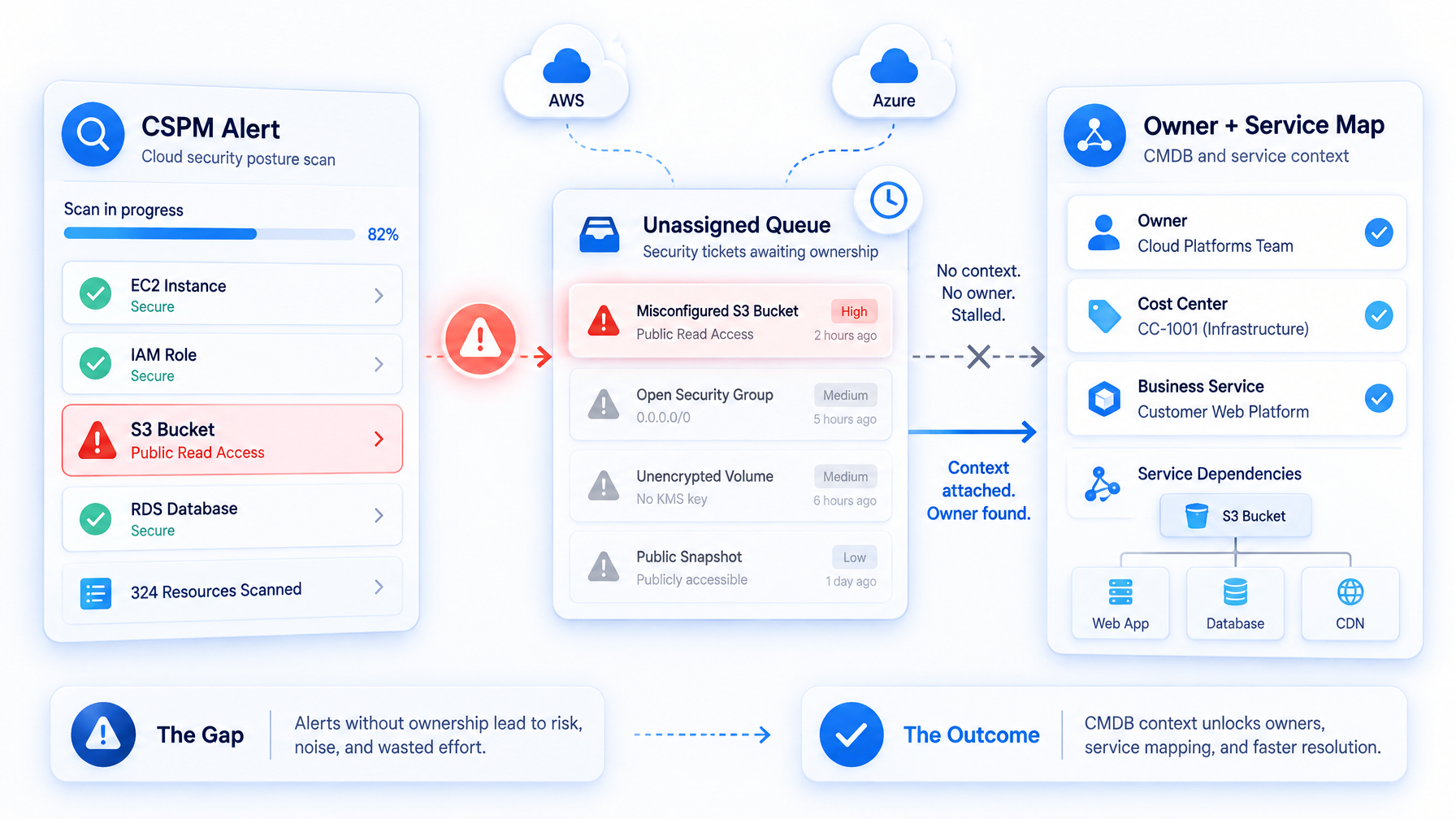
A CSPM scanner can flag a misconfigured cloud resource in minutes, but it cannot determine who owns it, which service depends on it, or whether it’s safe to change. That ownership and service-dependency context comes from a discovery-fed CMDB, not the scanner itself. When a finding has no matching CI record, the ticket has nowhere to route.
This gap between finding a problem and fixing it shows up clearly in industry metrics. According to the Verizon 2025 Data Breach Investigations Report, permission misconfigurations and unpatched cloud assets take a median of nearly eight months to resolve once identified. Cloud misconfiguration risks compound the longer that window stays open. The delay is rarely caused by a lack of security awareness. It happens because operational teams spend days trying to identify asset ownership before anyone can safely modify its settings.
See how a discovery-fed CMDB turns that median eight-month gap into an immediate ownership match instead of another dashboard to check.
Why is Cloud Security Posture Management important?
Cloud misconfigurations remain one of the most frequent vectors for enterprise security incidents, which is why Cloud Security Posture Management tools sit on so many shortlists. As organizations expand across multi-cloud architectures, the sheer volume of ephemeral resources, containers, serverless functions, temporary databases, and autoscaling groups makes manual cloud asset discovery impossible to sustain by hand.
The financial and operational stakes associated with cloud exposure continue to rise. The IBM 2025 Cost of a Data Breach Report notes that the global average cost of a data breach has reached $4.99 million, with cloud security incidents taking longer to contain when data is scattered across unmapped environments.
Where detection outpaces fixing
When security teams deploy posture management tools without a unified asset discovery foundation, three structural bottlenecks emerge:
- A finding lands without an owner tag. Security tools route alerts based on resource tags. If a developer deployed an asset without required metadata, the scanner has no target for the ticket.
- Result: The alert queues in a generic SecOps backlog, accumulating age while teams debate responsibility.
- A scanner flags a resource that no longer maps to an active service. Cloud environments accrue residual infrastructure, such as abandoned test databases, unused load balancers, and unattached storage volumes.
- Result: Without service mapping to confirm whether an asset is active, engineers avoid making changes for fear of causing an unplanned outage.
- Two discovery sources disagree on an asset’s status. The cloud console shows an active virtual machine, but the IT service management (ITSM) tool lists it as retired, and the security scanner marks it as unmanaged.
- Result: Security analysts waste hours reconciling conflicting data across disconnected spreadsheets and console views before starting remediation.
Organizations attempting to solve these visibility gaps often turn to Active vs. passive IT asset discovery: which one works better? to establish baseline inventory. When cloud environments scale rapidly, static inventory exports quickly fall out of sync with running reality.
Why do CSPM tools leave cloud asset gaps?
CSPM tools rely on cloud provider APIs to inspect configured resources, but they cannot identify untracked cloud accounts, unmanaged multi-cloud workloads, or offline assets. Without discovery-fed CMDB integration, scanners flag misconfigurations without providing the operational ownership or service context needed to remediate them safely.
Who ends up owning the problem nobody assigned
When cloud asset inventory is disconnected from security posture scanning, the operational burden spreads across multiple teams, creating friction at every step of the incident lifecycle.
For SecOps leads
Security Operations Center (SOC) analysts face high alert volumes. When a CSPM console generates hundreds of daily misconfiguration flags, analysts must triage them manually. Without asset context, a critical alert on an isolated sandbox environment looks identical to a critical alert on a database holding sensitive customer records. That lack of differentiation drives alert fatigue and raises the chance that a genuine threat gets overlooked.
For CMDB owners and IT operations
Configuration Management Database (CMDB) managers struggle to maintain an accurate system of record when cloud teams deploy infrastructure outside standard provisioning workflows. Every unmonitored cloud account or shadow workload creates a reconciliation backlog. Without CMDB cloud visibility into those dependencies, IT operations teams cannot calculate change risk or predict the blast radius of a proposed fix with confidence.
For compliance and audit teams
Regulatory frameworks do not evaluate cloud security based on posture scores alone. Compliance standards, including SOC 2, HIPAA, PCI-DSS, and ISO 27001, require an accurate, up-to-date inventory of system components that process or store regulated data, tracing back to the same NIST-aligned control families referenced earlier in this article. When an auditor asks for proof that all active cloud assets are accounted for, an export from a CSPM tool only shows the assets in accounts the security team already knows about. It cannot prove that no unmonitored accounts exist.
Understanding how cloud posture scanners interact with broader enterprise infrastructure requires evaluating how different cloud discovery technologies capture asset dependencies across hybrid environments.
How an owner gets attached to every finding
To make posture findings actionable, organizations need a mechanism that connects raw security alerts to operational context. That means feeding posture scanners data from a centralized discovery and CMDB layer that tracks assets, service dependencies, and business ownership across the IT estate.
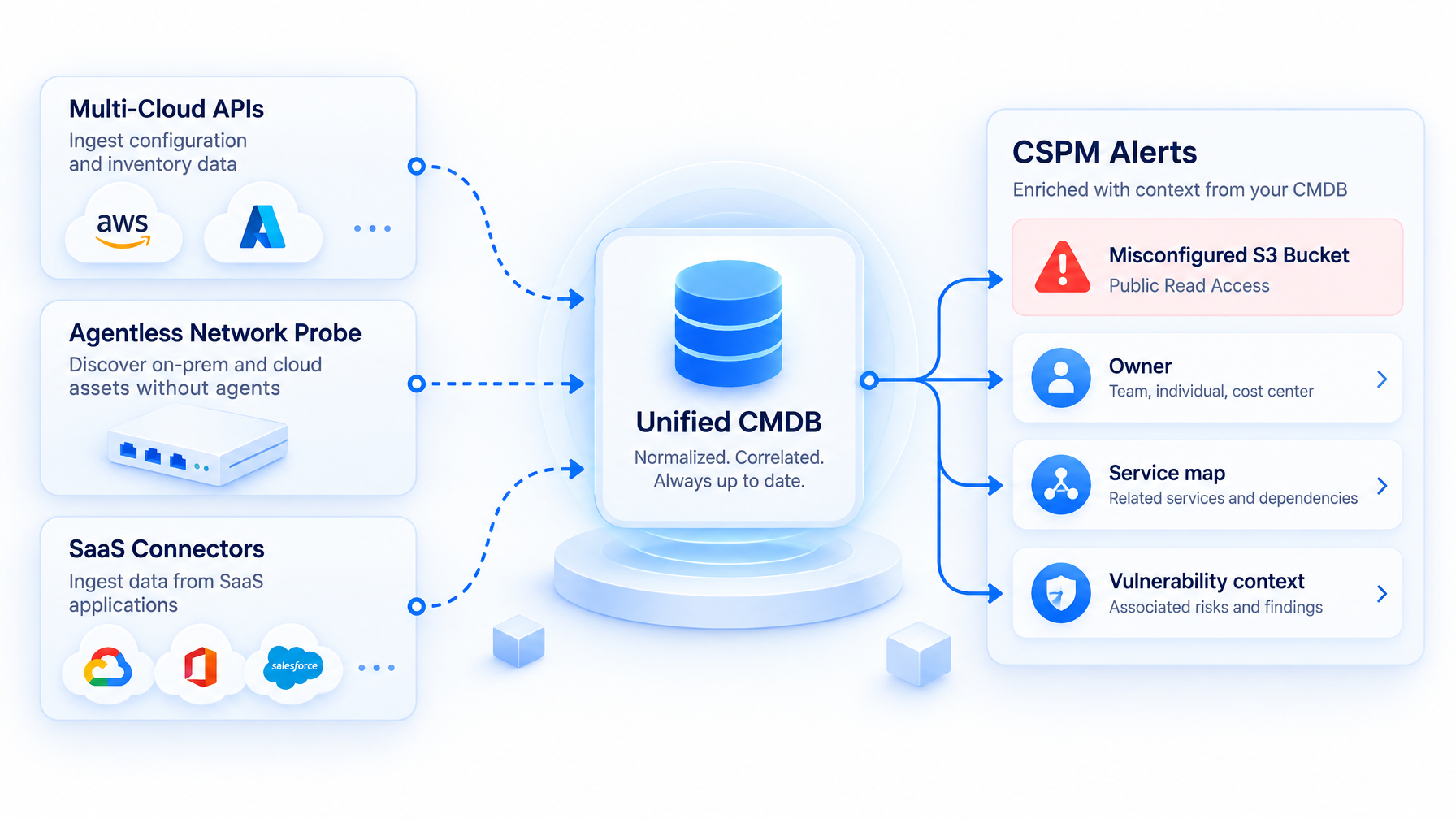
Connecting posture findings to operational context relies on three primary capabilities:
1. High-frequency scheduled discovery
Rather than relying on periodic manual imports or static cloud tag compliance, high-frequency scheduled discovery scans cloud provider APIs, on-premises networks, hypervisors, and SaaS accounts on a predictable cycle. This approach captures short-lived instances, newly provisioned storage buckets, and unmanaged cloud accounts as they appear. By reconciling these findings directly into the CMDB, every cloud resource can be matched against historical deployment records, IP ranges, and provisioning tickets to establish baseline ownership.
2. Service mapping for impact analysis
Knowing that a server has a misconfigured firewall rule is only half the equation. Service mapping links individual cloud components, such as virtual machines, microservices, databases, and serverless functions, to the business services they support.
When a posture tool flags a resource, service mapping shows its operational dependencies. Security teams can determine whether the asset supports a critical customer portal, an internal reporting tool, or a legacy staging environment, so they can prioritize remediation based on business impact rather than raw severity scores alone. This service mapping cloud security layer is what turns a severity score into a business-impact decision. Teams that need this layer can start with service mapping that builds dependency views once service definitions are in place.
3. Vulnerability and risk correlation
Grounding security posture in an authoritative asset record helps teams correlate misconfigurations with known software vulnerabilities on the same map. When National Vulnerability Database (NVD) CVE data is overlaid on Windows Server assets that sit on the same service map as a misconfigured cloud resource, analysts can see adjacency risk within an application tier. This replaces treating the two findings as disconnected tool outputs.
| Security Management Capability | Without a Shared Asset Record | With Discovery-Fed CMDB Context |
|---|---|---|
| Ownership attribution | Manual outreach across chat and email; days to locate an owner. | Mapping to assigned team, application owner, and cost center. |
| Triage confidence | Low; teams hesitate to enforce fixes due to unknown blast radius. | Higher; service map shows upstream and downstream dependencies. |
| Audit evidence | Disconnected exports from cloud consoles, spreadsheets, and ticketing tools. | Single record showing asset existence, posture status, and change history. |
Establishing clear ownership and service relationships is essential for maintaining The role of CMDB compliance in IT security and risk management across complex regulatory environments.
How does service mapping improve CSPM remediation?
Service mapping connects individual cloud resources to the business applications they support. When a CSPM tool flags a misconfiguration, service mapping reveals the asset’s operational dependencies, allowing security and IT teams to evaluate change risk, assign ownership immediately, and prioritize fixes based on business impact.
Cloud Security Posture Management examples in practice
Two patterns show up repeatedly when inventory lags behind posture scanning.
- The unmonitored cloud subscription. A business unit opens a standalone account outside procurement. The central CSPM never onboards it, so nothing is scanned until an external report lands. Network and API discovery that finds unmanaged IP blocks and accounts can bring the subscription into inventory before the next audit cycle.
- The low-severity finding on a high-impact dependency. An unencrypted volume scores low in the CSPM console, yet the host runs authentication for a customer portal. Service mapping elevates the fix by business impact, not raw severity alone.
These cases share one root: the scanner did its job. Attribution and service context did not. Choosing how to capture edge cases still depends on Active vs. passive IT asset discovery: which one works better? trade-offs for each estate.
Does Virima replace Cloud Security Posture Management tools?
No. Virima does not replace CSPM scanners. It supplies high-frequency discovery, CMDB ownership, and ViVID™ service maps so existing Cloud Security Posture Management tools can route findings to owners with service impact context instead of unassigned queues.
Where Virima fits alongside a CSPM tool
Virima is not a Cloud Security Posture Management tool, and it does not replace specialized Cloud Security Posture Management tools or other cloud security scanners. CSPM tools evaluate cloud configurations, detect policy violations, and measure security posture against compliance standards. They perform a necessary function in modern cloud security.
Virima complements those tools by solving the inventory, context, and ownership problem that keeps posture findings from moving to closure.
| Layer | Role in the workflow |
|---|---|
| CSPM security layer | Configuration scanning, policy checks, and compliance scores produce the misconfiguration alert. |
| Virima asset and service layer | High-frequency discovery, ViVID™ service maps, and a unified CMDB attach owner, cost center, service impact, and related vulnerability context. |
| Remediation workflow | The enriched finding lands in existing ITSM tickets with clear ownership and known blast radius so teams can fix safely. |
Immediate ownership resolution
When a CSPM tool generates a finding, Virima matches the cloud resource identifier against its unified CMDB. The finding can be enriched with the assigned application owner, support team, cost center, and environment tier. Tickets arrive in ITSM queues with attribution instead of raw cloud IDs.
Long-term accuracy
A discovery-fed CMDB stays aligned with the live cloud estate as accounts and services change, rather than depending on a point-in-time export. That keeps ownership and service context current for the next scan cycle, not only for the last quarterly cleanup.
Integration with existing workflows
Virima integrates with ServiceNow, Jira Service Management, Ivanti, and many more through a single integrations hub. Enriched asset context can pass into existing change and incident tickets, so teams keep working where the CSPM ticket already lives instead of opening a separate console for ownership lookup.
Organizations strengthening hybrid security posture can also review how discovery-sourced inventory supports security workflows without standing up a separate ownership console.
Moving from point-in-time inventory to a discovery-fed one
Bridging the gap between cloud security scanning and operational execution means shifting from static inventory exports to a discovery-fed system of record. The same shift shown in the layer table above, which includes CSPM scanning, Virima’s asset and service layer, and the resulting remediation workflow, plays out over time. Periodic manual exports pulled from cloud console CSVs give way to high-frequency discovery cycles across cloud APIs and hybrid infrastructure; siloed tool views across security, IT ops, and cloud teams consolidate into one CMDB shared across security and ITSM tools. Isolated posture alerts carrying raw cloud IDs become context-enriched findings with criticality, service maps, and verified owners.
Benefits that follow
Faster triage follows when ownership is already on the record. Cleaner audits follow when inventory evidence is current and attributable. Less duplicated tooling follows when security, ops, and compliance stop maintaining separate asset lists for the same estate.
Getting started
- Connect cloud accounts so discovery covers AWS and Azure subscriptions the team already operates, plus any unmanaged accounts found during the first pass.
- Run the first discovery cycle and reconcile results into the CMDB.
- Tag ownership gaps where creator, application owner, or cost center is missing.
- Map assets to ITSM so enriched findings land in the same queues as existing CSPM tickets.
- Review after 30 days for remaining unowned resources, shadow accounts, and service-map coverage.
For a deeper path on establishing authoritative asset visibility, read the guide on cybersecurity IT asset visibility and CMDB integration.
Close the cloud ownership gap
Finding misconfigurations is only half the work. If your security team spends days tracking down asset owners or guessing at change blast radius, Cloud Security Posture Management tools alone will not close the exposure window.
See how discovery-fed asset intelligence and service mapping bring ownership and impact into the same view as your CSPM findings. Start with Trusted Runtime Truth for the discovery-sourced inventory layer, then request a discovery-led demo to see how many cloud assets are still unmapped.
Frequently Asked Questions
What is Cloud Security Posture Management?
Cloud Security Posture Management (CSPM) is a security toolset that monitors cloud environments for misconfigurations, compliance policy violations, and exposure risks across IaaS, PaaS, and SaaS infrastructure on a scheduled scanning cadence.
Why is Cloud Security Posture Management important for compliance?
CSPM tools evaluate cloud configurations against frameworks such as SOC 2, HIPAA, and PCI-DSS, providing evidence that storage, firewalls, and access controls meet mandatory security baselines. Compliance also requires a current asset inventory as a separate control.
What are common Cloud Security Posture Management examples?
Common examples include detecting publicly accessible cloud storage buckets, unencrypted database volumes, overly permissive IAM roles, disabled logging settings, and virtual machines running exposed management ports.
What is the difference between CSPM and CNAPP?
CSPM focuses on cloud configuration, compliance, and posture scanning. Cloud-Native Application Protection Platforms (CNAPP) combine CSPM with cloud workload protection and cloud infrastructure entitlement management in a broader security platform.
Which CSPM tools does Virima work alongside?
Virima is designed to complement CSPM platforms such as Wiz, Prisma Cloud, and Microsoft Defender for Cloud. It adds discovery-fed CMDB ownership and ViVID™ service maps on top of whichever CSPM tool a team already runs, so findings route to an owner with service-impact context instead of sitting in an unassigned queue.