Why Network Security Management Fails Before the First Firewall Rule Is Written

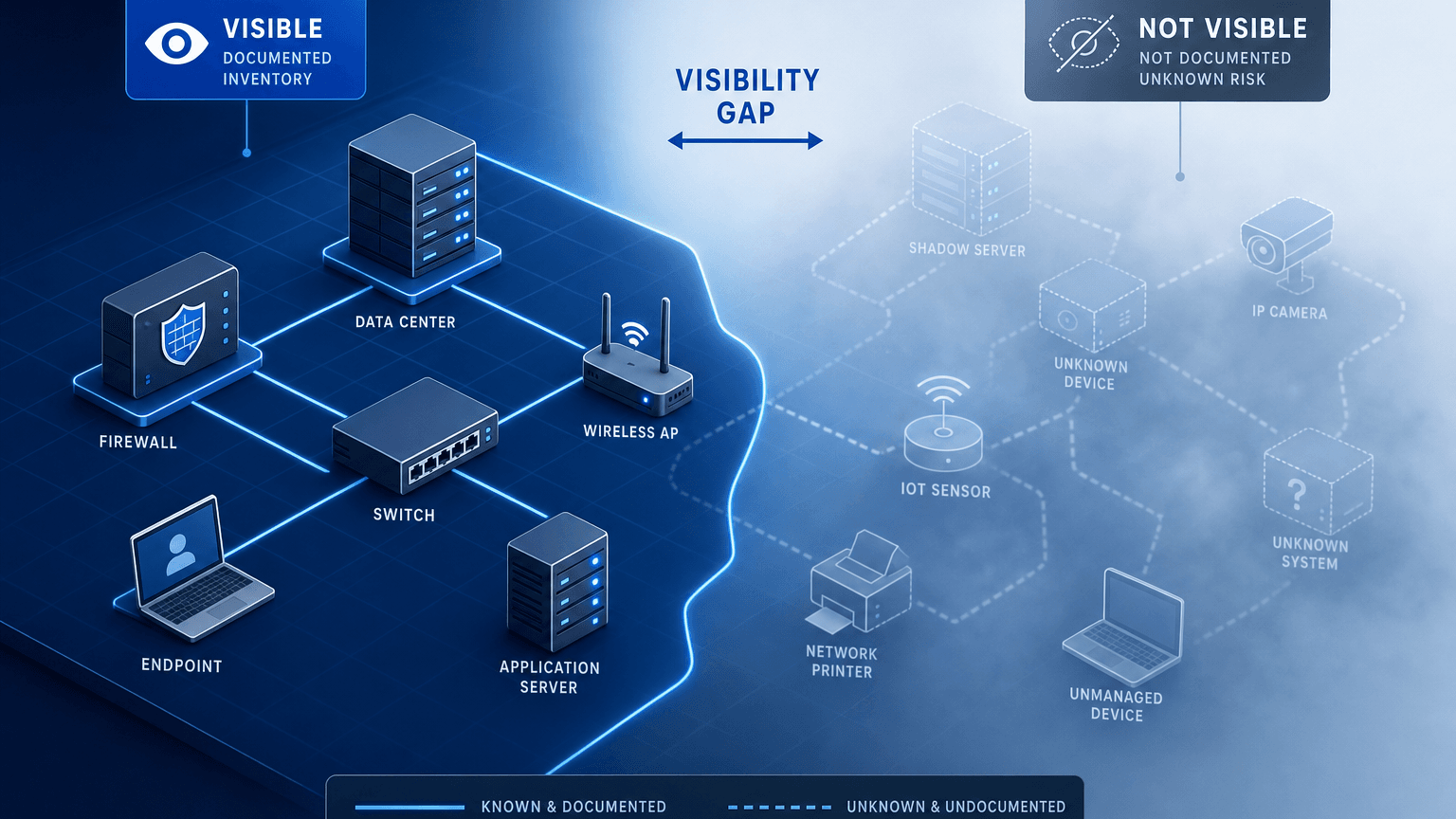
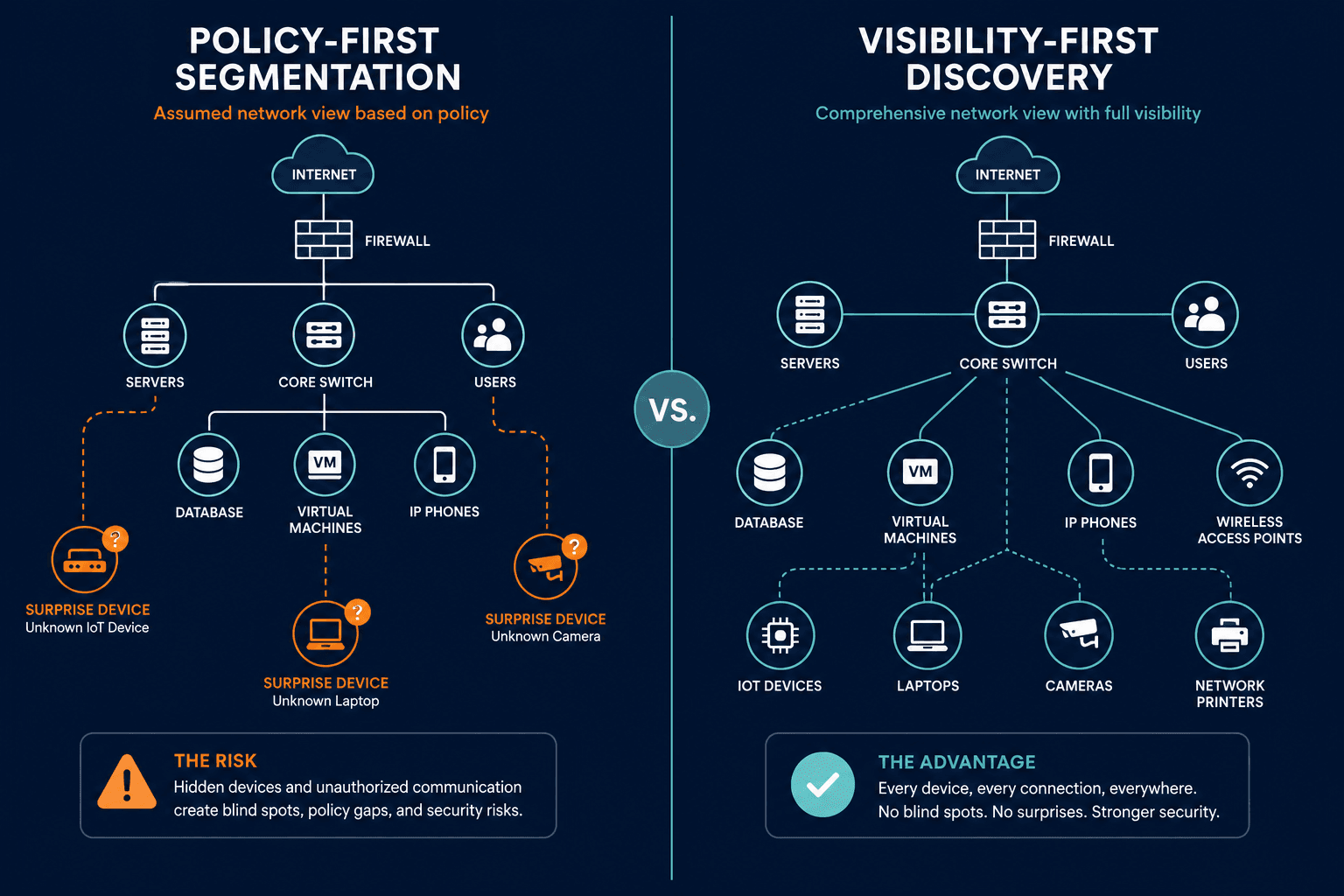
A segmentation program looks solid on paper until the first enforcement window. Policies are approved. Network access control and firewall owners are ready. Then an unmapped clinical device, a shadow server, or an east-west path nobody documented forces a broad exception, and the project stalls. Network security management is usually bought as a policy and enforcement problem. Research keeps showing it fails first as a visibility problem — the network security management visibility gap between what the inventory records and what is actually connected. That is why 79% of security professionals rank segmentation as a top priority while only 33% have fully implemented it.
Security teams still evaluate network access control, microsegmentation, and firewall management on rule depth and automation. Those tools matter. They cannot invent hosts, protocols, or dependencies the inventory never listed. Incomplete asset data turns good policy into outages, exception debt, or frozen rollouts. This piece separates visibility from enforcement without treating discovery as a replacement for the enforcement layer.
Why segmentation projects actually fail
Cisco’s 2026 Segmentation Report surveyed practitioners across roughly 400 failed segmentation projects. Coverage of that research, including the 79% priority versus 33% full-implementation gap, appears in Asimily’s analysis of segmentation operationalization. Layer 2 segmentation work most often failed when scope expanded mid-project because assets kept surfacing that were not in the original map. Teams wrote boundaries from known application lists, then found unmapped IP ranges, secondary interfaces, and business apps that needed undocumented cross-VLAN paths.
When production broke, most organizations reached for coordination fixes. Cisco’s report found that about 70% of attempted remedies were generic project-management moves: more status meetings, revised milestones, cross-functional boards. A visibility gap does not close because the program office meets more often. Project managers cannot schedule away an unknown PLC, a forgotten jump host, or a database dependency that never made the CMDB. Rules written on incomplete maps either trip production or get diluted with permanent exceptions that erase the security goal.
The mismatch is structural. Teams keep treating a technical inventory problem as a people-and-process problem. Process helps only after the estate is known well enough to scope without surprise. Help Net Security also flagged the same Cisco survey of 400 U.S.-based practitioners who lived through failed segmentation work. For a closer look at why stale inventories break change and segmentation work alike, see ITIL Change Management and CMDB Accuracy: Why One Depends on the Other.
Why do network segmentation projects fail mid-rollout?
Segmentation projects fail mid-rollout when scope expands because assets and dependencies were missing from the starting inventory. Cisco’s 2026 analysis of failed projects points to visibility gaps and mid-project discovery of unaccounted devices. Generic project-management fixes rarely close that gap on their own.
The devices that break every assumption
Enforcement stacks often assume agents, domain credentials, or managed OS images. Large parts of the estate never meet that bar. Programmable logic controllers, clinical devices, building systems, and many IoT endpoints cannot host a security agent without voiding support or breaking operations. BYOD and unmanaged OT paths sit outside the same model.
A device visibility gap is the difference between what an inventory records and what is actually connected and communicating on the network. That gap widens fastest in OT, IoT, and clinical environments, where devices cannot host the agents most enforcement tools expect.
Omdia’s Microsegmentation Survey 2026 found that 44% of respondents named comprehensive device visibility as their single most critical capability gap. That gap is not a nice-to-have dashboard. If the platform cannot classify hardware, firmware posture, protocol behavior, and owner, it cannot place a tight rule safely. Operators then face a bad choice: enforce and risk shutting a line or clinic path, or leave mixed device classes in wide, permissive segments.
Deploying the policy engine alone fails in mixed environments for this reason. Agent-based controls cover what they can reach. Everything else becomes a permanent exception unless agentless discovery and network-level inventory fill the map first. For more on closing that coverage gap, see macOS Discovery in CMDB: Why Apple Devices Are a Blind Spot and How to Fix It.
How do unmanaged IoT and OT devices affect network security management?
Unmanaged IoT, OT, and clinical devices often cannot run endpoint agents or join standard domain posture checks. Without agentless discovery and accurate device classification, network security teams leave wide exceptions in place so operations keep running. Those exceptions become lasting blind spots that enforcement tools alone cannot close.
The blind spots nobody’s enforcement tool was built to see
Firewall, NAC, and microsegmentation products enforce against the identities, tags, and topology they are given. They inherit the quality of that feed. When inventory is thin, enforcement looks complete on paper and soft in practice.
Vectra’s 2026 network visibility guide, citing Forrester and NETSCOUT, reports that 58% of organizations struggle with east-west and lateral movement visibility. Perimeter tools say little about traffic that never leaves the same broadcast domain or vSwitch. Hybrid and multi-tenant estates add another cut: many leaders still lack a unified view across on-prem, public cloud, and multi-tenant paths, compounding the same blind spot that lets lateral movement go undetected. Workloads in AWS or Azure talk to legacy databases on-prem along paths static rule books never modeled.
The structural point matches what security and architecture leaders already see on CMDB and vulnerability programs. Enforcement does not invent ground truth. It multiplies whatever inventory and dependency data it receives. Unmapped lateral paths become allowed paths. Broad rules become the only way to keep tickets down. See What Is ViVID Service Mapping? How Virima Visualizes IT Service Dependencies for how dependency mapping exposes those hidden paths before they become incidents.
Project-management fixes versus visibility fixes
Cisco failure categories show the same pattern in different clothes. The table below pairs common symptoms with the fix teams usually try and the visibility work that closes the gap.
| Symptom | The fix teams usually try | What closes the gap |
|---|---|---|
| Visibility gap: rules break unmapped critical apps mid-rollout | Workshops, application owner boards, longer discovery workshops on a fixed list | Multi-source discovery that maps live hosts, listening services, and communication paths before policy is drafted |
| Policy maintenance burden: rule sprawl and exceptions that never expire | Quarterly manual rule audits and cleanup tickets | Policy objects tied to an authoritative asset registry that reflects decommissions, IP changes, and role changes |
| Tooling limits: agents fail on OT, IoT, and clinical gear | Carve those subnets out of the project forever | Hybrid agent and agentless discovery that covers network infrastructure, SNMP targets, and API-sourced cloud inventory |
| Complex environment: uneven policy across data center, cloud, and branch | Separate point tools per zone and cloud account | One inventory and service-mapping layer that spans hybrid estates so enforcement tools share the same host and dependency truth |
Where cyber insurance enters the picture
Segmentation is no longer only an internal control story. Omdia’s survey found that 32% of organizations now cite cyber insurance as a driver for segmentation work. Underwriters are moving past a binary “do you have segmentation” checkbox toward questions about what share of critical assets sits under active policy coverage.
That shift turns inventory accuracy into a pricing and claims issue. If a post-incident review finds ransomware moved through unmapped, unsegmented hosts, coverage arguments get harder. Teams that cannot show which critical assets are covered cannot answer the newer underwriting questions with confidence. Visibility gaps become financial gaps, not just technical debt.
How does cyber insurance change network segmentation priorities?
Cyber insurance increasingly asks what percentage of critical assets sits under active policy coverage, not only whether segmentation exists on paper. Organizations that cannot inventory critical assets accurately struggle to answer underwriters and may face weaker claims positions after lateral ransomware movement through unmapped hosts.
What has to exist before enforcement does
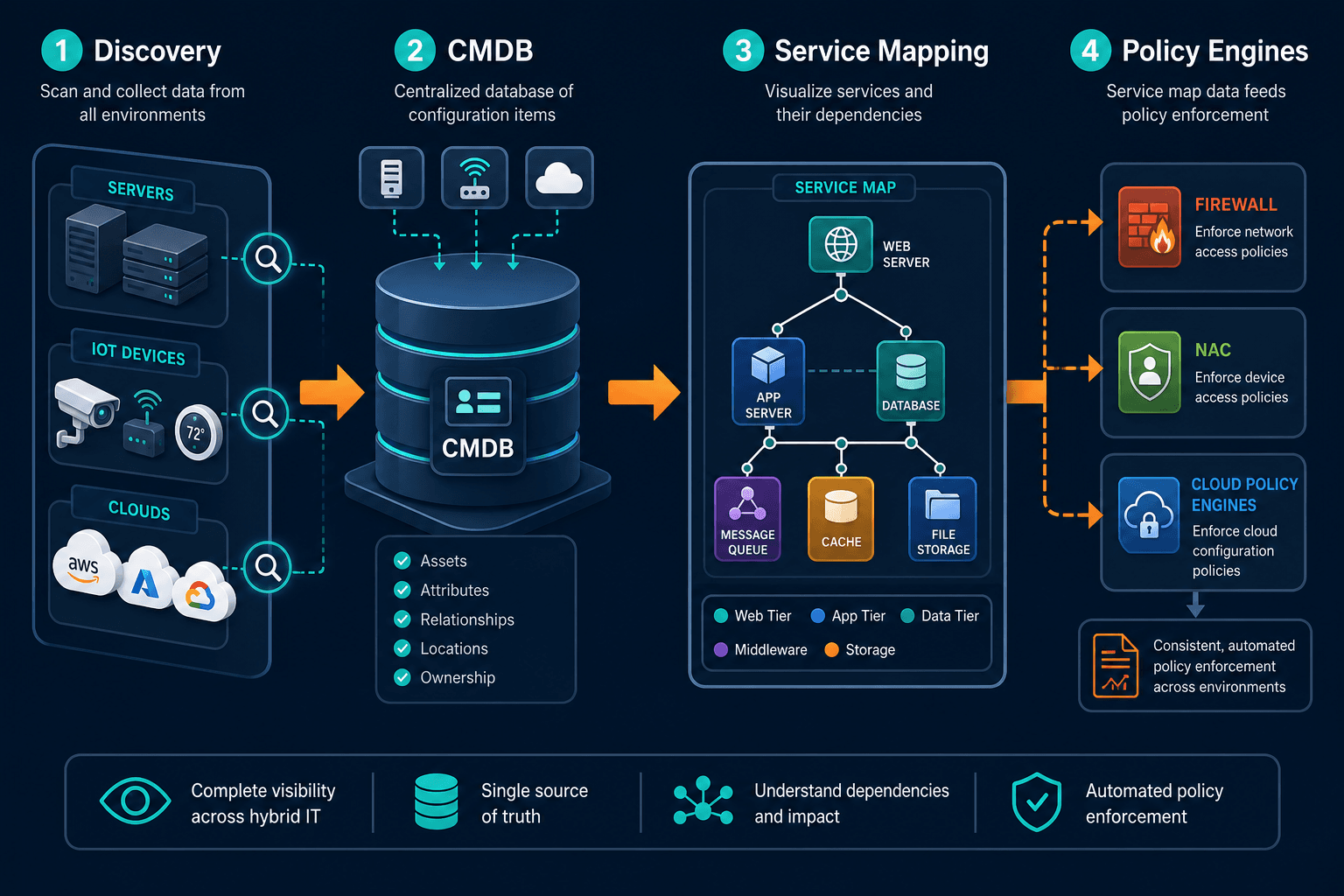
Firewall rules, NAC posture, and microsegmentation software are the enforcement plane. The enforcement plane needs an accurate, frequently refreshed asset inventory and dependency picture before the first production rule is written, not a spreadsheet reconciliation after the first outage.
Before a team writes the first rule, four things need to be in place:
- A live inventory covering managed and unmanaged device classes, on-prem and cloud
- A mapped set of communication paths between hosts, so blast radius is known before a rule ships
- Service definitions supplied so service maps can show application context instead of bare IPs
- A discovery refresh cadence frequent enough that policy objects don’t rot between change windows
Skip any one of these and policy design turns into guesswork.
Virima sits in that foundation layer. Hybrid agent-based and agentless discovery, CMDB population, and ViVID™ service maps (built after service definitions are supplied) give enforcement tools a clearer host and dependency feed. Virima does not replace NAC or the firewall. It reduces the chance those tools enforce against a fiction. Virima integrates with ServiceNow, Jira, Ivanti, and many more ITSM platforms teams already run, all listed on the integrations page.
When network security management starts with knowing what is on the network, segmentation scopes hold, exception lists shrink, and enforcement products can do the job they were purchased to do.
What must exist before network enforcement policies are written?
An accurate, frequently refreshed asset inventory and dependency map must exist before enforcement policies are written. NAC, firewall, and microsegmentation tools enforce against the hosts and paths they are given. Incomplete inventory produces outages, permanent exceptions, or stalled segmentation programs even when the policy design is sound.
See how discovery-sourced inventory and service maps feed the enforcement tools you already run, so segmentation work starts from known assets instead of surprise devices.
Closing the network security management visibility gap
The network security management visibility gap is why teams write rules against an incomplete estate. Cisco failed-project data, Omdia device-visibility and insurance findings, and east-west blind-spot research all point to the same order of operations: inventory and dependency truth first, enforcement second. Fix the feed, then the policy engine has something trustworthy to enforce.
If your segmentation or NAC program is stuck in exception debt, start with what the network actually holds, not another round of policy workshops alone.
Schedule a demo to walk through discovery-sourced inventory and ViVID™ maps as the input layer for the controls you already own.
Frequently Asked Questions
Does better project management fix a failed segmentation rollout?
Rarely on its own. Cisco’s study of failed segmentation projects found that most attempted fixes were general project-management remedies even when the root cause was a visibility gap. Unknown assets and dependencies that surface mid-project need inventory work, not only more status meetings.
Can agent-based tools provide full network visibility?
No. Agent-based tools cannot cover OT, IoT, or clinical devices that cannot host an agent. Survey data continues to rank unmanaged-device visibility among the top capability gaps, which is why agentless and network-level discovery sit beside agents in complete inventory designs.
Does cyber insurance actually require network segmentation?
Not universally in every policy yet. Underwriters are asking more specific questions about the share of critical assets under active policy coverage. Visibility gaps therefore affect pricing and claims readiness, not just technical security posture. Omdia reported that 32% of organizations already cite insurance as a segmentation driver.