Single tenant vs multi-tenant: what’s the difference, and which one do you need

A procurement review picks a SaaS platform and then stalls on one line item: single tenant vs multi-tenant. Security wants isolation language. Finance wants a lower unit cost. Operations wants predictable performance during month-end and patch windows. The labels sound binary, but the real decision is which isolation, cost, and change model the organization can operate after the contract is signed.
Single tenant vs multi-tenant is the difference between a dedicated software instance built for one customer and one shared instance serving many customers with logically separated data — and the choice trades cost and onboarding speed against isolation and customization control. This guide puts the trade-offs side by side and shows how to choose. It also flags a gap buyers miss: estate inventory still matters after the tenancy line item is chosen.
What is multi-tenant architecture?
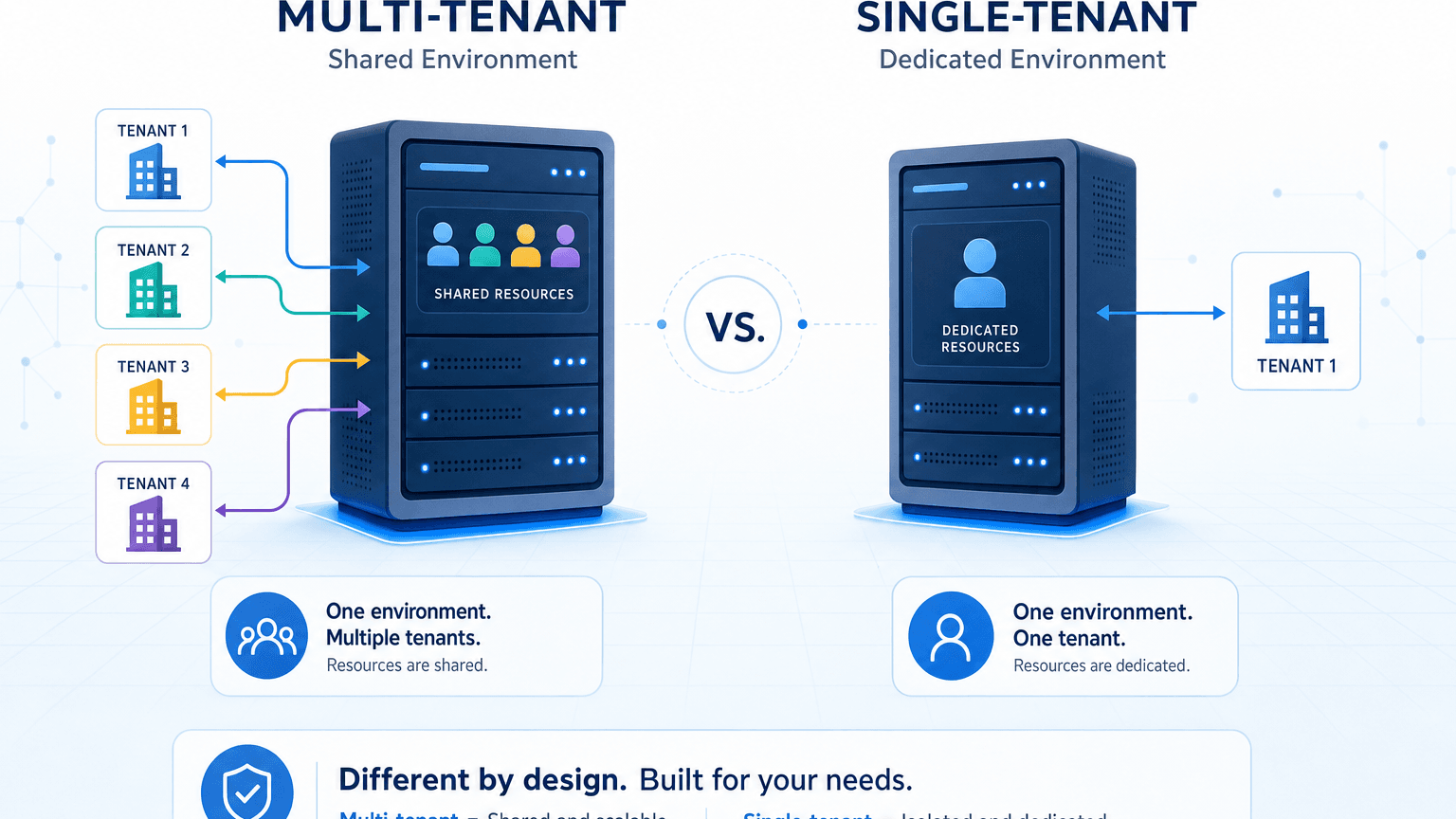
Multi-tenant architecture is a setup where multiple customers, or tenants, share the same application instance and underlying infrastructure. Each tenant’s data stays logically separated from every other tenant, even though everyone runs on the same servers, databases, and codebase underneath. IBM’s overview of multi-tenant systems frames the model as shared software and hardware with logical separation of customer data and configuration.
Microsoft’s Azure Architecture Center guide to multitenancy describes the same pattern for cloud systems: one solution serves many customers while keeping tenant data and customizations isolated through design controls rather than a separate stack for each buyer.
Advantages
- Lower cost, because infrastructure is shared across many customers instead of dedicated to one.
- Faster onboarding, because a new customer gains access without provisioning a full new environment from scratch.
- Simpler maintenance, because one update can roll out to every tenant at once.
- Easier shared capacity planning at the provider layer.
Trade-offs
- Less deep customization, because changes to the shared environment can affect every tenant.
- Isolation depends on the provider’s controls. Logical separation is not the same as a dedicated physical or account boundary.
- A noisy neighbor problem can appear when one tenant’s heavy usage stresses shared compute, storage, or network paths.
For IT buyers, multi-tenant usually means shared-platform economics plus provider-managed isolation and release cadence.
What is multi-tenant architecture in SaaS?
Multi-tenant architecture is a software design where many customers share one application instance and infrastructure while each tenant’s data stays logically separated. Buyers gain lower cost and faster onboarding. They rely on the provider’s isolation controls rather than a dedicated stack per customer.
What is single-tenant architecture?
Single-tenant architecture gives each customer a dedicated instance of the software. That can mean a dedicated database, a dedicated application stack, or a fuller infrastructure boundary such as a separate virtual network or cloud account. Nothing is shared with another customer at the isolated instance layer the contract defines.
CNCF’s discussion of SaaS built from single-tenant applications notes that many products default to multi-tenant SaaS, while some designs still run a separate deployment per customer when isolation or packaging needs demand it. Enterprise tiers sometimes add hard isolation such as dedicated accounts or network boundaries.
Advantages
- Stronger data isolation at the instance boundary, because other customers do not share that application or database instance.
- Higher customization headroom, because configuration and extensions for one customer do not rewrite a shared code path for everyone.
- More predictable performance for that customer, because resources are not pooled with unrelated tenants on the same instance.
- A clearer compliance narrative for some regulated workloads, because isolation is architectural, and sometimes physical or account-level, not only logical.
Trade-offs
- Higher cost, because dedicated infrastructure per customer costs more to run and support.
- Slower onboarding, because a new customer often needs provisioning of a new environment.
- Heavier maintenance, because updates and patches roll out instance by instance instead of once across a shared fleet.
Single-tenant is not automatically more secure in every control family. It changes where isolation lives and who funds idle capacity between peaks.
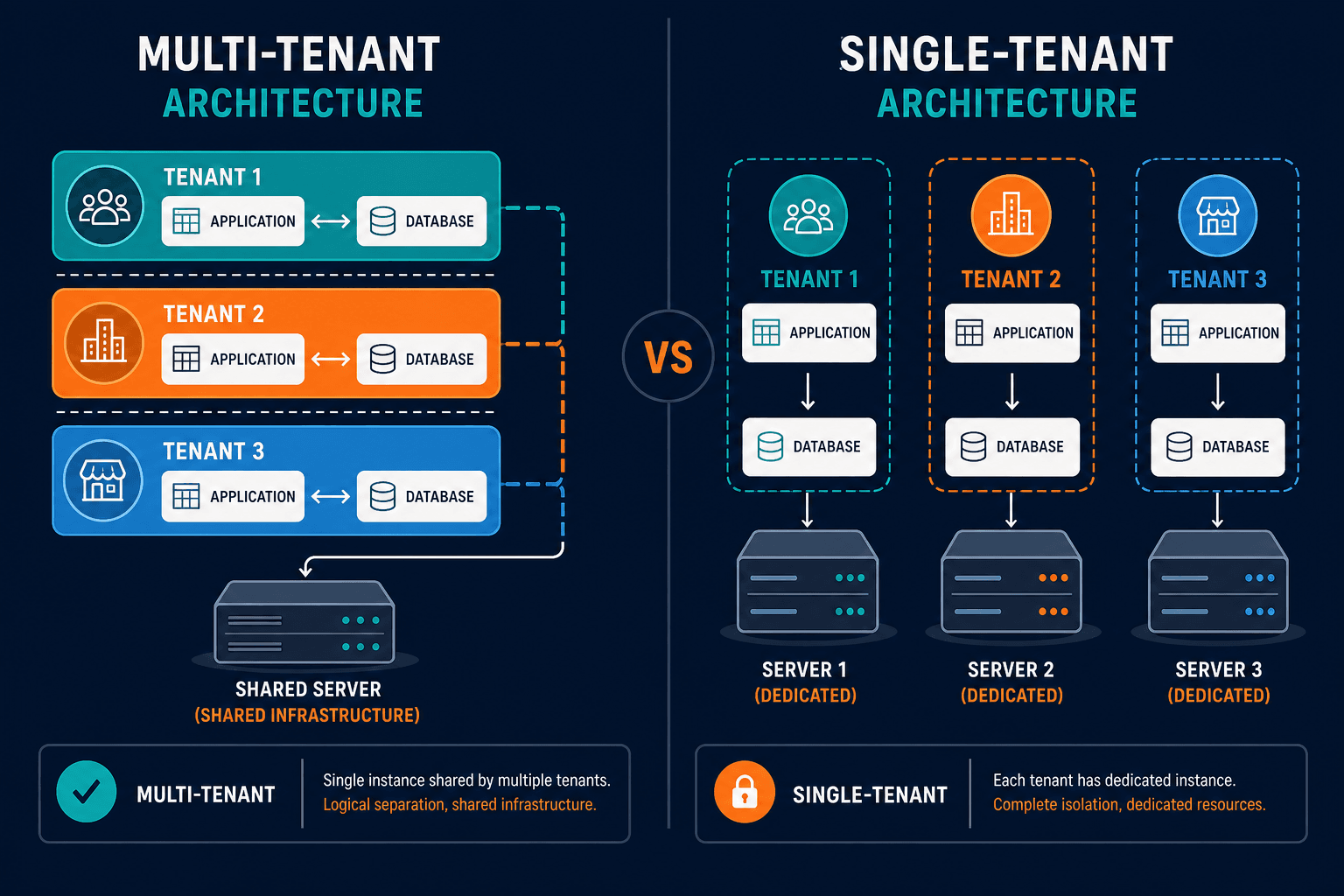
Single tenant vs multi-tenant at a glance
| Dimension | Multi-Tenant | Single Tenant |
|---|---|---|
| Cost | Lower, shared infrastructure | Higher, dedicated infrastructure |
| Isolation | Logical separation on shared systems | Physical or architectural separation of the instance |
| Customization | Limited by the shared environment | High within the dedicated environment |
| Onboarding speed | Fast | Slower, requires provisioning |
| Maintenance | Centralized, one update path for many tenants | Per-instance overhead |
| Best fit | Standardized needs and cost-sensitive programs | Strict isolation, deep customization, or dedicated-stack mandates |
The right SaaS tenancy model depends on what the organization can operate, not which label sounds more secure. Use the table as a shortlist filter. A regulated dedicated-database mandate will not match a team optimizing for fast shared-tier onboarding.
What is the main difference between single-tenant and multi-tenant?
Multi-tenant systems share one application and infrastructure across customers with logical data separation. Single-tenant systems give each customer a dedicated instance, which raises cost and provisioning time while increasing isolation and customization headroom. The choice is which operating model the organization can fund and govern.
Isolation, compliance, and what auditors actually ask
Data isolation in SaaS is a control-framework question, not a marketing label. Buyers often collapse single-tenant into compliant and multi-tenant into not compliant. Control frameworks care about implemented safeguards, evidence, and scope, not marketing labels alone.
NIST Special Publication 800-53 Revision 5 organizes security and privacy controls that organizations select and implement based on risk. Tenancy model can influence how you implement separation of duties, system isolation, and boundary protection, but it does not replace the need to show those controls work. A multi-tenant provider with strong tenant isolation, encryption, logging, and independent assurance can meet a control set. A single-tenant stack with weak access review and stale inventory can fail the same review. The same logic applies to SOC 2 and HIPAA — auditors evaluate implemented controls and evidence, not which tenancy label is on the contract. IT teams navigating a SOC 2 or HIPAA renewal often find their auditor never asks whether the platform is multi-tenant or single-tenant; the questions are about access reviews, encryption key management, and logging evidence.
What to ask vendors
Ask vendors for concrete answers about tenant isolation and access controls:
- Where does tenant data reside — row-level security in a shared database, a dedicated schema per tenant, a dedicated database per tenant, or a separate account entirely?
- How are noisy-neighbor and cross-tenant access prevented and tested?
- What is the patch and release model, and can one tenant delay a change that others need?
- Which audit reports and shared-responsibility matrices apply to your tier?
Match those answers to your regulatory scope, data classification, and residual risk appetite. Do not stop at the word tenant on the order form.
Which one should you choose?
There is no universally correct answer. The right choice depends on what the organization needs and what it can spend and operate.
Lean multi-tenant when:
- Workloads are standardized and customization depth is limited.
- Time-to-onboard and lower unit cost matter more than dedicated capacity.
- You trust the provider’s isolation design, monitoring, and assurance package for your data class.
Lean single-tenant when:
- Contracts, regulators, or internal policy require dedicated instances, databases, or account boundaries.
- Deep customization would break a shared release train.
- Performance isolation for peak loads is a hard requirement you will fund year-round.
For a 1,000-person IT organization already standardized on ServiceNow or Jira Service Management, the multi-tenant cost math changes once customization needs collide with the shared release train — that is the point to weigh single-tenant instead.
Many portfolios mix both. Commodity collaboration tools often sit on multi-tenant SaaS, while a core system of record for regulated data may sit on a dedicated tier. That portfolio decision is about matching each system to its risk and cost envelope, not forcing one tenancy model on every purchase.
The gap tenancy labels do not close
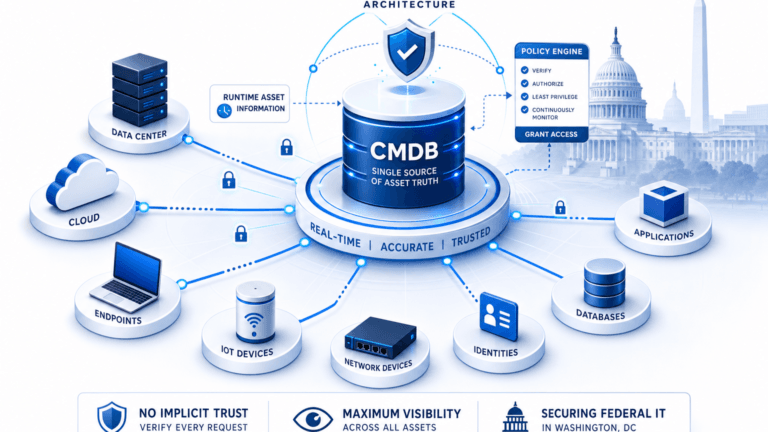
Single tenant vs multi-tenant answers how the vendor hosts the product. It does not answer whether your CMDB, asset inventory, and service maps still reflect the estate that product manages.
Why tenancy choice isn’t the whole answer
That gap has a measurable cost. Ivanti’s IT visibility research found that 74% of organizations have experienced a security incident tied to an unknown or unmanaged asset. More than a third of IT professionals say they lack sufficient data about the devices connecting to their networks. None of that risk is resolved by picking a tenancy model. It is resolved by knowing what is actually running.
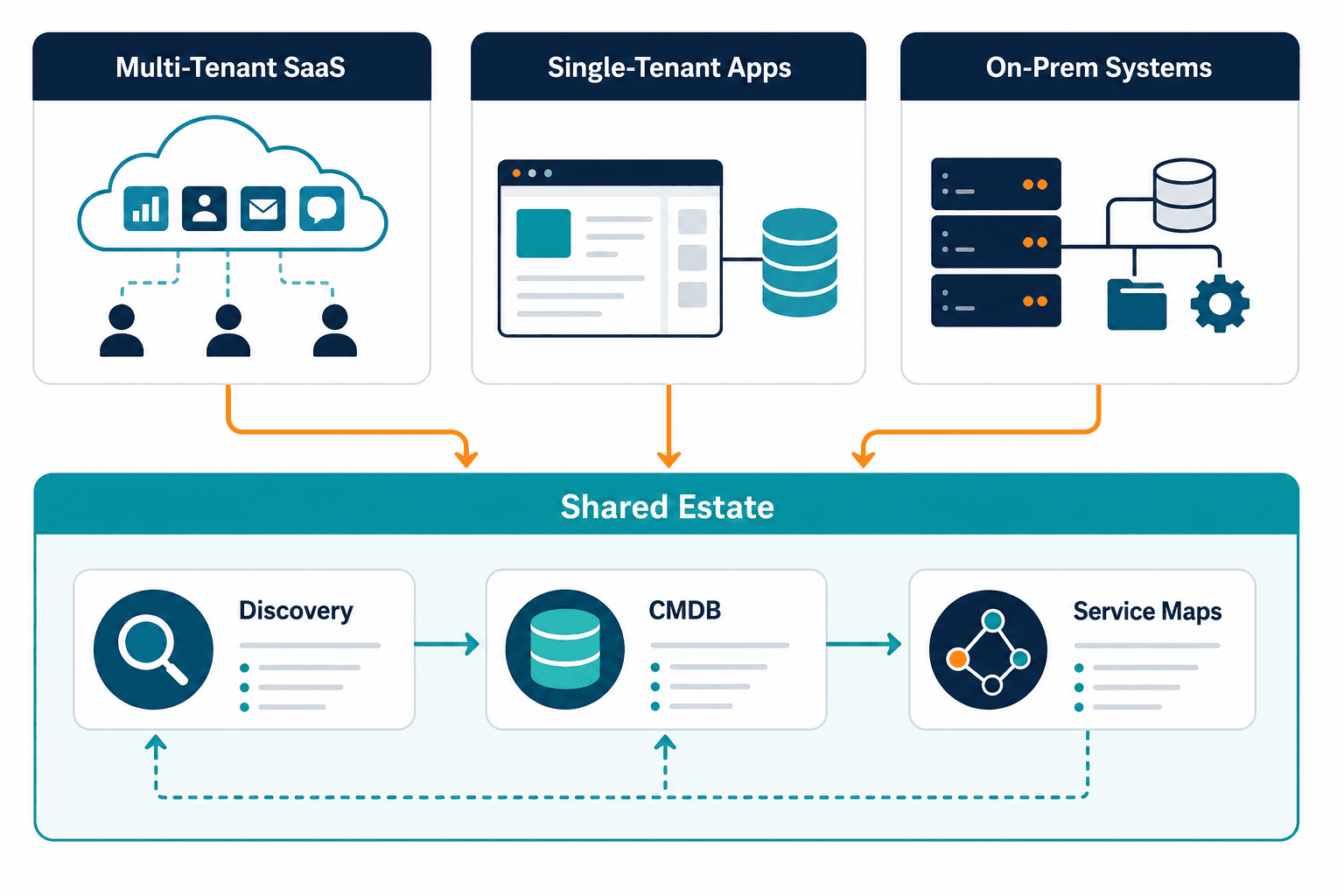
Hybrid organizations run multi-tenant SaaS next to single-tenant stacks next to on-prem systems. Ownership, dependency, and change risk live across those boundaries. If inventory is incomplete, incident and change teams still guess blast radius, whether the ticket system itself is shared or dedicated. High-frequency discovery cycles, a discovery-sourced configuration management database (CMDB), and service dependency maps built after service definitions are supplied give operators a clearer view of the environment. They show what exists, how it connects, and who owns it — across the tools you already bought. Best IT Asset Management Tools in 2026: Compared for Hybrid IT Teams
How Virima closes the gap
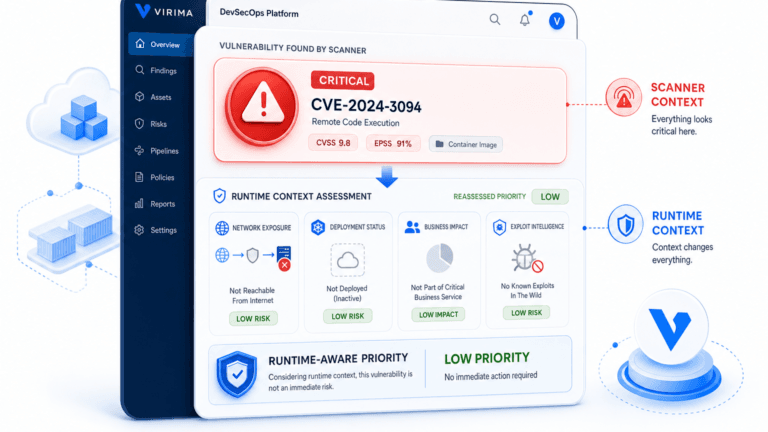
Virima sits in that foundation layer. Hybrid agent-based and agentless discovery, CMDB population, and ViVID™ service maps help teams keep estate context current enough to trust during change and incident work. Virima does not replace your tenancy decision with the SaaS vendor. It reduces the chance that tenancy debates hide missing inventory underneath. how discovery-sourced CMDB data cuts incident triage time Virima integrates with ServiceNow, Jira, Ivanti, and other major ITSM platforms that teams can explore on Virima’s integrations page.
After the architecture choice is settled, operators still need runtime and configuration truth that keeps up with the systems that choice created.
Does choosing single-tenant remove the need for asset inventory?
No. Single-tenant hosting isolates one customer’s application instance. Organizations still need discovery-sourced inventory and service context for the assets, integrations, and dependencies that instance manages. Tenancy model and estate visibility solve different problems in the same operating model.
Closing: match architecture to need, then prove the estate
Single tenant vs multi-tenant is a hosting and isolation trade-off. Multi-tenant architecture favors shared cost, faster onboarding, and centralized maintenance with logical separation. Single-tenant architecture favors dedicated instances, deeper customization, and stronger instance-level isolation at higher cost and slower provisioning. Choose by data class, compliance evidence, customization depth, performance isolation, and budget, not by slogan.
After the contract, operators still need to know what runs, what depends on what, and who owns the blast radius when something changes. Reduce MTTR with Xurrent Ticketing & Virima Service Mapping That is the inventory and mapping problem sitting under every tenancy debate.
Frequently Asked Questions
Is multi-tenant less secure than single-tenant?
Not automatically. Multi-tenant security depends on the provider’s isolation design, encryption, access control, monitoring, and assurance evidence. Single-tenant changes the isolation boundary and cost model. Both can meet or miss a control set depending on implementation quality and operational discipline.
When should a company pay for single-tenant SaaS?
Pay for single-tenant when policy, regulation, or contract requires dedicated instances or databases, when customization would break a shared release train, or when performance isolation is a funded hard requirement. Otherwise multi-tenant often fits standardized workloads at lower cost and faster onboarding.
Does Virima’s CMDB and discovery platform work across both single-tenant and multi-tenant SaaS tools?
Yes. Virima’s agent-based and agentless discovery populate the CMDB from what’s actually deployed, regardless of whether a given application is hosted single-tenant or multi-tenant — the discovery method doesn’t depend on the vendor’s tenancy model.
What should RFPs ask beyond multi-tenant or single-tenant?
Ask where tenant data lives, how cross-tenant access is prevented and tested, how noisy-neighbor risk is handled, what the patch model allows per tenant, and which audit reports apply to your tier. Pair those answers with your data classification and control framework, such as NIST SP 800-53 families relevant to isolation and boundary protection.