Top Tools That Connect Discovery Inventory to License and Lifecycle Records Still Miss the Join

Procurement renews a publisher contract from last year’s seat count. Finance asks why spend rose again. The SAM workbook shows entitlements. Discovery shows installs that never landed on those rows. Lifecycle still lists devices as active months after wipe. That is the usual failure mode behind top tools that connect discovery inventory to license and lifecycle records: each tool class does its job, and the join key between install truth and entitlement or stage truth stays weak.
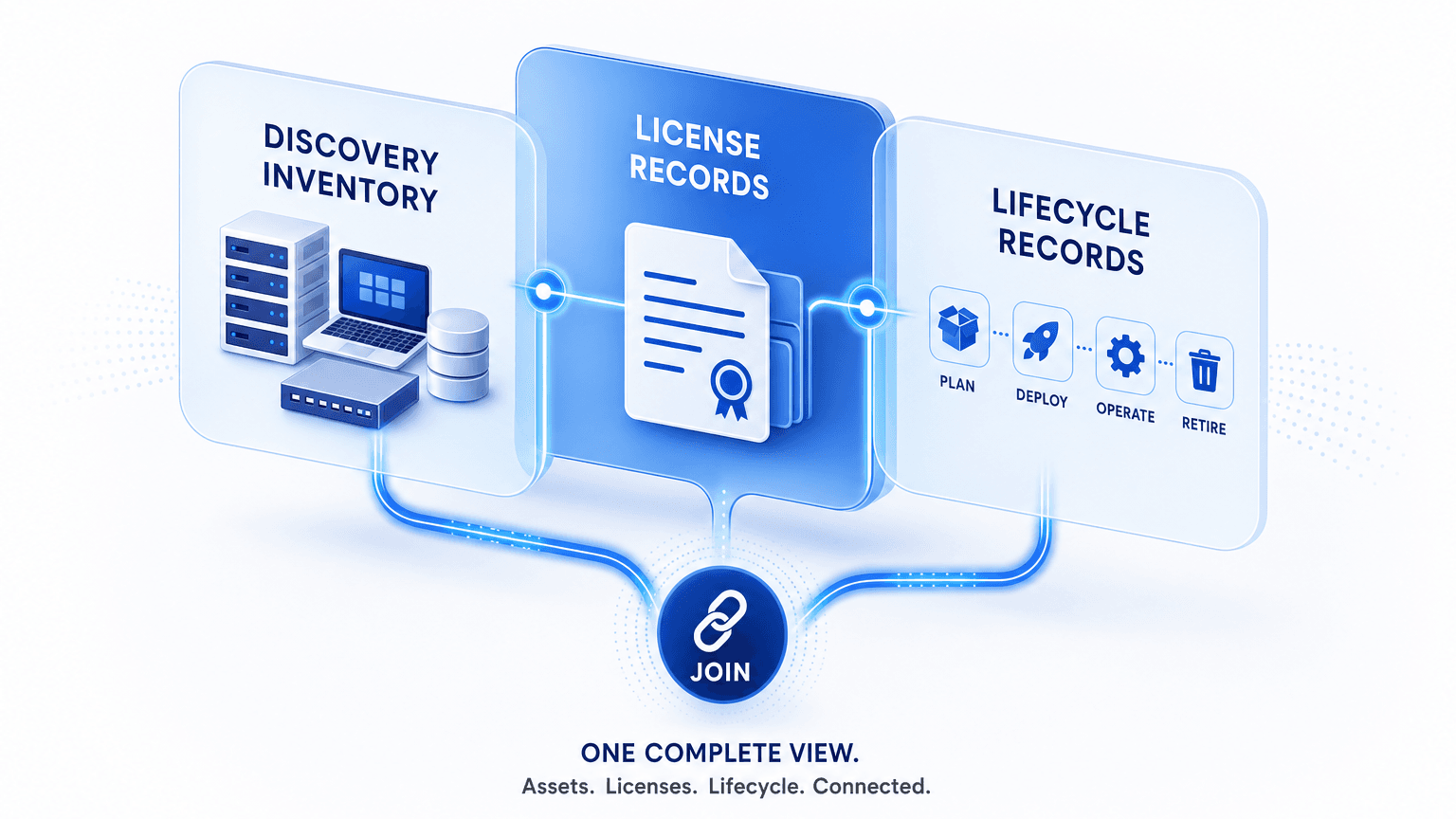
License and lifecycle work need three data planes at once. Discovery inventory says what is installed and where it runs. License records say what you bought and what rights apply. Lifecycle records say where each asset sits from request through retirement. Tools that claim to connect those planes only work when the inventory side stays current across hybrid estates and when identity matching does not collapse under generic software titles.
If you need the category frame before another SAM or ITAM shortlist, start with Trusted Runtime Truth. This guide maps the tool classes that actually sit on that join, where each class breaks, and what discovery-sourced inventory must supply before license and lifecycle math can be trusted.
What the join has to carry
A usable connection is not a CSV paste once a quarter. It is a durable path from a discovered install or hardware CI to an entitlement row and a lifecycle state.
| Plane | What it holds | What breaks without a live join |
|---|---|---|
| Discovery inventory | Hosts, installs, versions, locations, owners when known | Seat counts and risk lists that ignore shadow installs |
| License records | Entitlements, metrics, product use rights, contracts | Over-buy and under-license surprises at audit |
| Lifecycle records | Request, deploy, transfer, repair, retire, dispose | Ghost assets still billed or still in scope |
What tools connect discovery inventory to license and lifecycle records?
The main classes are discovery and inventory platforms, software asset management tools that hold entitlements, IT asset management systems that track hardware lifecycle, CMDB platforms that store configuration items and relationships, and ITSM modules that open tickets on those records. The connection works only when install and CI identity stay current and match entitlement and stage keys.
CISA Binding Operational Directive 23-01 pushes federal civilian agencies toward complete asset inventories and timely vulnerability visibility. Private-sector license and lifecycle programs inherit the same pressure. You cannot reconcile seats or retire devices you have not found.
The Flexera 2026 State of ITAM report press release states that only 31 percent of organizations have visibility into AI software spend as usage surges across the enterprise. That gap is the join failure in plain numbers: a discovery layer that cannot see new AI tooling cannot feed license or lifecycle records that account for it.
Tool class 1: Discovery and inventory platforms
These tools find hardware and software across networks, agents, hypervisors, and cloud APIs. They produce the install and device list everything else should trust.
Strengths. Coverage of hybrid estates when agent, agentless, and API methods are combined. Freshness when discovery runs on high-frequency scheduled cycles. Normalized titles when publishers and versions are cleaned for matching.
Breaks when. Scopes stop at one domain or one cloud account. Software normalization is weak, so the same product lands as five install strings. Ownership and last-seen signals never leave the discovery console, so SAM and lifecycle stay on stale keys.
Join rule. Discovery is the source of install truth. It is not a full entitlement calculator and not a full disposal workflow. For how install counts diverge from purchased seats, see the gap between purchased licenses and actual installs.
Tool class 2: Software asset management (SAM) and entitlement engines
SAM tools hold contracts, metrics, product use rights, and reconciliation worksheets. Strong SAM discovery integration connects normalized discovery data to entitlements and lifecycle fields for software products.
Strengths. Publisher-specific rules, audit packs, optimization scenarios, and renewal forecasts that discovery alone cannot run.
Breaks when. The inventory feed is a quarterly export. SaaS and cloud usage sit outside the on-prem install model. Hardware context is missing, so license-to-endpoint links fail. Teams treat SAM as discovery and stop scanning the estate — the fix is to connect discovery to SAM on a schedule, not just at audit time.
Join rule. SAM is the entitlement brain. It still needs a trusted install and device feed. Virima is not a publisher entitlement rule engine for every major SAM suite. Position it as discovery-sourced inventory and CMDB context that SAM and ITSM consume. For how that entitlement workflow runs end to end, see the software asset management process flow.
Tool class 3: IT asset management (ITAM) and hardware lifecycle systems
ITAM tools track request, receive, assign, repair, refresh, and retire for devices. They often store financial and contract fields next to custodianship.
Strengths. Chain of custody, warranty, and stage gates that pure discovery lists lack. Employee lifecycle hooks when HR and identity feeds exist.
Breaks when. Devices enter lifecycle only through procurement tickets, so shadow hardware that never opens a request stays invisible — software installed on it never updates the ITAM record, and retirement gets marked complete while the host still answers discovery.
Join rule. Lifecycle stage must reconcile to last discovery evidence. For software lifecycle stages that still need hardware visibility, see how to manage the software asset lifecycle.
Tool class 4: CMDB platforms
CMDBs store configuration items, relationships, and often service context. They are the operational book many ITSM processes read during change and incident work.
Strengths. Shared CI identity for tickets, maps, and ownership. Relationship types that license sheets never model.
Breaks when. CI classes are populated by import projects without ongoing discovery authority, so software CIs drift from installs while lifecycle and license fields stay optional attributes nobody maintains.
Join rule. A CMDB is a system of record for configuration, not a substitute for discovery currency. License and lifecycle attributes on a CI only stay honest when discovery and ITAM processes update them on a schedule. For a closer look at where the two systems diverge, see CMDB vs. ITAM: key differences, and for CMDB-focused discovery tooling, see top CMDB discovery tools.
Tool class 5: ITSM modules and integration hubs
Service desks, request catalogs, and asset modules open work on the same people who renew licenses and retire hardware. Integration hubs move CI and install data into those workflows.
Strengths. Human workflows on top of records. Approval paths for purchase and disposal. A place for exceptions when matching fails.
Breaks when. The ticket opens on a CI that no longer matches the live host. Integrations push one-way and never reconcile conflicts, which is how partner deep links multiply while the underlying inventory stays thin.
Join rule. Keep partner names plain and route through one hub when you list integrations: all integrations. ServiceNow, Jira, and Ivanti remain systems of engagement. They still need discovery-fed CI and install truth underneath.
Why do discovery inventory and license records disagree?
They disagree when install discovery and entitlement systems use different product names, different device identities, or different refresh schedules. Purchased seats reflect contracts. Discovered installs reflect what runs now. Without shared identity keys and high-frequency inventory cycles, both reports can look correct and still fail reconciliation.
Audit playbooks that walk over-license and under-license findings still depend on this join — see the software license compliance audit guide and the software audit discovery story for process detail.
Selection criteria that actually test the connection
- Identity keys. Can install, device, and entitlement rows share a stable key across tools?
- Normalization. Does software title cleanup happen before SAM reconciliation?
- Refresh cadence. Are discovery cycles frequent enough that lifecycle and license views are not last quarter’s truth?
- Hybrid coverage. Do agent, agentless, and API methods cover on-prem, VMware, and cloud paths you actually run (AWS and Azure for Virima cloud scope)?
- Ownership fields. Can license and lifecycle owners resolve without a tribal spreadsheet?
- Exception workflow. When matching fails, does ITSM open a clear exception instead of silent drift?
- Boundary honesty. Does the vendor admit what it does not do (full publisher rights engine versus discovery CMDB)?
For broader ITAM platform selection, see the ITAM solution buyers guide; this page focuses specifically on the discovery-to-license-and-lifecycle join.
When entitlements and lifecycle stages still float free of live installs, see how discovery-fed ITAM inventory keeps the join keys current across the estate.
Where Virima fits on that shortlist
Virima is a discovery-sourced ITAM and CMDB layer, with service mapping once service definitions exist, that supplies the inventory and configuration side of the join so SAM entitlement engines and ITSM lifecycle workflows have something true to attach to.
What Virima contributes
- Automated discovery across hybrid estates so install and device lists are not workshop fiction
- CMDB context and ownership signals under tickets and maps
- ITAM-oriented inventory that lifecycle and license teams can consume
- ViVID™ service maps after service definitions exist, when blast radius matters next to asset stage
- Windows Server NIST NVD overlays on maps where that signal applies, without claiming full multi-OS vulnerability scanning
What Virima does not claim
- Passive continuous real-time event discovery as current product behavior
- Autonomic Social Discovery (ASD) as a go-forward capability
- A complete replacement for every publisher-specific SAM entitlement suite
- Instant business-service invention without a definition input
- Replacement of ServiceNow, Jira, or other ITSM workflow systems
For discovery capability depth, see IT discovery features. For ITAM capability depth, see the ITAM feature page linked in the widget above.
How should teams connect discovery inventory to license and lifecycle tools?
Treat discovery inventory as the live install and device feed, keep SAM for entitlements and rights, keep ITAM for custody stages, and use CMDB and ITSM for shared identity and workflow. Schedule high-frequency discovery cycles, normalize software titles before reconciliation, and open exceptions when keys do not match instead of forcing a silent merge.
A practical path before the next renewal or audit
- Name the three planes you will join: discovery inventory, license entitlements, lifecycle stages.
- Inventory first so installs and devices exist before you argue tool brands.
- Pick a primary discovery authority and stop treating quarterly CSV as that authority.
- Feed normalized installs into SAM reconciliation on a schedule, not only at audit panic.
- Reconcile ITAM stages to last-seen discovery evidence, and flag the stages that drift most often as a standing exception queue instead of a one-time cleanup.
- Keep CMDB CI keys stable for tickets that touch license and lifecycle exceptions.
- Test with one publisher renewal and one hardware refresh cohort before you call the stack done.
Teams that skip steps 2 through 5 still miss the join; teams that finish it can defend seats and stages with current estate evidence.
Close the gap between tool shelves and live joins
Top tools that connect discovery inventory to license and lifecycle records fall into clear classes: discovery, SAM, ITAM, CMDB, and ITSM hubs. The shelf looks complete. The join still fails when install truth lags entitlements and stages. Put discovery-sourced inventory under the tools you already run so license and lifecycle work stop guessing.
When you want that inventory layer under the stack you already own, schedule a demo and walk one publisher and one device cohort the way production looks this week.
Frequently Asked Questions
What is the difference between discovery inventory and license records?
Discovery inventory reports what is installed and which devices exist now. License records report what you purchased and which rights apply. Both can be accurate in isolation and still disagree until product names, device keys, and refresh schedules are aligned.
Can a SAM tool replace discovery?
No. SAM tools excel at entitlements, metrics, and reconciliation rules. They still need a current install and device feed. Without discovery coverage across the hybrid estate, SAM reconciles against incomplete inventory.
Does Virima track hardware lifecycle stages alongside discovery?
Virima supplies ITAM-oriented inventory and discovery last-seen evidence that hardware lifecycle systems can reconcile against, so retired devices are not still active on the network and active devices are not missing from lifecycle books. It does not replace a dedicated ITAM custody workflow — it feeds the install and device truth that workflow needs to stay current.
Do I need both a CMDB and ITAM for license work?
Many estates use both. ITAM carries custody and financial lifecycle. CMDB carries configuration identity for operations. License reconciliation needs install truth first. CMDB and ITAM then share stable keys with SAM and ITSM rather than each inventing a private inventory.
How does Virima support discovery inventory for license and lifecycle tools?
Virima supplies discovery-sourced inventory and CMDB context that SAM entitlement tools and ITSM lifecycle workflows can consume. It does not replace every publisher SAM suite or claim passive continuous discovery, and it feeds rather than replaces ServiceNow or Jira as the service desk.