How to Ensure GDPR Compliance for Databases and Avoid Auditor Findings

In August 2026, Uber was fined nearly €825 million under the GDPR for fully automated driver deactivations without adequate human review, according to the French CNIL summary of the Dutch SA decision. The finding was not about failed encryption or missing backups. It was about decisions and data handling the organization could not explain with controlled records, which was a failure mode that recurs across enterprise database audits.
Months earlier, Ireland’s Data Protection Commission issued a €530 million fine for international transfer breaches, and DLA Piper’s January 2026 GDPR Fines and Data Breach Survey puts 2025 fines at roughly €1.2 billion overall, with cumulative fines since May 2018 near €7.1 billion. Meta’s €1.2 billion penalty from 2023 remains the largest single fine on record. Across those cases, regulators kept returning to the same question: can you show where personal data is stored, how it moves, and who can reach it?
Most auditor findings on databases trace back to a basic inventory question you can’t answer with dated evidence, rarely a broken cipher. This guide covers GDPR compliance for databases before the auditor arrives, what they check first, and how discovery-sourced infrastructure records close the gap spreadsheets leave open. Teams building that foundation often start with how IT asset discovery approaches work before rewriting encryption policies again.
What is GDPR compliance for databases?
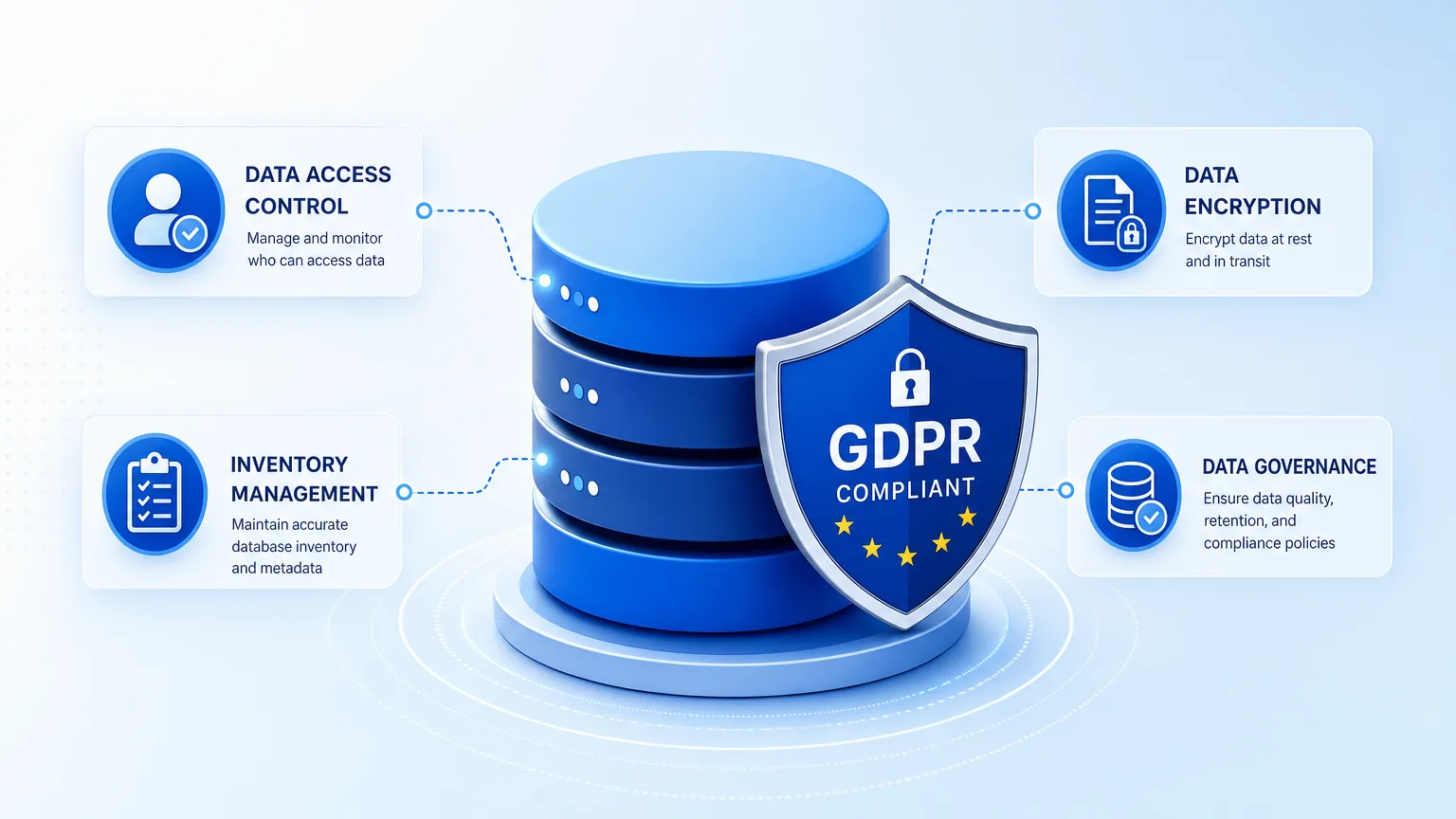
GDPR compliance for databases means applying legal, technical, and organizational controls so personal data held in database systems meets GDPR requirements, starting with a governance-layer inventory (the Article 30 Records of Processing Activities, or RoPA) that most programs treat as paperwork rather than infrastructure truth. Encryption and access settings matter too, but they’re necessary, not sufficient, without inventory proof behind them.
Treat the work as three layers. Auditors move through all three, even when your program only funded two.
| Layer | What it requires | Who owns it | What auditors check |
|---|---|---|---|
| Infrastructure | Data residency (EU vs non-EU or multi-region), encryption at rest, disaster recovery, backup placement | Infrastructure and cloud teams | Are instances hosted in claimed regions? Are backups encrypted and placed under the same residency story? |
| Database | Access controls, audit logging, retention rules, deletion workflows | DBA and data operations | Who can connect? What is the audit trail? How are deletions logged and proven? |
| Governance | Inventory of databases, proof of data flows, Data Processing Agreements (DPAs), access justification | Compliance plus IT leadership | Do you know every place personal data is stored? Can you prove who should have access and why? |
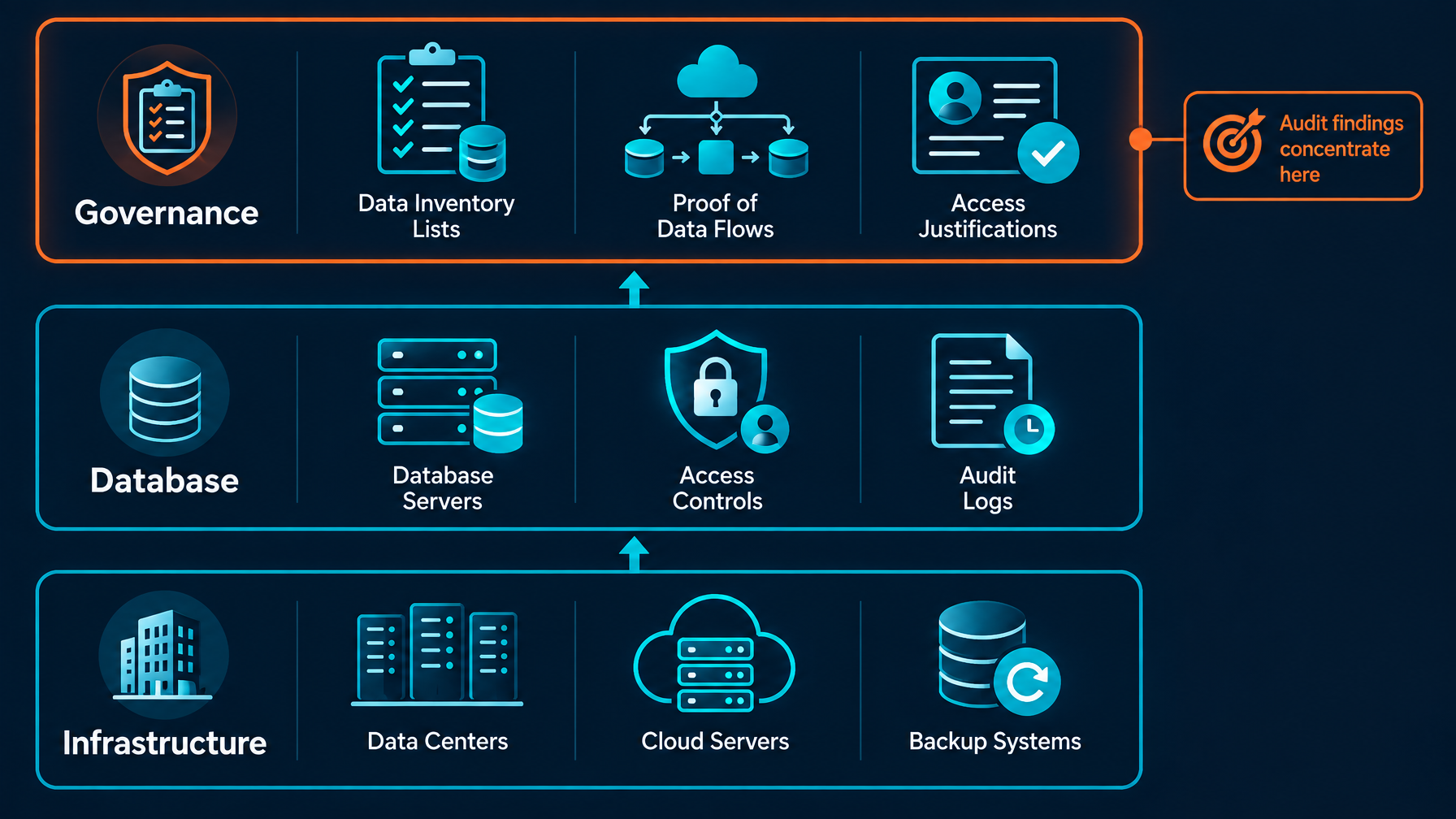
Most compliance budgets land on layers one and two. The third layer, governance, is where supervisory findings concentrate, and where spreadsheets fail first: encryption on a known instance doesn’t help if a second instance still processes customer email on a host marked decommissioned.
When supervisors assess GDPR database compliance, they use a short mental model:
- Can you list every database in scope for the environment under review?
- Can you identify which of those databases store personal data?
- Can you name an owner for each database (person or accountable team)?
- Can you show when that inventory was last refreshed against live infrastructure?
If any answer is “no,” “sort of,” or “we will get back to you,” the finding is a governance control gap, not a platform feature gap. A GDPR checklist from GDPR.eu still assumes you already know the systems in scope – inventory is the precondition those checklists rarely spell out. A CMDB not kept current by discovery creates the same pattern in ITSM: records exist, but nobody trusts them under pressure.
What does GDPR compliance for databases require beyond encryption?
It requires infrastructure placement and backup controls, database access and deletion proof, and a governed inventory of where personal data systems live. Auditors fail programs that cannot list databases, owners, and refresh dates even when platform security settings look complete.
Why GDPR compliance for databases matters
Administrative fines under the GDPR reach €20 million or 4% of worldwide annual turnover for the most serious infringements, whichever is higher, with lower-tier procedural failures still reaching €10 million or 2% turnover (Article 83). Those ceilings apply when database programs cannot evidence storage limitation, security of processing, or accountability.
The European Commission’s overview of EU data protection treats lawful processing, security, and accountability as linked duties. Fines are only one cost line. Breach notification work, customer churn after public decisions, and multi-week audit freezes land on the same teams that already own the databases.
Supervisors usually treat encryption and backups as table stakes. What they pressure-test is what the organization can prove about its own estate. An incomplete database inventory is an immediate red flag because control claims cannot cover systems the controller has not listed.
Scenario 1: Undiscovered databases
A legacy instance keeps processing account data on a server marked decommissioned in the CMDB. Nobody assigned an owner after the last migration. The auditor asks where customer data is stored. The undocumented instance has no current access review, no retention schedule, and no deletion log. That pattern maps to storage limitation and accountability failures under Article 5, even when no breach ticket exists yet.
Scenario 2: Unclear access paths
Six teams hold read access to a customer database. Three left the product years ago. The auditor asks for proof that each principal still has a legitimate need. Access lists without purpose and owner evidence fail the security-of-processing expectation in Article 32, which expects appropriate technical and organizational measures, including access control proportionate to risk.
Scenario 3: Retention without deletion evidence
Policy says customer records leave the system after a fixed period. The database still holds rows the business believes were purged. Nobody can produce deletion logs tied to the schedule. Storage limitation under Article 5 is a record-keeping problem as much as a purge job problem. Large transfer cases, including Meta’s 2023 penalty and the 2025 social media transfer fine covered by DLA Piper, show that incomplete records of how data moves drive enforcement, not only malware events.
Before the next audit window, ask the operating team:
- Can we list every database that stores personal data without a week of tribal knowledge interviews?
- Can we show who accessed each in-scope database in the last 30 days?
- Can we produce deletion evidence for records removed under the retention policy?
- Can we describe the path from collection point to database to deletion with named systems?
If any answer needs more than a day of manual reconstruction, the inventory is the bottleneck. Programs that treat asset inventory as the load-bearing control under security frameworks already know this pattern from other audits.
Why do GDPR auditors focus on database inventory first?
Inventory gaps mean access reviews, retention schedules, and DPAs cannot cover the full estate. Supervisors treat encryption as baseline and unknown systems as uncontrolled systems, which creates Article 5 and Article 32 findings before a breach occurs.
Why database inventory gaps hurt operations
Compliance teams feel inventory debt as calendar slip: manual evidence packs stretch audits by weeks while people chase owners, log exports, and forgotten replicas. Compliance leads should validate:
- Monthly-or-tighter inventory refresh, exported from a trusted system of record (a CMDB or equivalent registry) rather than a deadline spreadsheet
- Response to scoped data requests within 48 hours, with DPAs mapped to the processors and hosts that actually touch those databases
Operations teams feel the same gap as change risk and ticket load; two- or three-week manual discovery cycles leave a long blind window for new instances and silent decommissions. Ops leads should verify:
- Infrastructure scanning covers the agreed estate in a working day once scopes are set, with application-to-database dependencies known
- Access reports for a named database export in minutes, and inventory joins the ITSM system of record rather than living on a shared drive
Enterprise leadership sees a different cost curve: shadow databases that never enter the audit sample, “where does this customer live?” support tickets, and processors running jobs against systems that never appeared in the DPA register. Leadership should confirm a named executive owns inventory accuracy and that completeness is measured against live infrastructure, not last year’s spreadsheet.
Leadership should confirm a named executive owns database inventory accuracy, a central CMDB or equivalent holds database CIs, database-scope audits sit on the annual compliance calendar, and completeness is measured against live infrastructure rather than last year’s spreadsheet.
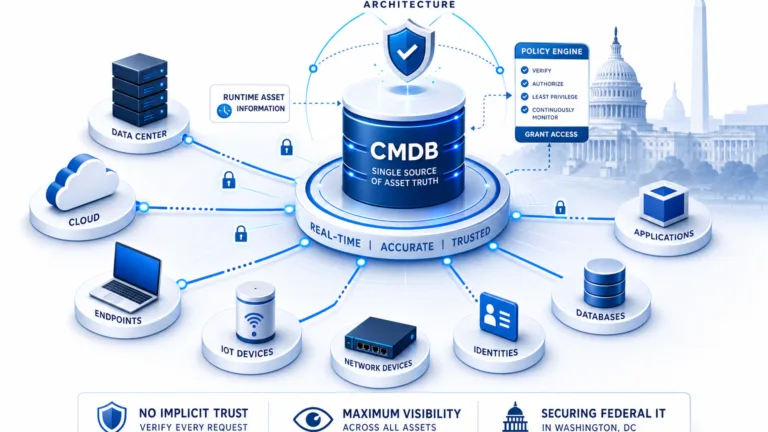
Most compliance budget still lands on platform controls. The cheaper control, knowing what you own, stays manual. That is the paradox that turns “we encrypted everything” into a finding when the auditor asks for the full list. Teams evaluating ITAM and inventory authority for hybrid estates use the same completeness question outside pure privacy work.
How automated database discovery addresses these gaps
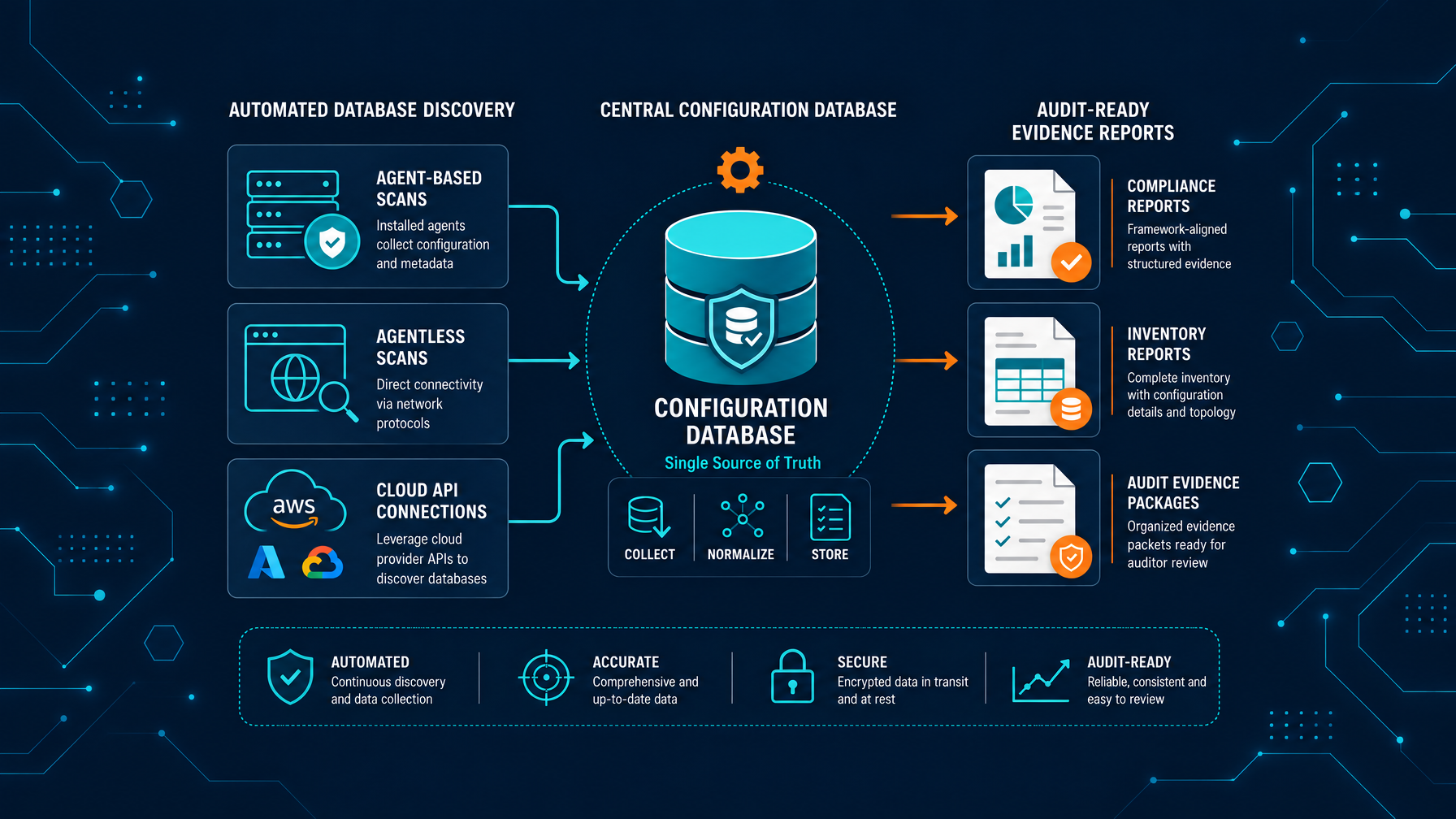
Automated discovery does not replace legal advice, DPIAs, or database-native security features. It supplies the upstream infrastructure catalog those programs need so controls attach to real systems. Three mechanisms matter for GDPR database evidence.
1. High-frequency scheduled database inventory
Discovery agents, agentless scans, and cloud APIs catalog database instances across on-prem, virtualization, and cloud accounts on a defined schedule. Each cycle refreshes location, lifecycle state, and ownership fields in the CMDB. Auditors care about a last-refreshed timestamp they can defend, not a static slide from last year’s workshop.
This supports a catalog of hosts and instances in scope, residency attributes for EU, non-EU, and multi-region placements, named owners on each database CI, visible last-updated timestamps, and a documented discovery frequency in policy (monthly minimum is common; many estates run weekly).
2. Dependency and access-oriented mapping
Once service definitions are provided, service maps show which applications and tiers depend on which database components. Separately, access and identity sources feed who connects. Together they support least-privilege reviews under Article 32 because purpose and path are visible instead of tribal. That covers access matrix candidates, purpose fields for retained access, service account ownership, unused-access review inputs, and application-to-database views for change and DPIA scope.
3. Audit-ready evidence export
A CMDB fed by discovery can export inventory snapshots, relationship views, and change history without rebuilding the pack from email threads. That is operational readiness, not a guarantee of a clean supervisory decision. Exports support scoped inventory packs in minutes, timestamped configuration snapshots, links from database CIs to covering DPAs, inputs for retention and deletion proof, and faster scoping when Article 33 breach notification clocks start (72 hours to the supervisory authority where required).
| Task | Manual (spreadsheets) | Automated (discovery + CMDB) |
|---|---|---|
| Database inventory cycle | Multi-week interview and spreadsheet pass | Scheduled refresh with dated records |
| Access evidence pack | Tens of hours, copy-paste error risk | Hours, repeatable export from system of record |
| Dependency proof | Tribal knowledge | Service maps once definitions exist |
| Audit readiness | Ad hoc, gaps likely | Standing exports from current inventory |
| Response to a new scoped request | Weeks of reconstruction | Same-day or next-day pack when scope is clear |
For the governance layer under those exports, see how Trusted Runtime Truth frames explainable estate records teams can defend in change, security, and compliance reviews.
How does automated discovery support GDPR compliance for databases?
Scheduled discovery (Article 5, Article 32) refreshes the database catalog, owners, and residency attributes. Service maps and access joins support least-privilege evidence. CMDB exports cut audit pack time from weeks of reconstruction to repeatable, timestamped reports without replacing legal or DPIA work.
GDPR Compliance for Databases in Practice
A financial services firm finds twelve undocumented databases
Compliance turns on automated discovery across the hybrid estate. Scans surface instances on hosts still marked decommissioned that continue to process account data. Pre-discovery, the team could not produce a complete list, owners were missing on a dozen systems, and deletion workflows had no reliable log trail. After ownership assignment and retention wiring, the firm can show which systems hold account data and how purge jobs attach to them. The exposure closed was inventory and accountability, not a new cipher suite.
A SaaS company audits third-party access
Service mapping, after service definitions were loaded, shows eight vendor integrations touching customer databases. Three paths are idle leftovers from retired products. Only five of eight processors had active DPAs aligned to live connections. The company removes unused paths, updates agreements, and enters the next review with a connection list that matches production.
A healthcare provider shortens breach scope assessment
When an incident ticket opens, the response team queries which databases store patient-related records and which principals touched the affected instance in the prior thirty days. Inventory and log exports that once took two weeks of reconstruction complete in hours. That speed matters when Article 33’s notification window applies. Scope quality still depends on classification expertise. Discovery only removes the blind hunt for which hosts exist.
Bytebase’s database compliance for GDPR overview covers platform-side controls inside the database tier. Pair that layer with infrastructure inventory so platform controls are not applied to an incomplete host list. Hosting and residency choices sit upstream of application config, which DanubeData’s GDPR-oriented hosting notes discuss from an infrastructure angle.
Building GDPR compliance for databases: from manual to map-driven
Today, compliance likely maintains a shared spreadsheet of “known databases,” and audit season becomes a scavenger hunt for access logs, configs, and deletion records. The fix is a discovery-fed CMDB: scheduled scans write database CIs into one system of record, evidence packs export in a day once scope is defined, and decommissioned hosts flag for review instead of vanishing into tribal memory.
Before: manual inventory
Compliance maintains a shared spreadsheet of “known databases.” Audit season becomes a three-week scavenger hunt for access logs, configs, and deletion records. Access changes move through email. The list drifts between annual refreshes. Nobody can prove completeness against live cloud accounts or forgotten racks.
After: discovery-fed CMDB
Scheduled discovery writes database CIs into a central CMDB. Compliance works from one system of record with weekly or monthly refresh. Evidence packs export in a day when scope is defined. Access changes are logged in the tools that already gate production. New instances appear on the next successful scan. Decommissioned hosts are flagged for review instead of vanishing into tribal memory.
Five-step roadmap
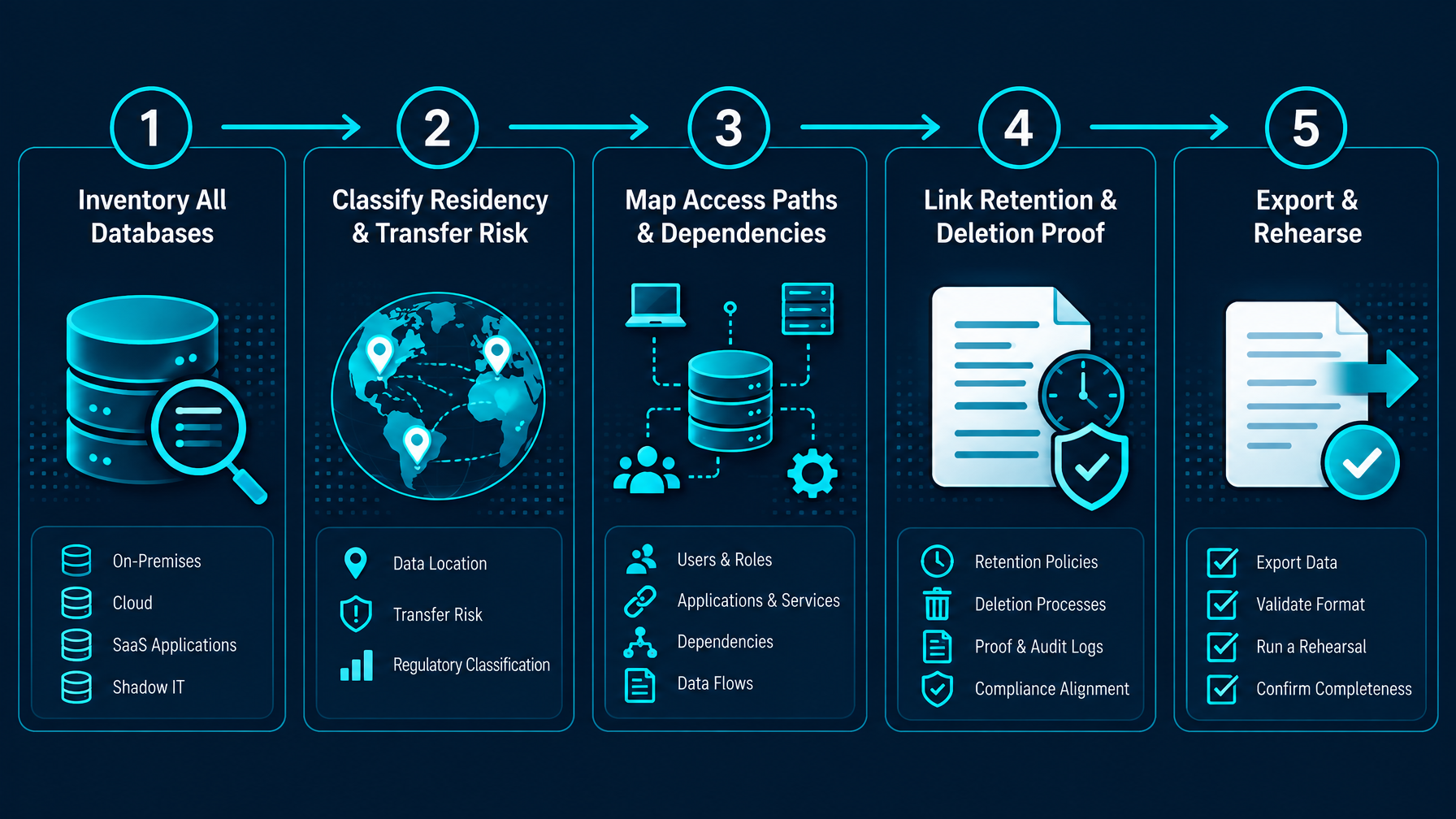
- Inventory all databases with automated discovery across cloud, on-prem, and agreed SaaS-adjacent data stores. Target a complete first catalog within a fixed window (many mid-market programs aim for four weeks) and assign ownership on every CI before calling the pass done.
- Classify residency and transfer risk in the CMDB fields that track region and processor. Identify multi-region and non-EU placements early so DPAs and transfer tools match reality.
- Map access paths and dependencies with service maps (after service definitions exist) plus identity and connection sources. Justify retained access, remove idle paths, and document least-privilege reviews.
- Link retention and deletion proof to each in-scope database. Article 5 storage limitation needs schedules and logs, not only a policy PDF.
- Export and rehearse compliance reports on a monthly cadence so the first auditor request is not the first export test.
Discovery-sourced CIs can feed ServiceNow, Jira, and Ivanti through Virima’s integrations overview rather than one-off spreadsheets. Ops gains a topology view that reduces surprise breakages when database permissions change. Compliance enters audits with packs already assembled. Inventory stays joined to infrastructure instead of freezing as a static snapshot.
Before you call the program audit-ready, confirm discovery runs on a documented schedule with reviewed results, the CMDB is the system of record for compliance reporting, access reviews run monthly with remediation deadlines, DPAs link to the databases they cover, retention and deletion are evidenced, and breach response can query current inventory inside the Article 33 window when it applies.
Dependency context under change and incident work still needs service maps once service definitions exist. That layer turns a bare host list into application impact paths without replacing ITSM change boards.
Know the Databases Before You Defend the Controls
GDPR compliance for databases starts with an unglamorous question: do you know which databases you own, where they run, and who can reach them? If the honest answer is “mostly” or “we think so,” the next supervisory interview is already at risk. High-frequency scheduled discovery and a live CMDB change the answer to dated inventory, named owners, and exportable evidence. Platform encryption still matters. It cannot cover systems your inventory never listed.
Supervisors are already testing that maturity at scale. Programs that treat database inventory as a standing control, not a scramble before the visit, enter those interviews with dated exports instead of tribal memory.
If you manage databases across cloud and on-prem and want to see how discovery-sourced inventory shortens audit evidence work, schedule a demo.
Frequently Asked Questions
What is the difference between database compliance and data protection proof?
Database compliance usually means the platform meets security baselines such as encryption, backup, and logging. Data protection proof means you can show regulators what personal data systems exist, why access is granted, and how retention works. Most programs fund the first and underfund the second.
How often should we refresh database inventory for GDPR?
Article 5(2) requires accountability you can demonstrate. Monthly inventory refresh is a practical floor for many hybrid estates. Annual-only audits leave long windows where new instances and silent decommissions never enter the controlled list.
Does automated discovery replace a Data Protection Impact Assessment?
No. Discovery inventories systems and relationships a DPIA needs as inputs. A DPIA still evaluates risk, necessity, and mitigations. You need both: discovery makes the system map honest so the DPIA isn’t built on an incomplete host list.
Does Virima’s discovery cover database instances across on-prem, cloud, and hybrid estates for GDPR inventory?
Yes. Virima combines agentless, agent-based, and API-based discovery (AWS, Azure) to catalog database instances across on-prem, virtualized, and cloud environments on a defined schedule, feeding location, lifecycle state, and ownership into the CMDB.
How does Virima’s CMDB export audit-ready evidence for a GDPR database review?
Virima’s CMDB exports timestamped inventory snapshots, relationship views, and change history directly from discovery data, so a compliance team can produce a scoped evidence pack in minutes instead of reconstructing it from email threads and spreadsheets.