Service Mapping Without a Full ServiceNow Stack: What Lean IT Can Still See

A change window opens on a host that carries payroll, warehouse APIs, and a vendor portal. The lean IT team runs Jira Service Management or HaloITSM, or ServiceNow ITSM without the ITOM add-ons. Someone asks what else depends on that server before anyone touches it. The room goes quiet for a familiar reason. People treat service mapping as something you only get after buying into ServiceNow’s full operations stack.
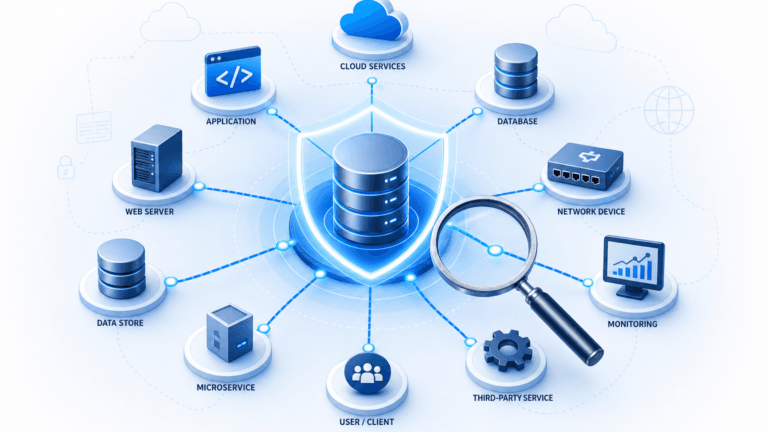
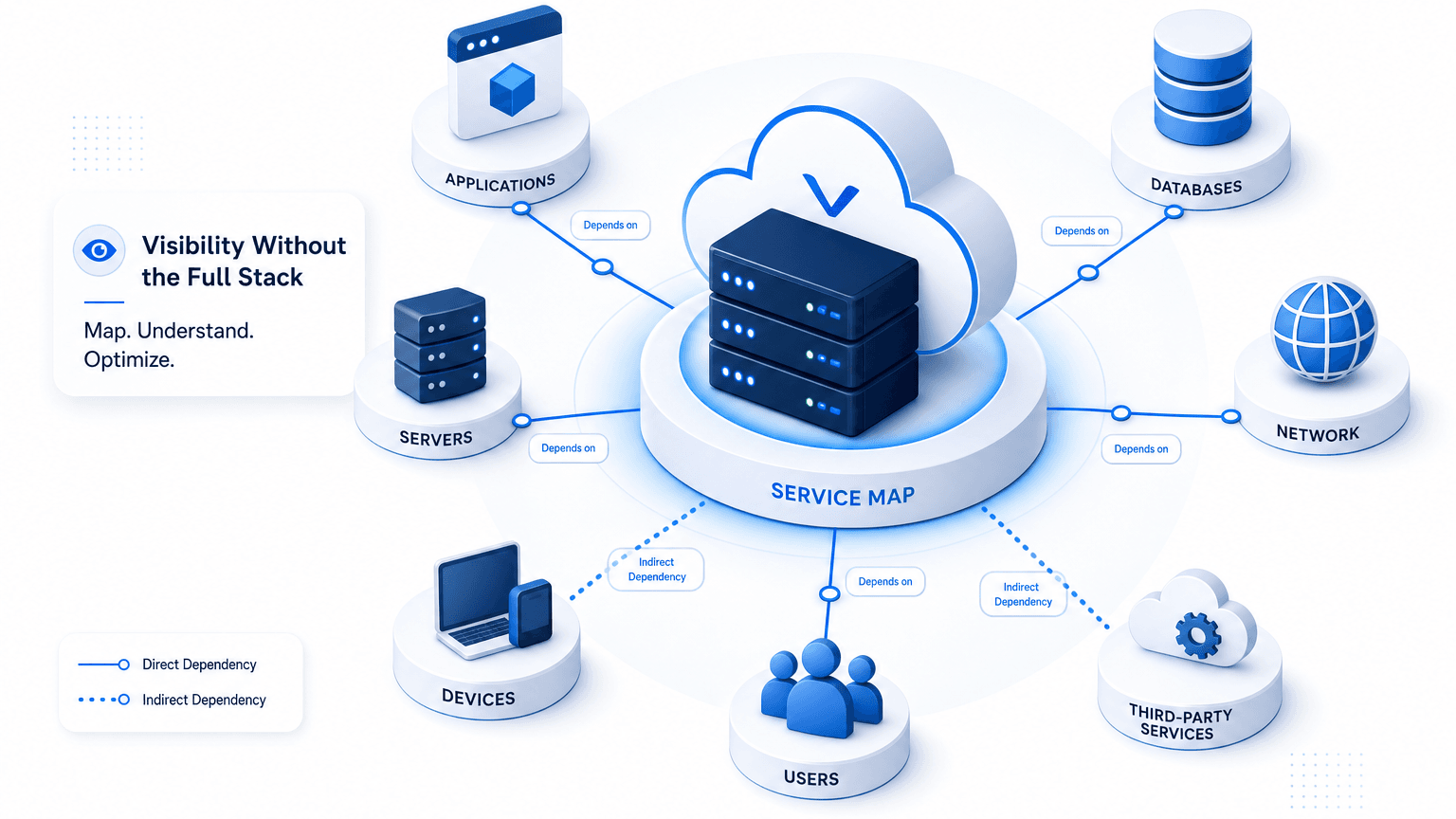
That assumption does more work than it should. Dependency visibility is a capability: a current map of how infrastructure supports named business services, usable before a change and during an incident. ServiceNow’s ITOM packages are one mature way to buy that capability. Lean IT can get the same class of outcomes- discovery-sourced inventory, a CMDB built for relationships, and ViVID™ service maps- from a dedicated layer such as Virima, while the desk stays on its current ITSM path.
What Service Mapping Requires Inside ServiceNow
Inside ServiceNow, discovery and service mapping sit in IT operations management, licensed apart from core ITSM. On ServiceNow’s current packaging, ITOM Advanced bundles Discovery and Service Mapping with related operations capabilities. ITOM Prime builds on Advanced with Event Management, Metric Intelligence, Service Observability, and additional reliability tooling. Older materials still say “ITOM Visibility” for the Discovery-plus-mapping bundle. Treat that as prior naming when you read older guides.
Discovery in that model depends on MID Server infrastructure in the customer environment so scans can reach on-prem and hybrid targets. That middleware layer is real program work: hosts to deploy, credentials to govern, ranges to scope, and upgrades to plan. Teams that budget only for the software line often discover the MID and operations load later.
ServiceNow does not publish list prices for ITOM Advanced or ITOM Prime on its public site. On the official ITOM pricing page, every price field routes to a custom quote or a demo conversation. Independent licensing advisors describe the commercial meter as infrastructure-led: what Discovery is allowed to see and retain in the CMDB drives subscription units more than named-user counts. Scoping, cloud lifecycle, and CMDB hygiene become cost controls as much as data-quality practices. ServiceNow leaves those figures off the public page, so this article stays with quote-only packaging and structural cost drivers.
The stack is built for organizations already deep on the ServiceNow platform, with enough scale to fund dedicated administration, MID Server operations, and a CSDM-style modeling program. That profile is valid for many large estates. Many lean teams need that Friday blast-radius answer long before they carry ServiceNow platform gravity at that scale.
Why This Feels Out of Reach for Lean Teams
Because service mapping shows up so often inside ServiceNow product stories, teams off that path quietly treat the capability as unavailable. The internal story shifts from “we chose a different stack” to “mapping only exists for full ITOM buyers.” Procurement never opens a ticket. Architecture never lists dependency visibility as a requirement. Incidents still arrive on the same incomplete picture.
The cost of that assumption shows up first in the response clock, and it also shows up in the license spreadsheet. Changes move through CAB with incomplete downstream lists. On-call engineers open three tools and still rebuild the impact path by hand.
A long-cited finding, popularized in The Visible Ops Handbook and discussed in New Relic’s MTTR guidance, holds that roughly 80% of MTTR is spent just identifying which change or component caused the outage. That share is identification work before anyone applies a fix. A current dependency view shortens that work on ServiceNow desks and on other ITSM platforms alike.
The corrective move is conceptual before it is commercial. Separate the job to be done, current service and dependency truth under change and incident, from the best-known product family that sells a full-stack version of that job. Once the job is named cleanly, lean teams can evaluate a discovery-plus-mapping platform that feeds the ITSM they already run, including as a direct alternative to buying ServiceNow ITOM solely for maps. That standing dependency truth is what Virima calls Trusted Runtime Truth: live, explainable estate context under change and incident.

Dependency Visibility Is a Capability Teams Can Own Outside ServiceNow
What makes service mapping operationally sophisticated is a small set of properties. The dependency model stays current under change. Blast radius is visible before a window opens. Incident and change context sit on the same map operators already trust. Those properties describe operational outcomes teams can measure. Teams can deliver them on any discovery-and-mapping stack that keeps dependency truth current, including stacks outside one vendor’s ITOM Advanced or ITOM Prime SKU.
Conceptually, the work breaks into a few durable requirements.
- Scheduled discovery that stays current. A one-time export or a quarterly spreadsheet freeze ages in days on a hybrid estate. High-frequency scheduled discovery (agent, agentless, and cloud APIs as the environment needs) refreshes configuration items and relationships on a cadence the team owns. Currency is a schedule and an ownership model.
- Named business services over raw inventory. A host list is inventory. A service map ties hosts, databases, middleware, and network paths to the services leadership cares about. Service composition still needs a definition step (manual entry, import, or an architecture feed). Map building then follows from those definitions plus discovered relationships.
- Context on the map and in the ticket together. When the incident record and the change record can point at the same CI and service path the map shows, triage stops bouncing between disconnected screens. The map becomes the shared picture under the workflow tool.
- Coverage that matches the estate. Lean teams still run on-prem racks next to AWS and Azure accounts. A mapping approach that only sees one plane leaves the other plane as tribal knowledge.
Those requirements are capability questions any serious mapping program has to answer, and multiple architectures can meet them. Buyers comparing different types of service dependency mapping already walk that ground in method terms: top-down entry-point mapping, bottom-up infrastructure relationships, traffic-based approaches, and hybrid patterns. The sophistication sits in how current the relationships stay and how clearly services are defined. Ticket-platform branding is secondary to that currency.
Fair trade-off
Outside a full ServiceNow ITOM program, teams usually run a dedicated discovery-and-mapping layer that integrates with the ITSM they already use. One platform owns tickets and workflow. Another owns authoritative inventory and dependency truth and hands that truth into the desk. That split is intentional architecture for many lean shops. It is also extra integration work. Name the split so nobody pretends it is free.
Enterprise-grade sophistication for lean IT still means the same bar large shops set for themselves: multi-source discovery, relationship quality, service-level blast radius, and explainable ownership. The packaging and admin model can stay lean. The dependency model should hold under the first multi-tier application the same way an enterprise program expects it to.
What Lean IT Can Still See
Even when ITOM Advanced or Prime stays off the bill, a disciplined lean team can still hold a practical baseline:
- An automatically refreshed dependency view fed by scheduled discovery that stays current past the first sprint
- Blast radius before a change is approved, using CI relationships and service membership on a shared map
- Incident and change context aligned to the same map, so the first question in a bridge call is which service path is in scope
- On-prem and cloud under one inventory and relationship model, so hybrid handoffs stop living only in senior engineers’ heads
That baseline is enough to change Friday behavior. The change owner opens the map, names the service, lists downstream CIs, and writes the window with that list attached. The incident commander starts from the failing CI’s service path with hostnames already placed on that path. Teams can reach that baseline while the service desk stays on its current platform.
When the team is ready to compare commercial options in list form, application dependency mapping tools worth evaluating sit in a separate ranking format. This article stays on the assumption problem and on how a full-capability platform can stand in for ServiceNow ITOM mapping on a lean commercial path.

How Virima Replaces the ITOM Mapping Stack for Lean Teams
Virima replaces the need to stand up ServiceNow Discovery, Service Mapping, MID Server operations, and ITOM-tier licensing solely to answer blast radius. Industry guidance still puts roughly 80% of MTTR on the identification stage. That is exactly the work a current dependency map shortens. The product path is a discovery-sourced CMDB plus ViVID™ service mapping that delivers enterprise-grade dependency visibility while the team keeps Jira Service Management, HaloITSM, Ivanti, ServiceNow ITSM-only, or another desk as the system of engagement.
That is the practical replacement story, scoped carefully:
- Teams already on ServiceNow ITSM keep the desk and feed authoritative CIs and relationships from Virima.
- Teams on other ITSM tools get the same discovery, CMDB, ITAM, and map stack they already run on the desk.
- Organizations with a healthy ServiceNow ITSM implementation keep that desk and add Virima as the discovery and map layer.
What ships matches the sophistication bar this article set earlier:
- Discovery: agentless and agent-based discovery, plus cloud discovery for AWS and Azure, on high-frequency schedules the team owns
- CMDB: designed under the ITIL framework, with normalization, de-duplication, customizable properties and relationships, and federation across installations
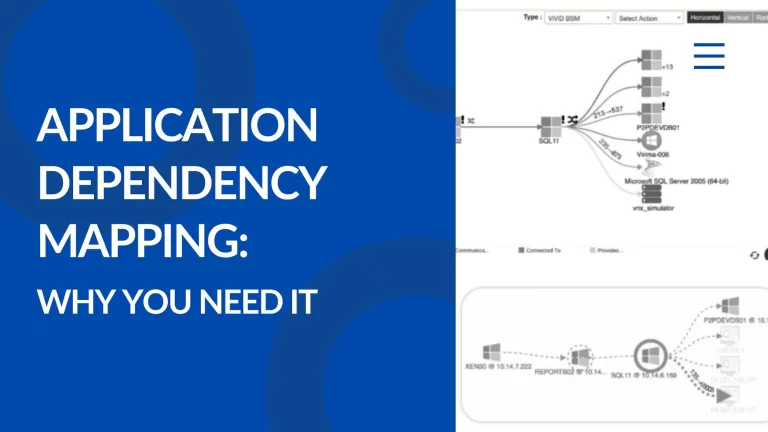
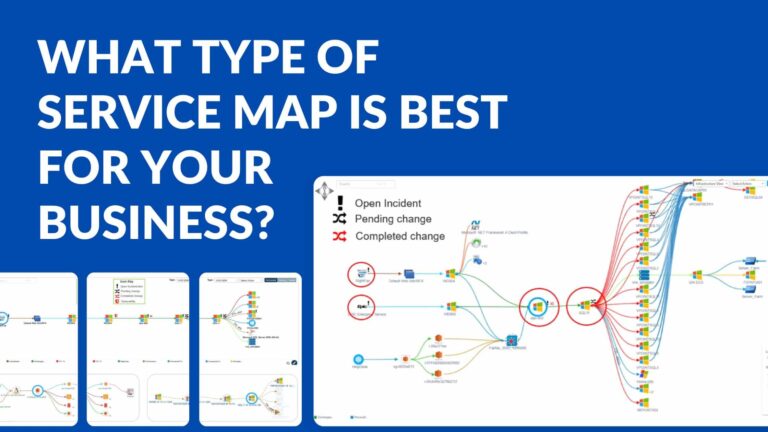
- ViVID™ service maps: once service definitions are provided, business service maps, application dependency maps, communication views, cloud relationships, network device dependencies, and topology views
- ViVID™ Insights: blast radius, incident and change impact, host-down and CI impact paths, plus Vulnerability Insights with Windows Server NIST NVD overlays weighted by service criticality
- ITAM: hardware and software assets, certificates, usage metering, licenses, contracts, inventory, and vendors
- Platform and handoff: reporting, runbooks, business rules, SSO, advanced permissions, MFA, full API access, and bi-directional ITSM integration so the desk stays current while discovery stays in the dedicated layer
ServiceNow ITOM Advanced and Prime stay quote-only on the public site, with infrastructure-led metering and MID Server program cost on top. Virima packages the full discovery-CMDB-map stack for lean operating models on Business Pro; commercial package details and plan tiers are live on the page. Use Virima when the primary goal is enterprise-capable maps under the ITSM you already run. Stay on or expand full ServiceNow ITOM when the organization already standardizes ITSM, ITOM, and CSDM on one platform with dedicated admin capacity.
When You Do Need the Full Stack
Some organizations should stay on ServiceNow’s deep ITOM path. The signal is already sunk platform gravity across ITSM, ITOM, and modeling programs.
You are a strong fit for full-stack ServiceNow mapping when ITSM, ITOM, and CSDM-style modeling are already standardized across the enterprise, a dedicated admin function already runs MID Servers and discovery schedules, and native ServiceNow workflows (CAB patterns, platform automation, ServiceNow-centric observability) are the operating system of record. In that setting, adding ITOM Advanced or Prime extends a platform you already staff and govern. The MID Server estate is already a known cost center on the operating budget.
Service mapping’s role in incident response still applies inside that world: the map shortens identification when the failing CI is correctly tied to the business service. The stack choice answers how you source and maintain that map. The operational need for the map stays the same either way.
Lean teams without that platform gravity can still pursue the same operational outcomes with Virima feeding Jira, HaloITSM, Ivanti, ServiceNow ITSM-only, or another desk. The decision turns on operating model and admin capacity, plus how much ServiceNow platform gravity the organization already carries.
Already Comparing Specific Tools?
If the open question has moved from “is mapping possible without full ServiceNow ITOM?” to “which product should we shortlist,” use the existing comparison and alternative pieces for deeper side-by-sides:
- ServiceNow Service Mapping’s overview and alternatives
- How Discovery and Service Mapping differ
- A direct alternative to ServiceNow’s application dependency mapping
These articles carry named comparison detail.
Where Lean Teams Take the Capability Next
Service mapping without a full ServiceNow stack is a real option when dependency visibility is treated as a capability with clear requirements: scheduled discovery currency, named services, shared context under change and incident, and hybrid coverage. ServiceNow’s ITOM Advanced and Prime packages remain a strong path for estates already built around that platform. They are one strong implementation of the capability. Other stacks can implement the same outcomes.
Virima is the dedicated alternative when you want to replace an ITOM-only purchase for discovery, CMDB, ITAM, and ViVID™ maps while keeping the ITSM you already trust. Lean and mid-size teams can run that full stack (discovery-sourced CMDB, ViVID™ service mapping after service definitions, ITAM, Vulnerability Insights, integrations, and full API access) without standing up ServiceNow ITOM solely for maps. Packaging, asset bands, discovery install counts, and support levels are set in a Contact Us or free trial conversation for the estate you actually run.
Schedule a demo or request a free trial to walk a hybrid estate path while the current ITSM desk stays in place.
Frequently Asked Questions
Do I need the full ServiceNow ITOM stack to get service mapping?
Service mapping is a dependency-visibility capability teams can run on more than one stack design. ServiceNow bundles Discovery and Service Mapping in ITOM Advanced, licensed apart from ITSM. Platforms such as Virima deliver discovery, CMDB, and ViVID™ maps that feed the ITSM you already run, including as an alternative to buying ITOM only for maps.
What’s the difference between ServiceNow Discovery and Service Mapping?
Discovery finds and updates configuration items and relationships across the estate. Service Mapping organizes that infrastructure under named business services so change and incident work can see blast radius. On current packaging, they ship together in ITOM Advanced, still separate from core ITSM licensing.
Can a small IT team get dependency mapping without ServiceNow?
Small and mid-size teams can run scheduled discovery, define business services, and maintain dependency maps that feed Jira, HaloITSM, or ITSM-only ServiceNow. Virima packages that full stack for lean IT on the ITSM path the team already runs.
How much does ServiceNow Service Mapping cost?
ServiceNow does not publish public list prices for ITOM Advanced or ITOM Prime. Pricing is quote-only on its ITOM page. Cost structure is separate ITOM licensing, infrastructure-led metering tied to discovered scope, plus MID Server and admin operations beyond the software line.
What’s the difference between service mapping and a CMDB?
A CMDB stores configuration items, attributes, and relationships as the system of record. Service mapping uses that data, plus service definitions, to show how infrastructure supports named business services for change impact and incident triage. The map is the service lens on CMDB truth.