Business Service Mapping in ServiceNow: Overview and Alternatives

Teams evaluating business service mapping in ServiceNow are usually deciding whether native ITOM Service Mapping is enough, or whether a discovery-fed map layer will get critical services into incident and change work faster. The cost of getting that wrong shows up on the bridge: a change is approved, a customer portal fails, and nobody can prove which business services sat on that node.
ServiceNow Service Mapping sits in the ITOM suite and draws from the CMDB. This page covers how that mapping works, where programs stall, and when Virima ViVID is a practical alternative while you keep the ITSM platform you already run.
Is ServiceNow Service Mapping enough, or do teams need an alternative?
ServiceNow Service Mapping fits organizations already deep in ITOM with budget and admins for pattern work and multi-month rollout. Virima ViVID builds discovery-fed service maps after service boundaries are defined, overlays incidents, changes, and Windows Server NVD context on the map, and connects to multiple ITSM tools without a full ITOM mapping stack.
Understanding Business Service Mapping in ServiceNow
ServiceNow’s service mapping sits within the ITOM product family. It runs on the Now Platform and draws directly from the configuration management database (CMDB). According to the EMA ServiceOps report, CMDB maturity and discovery frequency are two foundational prerequisites for service operations success. Both remain persistent challenges in most enterprise environments.
Accurate service maps depend on accurate CI data. Organizations deploying servicenow business service mapping typically start with ServiceNow Discovery to populate configuration items and their relationships first.
How ServiceNow Service Mapping Works
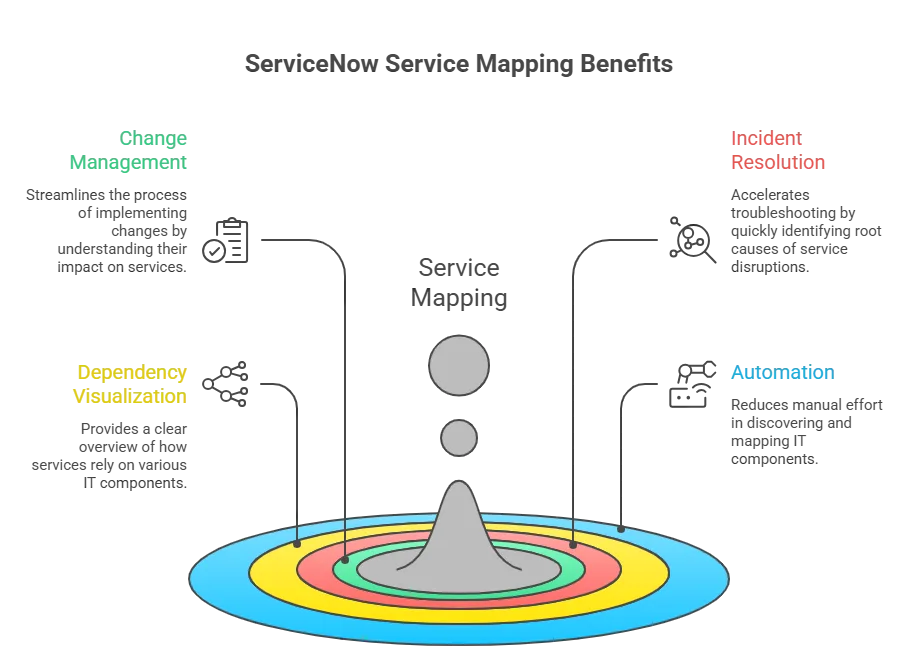
ServiceNow Discovery scans your environment and populates configuration items in the CMDB. Service mapping then takes those CIs and builds a structured view of how they connect to form business services. The view covers every upstream and downstream dependency for a given service. It updates as your environment changes.
When a CI fails or is scheduled for change, the map shows which business services are in the impact path. It also identifies which teams own the downstream components.
The five mapping approaches
ServiceNow supports five approaches to building service maps:
- Top-down mapping traces connections from the application layer down to supporting infrastructure. It handles dynamic, cloud-native architectures well, including Lambda-to-Lambda and Lambda-to-RDS relationships.
- Tag-based mapping builds maps from cloud resource tags. It requires less configuration but does not trace actual dependency connections between components.
- Traffic-based mapping uses machine learning to extract service-level relationships from network traffic data, enhancing top-down or tag-based maps with relational context.
- Service mesh mapping targets Istio-based microservices architectures, mapping communication patterns between individual microservices.
- Dynamic CI groups map services using collections of CIs that share specific attributes, useful where compute resources are provisioned as a service.
Business service mapping vs application dependency mapping
Application dependency mapping traces technical links among applications, hosts, and data stores. It answers which processes talk to which ports and which hosts sit under an app tier. That graph is necessary. It is not the full business view.
Business service mapping groups those technical dependencies under a service the business funds and restores. Ownership, change risk, and incident priority attach to that service name. Without that grouping, ops still has a tangle of CIs and no agreed blast radius for a CAB vote.
Strong programs run both layers. Dependency data feeds the graph. Service boundaries turn the graph into an impact model people trust at 2 AM. If service boundaries stay undefined, no tool can invent a stable business service map from traffic alone.
How does business service mapping differ from application dependency mapping?
Application dependency mapping traces technical links among apps, hosts, and data stores. Business service mapping groups those dependencies under a service the business recognizes, with ownership and impact scope. ADM feeds the graph. Business service mapping assigns that graph to services people fund and restore.
Key Features of ServiceNow Service Mapping
Service Dependency Visibility
ServiceNow’s service mapping shows how services, applications, and infrastructure components interact across your environment. When an incident management alert fires, your team can see every upstream and downstream dependency without manually tracing connections. Response shifts from reactive guesswork to structured triage.
Discovery-Schedule CMDB Freshness
ServiceNow integrates with the Now Platform CMDB so service maps can refresh on the discovery schedule you configure. Dependency data reflects the current state of the environment. It does not rely on a snapshot from last quarter’s manual update cycle. Update frequency depends on discovery schedule configuration and pattern maintenance cadence.
Efficiency for IT Operations Teams
High-frequency discovery cycles replace the manual effort of tracking component relationships. IT teams spend fewer hours on routine inventory validation. They gain more time for incident resolution, change planning, and proactive service management.
Multi-Cloud and Hybrid Support
ServiceNow provides out-of-the-box service visibility for Amazon AWS, Microsoft Azure, and Google GCP. Teams can extend coverage to additional vendors as needed. For teams managing workloads across on-premises infrastructure and multiple cloud platforms, this centralized view reduces the need to switch between provider consoles during triage.
Where ServiceNow Falls Short
Setup and Maintenance Complexity
Deploying ServiceNow service mapping requires significant technical expertise. Initial configuration, ongoing pattern updates, and troubleshooting all demand dedicated ServiceNow administrators. Teams without a staffed ServiceNow practice carry a substantial ongoing maintenance burden. Implementation timelines of three to six months are common for a focused deployment.
Tag-Based Mapping Gaps
Tag-based mapping identifies resources by cloud tag rather than tracing actual component connections. Cascade failures can be invisible: a database failure cascading to front-end application services will not appear in the dependency chain if the relationship was not directly discovered. For high-priority services under active incident management pressure, this gap matters.
Visual Map Overload at Scale
In large environments with hundreds of services and thousands of CIs, ServiceNow’s visual maps can become too cluttered to navigate under pressure. When a map displays every CI at once, isolating the specific dependency chain behind an active incident becomes its own challenge.
Discovery Pattern Maintenance Overhead
ServiceNow service mapping relies on patterns, which are predefined templates that identify and connect infrastructure components. These patterns require ongoing updates as your environment changes. New application versions, non-standard configurations, and new cloud services create mapping gaps when patterns fall behind. For a fit-focused take, read Is ServiceNow CMDB service mapping right for your business?
Why Most Service Mapping Programs Stall
Service mapping programs fail for four consistent reasons: scope overreach (mapping the entire IT estate at once), fragmented ownership (no team accountable for map accuracy over time), weak CMDB integrity (CI relationships missing or stale before mapping begins), and operational disconnect (incident and change teams not using maps in daily business processes). These failures compound. Poor data leads to distrust, and distrust leads to abandonment.
Organizations that sustain successful programs share two practices. They start with a small set of business-critical services rather than the full estate. They also connect service maps directly to ITSM workflows so ops teams use them every day. The EMA ServiceOps report identifies this operational integration as the deciding factor. Programs that integrate with workflows deliver value. Programs that do not produce accurate diagrams nobody opens during a 2 AM incident.
Why do service mapping programs stall?
Most programs stall from mapping too much too soon, unclear ownership of map quality, weak CMDB relationships before mapping starts, and maps that never enter incident or change workflows. Teams that win start with few critical services and attach maps to daily ITSM work.
→ See how Virima delivers Trusted Runtime Truth for IT service dependency mapping
Virima Service Mapping: Built for IT Operations Teams
After the gaps above, many teams want the same dependency visibility without carrying full ITOM mapping overhead. Virima builds discovery-fed service maps and uses ViVID™ to overlay ITSM records and NVD lookups on those views. Service boundaries still come from configuration, import, or a tool such as LeanIX. Once boundaries exist, maps update from discovery data on high-frequency schedules.
Discovery-Fed Service Maps
Virima’s IT discovery runs on high-frequency schedules to identify assets and map the network connections between them. Once service boundaries are defined, whether through configuration, spreadsheet import, or a tool like LeanIX, Virima builds and maintains the service map from that discovery data. Maps stay current as your environment changes without manual refresh cycles. For capability detail, see Virima service mapping.
Blast Radius Visibility for Incident Response
When an incident hits, ViVID™ shows your team which assets are affected and where the probable root cause sits, before the triage call stretches to two hours. Instead of tracing dependencies manually during an outage, ops teams pull up the service map and see the full impact scope immediately. ViVID™ also integrates with event management tools including SolarWinds, Nagios, and LogicMonitor to display alerts directly on the dependency view. Your team sees which business services are at risk before end users report disruption.
Change Impact Analysis Before the Window Opens
Virima’s service maps show how planned changes affect existing services. Before a change window opens, your team can see which services depend on the component being changed, catching conflicts before they escalate to P1 incidents. Change Advisory Boards work from the same visual view. They no longer need to debate verbal descriptions of assumed dependencies.
No-Code ITSM Integration
Virima connects to ServiceNow, Jira Service Management, Ivanti, HaloITSM, Xurrent, Hornbill, and TeamDynamix through no-code setup in the web admin portal. Full partner list: Virima integrations.
No back-end development or third-party middleware is required. Incident management tickets, change requests, and problem records benefit from accurate dependency data without switching platforms.
NVD Integration for Security-Aware Service Maps
ViVID™ integrates with the National Vulnerability Database (NVD) to surface known CPEs and CVEs for Windows Servers on the service map. Teams can weigh patch order by asset and business service criticality, then pair that view with a dedicated vulnerability scanner for broader OS coverage. This capability is not part of ServiceNow’s native service mapping module.
ServiceNow Service Mapping vs. Virima ViVID™: Side-by-Side
| Capability | ServiceNow Service Mapping | Virima ViVID service mapping |
|---|---|---|
| Time to first service map | Often 3-6+ months for a focused ITOM mapping deployment | Under 60 minutes once service boundaries are defined and discovery has run |
| ITSM records on the map | Native to the Now Platform; not a multi-ITSM overlay product | Incidents, changes, and related ITSM context overlaid on ViVID maps |
| NVD / CVE on the map | Not included in native service mapping | Windows Server NVD CPE/CVE context on the map; pair with a VM scanner for other OS types |
| Pricing model | ITOM suite packaging; list price not published; cost varies by SKU | Often lower TCO than full Discovery plus mapping for mid-sized estates; request a current quote |
| ITSM integrations | Native Now Platform | ServiceNow, Jira Service Management, Ivanti, HaloITSM, Xurrent, Hornbill, and TeamDynamix via no-code admin (see integrations hub) |
| Admin overhead | Dedicated admins for patterns and ongoing maintenance | Managed from the web portal; no dedicated pattern programming team required |
| Agentic IT readiness | Operates in ServiceNow AI / ITOM context | Discovery-fed Trusted Runtime Truth for impact before automated actions |
→ Compare Virima, Device42, and ServiceNow side by side.
Service Mapping as the Trust Layer for Agentic IT
AI agents taking on IT actions, remediating incidents, triggering changes, and provisioning infrastructure, need accurate service dependency data to act safely. Service maps define which services depend on which components, what will break if something changes, and who owns what. Without this trusted runtime truth, AI agents operating on stale CMDB data create unintended downstream failures across dependent services.
Virima’s discovery-fed service maps serve as the Trusted Runtime Truth layer that agentic IT operations require. Accurate, current dependency data gives AI-driven remediation workflows the context to assess impact before acting, not after. The EMA ServiceOps report identifies this operational foundation as consistently underdeveloped in enterprise environments that otherwise have AI capabilities in place. The capability exists, but the ground-truth data layer that makes it safe does not.
Choose the Right Service Mapping Approach
Teams usually pick among four paths. Stay inside ServiceNow ITOM mapping if the platform and budget already support it. Use a discovery and mapping layer that feeds the ITSM tools you keep. Rely on application dependency mapping first, then attach business service labels. Or maintain manual CMDB relationships only for a small service set. Cost, pattern work, and how often maps enter incident and change work should drive the choice, not a single brand default.
ServiceNow Service Mapping is the stronger fit when the estate is already standardized on the Now Platform ITOM suite, CMDB maturity is high, and a dedicated admin team will own patterns and a multi-month rollout. In that setting, native ITOM mapping and platform AI context matter more than a separate discovery-fed map layer.
Among ServiceNow service mapping alternatives, Virima’s ViVID™ service maps stand out for teams that need the same dependency visibility at lower cost. They come with ITSM overlays, NVD vulnerability context, and deployment measured in hours rather than months. Virima is a direct service mapping tool alternative built for mid-sized IT operations teams.
→ Request a demo and see how Virima maps your IT service dependencies!
Frequently Asked Questions
How much does ServiceNow service mapping cost?
ServiceNow does not publish standard list pricing for ITOM and service mapping. Cost usually scales with instance size, user count, and packaging. Mid-sized teams often treat full ITOM mapping as a major line item once implementation and pattern upkeep are included. For a structured feature comparison, see the Virima vs Device42 vs ServiceNow matrix.
What is the difference between ServiceNow Discovery and service mapping?
Discovery scans the environment and populates configuration items in the CMDB. Service mapping uses those CIs to build the dependency view of how they form a business service. Discovery answers what exists. Service mapping answers what depends on what. Service mapping is only as accurate as the Discovery data underneath it. Programs that skip CMDB integrity checks will stall. For a deeper breakdown, see ServiceNow Discovery vs service mapping.
How does business service mapping differ from application dependency mapping?
Application dependency mapping traces technical links among apps, hosts, and data stores. Business service mapping groups those links under a service the business recognizes. ADM builds the graph. Business service mapping turns that graph into impact and ownership for operations.
How does service mapping speed up incident response?
Service mapping gives your team a pre-built view of service dependencies. When a database server fails, instead of manually tracing which applications depend on it, your team opens the service map and sees every downstream service affected immediately. Virima’s ViVID™ feeds this dependency data directly into your ITSM platform. Whether that is ServiceNow, Ivanti, or Jira Service Management, the incident management ticket is already associated with the right CIs when it opens.
What is the difference between a CMDB and a service map?
A configuration management database (CMDB) stores configuration items, every server, application, and network device, along with their attributes and known relationships. Service mapping builds on that data to create an operational wiring diagram: which CIs form a business service, how they depend on each other, and what fails when one goes down. The CMDB is the inventory. The service map is the impact view. Without accurate CMDB data, service maps are unreliable.
Does Virima service mapping require a ServiceNow license?
No. Virima operates independently of ServiceNow and integrates with it as one of several supported ITSM platforms. Teams running Jira Service Management, Ivanti, HaloITSM, Xurrent, or other ITSM tools use Virima service mapping without any ServiceNow license. Virima is frequently chosen by organizations that need strong dependency visibility without ServiceNow ITOM licensing costs.
How does service mapping support change management?
Before a change window opens, service maps show which business services depend on the component being changed. Change Advisory Boards can evaluate risk based on real service impact instead of assumptions. When a CI is scheduled for change and ViVID™ shows open incident management tickets against dependent services, that context surfaces in the change record automatically, giving the CAB the full picture before approving.