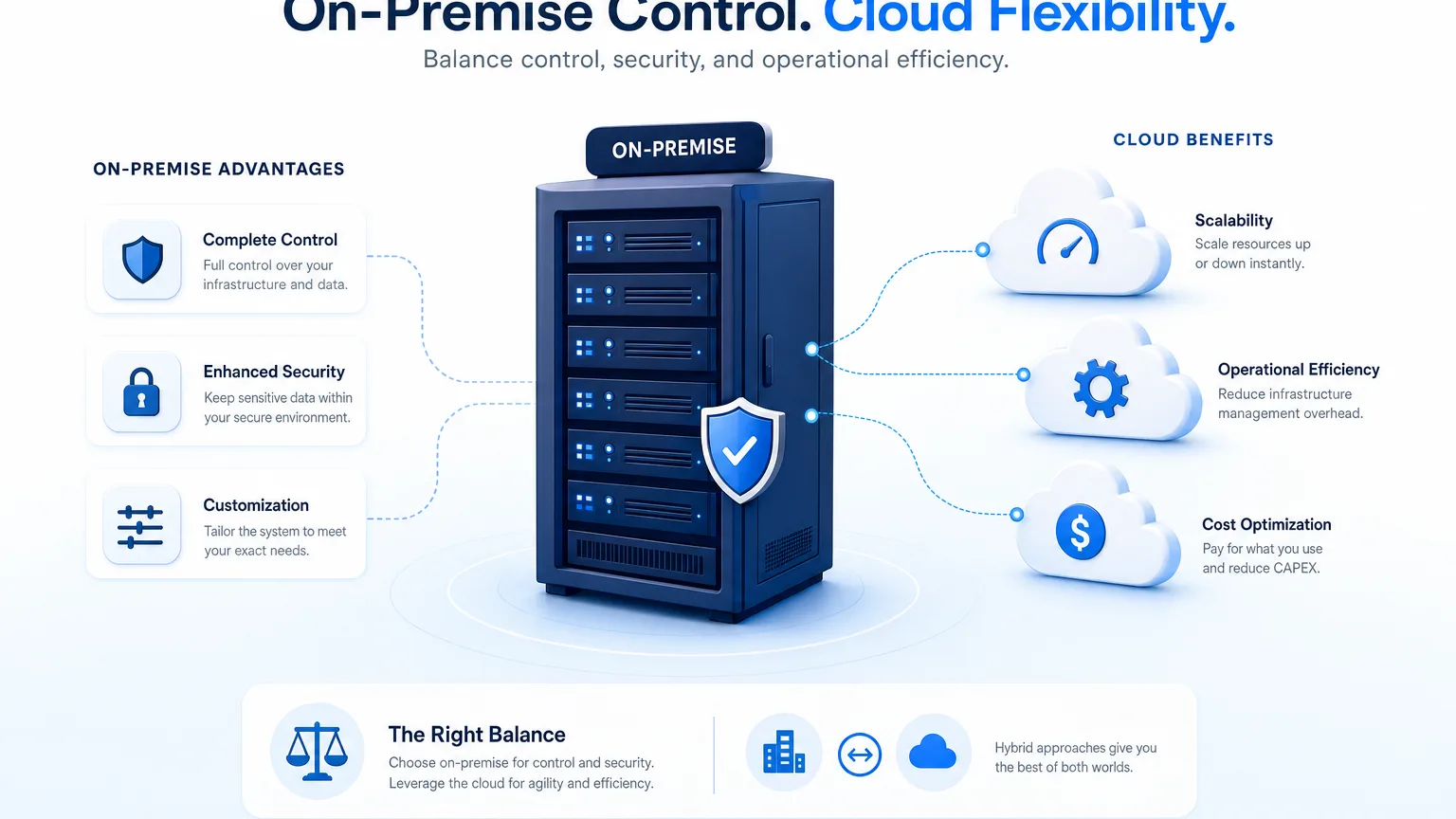
On-Premise Software in 2026: What It Actually Buys You

Somewhere in most IT organizations is a deployment policy written years ago that states all systems of record must stay on-premise. When the time comes to evaluate a Configuration Management Database (CMDB), IT asset management (ITAM) tool, or IT discovery platform, teams inherit that mandate without asking whether the original rationale still applies.
In 2026, the question is rarely whether on-premise software works. It does. The real question is whether paying the operational tax of self-hosting a platform actually buys the security, control, or compliance outcomes your organization assumes it provides.
The way a discovery engine collects asset data, probes air-gapped networks, and handles data residency differs significantly from standard SaaS tools — for a CMDB or ITAM platform, deployment architecture determines whether you can reach a segmented network at all, not just where the data sits. Treating “on-premise versus cloud CMDB” as a blanket binary filter often obscures the architectural choices that matter most.
What is on-premise software in modern IT architecture?
On-premise software is installed, hosted, and maintained directly on an organization’s local physical servers or private infrastructure. Unlike cloud-native SaaS, the purchasing organization retains full control over local network placement, data storage, hardware allocation, and system maintenance schedules.
What “on-premise software” actually means today
On-premise software is application software installed, hosted, and maintained directly on an organization’s own physical servers or private infrastructure, rather than run by a vendor in the cloud. The definition has blurred over the past decade, though, so it helps to distinguish self-hosting on local physical infrastructure from adjacent deployment architectures:
| Deployment model | Who manages what | Example |
|---|---|---|
| On-Premise (Self-Hosted) | Your team manages the physical host, operating system, database administration, network firewalls, storage, and application updates | Software running on hardware or hypervisors located inside your own data centers or server rooms |
| Private Cloud (Infrastructure-as-a-Service, or IaaS, hosting) | Your team still manages the OS, database, and application — only the physical hardware is rented | Self-managed software running on dedicated virtual infrastructure inside a public cloud provider such as AWS, Azure, or Google Cloud |
| Cloud-Native SaaS | The vendor hosts, scales, and updates the application centrally; your team accesses it via secure web interfaces and APIs, with local probes or light agents handling data collection inside internal networks | A platform hosted on secure multi-tenant or single-tenant cloud infrastructure |
Private cloud (IaaS) hosting is fundamentally self-managed software running on rented cloud compute, not true on-premise hardware. When IT procurement teams write “must be on-premise” into a platform RFP, they often lump private cloud hosting and local self-hosting together. Clarifying which layer of the stack requires physical locality is the first step toward a rational architecture decision. If you’re comparing named CMDB platforms rather than deployment models, see How Does Virima’s ServiceNow CMDB Sync Work? A Step-by-Step Guide.
The real reasons teams seek on-premise software
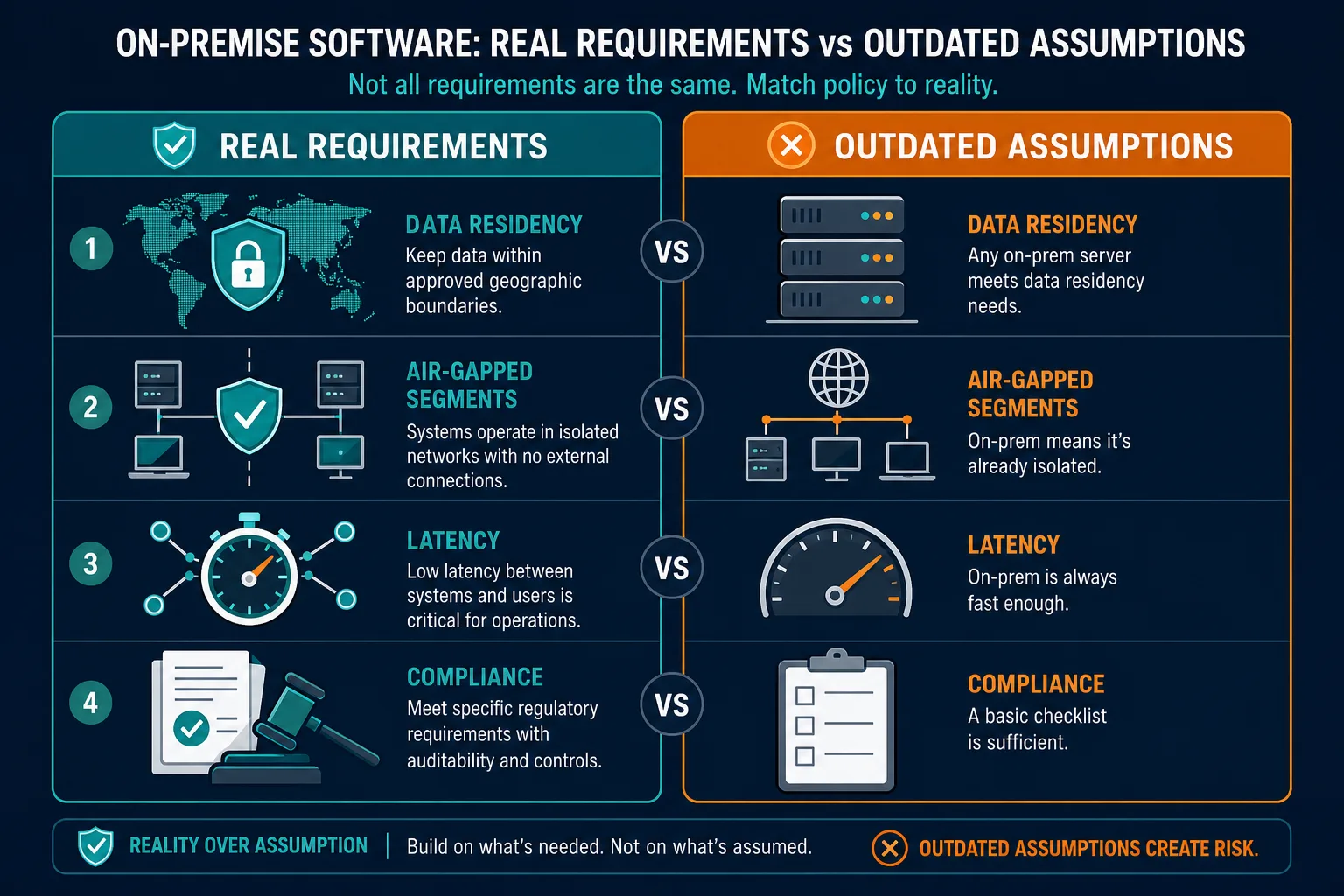
Most requests for self-hosted CMDB software and ITAM tools stem from a few specific operational constraints. When examined closely, some remain valid, while others persist because internal security policies have not been updated.
1. Hard data residency and data sovereignty laws
Strict regulatory frameworks in jurisdictions such as the EU, Germany, and highly regulated federal sectors require sensitive operational data to remain strictly within specific geographical boundaries or air-gapped enclaves. This is not a niche concern: as of 2026, 62 jurisdictions enforce some form of data localization requirement (Duality Technologies, 2026). Of those, 18 apply absolute in-country mandates and 44 apply conditional rules — and the total has more than doubled since 2020. If local privacy or national security laws mandate that internal system configuration details cannot pass through commercial public cloud regions, self-hosting or local sovereign enclaves become a strict legal requirement for data residency compliance. Teams weighing these requirements against CMDB accuracy goals can go deeper in CMDB Audit Essentials: Ensuring Data Accuracy and Compliance.
2. Air-gapped and segmented networks
Industrial control systems, defense enclaves, financial processing networks, and SCADA environments are deliberately isolated from the public internet. If a network segment has zero inbound or outbound internet connectivity by design, standard cloud-native platforms cannot connect directly to inventory those systems without specialized gateway architectures.
3. Legacy policy inheritance
This is one of the most frequently cited reasons in procurement reviews. An internal security baseline written in 2015 might state: “All core IT databases must reside on internal corporate servers.” That rule was designed to prevent unstructured sensitive data from leaking into unvetted public file shares. Applying it uncritically to modern SaaS platforms often forces teams to self-host software without evaluating the vendor’s actual cloud encryption, SOC 2 compliance, or data isolation controls.
4. Extreme latency requirements
For high-frequency trading or real-time industrial automation, milliseconds matter. However, for administrative and operational systems of record like a CMDB or ITAM inventory, real-time local processing latencies are rarely a bottleneck.
Is on-premise software inherently more secure than cloud SaaS?
On-premise software provides complete local physical and network control, but it is not inherently more secure. On-premise security depends entirely on the internal team’s ability to apply patches, manage OS vulnerabilities, configure firewalls, and maintain strict access controls, whereas cloud-native SaaS shifts that maintenance burden to dedicated vendor security operations.
The operational costs of self-hosting a system of record
Choosing on-premise software trades vendor management for internal operational burden. Before committing to a self-hosted deployment for IT discovery or CMDB, infrastructure teams must budget for four recurring operational expenses.
That tradeoff shows up directly in total cost of ownership. Cloud deployments can cut TCO by 30 to 50 percent over five years compared to self-hosted alternatives once hardware refreshes, patching labor, and downtime are factored in (Spacelift, 2026). For enterprise systems such as ERP, on-premise TCO has run 66 to 71 percent higher than cloud over a 10-year horizon (Bizowie, 2026). The same staffing and maintenance math applies to a self-hosted CMDB or discovery platform.
| Cost category | What it includes |
|---|---|
| Infrastructure provisioning & database administration | Server sizing, OS licensing, storage allocation, DB tuning |
| Maintenance, patching & vulnerability mitigation | Manual upgrade cycles, emergency security patch application |
| High availability & disaster recovery overhead | Multi-node clustering, database replication, backup testing |
| Slower feature velocity & delayed bug fixes | Waiting for manual release upgrades vs. instant SaaS updates |
1. Infrastructure provisioning and DB administration
A CMDB stores complex dependency graphs as an enterprise database. Self-hosting means allocating database cluster licenses, provisioning high-speed storage, and assigning certified DBAs to keep query performance and indexing under control as the CI count grows.
2. The patching and upgrade tax
Every security patch, OS update, and application upgrade falls on your internal infrastructure engineers. When a zero-day surfaces in an underlying web server or database engine, your team is the one running the emergency maintenance window — not a vendor security operations center.
3. High availability (HA) and disaster recovery (DR)
Keeping a self-hosted system of record available through hardware failure means building, testing, and maintaining secondary database mirrors, load balancers, and failover sites across multiple physical locations — and proving the failover actually works on a schedule.
4. Feature stagnation
On-premise deployments typically lag months or years behind cloud-native releases, because internal teams delay upgrade projects to avoid operational risk rather than adopting improvements as they ship.
If the operational math above changes your calculus, our solutions team can show you where a hybrid deployment cuts that overhead — Schedule a Demo.
The deployment question that actually matters for CMDB and discovery tools
Choosing among IT discovery deployment models is rarely a simple choice between self-hosting the entire application or opening corporate networks to external access. The real architectural challenge is reaching isolated or segmented network layers to gather inventory data accurately.
Modern enterprise discovery engines solve this by decoupling the data collection layer from the central platform engine, the same architecture behind Virima’s IT Discovery approach:
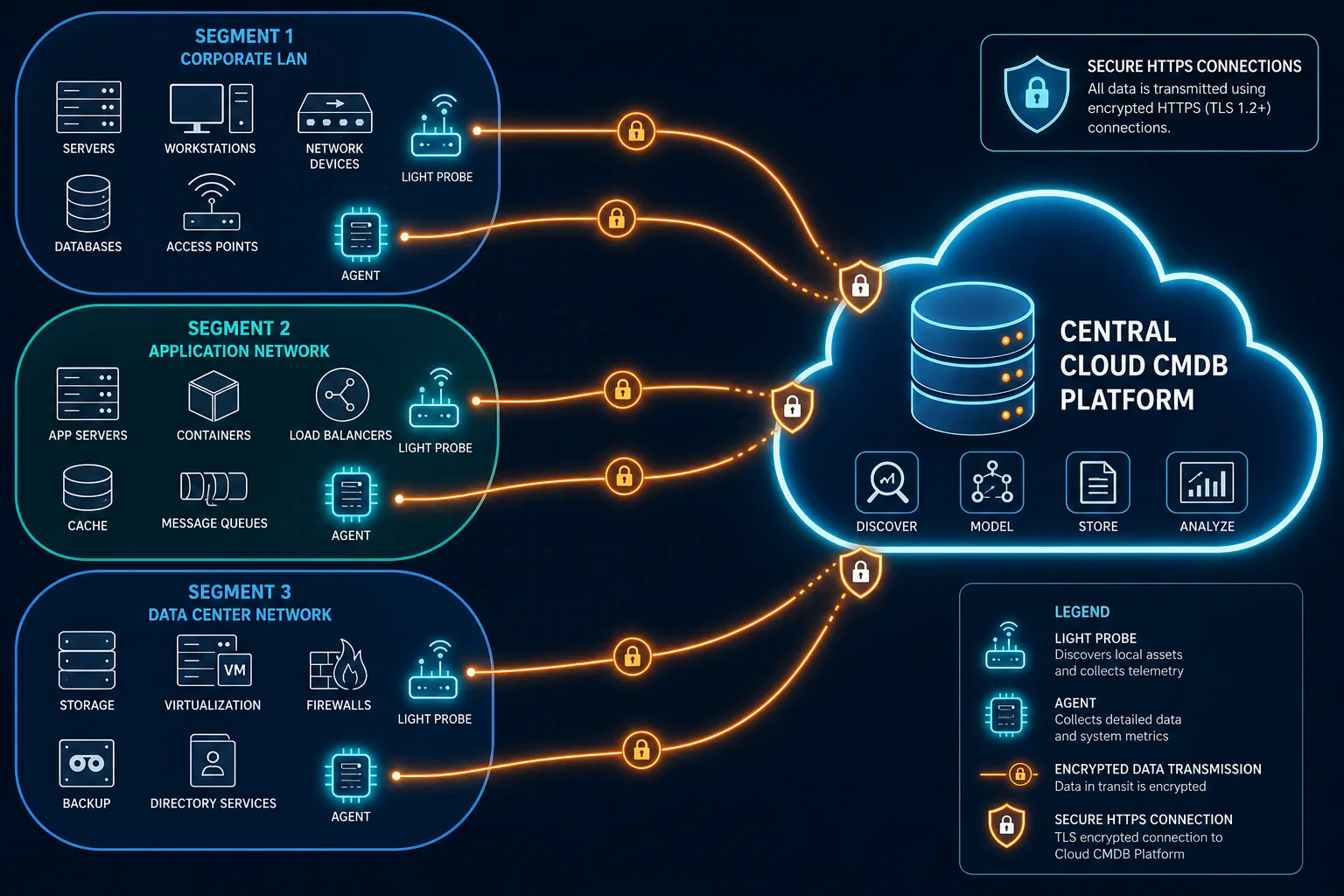
- Agentless discovery probes run as lightweight local collector software deployed inside isolated or segmented subnets, performing local network scans (using WMI, SSH, SNMP, or local APIs) entirely behind internal firewalls, then compressing, encrypting, and transmitting only the discovery findings outbound to the central platform over secure HTTPS connections.
- Agent-based discovery puts local agents directly on target hosts for remote endpoints, off-network devices, or strict zero-trust zones, gathering hardware, software, and configuration metadata locally and reporting back securely without requiring inbound management ports to be opened across firewalls.
- API-based cloud integrations inventory cloud infrastructure, SaaS applications, and virtual environments through secure API connectors, avoiding the need for network-level IP sweeping entirely.
By deploying lightweight local discovery collectors on-premise while maintaining the core CMDB application in a secure cloud tenant, organizations obtain full visibility into internal and air-gapped segments. They gain that visibility without taking on the burden of managing a complex self-hosted application stack.
To learn more about optimizing discovery collectors for complex topologies, review our guide on agent-based versus agentless discovery approaches or explore our analysis of API-based discovery for multi-cloud environments.
Where Virima stands on deployment models
Virima takes a clear, transparent position on platform architecture.
Virima runs as a cloud-native SaaS platform, which means it delivers continuous feature updates, high-availability guarantees, and vendor-managed patching without adding infrastructure maintenance overhead for your team.
For organizations with strict air-gapped network segments or complex data topologies, Virima uses secure local discovery probes and agents. These components operate inside your local environment to discover on-premise hardware, virtualized assets, and network infrastructure securely, feeding structured dependency data back into your central cloud CMDB tenant.
For enterprise organizations operating under strict legal data-sovereignty mandates or federal regulatory requirements, Virima evaluates self-hosted or dedicated private cloud deployment models on a case-by-case basis. We encourage teams to discuss their specific compliance needs with our solutions engineering team to determine the optimal deployment architecture.
For a detailed overview of our architecture, security controls, and cloud infrastructure compliance, refer to the Virima SaaS Overview.
A framework to re-test your “must be on-premise” requirement
Before finalizing a procurement requirement for self-hosted IT software, bring these five diagnostic questions to your security, compliance, and infrastructure architecture teams:
- Which specific regulatory clause mandates on-premise hosting?
- Goal: Distinguish explicit legal requirements (such as specific data residency statutes) from general internal guidelines.
- Is the underlying requirement about data locality or network access?
- Goal: Determine whether local discovery probes transmitting encrypted asset metadata over outbound port 443 satisfy your security posture without requiring a local database installation.
- What operational budget is allocated for ongoing DBA, OS, and application maintenance?
- Goal: Ensure the full total cost of ownership (TCO) of self-hosting is calculated, including internal staff hours for patching and disaster recovery testing.
- Does our internal team have the capacity to maintain high availability and apply emergency patches within 24 hours?
- Goal: Evaluate whether internal maintenance cycles can match the threat response and SLA metrics provided by enterprise cloud operations.
- Are we requiring the entire platform to be on-premise, or only the data collection mechanism?
- Goal: Identify whether a hybrid architecture, combining local discovery collectors with a managed cloud system of record, delivers the required control while eliminating application overhead.
Frequently Asked Questions
What is the main difference between on-premise software and SaaS?
On-premise software is installed and operated on an organization’s own local servers, requiring internal teams to manage hardware, database administration, patches, and security updates. Software-as-a-Service (SaaS) is hosted centrally by the vendor in the cloud, offering continuous updates, automated scaling, and reduced infrastructure management burden.
Can cloud-native CMDB platforms discover on-premise hardware and local network assets?
Yes. Cloud-native CMDB platforms use local agentless discovery probes or lightweight software agents placed inside internal network subnets. These probes scan local hardware, virtual machines, and network devices behind corporate firewalls and securely transmit encrypted inventory details back to the central cloud repository.
How do discovery platforms inventory air-gapped or highly secure network segments?
Discovery platforms inventory air-gapped segments by deploying isolated local collector probes or agents directly within the secure zone. Data is gathered locally and can be exported via secure, one-way encrypted gateways, scheduled file transfers, or dedicated proxy connectors that satisfy strict network isolation policies.
How does Virima support organizations with complex network segmentation requirements?
Virima combines a cloud-native platform with flexible agent-based, agentless, and API-driven discovery options. Local probes sit within segmented or on-premise networks to gather complete asset and dependency details, providing full operational visibility while keeping internal infrastructure secure.