Closing Cloud and SaaS Blind Spots With API-Based IT Discovery

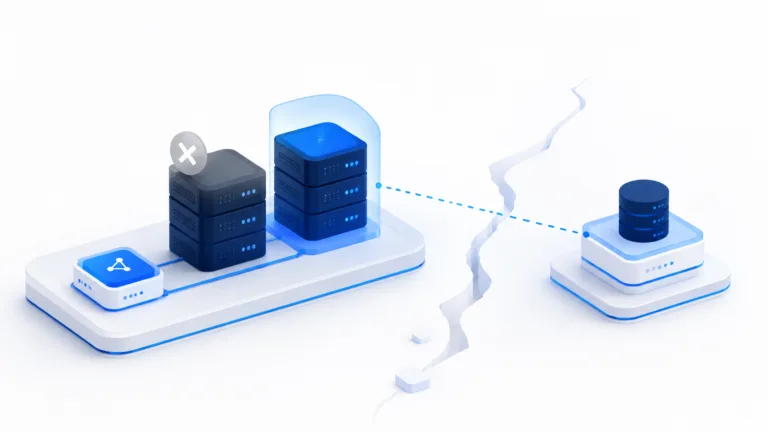
A c5.xlarge instance spins up for a six-minute batch job, finishes, and terminates, and no subnet scan ever touches it. In the same quarter, a business unit signs up for three new SaaS tools without routing any of them through IT. Add up enough of these gaps and the CMDB stops reflecting what is actually running, so incident response starts with a guess instead of a map. API-based IT discovery closes that gap by querying cloud provider and SaaS management APIs directly, pulling structured asset data that IP scans and local agents cannot reach. The real evaluation question is not whether to add it, but how it fits alongside the agentless and agent-based methods a hybrid CMDB still needs.
The cloud visibility challenge in hybrid enterprise IT
Cloud instances launch, scale, and terminate in minutes. Software subscriptions proliferate across business units without central IT oversight. Traditional cloud service discovery wasn’t built for this pace — legacy discovery approaches struggle to capture these rapid changes.
Subnet probes and local agents were designed for static on-premises data centers. IP ping sweeps cannot detect serverless functions, object storage buckets, or managed database instances that lack accessible network ports. Deploying local software agents on cloud infrastructure introduces maintenance overhead and security concerns. Agents also cannot run on multi-tenant SaaS applications where underlying server access is restricted.
According to the Flexera 2026 State of the Cloud Report, 89% of enterprise IT organizations operate a multi-cloud strategy. Organizations run workloads across multiple public clouds and dozens of SaaS platforms. That unchecked expansion creates blind spots in central configuration management databases — the exact problem hybrid CMDB discovery is meant to solve. When CIs are missing from the CMDB, change impact analysis fails, security vulnerability matching drops, and cloud spend inflates.
Closing these visibility gaps requires direct integration with cloud control planes. API-based asset discovery establishes programmatic communication with cloud management APIs. This technique retrieves structured metadata without modifying target virtual machines or deploying software agents.
What is API-based IT discovery?
API-based IT discovery is an agentless inventory method that queries cloud provider APIs and SaaS management endpoints directly. It collects structured asset metadata, resource relationships, and configuration settings across AWS, Azure, and enterprise SaaS platforms without local software installations or network ping sweeps.
How API-based discovery collects cloud and SaaS inventory
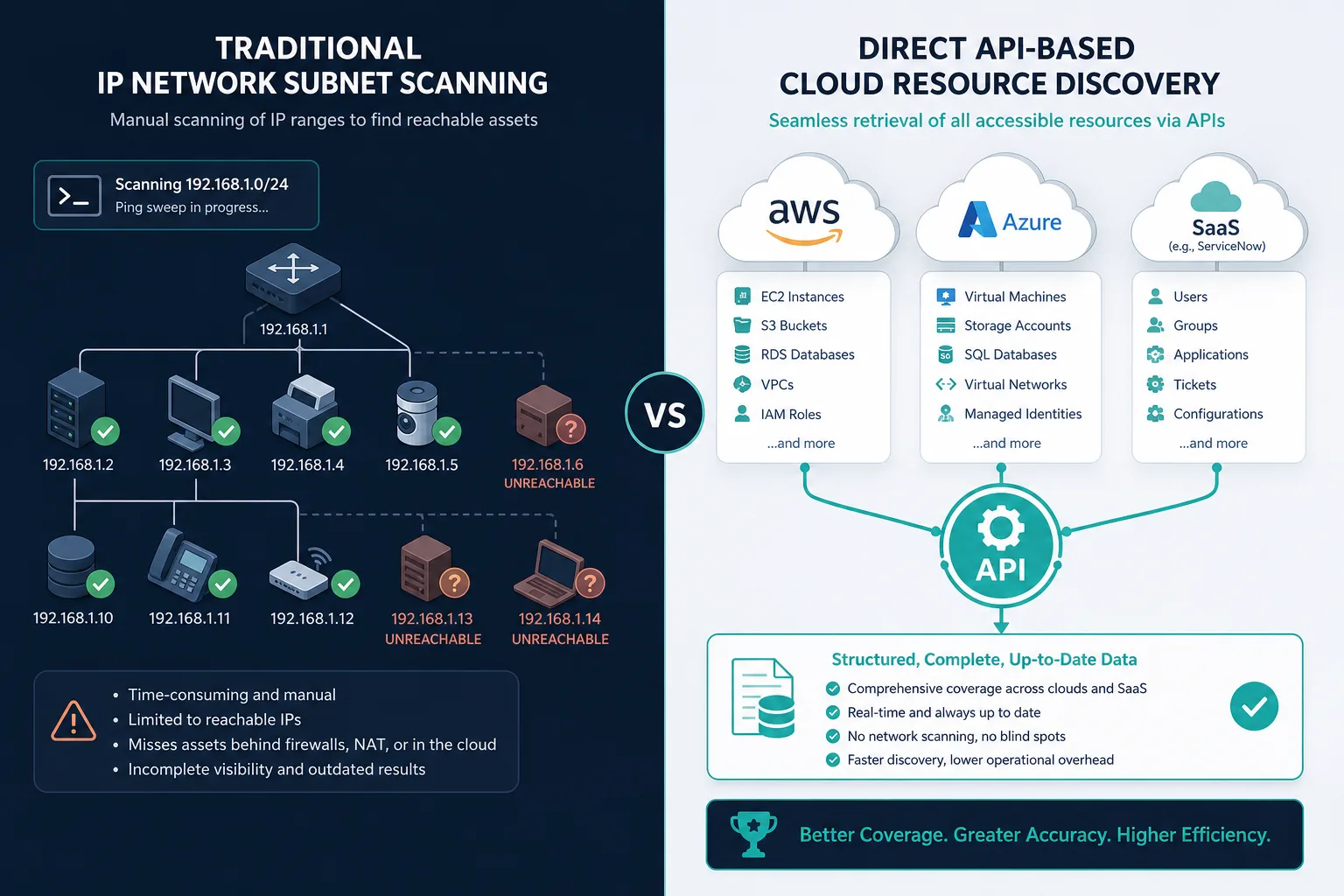
API-based discovery operates by authenticating to cloud service provider control planes using secure credentials. Instead of probing individual IP addresses, the discovery engine communicates with management APIs like AWS CloudControl, Azure Resource Manager, and Google Cloud’s Cloud Asset Inventory, alongside cloud provider identity services.
The collection process follows a structured sequence:
- Authentication occurs via IAM roles, service principals, or OAuth 2.0 tokens stored in secure credential vaults.
- The discovery engine issues API queries to enumerate active regions, resource groups, and service subscriptions.
- Cloud providers return structured JSON or XML responses detailing instance sizes, storage volumes, virtual networks, and assigned tags across AWS, Azure, and Google Cloud accounts.
- SaaS discovery integration connectors query administrative APIs to pull active user rosters, license allocations, and integration permissions.
- The discovery engine normalizes raw metadata and updates Configuration Items in the CMDB.
This programmatic approach captures ephemeral resources that exist briefly between traditional discovery schedules. API calls also collect rich metadata such as cloud resource tags, billing owner tags, and policy compliance states.
API-based discovery extends to Google Cloud through APIs like Cloud Asset Inventory, alongside AWS CloudControl and Azure Resource Manager. A single discovery engine can enumerate compute, storage, and networking resources across all three major clouds without deploying agents on any of them.
Direct API polling eliminates manual CSV updates and prevents stale CI records, since every discovery cycle pulls current state straight from the provider instead of a point-in-time export.
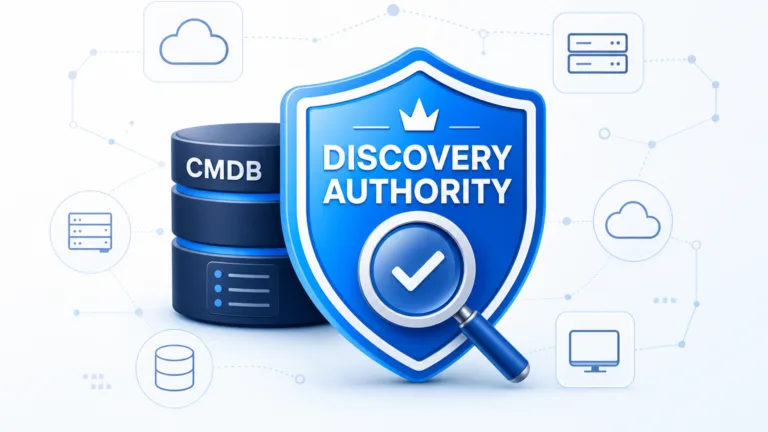
API discovery also extends visibility into SaaS application inventories. OAuth integrations connect directly to enterprise SaaS tools to track user provisioning, active login activity, and application integrations. Combining IaaS, PaaS, and SaaS data feeds into a unified CMDB delivers operational context for IT service management.
Organizations looking to establish accurate asset tracking can evaluate Virima’s trusted runtime truth to unify cloud discovery across multi-cloud environments.
Comparing discovery methods: API vs. agentless vs. agent-based
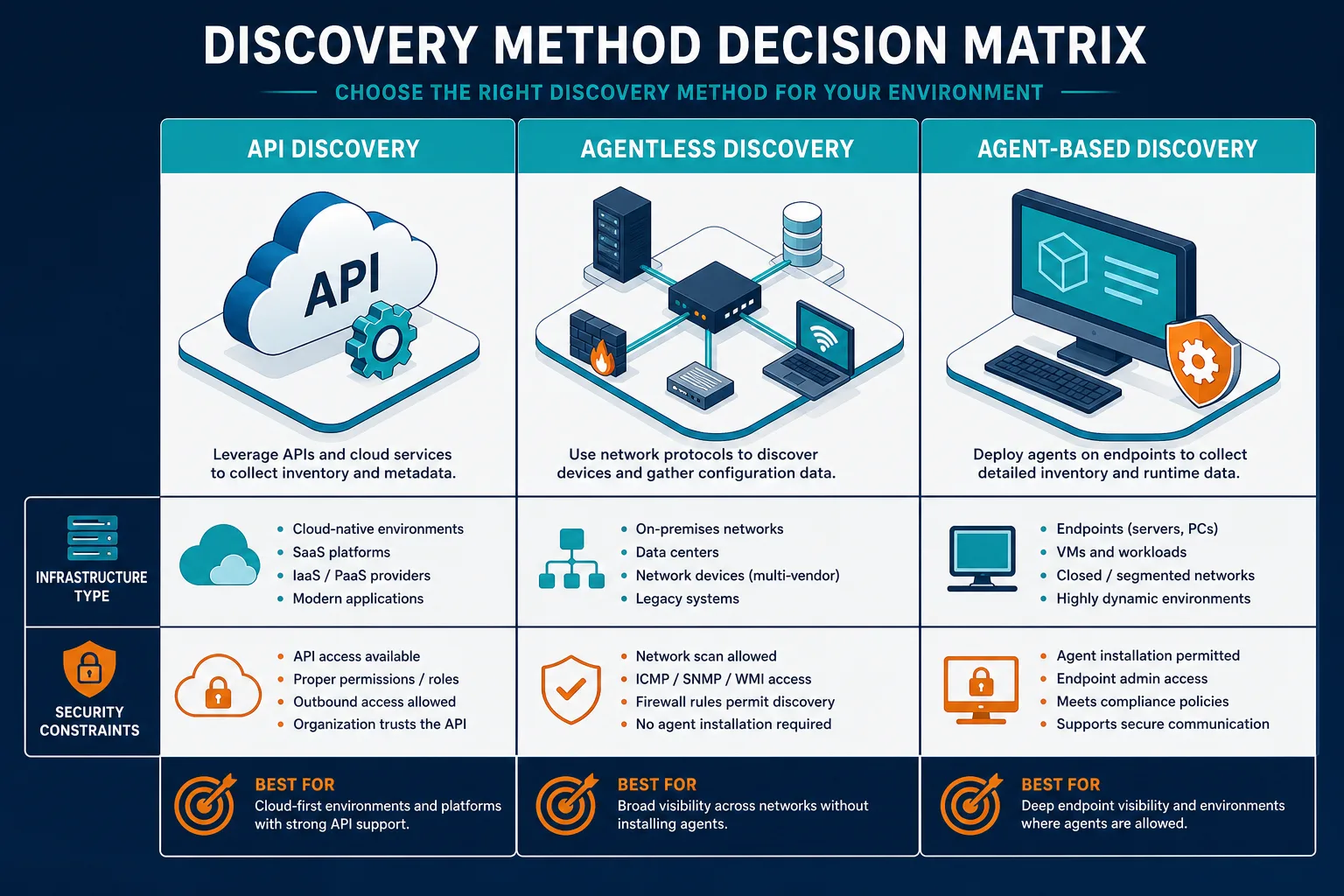
Selecting the correct discovery method requires matching technical capabilities to specific asset categories, which is the core of any API discovery vs. agentless decision. Enterprise IT architectures perform best when combining API discovery, agentless network scanning, and lightweight agents.
| Discovery Method | Target Infrastructure | Data Collected | Key Advantage | Main Limitation |
|---|---|---|---|---|
| API-Based Discovery | AWS, Azure, Google Cloud, SaaS, Hypervisors | Cloud resources, tags, SaaS users, policies | Zero host impact, discovers serverless and PaaS | Requires cloud API read credentials |
| Agentless Network Scanning | On-prem servers, network gear, IP devices | OS details, open ports, installed software | No host installation needed | Blocked by cloud firewalls and subnets |
| Agent-Based Discovery | Air-gapped hosts, remote laptops, endpoints | Deep software inventory, local files, execution logs | Persistent visibility off-network | High deployment and maintenance effort |
API-based discovery excels in cloud and SaaS environments where host-level access is impractical or prohibited. It retrieves cloud configuration data without consuming host CPU cycles or requiring administrative logins on virtual machines.
Agentless network scanning remains necessary for physical network hardware, storage arrays, and legacy on-premises servers. WMI, SSH, and SNMP protocols gather hardware attributes and installed software details from devices within corporate firewalls.
Agent-based collection serves specialized needs, such as tracking remote employee laptops or securing air-gapped systems. Combining these three methods into a unified discovery framework ensures total coverage across hybrid infrastructure. For a deeper comparison of when to choose agent-based versus agentless collection, see Agent-Based vs. Agentless Discovery: Which Is Best for Your Business. Virima’s IT Discovery capability runs all three methods from one console, so teams do not have to stitch together separate tools for cloud, network, and endpoint coverage.
How does API discovery differ from agentless network discovery?
API discovery communicates directly with cloud management endpoints to retrieve cloud infrastructure and SaaS metadata. Agentless network discovery uses network protocols like SNMP, WMI, and SSH to scan physical devices and on-premises servers within network subnets.
Mapping SaaS dependencies and cloud relationships
Collecting raw asset inventories is only the first step in cloud management. IT service management teams must understand how cloud resources and SaaS applications connect to business services.
API-based discovery retrieves relationship metadata embedded within cloud configurations. For example, API queries identify which virtual machine attaches to a specific virtual network interface, security group, and block storage volume. Cloud tags further map individual resources to business units, environments, and application owners.
SaaS integrations reveal critical dependency chains across enterprise tools. API connectors trace SSO sessions from the identity provider to uncover OAuth authorizations between core SaaS platforms and third-party tools. Identifying these connections prevents shadow IT risks and highlights data flow paths across cloud services.
Unexpected dependencies between microservices and external SaaS APIs are a common source of cloud service disruptions. Without clear service maps, IT operations teams struggle to assess change impact or determine the root cause of service degradation.
API discovery feeds live relationship data directly into dependency mapping engines. Teams can explore how cloud assets support critical business applications using Virima’s service mapping capabilities. That live dependency mapping ensures CAB teams visualize blast radius before approving infrastructure changes.
Best practices for implementing API-based IT discovery
Successfully deploying API-based IT discovery requires careful security planning, credential management, and discovery scheduling. IT Ops Managers running hybrid AWS, Azure, and SaaS environments — especially teams that inherited a stale CMDB after a cloud migration — see the fastest payoff from tightening API-based asset discovery practices in the five areas below.
1. Enforce least-privilege API credentials
Cloud discovery requires read-only administrative access to provider control planes. Create dedicated IAM roles and service principals specifically for discovery tools. Attach restrictive read-only policies, such as ReadOnlyAccess in AWS or Reader roles in Azure. Never assign write permissions or global admin credentials to discovery service accounts.
2. Automate credential rotation and vault integration
Store cloud API keys and client secrets in enterprise key vaults. Configure discovery engines to fetch credentials dynamically at runtime. Rotating discovery credentials every 30 to 90 days reduces security exposure and maintains compliance with enterprise security policies.
3. Balance discovery frequency and API rate limits
Cloud service providers enforce API rate limits to prevent control plane overload. Configure discovery schedules based on resource volatility. Run high-frequency discovery cycles every 15 to 30 minutes for volatile cloud compute instances. Schedule deep SaaS user inventory updates once or twice daily to avoid hitting provider rate quotas.
4. Normalize data across multi-cloud vendors
AWS, Azure, and SaaS vendors use different naming conventions for equivalent resource types. Establish standardized CI taxonomy rules in your CMDB so API-based asset discovery output stays consistent across vendors. Normalize attributes like region names, instance tiers, and status flags into a single, vendor-neutral format as part of a broader cloud asset management practice.
5. Integrate discovery data with enterprise ITSM platforms
Asset inventories deliver maximum value when integrated into daily IT workflows. Ensure your discovery platform connects directly to your central ITSM platform. Virima supports native integration with platforms including ServiceNow, Jira Service Management, Ivanti, HaloITSM, Xurrent, and Hornbill. Bi-directional synchronization keeps incident, problem, and change records aligned with live operational truth.
What security permissions does API discovery require?
API discovery requires read-only permissions on cloud provider management APIs and SaaS administrative portals. Using restricted IAM roles, Azure Reader permissions, and OAuth read scopes ensures discovery tools collect asset metadata without authorization to alter cloud configurations or access tenant data.