AI Helpdesk Software Fails the Moment It Trusts the Wrong Ticket

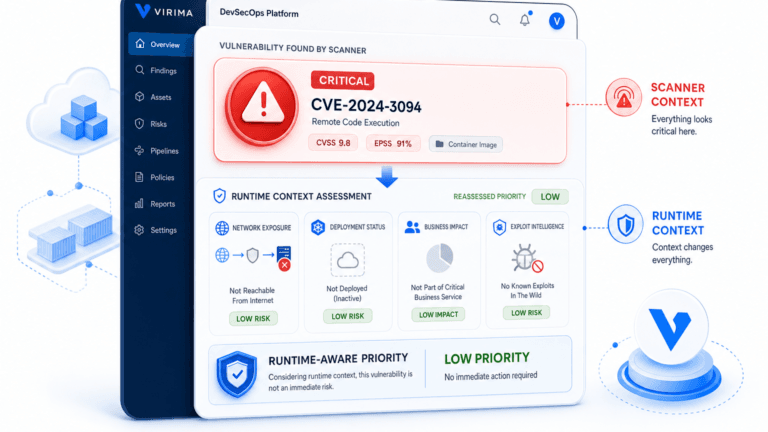
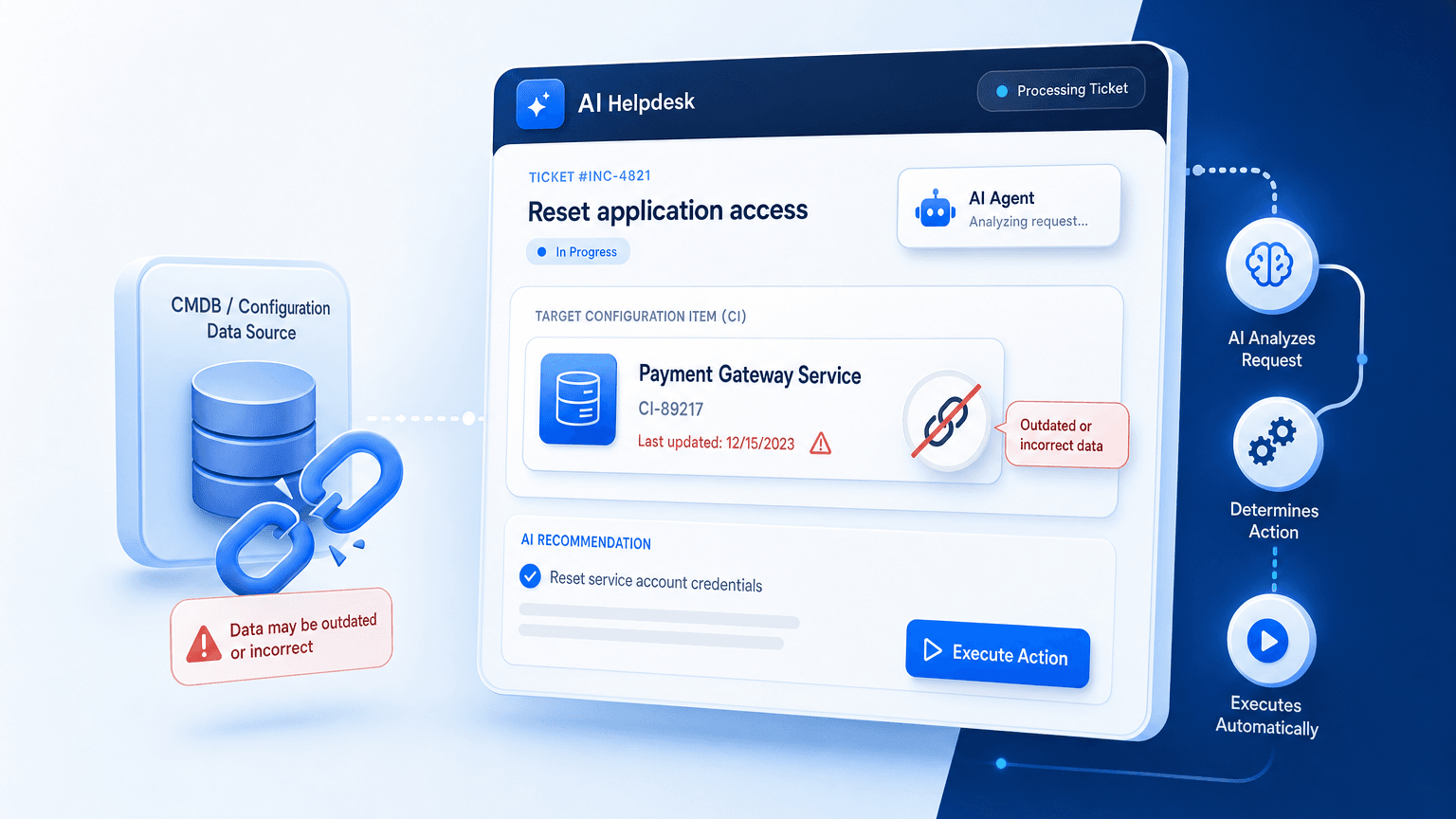
An IT service desk turns on an AI agent inside the ticketing platform the team already uses. A priority ticket lands for a production server, and the agent matches it to a configuration item (CI) still marked active, then downgrades the priority and runs a scripted fix. Infrastructure had decommissioned that host three months earlier. The ticket still named the old server. The CI record still showed the old owner. No model hallucination occurred, and the agent followed the record it was given. That is the risk this piece is about: AI helpdesk software is only as safe as the ticket and configuration data behind it. Customer-support buyer’s guides score bots on deflection and seat price. They rarely ask what the agent will touch once it can change infrastructure, not just answer a chat.
Even architecture writing inside major ITSM platforms now treats configuration data as the accountability layer for agent action. A ServiceNow Community architect blog frames the CMDB as AI infrastructure for that reason: agents need a governed system of record before autonomous work is defensible.
What is AI helpdesk software?
Buyers searching “what is AI helpdesk software” usually meet a stack of classifiers, routers, drafters, and resolution bots layered on a ticketing or chat product. In practice, the category splits into two modes.
- AI-assisted triage classifies tickets, suggests routing, drafts replies, and summarizes history for a human who still owns the action.
- Agentic automation goes further. It executes steps such as password resets, access changes, restarts, or catalog fulfillments with limited or no human approval on each step.
Traditional ticketing systems route work through static rules a human configured in advance; AI helpdesk software instead reads ticket content and configuration data to decide the path itself — faster, but only as reliable as the record it reads.
Capabilities teams expect in RFPs usually include:
- Ticket classification and intent detection
- Routing and queue assignment
- Drafting and summarization
- Guided or autonomous resolution paths
- Escalation rules when confidence is low, or policy blocks the action
Industry forecasts for agentic customer service are aggressive. TechMonitor reported Gartner’s March 2025 projection that by 2029 agentic AI will autonomously resolve about 80% of common customer service issues without human intervention. That figure comes from Gartner’s customer-service practice. It is not a measured IT service-desk outcome, and it should not be stretched into a promise that internal infrastructure tickets will self-heal at the same rate.
For IT, the harder question is what record the agent reads when the ticket names a server, a network path, or a business service. Virima’s deeper take on that mechanism sits in AI Agents in ITSM: the agentic ITSM data layer decides whether automation is safe.
The hidden gap in every buyer’s guide
CX buyer’s guides still score the category on deflection, connector counts, and pricing units. Production IT breaks on a different axis.
| What the buyer’s guide checks | What breaks in production |
|---|---|
| Deflection rate/resolution % | Agent closes or remediates the wrong CI with high confidence |
| Integration count | Connectors exist, yet feed aged ownership and status fields |
| Pricing (seat, usage, outcome) | Cost of a wrong automated action is not in the price card |
| Model or LLM quality | Model behavior is fine; the ticket or CI it trusted was wrong |
Why is AI helpdesk software important for IT teams?
Ticket volume grows faster than headcount in most mid-size and enterprise service desks. Leadership still pushes AI into service operations because queue wait times, after-hours coverage, and mean time to resolve show up in board packs. AI helpdesk software matters because it is one of the few levers that can absorb repetitive work without a linear hiring plan.
That pressure is real. The risk is also real when the same automation can change access, restart hosts, or close incidents without a fresh view of what still runs in the estate. ITSM.tools has argued that AI service desk context, not another model upgrade, is the missing piece in AI-driven IT service desks. Intelligence without current asset and service context accelerates the wrong path.
For internal desks, the same AI helpdesk software category only pays off when ticket automation inherits current ownership and service impact, not when the model alone gets smarter.
Where the risk actually sits
Three patterns show up when agents sit on top of weak inventory.
- Misrouted work from stale ownership. The ticket inherits an application owner who left, or a support group that no longer covers the CI. The agent routes with confidence. The queue burns hours before a human notices the assignment was dead on arrival.
- Automated steps against hosts the team already retired. Operators decommissioned a server after cutover, yet the ticket and CI still list it as production. The agent runs a “safe” fix against the wrong target. The change lands off the live path while the real incident keeps burning.
- Escalation logic blind to downstream services. Severity rules look only at the CI class or a static priority field. They never see which customer-facing service still depends on that node. P2 work stays P2 while a revenue path sits in the blast radius.
Inventory quality is not a side issue. Flexera’s 2026 State of ITAM press summary reported that complete IT asset visibility dropped to 36%, which leaves most organizations working from incomplete records. An agent that trusts those records inherits the same gaps.

Why does AI helpdesk software fail on internal IT tickets?
Internal AI helpdesk agents act on ticket text and configuration records. When ownership, status, or service dependencies are stale, the agent routes or remediates the wrong CI with confidence. The model can be correct while the record it trusted is not.
What it costs to trust the wrong ticket
For ops teams
When an agent “resolves” a ticket against a wrong CI, humans still re-verify. They open consoles, ping owners, and rebuild the timeline the automation skipped.
A single wrong-CI close can create a reopen chain: the original reporter returns, a second technician redoes discovery by hand, and the change calendar absorbs a cleanup change that should never have been needed. The hours do not show up as AI failure in the vendor dashboard. They show up as reopen rates, war-room time, and lost trust in every later suggestion the bot makes.
For leadership
Board exposure changes when the actor is software. An outage tied to a human change at least has a named approver and a CAB trail. An outage tied to an agent action against a stale record raises a different question: which system of record authorized that step, and who owns the data quality bar for production automation.
For regulated environments
Auditors increasingly ask what evidence the organization used, not only what button was clicked. For agentic service desk work, that means retaining which CI version, owner, and relationship set the agent read at decision time.
A CMDB that maps infrastructure and dependencies can supply that evidence trail. It does not classify the content of files or messages. Teams that need a clear view of CMDB requirements for ITSM can start with must-have CMDB capabilities for ITSM for how service workflows should consume that record.
Before scaling further: the “Getting started” checklist later in this piece is a fast way to check whether your own highest-volume queues are running on complete records.
How the data layer fixes this
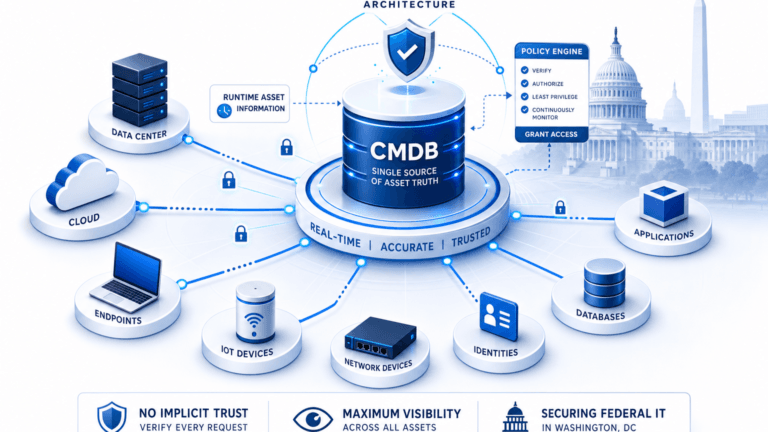
Virima does not replace the AI helpdesk or ITSM product. It supplies the discovery-fed inventory, CMDB, and service maps those tools should read before an agent acts.
1. High-frequency scheduled discovery
High-frequency scheduled discovery refreshes what exists across hybrid estates on a predictable cycle. Short-lived cloud instances, moved workloads, and retired hosts show up as the environment changes, so the CI an agent reads is less likely to be last quarter’s spreadsheet export. See IT discovery for how that inventory feed is built.
2. A discovery-sourced CMDB
A CMDB fed by discovery holds verified identity, ownership, and status fields instead of relying only on manual updates after every project. Agents and humans then share one governed record rather than three conflicting lists. The CMDB layer is where ticket text meets a durable CI identity — the CMDB for AI agents that ticketing tools don’t natively hold. See CMDB for AI agents for the full data-layer breakdown.
3. ViVID™ service mapping
Once service definitions exist, ViVID™, Virima’s service mapping layer, builds dependency maps so impact is visible before change. An agent, or the reviewer of an agent proposal, can see upstream and downstream relationships instead of treating a host as an island. Start from service mapping to see how those maps are built.
What data should an AI helpdesk agent read before it acts?
At minimum: a current CI identity, owner and support group, environment and status, and service dependencies when the change can affect other systems. High-frequency scheduled discovery and a discovery-fed CMDB keep those fields from aging between manual audits.
| Manual context-gathering | Discovery-sourced context |
|---|---|
| Technician checks several tools before acting | Agent and human read one governed CI record |
| Asset data ages between audit cycles | High-frequency scheduled scans keep records current |
| Dependency knowledge sits with one senior engineer | ViVID™ renders dependencies as a shared map |

Does Virima replace AI helpdesk software?
No. Virima is not a customer-support or IT helpdesk product. It supplies high-frequency scheduled discovery, a discovery-sourced CMDB, and ViVID™ service maps so AI helpdesk and ITSM tools act on current configuration and impact context.
AI helpdesk software examples in practice
- Ownership check before a device action. A password-reset or wipe workflow confirms the device CI still maps to the requester and an active support group before the agent proceeds.
- Change guardrail on open incidents. A proposed restart stops when the CI already sits on an open major incident or a frozen change window.
- Decision-time evidence. The audit package stores which CI version, owner, and service map slice the agent read when it chose a path, not only the final status code.
Those patterns improve incident handling when maps stay current. Teams tightening response design can also review incident response with service mapping.
How Virima supports AI-ready IT service desks
Virima sits under the ITSM and AI helpdesk stack, not beside it as another ticket UI. ServiceNow, Jira Service Management, Ivanti, HaloITSM, and similar platforms remain the system of engagement, the right fit whether you’re evaluating AI helpdesk software for IT service delivery or already running one. Virima supplies discovery-sourced truth to those platforms, and their AI add-ons can consume it through a single integrations hub.
Immediate operational impact
Triage and automation proposals arrive with owner, environment, and service impact already attached, so fewer tickets bounce between queues while people hunt for who still owns the box.
Long-term accuracy
Discovery cadence keeps the record from rotting between annual cleanups, so agents scale only as far as that cadence holds without a second helpdesk UI or a rip-and-replace of the tools already in place.
Moving from guesswork to a governed data layer
| Old way | New way |
|---|---|
| Agent trusts ticket text plus last manual CI edit | Agent reads discovery-reconciled CI and service map |
| Ownership fixed in chat after the fact | Ownership and support group live on the CI before automation runs |
| Impact guessed from memory | Impact read from ViVID™ relationships when service defs exist |
Faster, defensible triage. Reviewers spend less time rebuilding context the record should already hold.
Cleaner automation boundaries. Teams can limit agent actions to CI classes and services with healthy coverage scores.
Audit-ready evidence. Decision packages can cite the data version used, which matters when regulators or customers ask how automation was controlled.
Getting started
- Audit CI coverage for the queues you plan to automate first (identity, owner, status, environment).
- Run a discovery baseline across the hybrid estate those queues touch.
- Connect ITSM and AI tooling so tickets resolve against the same CMDB identities.
- Define agent action boundaries by CI class, change type, and service criticality.
- Review before scaling with reopen rates, wrong-CI incidents, and coverage gaps on a fixed cadence.
Close the ticket-trust gap before you scale the agent
If your AI helpdesk software can act on infrastructure, model quality is not the whole purchase. The ticket and CI it trusts decide whether automation removes toil or creates a quieter outage.
Run the CI coverage audit from the “Getting started” checklist above against your highest-automated queues first. Then explore Trusted Runtime Truth for discovery-sourced inventory and maps under the desk you already run, and request a demo when you’re ready to see the gaps mapped in a working environment.
Frequently Asked Questions
What is AI helpdesk software?
AI helpdesk software adds classification, routing, drafting, and sometimes autonomous resolution on top of ticketing or chat. AI-assisted modes suggest actions for humans. Agentic modes execute approved steps with less human touch per ticket.
Why is AI helpdesk software risky for IT service desks specifically?
Internal IT agents can change access, restart hosts, or close infrastructure incidents. When ticket text or CI records are stale, automation applies the wrong fix with speed. Customer-chat mistakes rarely share that blast radius.
What is the difference between AI helpdesk software and a CMDB?
AI helpdesk software works with tickets and conversations. A CMDB stores configuration items, relationships, and ownership for the estate. IT automation needs both: the desk for workflow, the CMDB for what the agent is allowed to trust.
Can AI helpdesk tools work with our existing ITSM platform?
Yes. Most enterprises keep ServiceNow, Jira Service Management, Ivanti, or similar as the system of engagement and add AI on top. A discovery-fed CMDB and service maps plug in as the data layer rather than a full helpdesk rip-and-replace.
Does Virima replace my AI helpdesk or ITSM platform?
No. Virima is not a customer-support or IT helpdesk product. It supplies high-frequency scheduled discovery, a discovery-sourced CMDB, and ViVID™ service maps so AI helpdesk and ITSM tools act on current configuration and impact context.