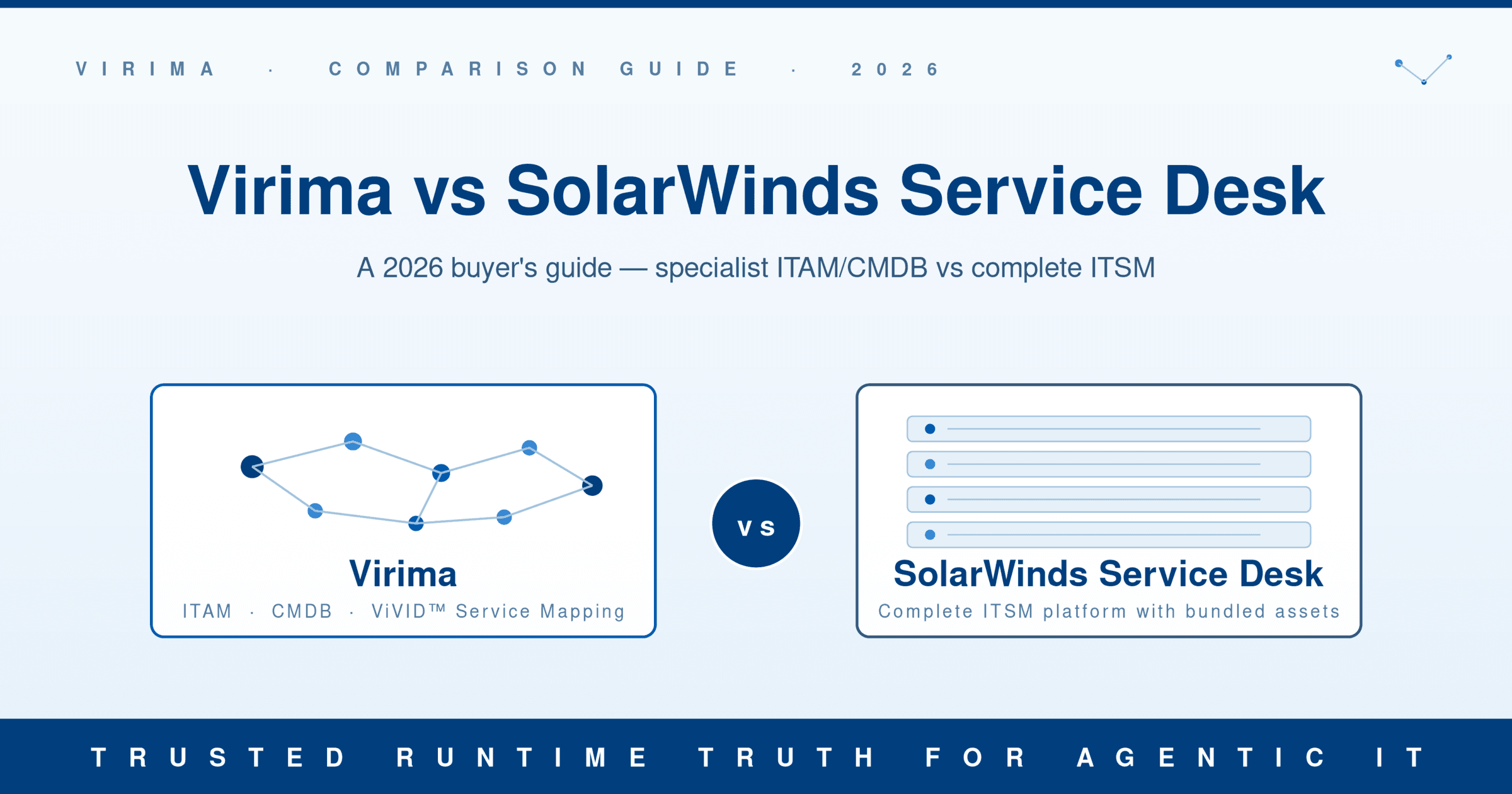
Virima vs SolarWinds Service Desk 2026: What to know before you buy

Gartner research put a sobering number on CMDB inaccuracy: 99% of organizations using CMDB tooling that don’t confront CI data quality gaps were projected to see visible business disruptions by the end of 2024. Another stat from the same body — only 25% of enterprises pull meaningful value out of their CMDB.
That’s the backdrop for a buyer question that’s getting sharper as AI agents start showing up inside ITSMs: do you need a complete service desk with assets bolted on, or a specialist platform that delivers trusted runtime truth — the operational ground state your service desk, your CAB, your auditors, and any AI agents you’re starting to run all depend on?
Virima vs SolarWinds Service Desk lands exactly on that fault line. We’ll dig into ratings, pricing, real user sentiment, and where each one earns its keep. By the end, you’ll know which one fits the IT operation you actually run — and which is going to feel like solving the wrong problem.
At a glance: Virima vs SolarWinds Service Desk
Skim this if you’re short on time. The rest of the post unpacks each row.
| Dimension | Virima | SolarWinds Service Desk |
|---|---|---|
| Best for | Mid-market & enterprise IT teams with an existing ITSM that need accurate discovery, a non-drifting CMDB, and visual service mapping | Small to mid-market teams standing up service management for the first time or replacing a legacy help desk |
| Discovery methods | Agentless scans + agent-based collection + cloud API connectors (AWS, Azure, SCCM, Intune, SaaS) | SNMP-based network discovery, primarily on-premises |
| CMDB maintenance | Refreshed through high-frequency discovery cycles with versioned CI history | Manual updates plus periodic discovery scans |
| Service mapping | ViVID™ visual dependency maps with ownership, incidents, and vulnerability overlays | Static asset relationship views |
| Works with existing ITSM | Yes — bidirectional sync with ServiceNow, Ivanti, Halo, Xurrent, JSM, TeamDynamix | No — IT IS the ITSM |
| Entry pricing | Published — SMB at $10,000/year (up to 100 servers / 900 devices, all features). Enterprise: custom quote. No cost spikes for newly discovered assets mid-contract. | Published — Team $19, Business $39, Professional $69 per technician/month |
What is Virima?
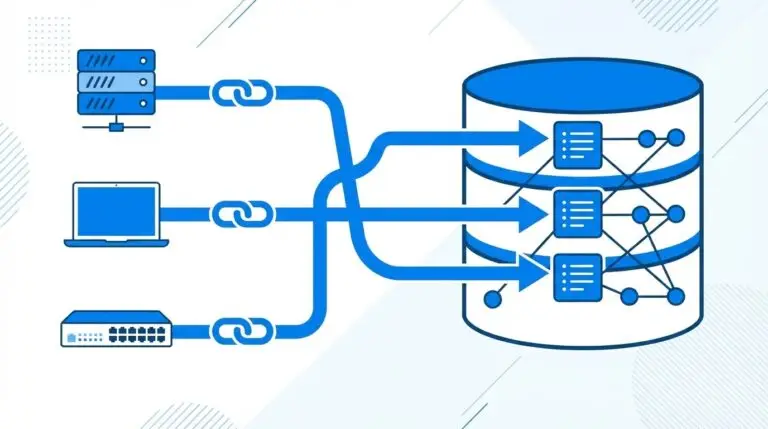
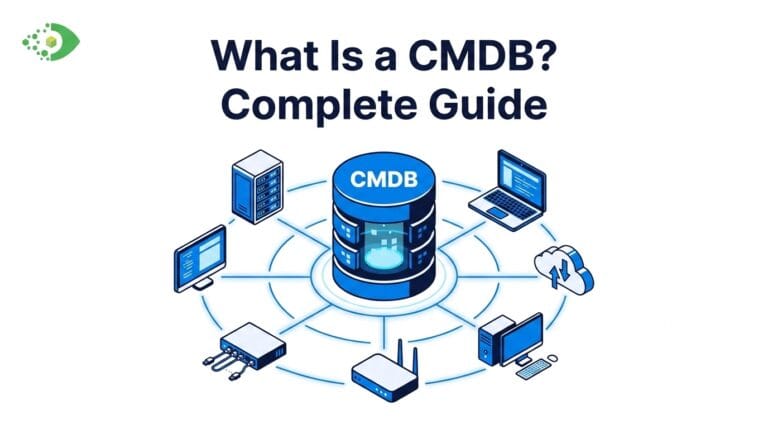
Virima delivers trusted runtime truth for agentic IT — the operational ground state your service desk, your CAB, your auditors, and any AI agents you’re starting to run need to make decisions that hold up. The platform is built on three structural advantages: authoritative multi-source discovery across hybrid environments, a CMDB that refreshes through high-frequency discovery cycles, and visual service dependency mapping with operational overlays (the last one is the headline feature — more on that below).
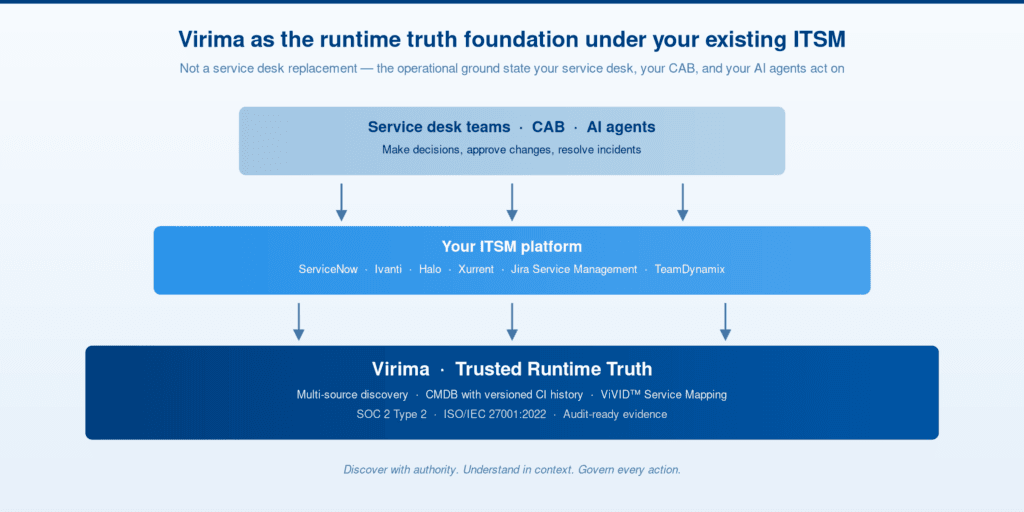
The proof line is short: discover with authority, understand in context, govern every action. The pitch is that Virima makes whatever ITSM you already run smarter about your assets and services, rather than asking you to rip and replace your service desk.
Reviews track that positioning. Virima holds a 4.6/5 on Capterra across 15 verified reviews, a 4.4/5 on Gartner Peer Insights, and a similar 4.4/5 on G2 as of early 2026 — the kind of consistency that’s harder to fake than a single platform’s leaderboard score.
What Virima helps IT teams do:
- Discover assets across on-prem, AWS, Azure, SCCM, Intune, and SaaS through agentless scans, agent-based collection, and API connectors
- Build and maintain a CMDB through high-frequency discovery cycles — so it doesn’t drift
- Visualize service dependencies — with ownership, incidents, and vulnerability status overlaid — through ViVID™ Service Mapping
- Sync bidirectionally with ServiceNow, Ivanti, Halo, Xurrent, Jira Service Management, and TeamDynamix
- Track lifecycle, licenses, contracts, and audit-ready evidence for compliance leaders and CISOs
Recognition: Virima is listed on Gartner Peer Insights for IT Asset Management Tools and has been reviewed favorably by ITAM Review as an enterprise-grade ITAM and CMDB platform.
Sources: Capterra, Gartner Peer Insights, Software Advice.
Virima pricing
The pricing page lists two bundles, both feature-complete (no à la carte gotchas):
- SMB: $10,000 per year — covers up to 100 servers and 900 devices. Includes discovery, CMDB, ViVID™ Service Mapping, hardware and software asset management, license management, contract management, vendor management, SSO, full API access, and third-party ITSM integration.
- Enterprise: Custom quote. Adds unlimited discovery app installations, premium support, a Concierge Service, a Customer Success Manager, multi-tenant portal, and add-on options for private hosting and dedicated hosted environments.
The single best line on the page is operational rather than commercial: “No cost spikes for newly discovered assets mid-contract.” That’s the gotcha that bites ITAM buyers using per-device-license tools — discovery finds the assets you didn’t know you had, and the bill ticks up. Virima prices the bundle to scope, not to the discovery counter.
The implementation profile is narrower than a full ITSM swap — you’re configuring discovery, the CMDB, and an ITSM connector, not migrating your service desk — so the deployment effort and cost tend to land well below a service desk replacement.
What is SolarWinds Service Desk?
SolarWinds Service Desk is the cloud ITSM platform originally launched as Samanage. SolarWinds acquired it in 2019 and absorbed it into the broader SolarWinds portfolio. It’s a complete service desk: ticketing, change management, asset tracking, and service catalog wrapped into one platform, marketed as a faster-to-deploy alternative to ServiceNow.
On G2, SolarWinds Service Desk carries a 4.3/5 rating across 764 reviews — a solid score with the volume to back it up. Capterra tracks in a similar range.
What SolarWinds Service Desk helps IT teams do:
- Run a unified service desk with ticketing, change, and incident workflows
- Track basic asset inventory tied to tickets
- Configure workflows through a low-code/no-code admin interface — no certified admins required, unlike ServiceNow
- Publish a service catalog for end users
- Get up and running in weeks rather than months
The product wins points for usability. Reviewers consistently praise the interface and the speed of getting a ticketing system running compared to heavier enterprise ITSMs.
Sources: G2, Capterra, Gartner Peer Insights.
SolarWinds Service Desk pricing
Pricing is published — and that’s worth something. SolarWinds lists three tiers:
- Team: $19 per technician per month — essential ITSM tools for small teams
- Business: $39 per technician per month — adds change and asset management
- Professional: $69 per technician per month — full ITIL suite with advanced customization, automation, and analytics
(There’s also an Enterprise tier with custom pricing, plus a 30-day free trial that opens up Premier features during the trial window.)
The math is genuinely good for small teams. If you’re running a 10-person help desk and you need a working service catalog plus ticketing without writing a check to Big Enterprise ITSM, $39 per technician per month is hard to beat. The catch — and you’ll see this in the review threads — is what happens when you scale up: reporting depth, advanced workflows, and asset management start to feel boxed in.
Who uses Virima vs SolarWinds Service Desk?
Different buyers, different jobs.
Who is Virima’s target audience?
- Mid-market and enterprise IT operations teams already running a mature ITSM (ServiceNow, Ivanti, JSM, Halo, Xurrent, TeamDynamix) who need accurate discovery and a CMDB that doesn’t drift
- IT Directors and IT Asset Managers who measure success in how fast they can answer “what’s running where, and who owns it”
- Compliance leaders and CISOs who need defensible asset records for audits — versioned CI history with discovery source, last-seen timestamp, and change trail
- Hybrid IT shops with assets spread across on-prem, AWS, Azure, and SaaS
Why they choose it: Virima fixes the asset and CMDB layer without forcing a service desk migration. The ITSM you already trained your team on stays.
Who is SolarWinds Service Desk’s target audience?
- Small to mid-market IT teams standing up service management for the first time, or replacing a legacy help desk with something cloud-native
- Help desk managers who want ticketing, service catalog, and basic asset tracking in one license
- Organizations migrating off older ITSMs like Spiceworks, legacy Jira Service Desk, or homegrown ticket systems
If your shortlist also includes ManageEngine’s bundled ITSM offering, the Virima vs ManageEngine ServiceDesk Plus comparison runs the same analysis across CMDB freshness, discovery depth, and ITSM portability.
Why they choose it: All-in-one simplicity. One vendor, one platform, one bill. Especially attractive for IT teams without the headcount to run multiple specialist tools.
The overlap? Real but narrow. Some larger orgs run SolarWinds Service Desk for help desk operations and a specialist CMDB and discovery platform like Virima feeding ServiceNow or another enterprise ITSM for the broader asset and dependency story. They’re not direct competitors as often as people assume.
Virima’s key features
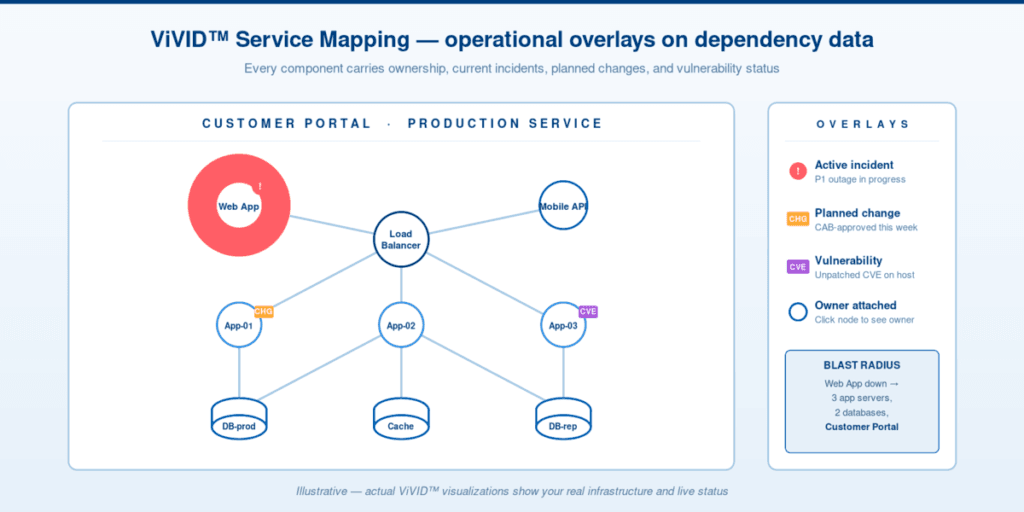
ViVID™ Service Mapping. This is the differentiator. Virima takes discovery data and renders services as visual dependency maps that overlay current incidents, planned changes, ownership, and vulnerability status on every component. CABs use it to see blast radius before approving a change. Incident teams use it to spot components with active issues or recent changes as likely root causes. Robert Hanson, IT Manager and Director at a US-based bank, captured it well: “Auditors demand clear evidence of data flow and system communications. With ViVID™, we have complete visibility into every connection, helping us strengthen business continuity, prioritize critical services, and deliver the transparency auditors value.”
High-frequency discovery with multi-source authority. Three paths run in parallel — agentless network scans, agent-based collection on systems you control, and API connectors that pull asset inventory from AWS, Azure, SCCM, Intune, and other cloud or management platforms. Authority means more than scale: every CI carries source provenance, attribute-level conflict resolution, and freshness scoring. So when two sources disagree about a server’s owner, Virima knows which source is right about that attribute at that moment. A Capterra reviewer praised “the autonomic socially intelligent algorithms that perform discovery — far better than all of the products I’ve ever used.”
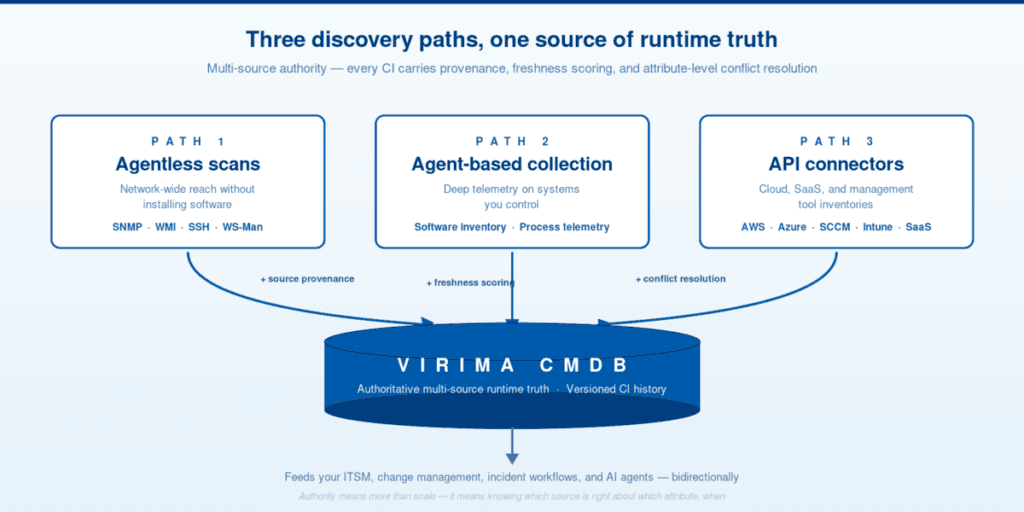
Bidirectional ITSM sync. Virima connects natively to ServiceNow, Ivanti, Halo, Xurrent, Jira Service Management, and TeamDynamix. CI data and dependency context flow into the ITSM your team already uses, so your workflows don’t change — they just get better information.
Certified trust posture. Virima holds SOC 2 Type 2 (August 2025) and ISO/IEC 27001:2022 (January 2026) — auditors have signed off on how the platform handles data and decisions. Every recommendation traces back to its discovery source, confidence score, and freshness window. Audit trails aren’t generated after the fact; they’re produced at the moment the decision is made. For compliance leaders and CISOs evaluating tools, that explainability isn’t a feature — it’s a posture.
Audit-ready CMDB. Every CI carries discovery source, last-seen timestamp, and change history. When the audit window opens, compliance leaders point at records, not at hastily rebuilt spreadsheets.
Customer experience that punches above the company’s size. From another Capterra review: “Our business relationship with Virima is second to none. When we had to meet a launch deadline, the implementation team committed to 30+ days of 12–16 hour days, 7 days a week with us. They have been one of the few vendors where it really does feel like we’re in a partnership.” That’s the kind of quote you can’t manufacture.
SolarWinds Service Desk’s key features
Unified ticketing and service catalog. Tickets, change requests, and incident workflows all live in one interface. End users get a self-service portal; technicians get a single queue. For teams whose pain point is “we don’t have a service desk yet” or “our current one is a mess,” that consolidation is the whole pitch.
Low-code/no-code admin. Workflows, automation, and form fields can be edited through a drag-and-drop interface without certified admins. SolarWinds positions this as the alternative to ServiceNow’s “never-ending implementation”. It’s a real strength — smaller teams can actually maintain the platform without a dedicated SaaS admin role.
Asset management tied to tickets. Hardware specs, software installations, warranty info, and ownership all live next to tickets. Technicians see what hardware or software a ticket relates to without context switching. The depth is shallower than a specialist ITAM tool, but for everyday help desk work, it’s enough.
SSO and SLA management at standard pricing. Unlike Jira Service Management (which locks SSO behind premium tiers and charges extra for some asset features), SolarWinds Service Desk includes SSO and SLA tooling in its standard plans.
Faster deployment than enterprise ITSMs. Most implementations go live in weeks, not months. The trade-off shows up later when you want deep customization or reporting, but for time-to-first-ticket, it’s hard to argue with.
The common ground
Both platforms touch some of the same surfaces. Here’s how they approach each one.
Asset discovery
Virima runs three-path discovery (agentless + agent-based + cloud API connectors) on high-frequency cycles. The point is keeping the CMDB current as the environment changes — and covering hybrid estates without manual stitching.
SolarWinds Service Desk uses SNMP-based network discovery for on-premises infrastructure. It works well in environments that live mostly in their own data centers. Cloud coverage is thinner — AWS, Azure, and multi-cloud usually need supplemental tooling or manual entry.
CMDB
Virima populates and refreshes CIs directly from discovery output, with versioned change history per CI. The CMDB stays in step with the environment because your team configures scope once and discovery handles the steady-state work.
SolarWinds Service Desk includes a CMDB that stores asset records and relationships, but accuracy depends on people updating it as the environment changes. Smaller estates handle this fine; larger ones drift.
Service mapping
Virima’s ViVID™ renders dynamic dependency maps with operational overlays — incidents, changes, ownership, vulnerability status. The maps update from discovery output.
SolarWinds Service Desk shows asset relationships as static views — useful for tracing connections, but without the operational overlays that turn maps into decision tools.
Change and incident workflows
Both platforms feed asset data into change and incident workflows. SolarWinds does it inside its own ITSM. Virima does it inside whatever ITSM you already run, via the bidirectional sync — same outcome, different architecture.
What do real users say?
Here’s where the review data gets specific.
On G2, SolarWinds Service Desk’s 764 reviews skew positive: 59% five-star, 34% four-star. Reviewers consistently praise ease of use, ticket management, and the drag-and-drop admin experience. The recurring complaints? Reporting depth (“limited, and even customization in reporting is limited”), customer support response times, and the absence of a mobile app for technicians. One Capterra reviewer noted that “support has been a bit slow on response when inquiring regarding technical issues, even after purchase.”
Virima’s review volume is smaller (15 verified reviews on Capterra at the time of writing) but the sentiment is densely positive. The standout themes:
- Discovery quality. Multiple reviewers single out the discovery engine as superior to what they’ve used before.
- ViVID™ as a differentiator. Reviewers cite the visual service maps as the reason they picked Virima over alternatives. From a Capterra review: “The business service maps are a great visual representation of the CMDB — that was the differentiator for Virima during POC selection.”
- Customer support. Across reviews, the words “partnership” and “going above and beyond” come up repeatedly — including the 30-day all-hours launch support quote above.
The honest critique of Virima: reviewers note the UI design is still catching up to the depth of functionality, and that discovery scans can take longer than expected on large estates (though Virima has pushed back that this is by design — scans are tuned to not impact production network performance).
The honest critique of SolarWinds Service Desk: reporting flexibility and support responsiveness keep coming up, and asset management can feel shallow if you’re coming from a specialist ITAM tool.
What key problems does each solve?
Virima is your service map and source of truth
If your nightmare is “we approved a change last week that broke something three layers deep and nobody saw the dependency,” Virima is built for you. The platform is engineered around the question “what’s running where, and what depends on what?” — and the answer is rendered visually, refreshed through high-frequency discovery cycles, and surfaced inside the ITSM workflows your team already uses.
Key features:
- ViVID™ Service Mapping with operational overlays
- High-frequency discovery across hybrid environments
- Bidirectional ITSM sync (ServiceNow, Ivanti, Halo, Xurrent, JSM, TeamDynamix)
- Audit-ready CI history for compliance leaders
SolarWinds Service Desk is your help desk in a box
If your nightmare is “we don’t really have a service desk; we have a shared inbox and a spreadsheet,” SolarWinds Service Desk is built for you. The platform handles ticketing, service catalog, change, incident, and basic asset tracking in one tool — without certified admins or a six-month implementation.
Key features:
- Unified ticketing and service catalog
- Low-code/no-code workflow admin
- Change management with built-in approvals
- Asset records tied to tickets
- Published pricing starting at $19/technician/month
Decision scorecard
Rated 1–5 stars across the six dimensions that actually move buyer decisions. Verdict explains why.
| Dimension | Virima | SolarWinds Service Desk | Verdict |
|---|---|---|---|
| Asset discovery breadth | ★★★★★ | ★★★☆☆ | Virima’s three-path discovery covers hybrid environments SolarWinds doesn’t reach natively. |
| CMDB accuracy at scale | ★★★★★ | ★★★☆☆ | Discovery-driven CMDB refresh beats manual upkeep once the estate grows beyond a few hundred CIs. |
| Service dependency mapping | ★★★★★ | ★★☆☆☆ | ViVID™ overlays operational status on the map; SolarWinds shows structural relationships only. |
| Unified ticketing & service catalog | ★★☆☆☆ | ★★★★★ | Honest win for SolarWinds — it IS the ITSM. Virima doesn’t do tickets (by design). |
| Pricing transparency & entry cost | ★★★★☆ | ★★★★☆ | Both publish list pricing. SolarWinds is per-technician ($19/$39/$69 per month). Virima is per-bundle ($10K/year SMB) with no asset-count spikes mid-contract. Pick the unit that matches your team shape. |
| ITSM integration breadth | ★★★★★ | ★★☆☆☆ | Virima syncs bidirectionally with six major ITSMs. SolarWinds replaces yours. |
Choose Virima if you already run an ITSM your team trusts (ServiceNow, Ivanti, Halo, Xurrent, JSM, TeamDynamix) and you need the asset and CMDB layer to stop being the weakest link. You’re not replacing your service desk; you’re making it smarter. The brand promise — move faster, act safely — depends on having runtime truth your ITSM, your CAB, your auditors, and any AI agents in the workflow can all stand behind.
Choose SolarWinds Service Desk if you’re standing up service management for the first time, or replacing a legacy help desk, and you want one vendor and one bill. You don’t need deep cloud discovery or visual dependency mapping today, and your asset story is “tickets need to know what hardware they’re about.”
One framing worth holding onto as you decide: as AI agents start operating inside service desks — drafting tickets, recommending changes, executing approved workflows — the question stops being “do we have a service desk?” and starts being “governed action on what state?”
Without runtime truth, governed AI agent action operates on stale or incomplete data, which is the failure mode that creates compliance violations and outages. SolarWinds Service Desk gives you the desk. Virima gives you the runtime truth the desk (and its AI agents) need to act on.
FAQs
Can Virima integrate with SolarWinds products?
Yes. Virima can sit alongside SolarWinds monitoring tools while integrating with your primary ITSM via bidirectional sync. The two products serve different jobs — asset discovery and CMDB on one side, service desk on the other — and can coexist in a broader IT operations stack.
Which is faster to implement?
SolarWinds Service Desk goes live in weeks for most deployments because it’s a service desk in a box. Virima implementation is also weeks-scale, but the scope is narrower — discovery, CMDB, and the ITSM connector — because you’re not replacing your service desk. Most teams find Virima’s deployment touches fewer people in the organization.
Which handles hybrid cloud better?
Virima. AWS, Azure, and multi-cloud environments are covered through API connectors built into the discovery layer. SolarWinds Service Desk discovery is primarily on-premises and SNMP-based, so cloud coverage usually requires supplemental tooling.
Do I have to replace my existing ITSM to use either tool?
SolarWinds Service Desk IS the ITSM, so adopting it means migrating your tickets, workflows, and user training. Virima integrates with existing ITSM platforms (ServiceNow, Ivanti, Halo, Xurrent, Jira Service Management, TeamDynamix) so your team keeps its current workflows. This is the core reason most teams pick Virima as a SolarWinds Service Desk alternative — they want the asset layer fixed, not the service desk replaced.