IT Asset Management Platform Scalability: What to Look For at Enterprise Scale

IT asset management platform scalability comes down to one question most vendor demos skip. How does the platform behave when your estate doubles? This question gets urgent fast. A cloud migration, an acquisition, or an ITSM consolidation can all trigger it.
At 2,000 assets, almost any ITAM tool holds up. But at 20,000, mid-size tools start to strain. You see stale CI records, growing reconciliation backlogs, and admin work that piles up faster than your team can clear it. At 100,000 assets, those same gaps turn into real operational risk. So this guide walks you through five things to look for, the benchmarks to hold vendors to, and what the “feels heavy” objection really means.
CMDB and ITAM at scale: what to look for when your IT estate grows
IT asset management platform scalability is the ability to stay accurate and efficient as the estate grows. A platform built for scale handles more assets, more sites, and more cloud complexity. And it does so without piling on manual work, extra infrastructure, or constant admin effort.
When your organization grows, asset data accuracy usually breaks first. Growth comes from acquisitions, cloud expansion, or new locations. A discovery cycle that takes 4 hours on 10,000 assets can take days on 100,000. That only changes if the discovery engine was designed for that load. So when a cycle runs longer than your environment changes, the records fall behind. Then your team makes decisions on data that no longer matches reality.
This problem is well documented. Gartner found that inaccurate CI data slows incident resolution and weakens change quality. Industry analyses also put typical CMDB accuracy at around 60% (Gartner, 3 Steps to Improve IT Service View CMDB Data Quality).
So the real question is not whether a platform can hold more assets. The question is how it handles them. And what that costs you in admin effort, infrastructure, and data quality.
Where IT estate growth exposes platform limits
Most ITAM platforms claim enterprise scalability. But few define what that actually means. In practice, growth exposes three clear pressure points.
Discovery cycle degradation. A full pass that takes 4 hours on 10,000 assets may take 40+ hours on 100,000. When that window stretches past your change rate, records go stale between passes. ServiceNow even flags a CI as stale after 60 days without an update. But on a busy estate, records can age out much faster. So your team ends up working from an old picture, not the current one.
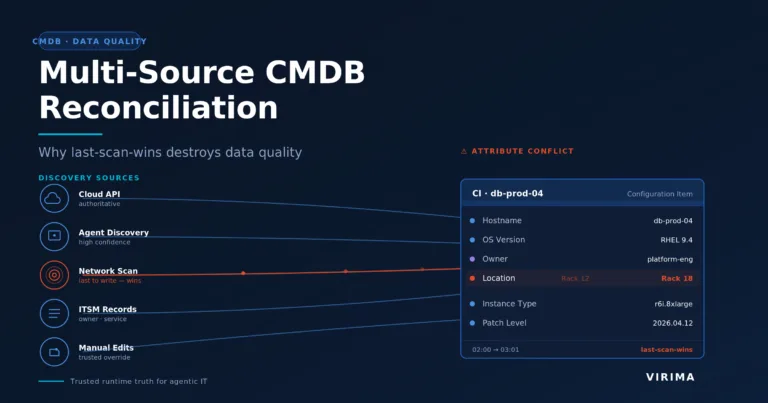
Reconciliation debt. Large environments pull CI data from many sources. These include agent-based scans, agentless network scans, cloud API pulls, and manual imports. You need a reconciliation layer to merge them into one trusted CI. Without dedup logic and source-authority rules, one server can show up as three partial records. At 10,000 assets, an admin can fix this by hand. But at 100,000, it becomes a full-time job with no end.
Admin complexity that grows fast. Access controls, multi-site setup, and integration upkeep all take more effort as you grow. The more teams, sites, and connected systems you add, the heavier it gets. Some platforms handle this with workarounds instead of native automated CMDB design. As a result, those setups break easily during upgrades.
Five requirements that separate scalable enterprise ITAM from mid-market tools
When you weigh IT asset management platform scalability, these five things matter most. They tell you far more than the CI capacity number on a pricing sheet.
1. A tiered discovery architecture
The most common bottleneck on large estates is a single-method discovery engine. Persistent agents on every device give you deep software inventory. But they also add deployment, patching, and upkeep that grows with scale. On 50,000+ endpoints, that upkeep turns into a real burden. So the agent-based vs. agentless discovery choice matters a lot at volume.
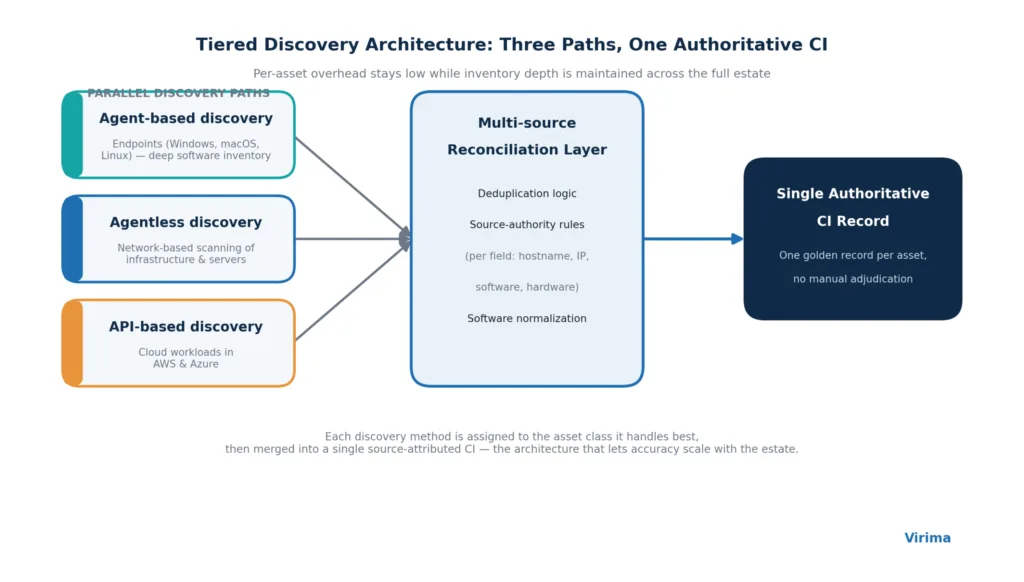
Platforms built for scale mix methods by asset class. They use agentless scans for network gear and servers. They add lightweight agents where you need deep software detail. And they use API-based collection for cloud workloads in AWS and Azure. That way, per-asset overhead stays low while inventory depth stays high.
Virima’s IT discovery runs all three methods at once. So you can match the right method to each asset class. You don’t have to force one approach across the whole environment.
2. Multi-source reconciliation with defined source-authority rules
In a multi-source setup, the same asset often shows up in more than one feed. Without reconciliation logic, those feeds create duplicate or clashing records. For example, the agent scan finds full software detail but no network data. Then the agentless scan finds the MAC address and ports but no software. Neither record is complete. And neither one is the truth.
Platforms built for scale fix this with source-authority rules. For each field, one source wins by design. So hostname, IP, software, and hardware each have a trusted owner. On a conflict, that owner’s data takes priority. The result is one golden CI record, built from the best source for each field. And it stays accurate without manual cleanup.
Virima’s CMDB applies this reconciliation automatically. It merges every feed into a single trusted CI using configurable source-authority logic. So no admin has to settle clashes between scans by hand.
3. Software normalization at volume
A 50,000-asset estate can hold 150,000 to 300,000 software install records. Without normalization, one app shows up many ways. You might see “Microsoft Office 365,” “Office 365 ProPlus,” and “Microsoft 365 Apps for Enterprise,” plus a dozen more. Each one looks like a separate license. So your compliance math breaks, because one entitlement maps to dozens of fragments.
This risk is real, not theoretical. Flexera’s 2024 State of ITAM report found that 53% of IT teams lack full asset visibility. It also found that even advanced teams waste roughly 30% of their desktop software spend (Flexera 2024 State of ITAM Report). Normalization fixes this. It cleans up publisher and product names against one standard list. So it’s the base layer for software license management at scale. And any platform that needs a hand-written rule for each new product won’t keep up.
4. Native RBAC with multi-site segmentation
Enterprise environments are not one big bucket. A regional manager in EMEA should not see North American records. Security teams need vulnerability data from NVD lookups, but not contract costs. And finance needs depreciation reports, but not CI relationship maps.
So role-based access and multi-site separation are core needs at scale, not extras. Without them, a shared ITAM environment gets messy fast as teams grow. And platforms that fake this with workarounds tend to break during big upgrades or reorgs.
5. API-based ITSM integration with high sync frequency
Your CMDB and ITAM data flows into incident, change, and problem workflows. So sync speed matters. A CMDB with 100,000 records that syncs once a day helps less than one with 50,000 records that syncs every 15 minutes. When downstream tools carry stale data, people stop trusting the CMDB. Then they work around it, which makes accuracy even worse. That loss of trust is exactly what Gartner warns about.
Virima syncs both ways with ServiceNow, Jira Service Management, Ivanti, HaloITSM, Xurrent, Hornbill, and TeamDynamix. It uses API connections that push CI updates as discovery finds them. So you get fresh data, not overnight batch dumps.
Benchmarks: what a scalable CMDB looks like at enterprise scale
Don’t accept vague “enterprise scale” claims. Instead, hold vendors to clear numbers. Use this scorecard as your checklist:
| Benchmark | Target threshold at 100,000+ assets | What a miss tells you |
|---|---|---|
| Discovery cycle completion window | Full-estate pass completes within 24 hours, no added infrastructure beyond initial provisioning | If the estate must be chunked to fit the window, you’re seeing architectural limits, not flexibility |
| CMDB data freshness window | CI data reflects the current environment within 24–48 hours under normal conditions | Slower refresh than the environment’s change rate means decisions run on stale data |
| Multi-source reconciliation processing time | Completes within 4 hours of a discovery cycle finishing | Longer creates a sync gap where the CMDB reflects the previous cycle, not the current one |
| License compliance report generation | Full estate-wide entitlement report generates in minutes | Offline batch jobs or query timeouts signal a platform not architected for large software estates |
| ITSM integration sync latency | CI/asset data syncs downstream every 15–30 minutes during active change | Daily or hourly intervals are insufficient for change workflows that depend on current context |
So a platform built for scale should hit each of these marks. It should finish full discovery within 24 hours at 100,000+ assets. It should reconcile in under 4 hours. And it should sync CI updates every 15 to 30 minutes. Plus, it should build compliance reports in minutes, with no batch delays. That is how accuracy scales with your environment instead of falling behind it.
The “feels heavy on large estates” objection, answered
When teams say a platform “feels heavy” at scale, they usually mean one of three things. And each one has a clear architectural fix.
Resource use on endpoints. Legacy agents run nonstop on every device. On 500 endpoints, a 2% CPU hit means nothing. But on 50,000 endpoints, that same hit slows apps during scans. And the patching becomes a cost you never planned for. The fix is not to drop agents, because they give software depth that agentless scans can’t match. Instead, you deploy them selectively. So you use lightweight agents only where you need deep detail, and agentless methods everywhere else. Virima’s agent runs on a schedule rather than nonstop. That keeps resource use low between scans and avoids the CPU spikes that make old agents so unpopular.
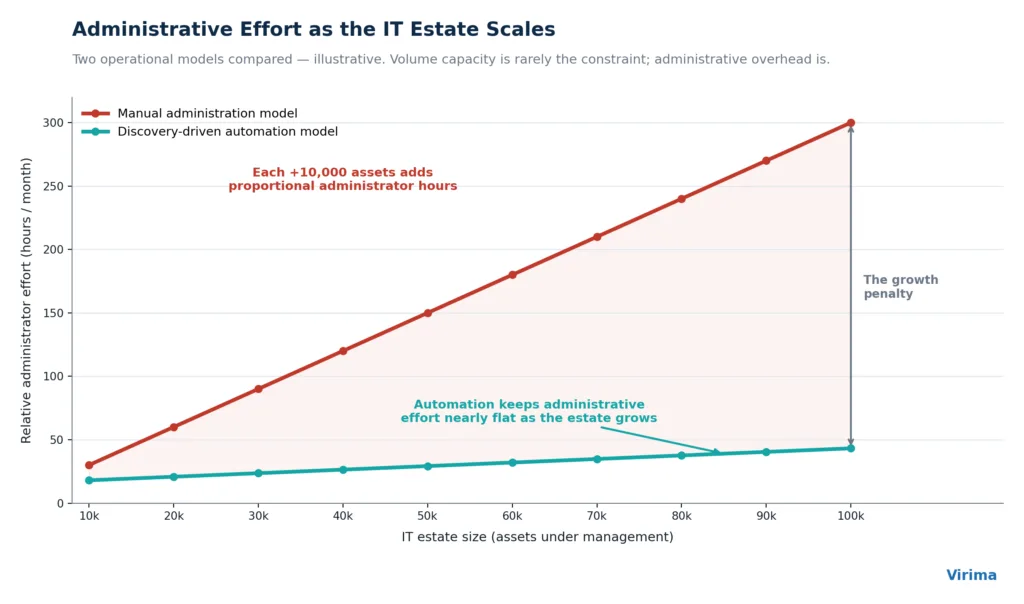
Manual admin work at scale. Some platforms make admins manage schedules, fix duplicates, write normalization rules, and set up access by hand. So the burden of growth lands right on your team. But this isn’t really about estate size. It’s about how much the platform handles on its own. A platform that runs reconciliation, normalization, and lifecycle tasks through discovery does not get harder as you grow. One that leans on manual work does.
.
Change event noise. Large estates create a lot of CI change events every day. Platforms that flag every change for review create alert fatigue. So the system gets harder to use as you grow. Virima’s ViVID™ service maps add context to each change. They map every CI to the services and business functions it supports. So your team can see which changes touch critical services and which are routine. That cuts the noise without losing the signal. You can dig deeper in our CMDB best practices guide for accuracy at scale.
Discovery architecture is the real scalability lever
Volume capacity is rarely your real limit. That’s just how many CIs a database can hold. The real test of IT asset management platform scalability is discovery throughput. In other words, how fast can the platform collect accurate data from a growing estate and keep it fresh on its own? So when you evaluate vendors, ask pointed questions. Ask how reconciliation handles assets that show up in many sources. Ask what happens to freshness when the estate doubles. Ask the minimum sync frequency for ITSM integrations. Ask how access works across sites and business units. And ask for real details from their largest live deployments, not general scale claims.
FAQs: CMDB scalability and ITAM at scale
How many assets can an ITAM platform manage before performance degrades?
It depends on architecture, not product tier. Platforms that use tiered discovery, source-authority reconciliation, and API-based ITSM sync scale well. They handle large estates without big drops in performance. But platforms that rely on persistent agents and manual reconciliation hit friction much sooner. So the choices you make at deployment set that threshold for your environment.
What causes CMDB data to go stale in large IT environments?
The main cause is a mismatch between cycle speed and change rate. Say your environment makes 500 CI changes a day. And say a full discovery cycle takes 48 hours. Then your CMDB always shows the environment as it was two days ago. So the fix is targeted, high-frequency cycles on active segments. That keeps data fresh as you grow, instead of relying only on slow full passes.
How do IT teams manage software license compliance across 200,000+ software installations?
Normalization comes first. Without it, the same app appears under dozens of name variants. So mapping entitlements to installs becomes unreliable. Platforms with native normalization libraries solve this. They map publisher and product variants to one canonical entry. That makes large-estate compliance reporting workable without manual rules for every product.
What makes Virima better suited for large IT estates than legacy ITAM tools?
Virima uses a tiered discovery architecture. That means agentless, lightweight agent-based, and API-based cloud collection. So per-asset overhead stays low at scale. Then multi-source reconciliation keeps single trusted CI records without manual cleanup. And API-based, two-way ITSM sync pushes updates as discovery finds them, not in batches. Together, these keep admin effort low as you grow.
Does Virima require additional infrastructure as the IT estate grows?
In most cases, Virima absorbs growth through configuration. So you adjust discovery schedules, add credential sets for new segments, and expand cloud API connections. You usually don’t need to deploy extra discovery servers.
Building for the estate you’ll have, not the one you have today
Every IT estate keeps changing. Cloud workloads expand. Acquisitions bring new infrastructure. And SaaS adoption adds software that skips normal procurement. So the platform you pick today must handle the estate you’ll run in three years, not just today’s.
That means looking past the demo. So ask hard questions about how the platform behaves under growth. Can its discovery engine handle 3x more assets? Can its reconciliation layer keep up with 5x more CI changes? And does its admin model absorb growth or dump it on your team? When the answers are clear and specific, you’ve found a platform built for scale.
So take these five benchmarks into your next vendor review. Use them as a scorecard for discovery window, freshness, reconciliation time, report speed, and sync latency. Then, when you’re ready to see it in action, schedule a demo. You’ll watch Virima keep accurate data across large, complex hybrid environments — at the asset counts your roadmap is heading toward.
See Everything. Know the Impact. Act with Confidence.