ITSM vs ITIL: Key Differences, Examples, and How They Work Together

A change window looks clean on the ticket, reviewers have signed off, and the runbook still matches last quarter’s diagram. Then the cutover hits a dependency nobody logged, the rollback path is incomplete, and the post-incident review argues definitions instead of fixing ownership. That pattern shows up when teams treat ITSM and ITIL as rival products instead of a discipline and a framework, so people buy software for a framework problem, or invent process for a data problem. This article settles ITSM vs ITIL: where ITSM ends and ITIL begins, and why accurate configuration data decides whether configuration-dependent practices hold up under pressure.
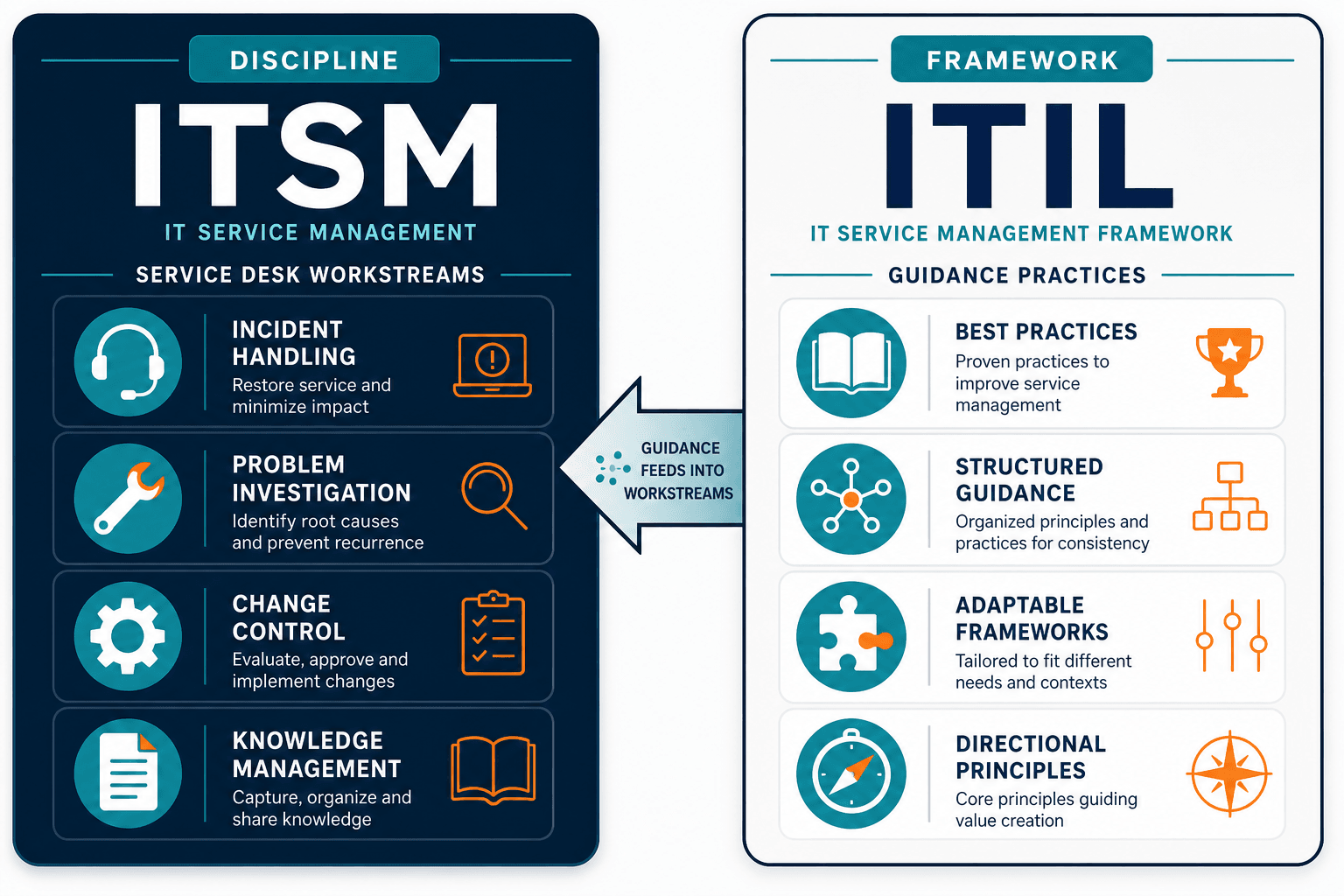
ITSM is the discipline of designing, delivering, and improving IT services for the business. ITIL is a widely used framework of guidance and practices that structures how many organizations run that discipline. One describes the operating work your teams own. The other is a playbook many teams adopt for that work. Confusing the two leads teams to over-index on certifications, under-invest in inventory quality, or assume an ITSM platform alone produces ITIL outcomes.
ITSM vs ITIL at a glance
ITSM is the operating discipline your organization owns for designing and running IT services. ITIL is optional framework guidance that can shape that work. You need both only when the framework improves practice design; you always need clear ownership, workflows, and trustworthy configuration data for change, incident impact, and service configuration work.
- ITSM: how your teams request, restore, change, and improve services day to day.
- ITIL: PeopleCert-stewarded guidance (ITIL 4 practices and the Service Value System) many teams adapt.
- Not either-or: choose how deeply to adopt ITIL inside ITSM, not ITSM or ITIL.
- Data layer: for change enablement, incident impact analysis, ITAM, and service configuration management, CI accuracy often decides whether documented processes work in production.
| When configuration-dependent ITIL practices stall on stale CI records, the issue is runtime accuracy, not another process binder. Explore Trusted Runtime Truth. |
What ITSM covers
IT service management is the operating model for how technology supports business outcomes. It covers the people, processes, and technology used to request, restore, change, and improve services. Incident handling, request fulfillment, problem investigation, change control, knowledge, and service level management all sit inside that discipline. So do ownership, escalation paths, measurement, and the handoffs between the service desk and infrastructure teams.
ITSM is not a single product category with one correct vendor. It is the set of practices an organization runs whether the stack is ServiceNow, Jira Service Management, Ivanti, HaloITSM, Xurrent, Hornbill, or a mix. A team can practice strong ITSM with lightweight tooling if roles, workflows, and data are clear. A team can also run expensive platforms and still deliver weak service if tickets float without accurate configuration context. Flexera’s 2024 State of ITAM Report found that 53% of IT teams still struggle to gain or maintain complete visibility of their technology investments, the same gap that turns ITSM data into guesswork.
When practitioners ask what is ITSM vs ITIL, the useful first cut is operational. ITSM answers how your organization designs and runs services day to day. It is measured in restore times, change success rates, backlog age, and user trust. Frameworks influence those metrics, and they never replace the operating results your stakeholders score. For how those numbers tie back to configuration accuracy, see ITSM performance metrics and CMDB data quality.
What ITIL is (and what it is not)
ITIL is a globally recognized service-management framework maintained under PeopleCert. Originally known as the Information Technology Infrastructure Library, the expansion was retired as the framework extended beyond infrastructure. Atlassian documents ITIL 4 as flexible best-practice guidance for designing, delivering, and improving IT services. That guide describes 34 management practices that support the Service Value System. Those practices replaced older process-heavy catalogs and leave room for Agile and DevOps-style delivery.
Shared language is one of ITIL’s practical gifts to multi-team environments. Incident, problem, change, configuration item, and configuration management database mean something consistent when the framework is taught well. ITIL also supplies structure: guiding principles, a service value system, four dimensions of service management, and practice guidance teams can adapt. ITIL is not a piece of software. It is not a mandatory government standard for private enterprises. It is not proof that a tool labeled “ITIL aligned” will guarantee outcomes on your estate.
Organizations adopt ITIL at different depths. Some train a few process owners and map major workflows. Others build maturity programs with continual improvement boards and practice-level metrics. Either depth can work when the goal is a tighter ITIL ITSM pairing that produces clearer service decisions. The failure mode is treating ITIL documentation as the finish line while the CMDB still depends on spreadsheets and tribal knowledge.
ITIL 4 versus older ITIL v3 framing
ITIL v3 organized work around a five-stage service lifecycle: Service Strategy, Service Design, Service Transition, Service Operation, and Continual Service Improvement. ITIL 4 reorganizes service management around the Service Value System. That system includes guiding principles, governance, the service value chain, management practices, and continual improvement, plus four dimensions of service management. Teams still run familiar work such as incident and change, but the official organizing model is no longer those five lifecycle stages. When older training materials still list five stages of ITSM, treat that as v3 history, not current ITIL 4 structure.
How ITSM and ITIL are similar
Both aim at better service quality, clearer business alignment, stronger customer experience, and continual improvement. Both care about roles, handoffs, measurement, and risk control. Both fail in the same places when records are stale: change impact guesses wrong, major incidents route late, and audits cannot prove which CIs support a controlled service. The difference is role, not goal. ITSM is the work and ownership model. ITIL is one proven way to design and name that work.
Can you implement ITSM without ITIL?
Yes. Organizations can use ITIL selectively, combine it with Agile or DevOps, adopt alternatives such as ISO/IEC 20000 or COBIT, or build an internal operating model. Many still use ITIL terms because vendors, partners, and auditors already share that vocabulary. The decision is depth of framework adoption inside ITSM, not a forced choice between ITSM and ITIL.
ITSM vs ITIL in plain terms
The itsm and itil difference is easiest to hold as category versus framework.
| Dimension | ITSM | ITIL |
|---|---|---|
| What it is | Discipline and operating model for IT services | Framework of guidance and practices for service management |
| Primary question | How do we run services for this business? | What proven guidance should shape those practices? |
| Ownership | Your organization owns the model and outcomes | PeopleCert stewards the framework and certifications |
| Tools | ITSM platforms execute workflows and records | ITIL does not ship as a product; tools may align to practices |
| Success signal | Service quality, speed, risk control, user trust | Consistent practice design and shared terminology |
| Flexibility | Must fit local org design and stack | Designed to be adapted, not copied line by line |
ITIL ITSM pairings work when the framework shapes the discipline without becoming theater. Vocabulary-only teams produce process maps that look mature and still fail change impact checks. Ticket-only teams move fast until a major incident exposes missing relationships between services and infrastructure.
What is the difference between ITSM and ITIL?
IT service management (ITSM) is the organizational discipline of managing IT services end to end. ITIL is a leading service-management framework that supplies practices, language, and structure many teams use to design that discipline. You practice ITSM with or without ITIL, and you use ITIL to guide ITSM rather than replace it.
How the ITIL framework shapes ITSM work
An itil framework itsm program usually starts with a small set of high-traffic practices:
- Incident management restores service when disruption hits users.
- Problem management finds recurring causes behind repeat noise.
- Change enablement (called change control in many ITIL 4 materials) balances speed and risk.
- Service configuration management keeps the records those practices trust.
- Request management handles standard demand from the business.
- Knowledge management reduces repeat effort across shifts and vendors.
ITIL 4’s service value chain activities describe how work moves: Plan, Improve, Engage, Design and transition, Obtain/build, and Deliver and support. They are not a rigid waterfall. Teams combine them based on the outcome. That flexibility is why modern ITSM programs can absorb cloud release trains and still keep governance language auditors recognize.
Where ITIL practices run on data
Where ITIL guidance meets reality is data. Change enablement needs to know what a configuration item connects to before approval. Incident management needs service context to prioritize and route. Problem management needs history tied to the same objects over time. For configuration-dependent practices such as change enablement, incident impact analysis, IT asset management, and service configuration management, data accuracy often determines whether documented processes work reliably in production. Virima’s comparison of CMDB and SACM concepts helps when teams confuse a database product with the full service asset and configuration management practice.
ITIL vs ITSM tools: what you are really buying
Search traffic for itil vs itsm tools often hides a category error: buyers compare platforms as if one SKU were “the ITIL product” and another were “the ITSM product.” ITSM tools are software systems that record tickets, workflows, approvals, catalogs, and often asset or CI records. ITIL remains the guidance those workflows may follow.
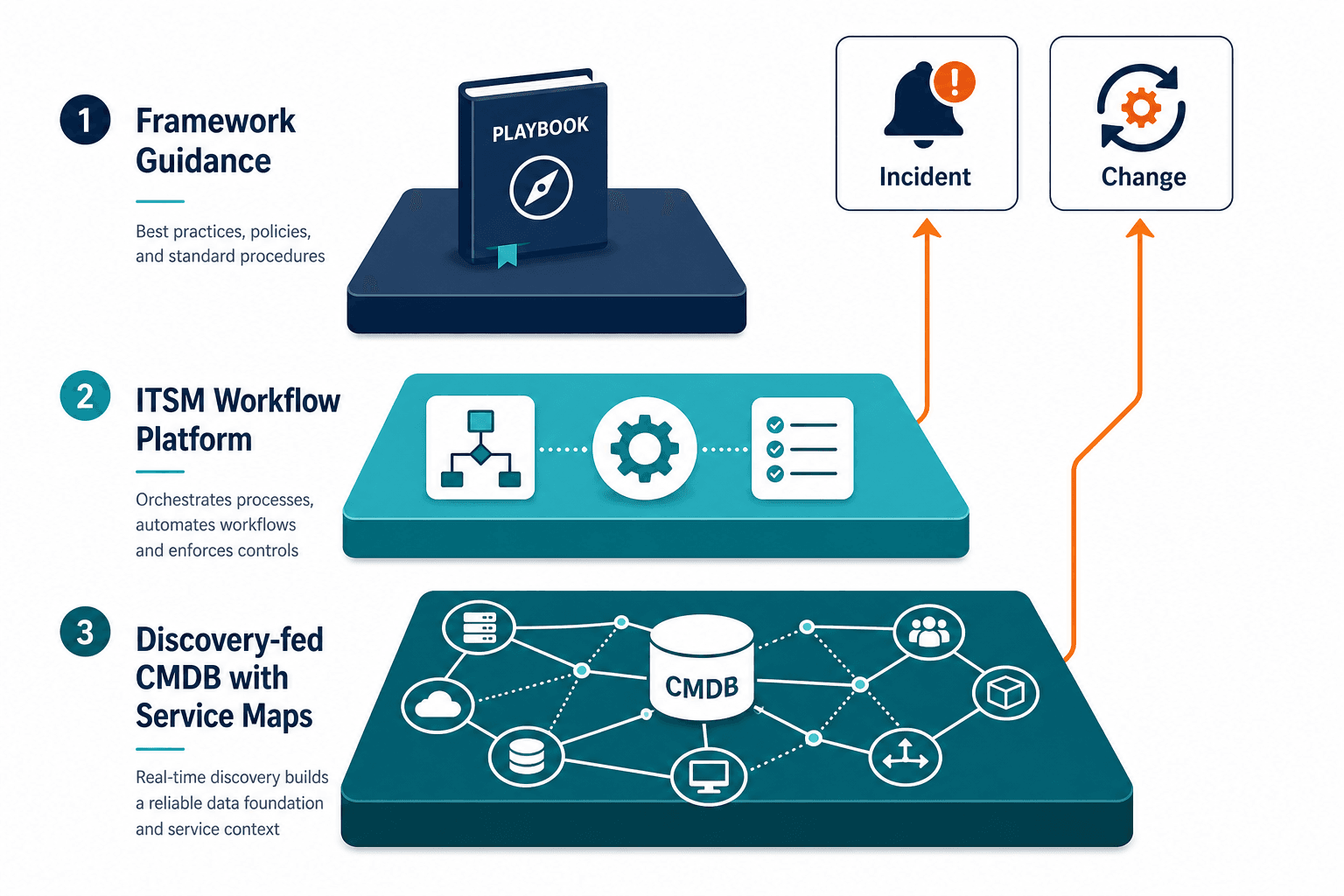
A strong ITSM platform can support ITIL-aligned states, forms, and reports, but it cannot invent accurate infrastructure relationships if discovery is thin, keep ownership current if HR and cloud tags never reconcile, or make a stale CI graph safe for automated change risk scoring. That is why architecture conversations should separate three layers.
The three layers you’re actually buying
- Framework guidance (often ITIL, sometimes COBIT, ISO 20000, or internal standards)
- ITSM workflow system of record for work and service interactions
- Discovery-sourced configuration and dependency truth that feeds the workflow system
Virima sits primarily in the third layer. Hybrid discovery populates and refreshes configuration items on scheduled discovery cycles. The CMDB holds relationships and ownership. Once service definitions are provided, manually, by spreadsheet import, or through an enterprise architecture integration, ViVID™ builds dependency maps from that input and does not invent which applications form a service. Service maps show blast radius once service definitions are provided. Bi-directional integrations push that context into platforms such as ServiceNow, Jira Service Management, Ivanti, HaloITSM, Xurrent, and Hornbill through Virima integrations so ITIL-shaped practices run on current estate data. Virima is not a substitute for choosing an ITSM operating model. It is the data foundation that keeps incident, change, asset, and configuration practices honest.
Is ITIL a tool or a framework?
ITIL is a framework of service management guidance and practices, not a software product. IT service management (ITSM) tools may implement workflows that follow ITIL practices, but training and platform features still depend on accurate configuration data to produce reliable outcomes in live environments.
What’s the difference between ITSM tools and the ITIL framework?
ITSM tools are workflow platforms that record tickets, approvals, and configuration items. ITIL is not software; it is guidance those platforms may follow. Buying an ITSM tool does not create accurate configuration data on its own. That depends on discovery feeding the platform current relationships.
When does CMDB quality decide ITIL practice outcomes?
Change enablement, major incident routing, and configuration management fail when CI relationships and ownership are stale, even if ticket workflows look ITIL-shaped. The framework names the practice. Discovery-sourced records decide whether impact analysis and escalation match the live estate.
| Illustrative ops walk-through (not a customer claim): A change window targets one application CI. The ticket lists the host, but the CMDB still shows last quarter’s map and omits a shared database and a new load balancer. Impact analysis clears the change. Cutover stalls when the missing dependency fails health checks. Rollback is incomplete because the service definition never listed the balancer. Mean time to restore stretches while teams reconcile ownership across three systems of record. The ITIL practice labels were correct. The configuration layer under them was not. Fixing the practice design alone would not have found the missing relationship. |
Why the distinction matters when processes break
Process failure rarely announces itself as “we confused a category with a framework.” It shows up as symptoms. Changes fail because impact analysis used last year’s application map. Major incidents stretch because responders page the wrong owner. Audits stall because evidence cannot show which CIs support a controlled service. Asset and configuration reviews disagree because two systems define “in use” differently. Teams we work with typically find the CI graph breaks first under change-window pressure, long before ITIL practice design gets blamed.
What the visibility gap costs
The stakes keep rising as ITSM spend grows. Industry analysts put the global ITSM market well into the tens of billions of dollars, with continued growth through the decade. Every dollar poured into workflow tooling on top of a broken configuration record buys a faster way to act on bad data.
Teams that keep the itsm vs itil distinction clear make better investment calls. They fund training when practice design is the bottleneck. They fund workflow tooling when intake, routing, and SLA mechanics are the bottleneck. They fund discovery and CMDB quality when configuration-dependent practices are blocked by unknown dependencies. Mixing those budgets is how organizations buy another module and still cannot answer what will break on Saturday night.
For change specifically, ITIL-aligned enablement only moves as fast as confidence in impact. Where the organization’s change model calls for CAB or equivalent review, reviewers need accurate dependency information, not a longer agenda. Practical ITSM change management practices depend on current relationships. The same pattern holds for problem management and service configuration work: better questions need better objects behind the ticket.
Building an ITSM program that uses ITIL without cargo-culting it
The itil framework itsm balance starts with a small, measurable scope. Pick two or three practices that already consume the most risk or labor, write the outcomes in business language, then map the minimum records each needs, services, CIs, owners, change models, known errors, and test whether those records exist and stay fresh.
Use ITIL language where it improves handoffs across teams and vendors, and drop ceremony that only exists to decorate a maturity slide. Keep the guiding principles that hold up under stress:
- Focus on value
- Start where you are
- Progress with feedback
- Keep work visible
- Prefer simple controls that people will actually run
Connect the ITSM platform to authoritative discovery instead of manual CI upkeep as the default. Scheduled discovery cycles, reconciliation rules, and service maps close the gap between the estate and the record the service desk trusts. For the deeper case on why runtime accuracy matters for governed operations, see Trusted Runtime Truth.
Making ITSM and ITIL work as one system
ITSM vs ITIL is not a contest to crown a winner. Your organization owns the discipline. ITIL is optional guidance for structuring it, and tools are the workflow layer staff touch every day. For configuration-dependent practices, data decides whether those workflows describe the real estate. When configuration items, relationships, and service maps stay current, ITIL-shaped incident, change, problem, and configuration work stop arguing with reality. That is the standard worth managing to, whether your next investment is training, an ITSM module, or the discovery layer that feeds both.
See how scheduled discovery, CMDB relationships, and ViVID™ maps after service definitions feed the configuration layer ITIL-shaped incident, change, and problem work actually needs.
Frequently Asked Questions
Is ITSM the same as ITIL?
ITSM and ITIL are related, not identical. ITSM is the discipline of managing IT services, and ITIL is a framework many organizations use to design and improve that discipline. You can run ITSM without ITIL, and study ITIL without a mature ITSM operating model in production.
Can you have ITSM without ITIL?
Yes. ITSM describes the work of delivering and improving services, and other frameworks or internal standards can shape that work instead of ITIL. Many teams still adopt ITIL terms because vendors, partners, and auditors already share that vocabulary.
How is ITIL 4 structured?
ITIL 4 organizes service management through the Service Value System, which includes guiding principles, governance, the service value chain, management practices, and continual improvement. It also asks organizations to consider four dimensions of service management. The five-stage lifecycle belongs to older ITIL v3 materials, not the current organizing model.
Does an ITSM tool make you ITIL compliant?
An ITSM tool can support ITIL-aligned workflows, forms, and reporting, but outcomes still depend on how practices are designed, measured, and evidenced. Accurate configuration and asset data remain a common missing piece even after go-live. Virima feeds discovery-sourced CI and relationship data into ITSM platforms so those workflows reference the live estate.
Where does a CMDB fit in ITSM and ITIL?
Service configuration management relies on trusted records of configuration items and relationships. In ITSM operations, those same records power impact analysis, prioritization, and audit evidence for configuration-dependent practices. Virima focuses on discovery, CMDB accuracy, and service mapping so both run on current inventories, not stale ones.