Maximizing IT Service Performance With Integrated ServiceNow ITSM and CMDB Solutions

ServiceNow offers two core solutions for managing IT services and infrastructure: the Configuration Management Database (CMDB) and the IT Service Management (ITSM) suite.
This article breaks down how these two components work together to improve IT service delivery. We also cover how Virima’s IT discovery and Virima Visual Impact Display (ViVID™) strengthen this integration by keeping your CMDB accurate and your service dependencies visible.
Understanding ServiceNow CMDB
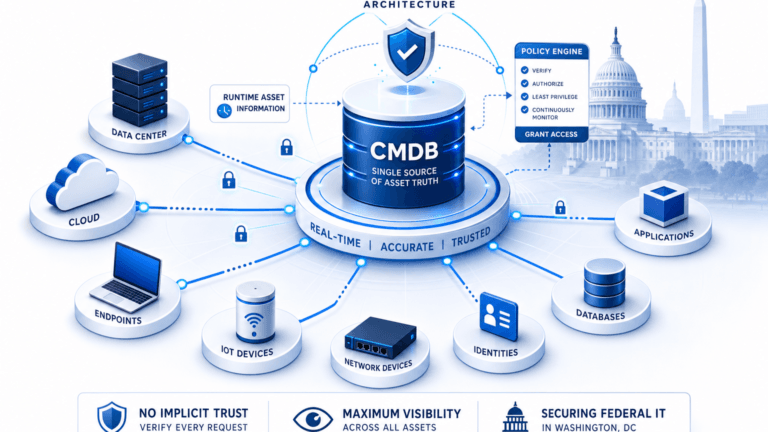
A CMDB is a centralized repository that stores information about all the hardware, software, and other assets in your IT environment. In fact, recent 2025 data shows that around 61% of organizations actively use CMDB tools to track infrastructure relationships and dependencies, reinforcing their role in modern IT operations. It gives IT teams accurate, current data about their infrastructure so they can manage and support IT services more effectively.
This information is stored as configuration items (CIs) with their attributes, relationships, and classes. When you can see how different components connect, managing data for ITSM processes gets much simpler.
Benefits of using ServiceNow CMDB
As the central repository for CI relationships, attributes, and classes, ServiceNow CMDB delivers several operational advantages:
- Improved visibility into IT infrastructure and asset dependencies
- Faster incident and problem resolution through accurate CI data
- Clear understanding of how changes will affect related services
- A single source of truth that supports collaboration across IT teams
Integrating ServiceNow CMDB with ServiceNow ITSM processes leads to more efficient service delivery across incident, problem, and change management.
But these benefits only hold if the CMDB is populated accurately and kept current. According to industry research, nearly 80% of CMDB initiatives fail to deliver meaningful business value due to poor data quality and a lack of governance. Manual updates go stale fast. A discovery solution like Virima automatically populates the CMDB by scanning your network with agentless and agent-based discovery, so nothing gets missed as your environment changes.
Understanding ServiceNow ITSM
IT Service Management (ITSM) is the set of practices, policies, and procedures used to plan, deliver, operate, and control IT services. ServiceNow ITSM aligns IT services with business needs so that technology supports organizational goals and delivers value.
CMDB plays a direct role here. Accurate CI data and relationship maps improve decision-making across every ITSM process, from incident response to change management.
Core components of ServiceNow ITSM
ServiceNow ITSM covers the full ITSM lifecycle, including:
- Incident management
- Problem management
- Change management
- Knowledge management
- Employee center
- Vendor management workspace
- Workforce optimization
- Predictive intelligence
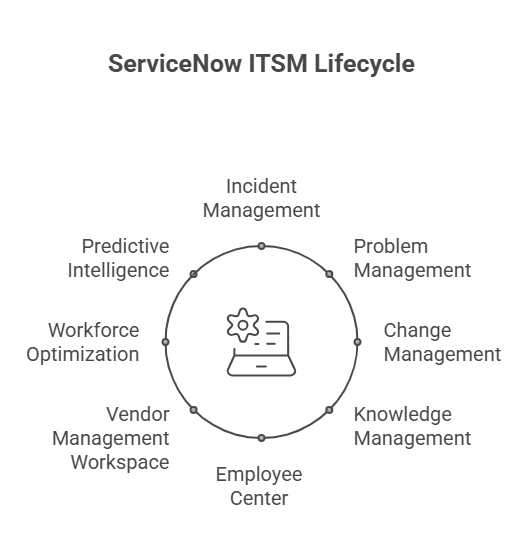
ServiceNow ITSM provides an end-to-end platform that lets organizations automate IT support workflows and integrate with other tools in their stack.
That said, ServiceNow ITSM may not fit every organization. The licensing costs are steep, especially for startups, and the platform can be complex to navigate if you only need a subset of ITSM capabilities. In those cases, alternatives like Virima provide ITIL-compliant ITSM with PinkVERIFY ITIL 4 certification across six core processes, at a lower cost and with simpler deployment. You can also pair Virima’s discovery and service mapping with your existing ServiceNow CMDB if you’ve already invested in that platform.
Integration of ServiceNow ITSM and CMDB: Why does it matter?
Integrating CMDB with ITSM processes gives IT teams immediate access to CI relationships and dependencies when they need them most. The CMDB maintains a full inventory of CIs and how they connect, which directly supports faster, more informed decisions across every ServiceNow ITSM workflow.
Here is how that plays out in practice:
Incident management: Faster resolution with CI data
When an incident hits, your team needs to know which systems are affected and what depends on what. CMDB integration gives incident responders immediate access to CI data, so they can pinpoint affected components, trace dependencies, and restore service faster. The result is shorter resolution times and less business disruption.
Problem management: Identifying root causes and affected CIs
Problem management is about finding and fixing the root causes behind recurring incidents. With CMDB integration, your team can analyze CI relationships to spot patterns and dependencies that contribute to repeat issues. That means fewer recurring problems and a more stable IT environment.
Change management: Assessing impact before making changes
Every change to the IT infrastructure carries risk. CMDB integration gives your change advisory board (CAB) a clear view of which CIs are affected by a proposed change, what depends on them, and where the blast radius extends.
This supports better risk assessment and informed approvals. Teams can plan changes with confidence because they see the full upstream and downstream dependencies before anything moves to production.
After implementation, the CMDB needs to reflect the new state accurately. This is where auto-discovery earns its value. Virima Discovery automatically detects changes and updates the CMDB, so your team is not relying on manual post-change documentation. And unlike ServiceNow Discovery, Virima’s integration is codeless and includes ViVID™ service mapping at no additional cost.
Service catalog: Providing accurate service information
The service catalog lists every IT service your organization offers. When the catalog pulls from an accurate CMDB, users can request services knowing the information is current. They see what is available, what supports it, and whether it meets their needs.
Knowledge management: CI-related knowledge stays current
Knowledge management depends on accurate, current information about IT services and infrastructure. CMDB integration ensures that knowledge articles, documentation, and troubleshooting guides reference real CI data rather than outdated records.
This supports self-service resolution, reduces escalations, and gives your support teams reliable information to work from.
How combined ServiceNow CMDB and ITSM integration drives better service delivery
When ServiceNow CMDB and ITSM work together, every process benefits from accurate, accessible CI data. Incident teams find root causes faster. Change managers assess impact with real dependency data. Problem managers trace recurring issues to their source.
But CI data is not static. As your team executes ITSM processes, the environment changes. Servers get patched, network configurations shift, and new applications deploy. If the CMDB does not reflect those changes, your team starts making decisions on stale data.
Auto-discovery tools keep the CMDB current without manual effort. Virima Discovery detects CI changes on each scan cycle and pushes updates to the CMDB automatically. Whether you are using Virima’s built-in CMDB or syncing to ServiceNow via Virima’s codeless integration with 100+ blueprints for mapping ServiceNow tables, the data stays fresh.
ViVID™ makes that data actionable. Instead of querying the CMDB to check for related incidents or pending changes, your team sees them overlaid on dynamic service maps. When a change request comes through, the CAB can see exactly which services sit downstream and whether any of those services already have open incidents. That visibility reduces change-induced outages and speeds up root cause analysis when incidents occur.
Virima also fills a gap that neither auto-discovery nor service mapping can cover on their own. Autonomic Social Discovery™ (ASD) automates human intelligence gathering for CI attributes that probes cannot detect, like asset lifecycle status, ownership, business criticality, and SLAs. This rounds out your CMDB with the context your team needs for informed operational decisions.
What should you look for in a ServiceNow CMDB alternative?
If you are evaluating options to extend or replace ServiceNow’s native discovery and service mapping, focus on four things: discovery depth, integration simplicity, visualization capability, and total cost.
Discovery depth means more than basic network scanning. Look for agentless and agent-based options, support for hybrid and cloud environments (AWS, Azure), and a large probe library that covers diverse asset types.
Integration simplicity matters because a tool that takes months to connect to your ServiceNow CMDB defeats the purpose. Virima’s ServiceNow integration is 100% codeless and configurable through a web admin portal. You select from over 100 blueprints to map Virima discovery data to ServiceNow tables, choose which properties to sync, and set correlators to prevent duplicates.
CIs discovered by Virima appear in your ServiceNow CMDB without manual import, and new action links in each CMDB record let ITSM users rescan assets and view ViVID service maps directly from ServiceNow.
Visualization should go beyond static topology maps. ViVID™ overlays open incidents, pending changes, and vulnerabilities on live service dependency maps, giving your team operational context that static maps cannot provide.
ViVID currently integrates with ServiceNow, Ivanti, Jira Service Management, and HaloITSM, so the same operational overlays work regardless of which ITSM platform you run.
Total cost includes licensing, deployment effort, and ongoing maintenance. Virima includes service mapping and ViVID at no extra cost, integrates NIST NVD vulnerability data at no additional charge, and is SOC 2 Type II certified.
Book a demo to learn more about how Virima Discovery and ViVID™ service mapping can improve your service delivery with ServiceNow ITSM and CMDB integration.
FAQ
How does auto-discovery improve CMDB reliability?
Manual CMDB updates fall behind within days. Industry research indicates that the average CMDB is only about 60% accurate when maintained manually, which significantly impacts trust and usability. Staff forget to log changes, decommissioned assets linger in records, and new deployments go untracked. The result is a CMDB that teams stop trusting, which undermines every ServiceNow ITSM process that depends on it.
Auto-discovery solves this by running scheduled scans across your environment and updating CI data automatically. Virima Discovery uses agentless IP-based scanning with 100+ probes and optional agents for Windows, macOS, and Linux to detect configuration changes with each scan cycle. New assets get added, retired assets get flagged, and relationship data stays current. Your team can trust the CMDB because the data reflects what is actually running, not what someone last remembered to document.
How does service mapping relate to CMDB?
A CMDB stores CI data. Service mapping shows how those CIs connect to form the business services your organization depends on. Without service mapping, you have an inventory. With it, you have a live picture of which servers, applications, and network devices support each service.
Virima’s ViVID™ (Virima Visual Impact Display) takes this further by overlaying ITSM records, open incidents, and pending changes directly on the service dependency maps. When your ops team looks at a service map, they see not just the architecture but the current operational state: which CIs have active incidents, which changes are in flight, and where the risk is concentrated. This is what sets ViVID apart from basic dependency maps.