Leveraging Virima for optimal Jira change management

How Virima and Jira Change Management Work Together
The Virima and Jira Service Management integration brings together IT discovery, CMDB accuracy, and visual service dependency mapping in one connected workflow. When these capabilities run alongside Jira’s native change management process, your change managers see the infrastructure picture before they approve a ticket, not after an incident.
For IT operations teams already using Jira Service Management, the integration does not replace what is working. It fills in what Jira cannot do on its own: discovering what is really in your environment, mapping how services depend on each other, and surfacing live change and incident data directly on those maps.
ViVID™ Service Maps Bring Jira Change Management Into Focus
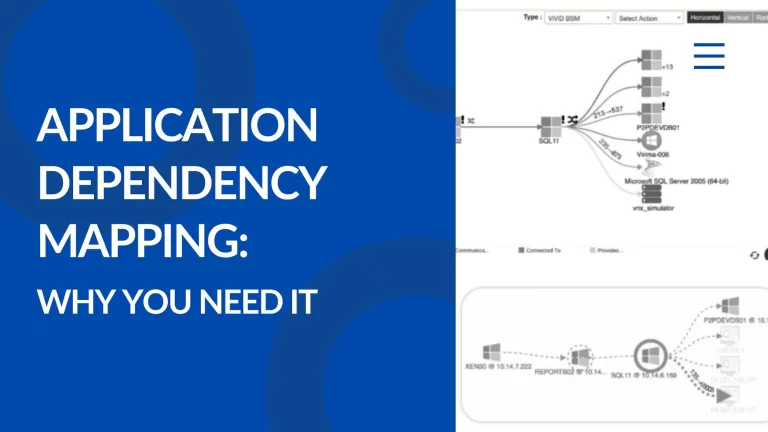
Virima’s ViVID™ service mapping builds dynamic dependency maps from discovery-driven data. Your team defines the services that matter, and Virima builds the dependency picture from what it finds in your environment. These are not static diagrams. They reflect the infrastructure that discovery has confirmed.
When ViVID™ is connected to Jira Service Management, open JSM records appear directly on the map. An active incident linked to a downstream server is visible before a change ticket is approved. A recent patch on a dependent CI shows up in context. Change managers can see the impact radius of a proposed change without switching tools or pulling reports.
This matters most during the Jira change management assessment stage. Instead of asking “what might this affect?” your team asks “what does the map show?” That shift from guesswork to discovery-sourced evidence reduces the risk of approving a change that breaks something adjacent.
A Discovery-Driven CMDB for More Reliable Jira Change Records
Jira’s native CMDB (Insight) gives your team a place to store configuration items. What it does not do is keep those records current on its own. Assets get decommissioned, new servers are provisioned, cloud instances spin up. Without a discovery engine running high-frequency discovery cycles across your environment, the CMDB drifts.
Virima solves this through flexible discovery methods that cover physical, virtual, and cloud assets across AWS and Azure. The CMDB it builds is populated from what is actually there, not what was documented last quarter. When a change ticket in Jira references a CI, the data behind that CI is discovery-sourced rather than manually maintained.
The result is a CMDB your Jira change management process can trust. Change managers make decisions based on accurate relationship data, not outdated records.
Connecting Virima to Jira Service Management
The integration between Virima and Jira Service Management uses API connectors that synchronize data bidirectionally. Configuration items from Virima’s CMDB flow into Jira, and change and incident records from Jira surface on ViVID™ service maps. Setup follows a defined process that your team can complete without custom development.
Once connected, change managers working in Jira see enriched CI records. Infrastructure engineers can open the associated service map to check upstream and downstream dependencies before the change window opens. No tool switching, no separate CMDB login.
For teams using Jira Service Management alongside other ITSM platforms, Virima also integrates with ServiceNow, Ivanti, Halo, and Xurrent, so the same discovery-driven CMDB can feed multiple systems.
Change Impact Analysis Before the Change Window
The practical payoff of change impact analysis with Virima is time-shifted risk assessment. Rather than reviewing impact after an incident, your team reviews it during the Jira change management process, when there is still time to adjust the plan, notify stakeholders, or schedule the change for a lower-risk window.
ViVID™ overlays active incidents, recent changes, and open Jira records onto the service map in context. A change manager reviewing a network device change can see if there is already an open incident on a connected application server. That visibility changes the quality of the approval decision.
Teams that want to go deeper on how Virima connects CMDB accuracy to change outcomes can read our guide on optimizing the IT change management process with Virima.
| Want to see how discovery-driven data improves your change process? Explore Virima’s Trusted Runtime Truth capabilities and see how your Jira change management workflow benefits from accurate, discovery-sourced CI data. |
Why CMDB Accuracy Is the Foundation of Safe Jira Changes
A Jira change management process is only as good as the data behind the change records. If a CI record shows the wrong owner, the wrong relationships, or the wrong status, the change assessment fails before it starts. Teams that have tried to maintain CMDB accuracy manually know how quickly records drift.
Virima’s discovery-driven approach means the CMDB reflects your actual environment through high-frequency discovery cycles, not a one-time import. When an asset changes state, discovery picks it up and updates the CI. The change manager in Jira sees current data.
This also supports root cause identification after incidents. Because ViVID™ maps show service dependencies backed by discovery data, post-change review in Jira is faster. Your team can trace an incident back through the dependency chain and identify which CI state contributed to the failure.
For more on how Virima supports Jira customers specifically, see 3 ways Virima offers Jira Service Management customers a true CMDB.
Better Jira Change Management Starts With What Is Really Running
Jira Service Management gives your team a strong Jira change management workflow. Virima gives that workflow the infrastructure truth it needs to operate safely. Together, they close the gap between what your change records say and what is actually running in your environment.
Discovery-driven CMDB accuracy, ViVID™ service maps with live Jira record overlays, and API-based integration combine to make your change process more defensible at every stage. Your team approves changes with evidence, not assumptions.
| Schedule a demo to see how Virima strengthens your Jira change management process with discovery-driven runtime truth. |
Frequently Asked Questions
Why do change management processes fail even when teams follow ITIL practices?
Most change failures trace back to inaccurate configuration data, not process gaps. When a CMDB does not reflect the actual environment, the change assessment is built on stale relationships and incorrect CI ownership. Teams approve changes confidently, then discover downstream impacts that the documentation never showed. Keeping CMDB data current through high-frequency discovery cycles is the most direct way to reduce change-related incidents.
What is change impact analysis, and why does it matter for Jira change management?
Change impact analysis is the process of identifying which services, applications, and infrastructure components a proposed change will affect before the change window opens. In a Jira change management workflow, this analysis is only as accurate as the dependency data available at ticket review time. Virima’s change impact analysis uses discovery-sourced CMDB data and ViVID™ service maps to show change managers exactly which CIs sit upstream and downstream of the change target, so approvals are based on evidence rather than assumptions.
How does Virima integrate with Jira Service Management for change management?
Virima connects to Jira Service Management via API connectors that enable bidirectional data sync. Configuration items from Virima’s discovery-driven CMDB populate Jira’s Insight asset store. Change and incident records from Jira then surface as overlays on ViVID™ service maps inside Virima. Change managers see enriched CI records in Jira, and infrastructure teams see live Jira record context on the service map. The full integration walkthrough is at the Virima Jira Service Management integration page.
How often should a CMDB be updated to support safe change management?
There is no single right answer, but the governing principle is that CI data must be current enough to reflect the state of the environment at the time of the change assessment. Environments that change frequently (cloud workloads, containerized apps, dynamic network configurations) require high-frequency discovery cycles to keep the CMDB useful. A CMDB populated from a quarterly audit or a one-time import will produce gaps that show up as change-related incidents. Discovery-driven refresh, triggered by schedule or tied to change events, is the most defensible approach for active change management programs.
Does Virima work with ITSM platforms other than Jira Service Management?
Yes. Virima integrates with ServiceNow, Ivanti, Halo, Xurrent, and Jira Service Management. The same discovery-driven CMDB and ViVID™ service maps can feed multiple ITSM platforms simultaneously. Teams that run Jira as their primary change management tool and use another ITSM for incident management can connect both to a single Virima CMDB, keeping CI data consistent across workflows.