IT Service Management Systems: A Practical Guide for IT Leaders

What ITSM Systems Are Built to Do
IT service management (ITSM) is the practice of designing, delivering, and managing IT services in alignment with business needs. An ITSM system is the software platform that structures that practice, providing workflows, automation, and reporting for the processes IT teams run every day.
Gartner defines ITSM platforms as software offering cohesive workflow management and automation for IT and operations teams, with incident management, service request fulfillment, and change control at the core. According to Gartner’s 2025 Market Guide for IT Service Management Platforms, these tools maintain a critical role as the system of record for I&O leaders delivering integrated IT services.
The global ITSM market is projected to reach $28.01 billion by 2030, growing at a compound annual rate of 13.9%, according to a 2026 market analysis by The Business Research Company. That growth reflects how deeply ITSM has embedded itself in enterprise IT operations, not just as a ticketing layer but as the coordination fabric for the entire service delivery chain.
ITSM systems do not operate in isolation. They connect to the configuration management database (CMDB), IT asset management tools, monitoring systems, and increasingly, AI-driven automation. The depth of those connections determines whether the platform delivers real operational value or just manages paperwork digitally.
Core Processes Every ITSM Platform Must Handle
Most enterprise ITSM systems organize their work around a standard set of processes. Organizations evaluating platforms should expect these as core capabilities, not add-ons.
Incident Management routes and resolves unplanned disruptions. Resolution speed depends heavily on whether the platform can surface related configuration items (CIs), linked changes, and affected services at the moment the incident is created.
Change Management governs planned modifications to the IT environment. Effective change workflows include pre-change impact analysis, CAB review routing, and post-change verification. Without accurate dependency data, change approvals become guesswork rather than governed decisions.
Problem Management identifies root causes behind recurring incidents. When a major outage repeats itself, problem management connects the dots between incidents, assets, and configuration drift.
Service Request Management handles routine user requests, from password resets to software provisioning. Automation and self-service portals reduce ticket volume when the catalog stays current.
Asset and Configuration Management tracks what assets exist, how they are configured, and how they relate to each other. This is where ITSM and CMDB intersect, and where the quality of the entire system is determined. For a deeper view of how ITSM connects to IT operations management, see Virima’s guide to ITOM vs. ITSM.
What is an IT service management system?
An IT service management (ITSM) system is software that structures and automates the processes IT teams use to deliver and support technology services. Core functions include incident management, change control, service request fulfillment, and configuration management, all governed by frameworks such as ITIL.
Why ITSM Initiatives Fall Short on Configuration Data
The most common ITSM failure pattern is not a platform problem. It is a data problem. ITSM systems depend on accurate, current information about assets, services, and dependencies to function well. When that data is stale or incomplete, every downstream process suffers.
An incident ticket lands with no affected CI attached. A change request passes approval without flagging the three downstream systems it will affect. A service restoration takes four hours instead of forty minutes because no one can trace which configuration item caused the outage.
This is not a workflow gap. It is a configuration data gap. The platform is doing exactly what it was configured to do; it simply has nothing accurate to work with.
This is where Virima’s CMDB addresses a gap most ITSM platforms cannot close on their own. Discovery-sourced configuration data, pulled directly from devices and enriched from multiple authoritative sources, gives ITSM workflows the asset context they need at the moment a ticket, change request, or incident is triggered.
What causes ITSM system failures?
Most ITSM system failures trace back to poor configuration data quality rather than platform limitations. When the CMDB contains stale, incomplete, or manually entered records, incident resolution slows, change risk assessments miss dependencies, and automation decisions rely on inaccurate context.
What to Evaluate When Selecting an ITSM Platform
Every enterprise ITSM platform covers the core processes listed above. Differentiation comes in how well the platform handles data quality, integration depth, and scalability as the IT estate grows.
Configuration data freshness: Can the platform receive discovery-sourced CI updates automatically, or does it rely on manual imports? An ITSM system is only as accurate as the data feeding it.
Integration breadth: Does the platform support bidirectional sync with the tools your teams already use? Look for named integrations with platforms such as ServiceNow, Jira Service Management, Ivanti, Halo, Xurrent, Hornbill, and TeamDynamix, rather than vague API compatibility claims.
Service dependency visibility: Can the platform show which services are affected by a CI, and which CIs belong to a service? This is the capability that transforms incident response from triage-by-guesswork to impact-aware resolution. Virima’s ViVID™ service maps deliver this visibility by building dependency maps from discovery-sourced data.
Automation governance: When the platform triggers an automated action, is there an audit trail? Who approved it? What data supported the decision? Governance on automated workflows is not optional in enterprise environments.
Scalability: A platform that works well at 2,000 CIs may struggle at 200,000. Ask vendors how configuration item counts, discovery frequency, and concurrent user loads affect performance.
For a side-by-side comparison of leading platforms, see Virima’s ITSM software platforms buyers’ guide for 2026.
The CMDB Connection: Why Configuration Data Drives ITSM Quality
An ITSM system without an accurate CMDB is a process engine with unreliable inputs. The CMDB is where configuration items (CIs) are stored, where relationships between assets are mapped, and where ownership, lifecycle status, and change history are tracked.
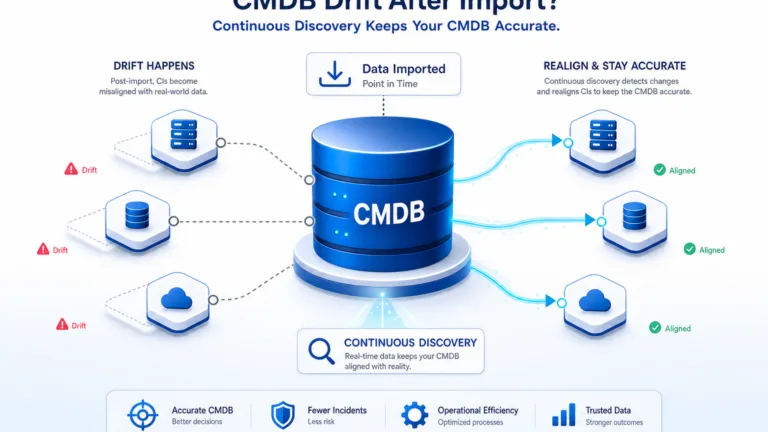
The gap most organizations discover is not in their ITSM platform. It is in the quality of the configuration data feeding it. Manual CMDB population drifts from reality within weeks. Import-based approaches produce point-in-time snapshots that age quickly in dynamic environments.
Discovery-sourced configuration data addresses this by populating the CMDB from what actually exists on the network. Virima’s discovery agents scan the environment on a scheduled basis, reconcile findings across multiple data sources, including Microsoft Intune, SCCM, and AWS, deduplicate records, and maintain verified CI data in the CMDB. The result is configuration data that reflects the live IT estate rather than a record of what it looked like six months ago.
For IT teams working on CMDB quality, Virima’s guide to successful CMDB implementation covers the common failure modes and how to address them.
→ See how Trusted Runtime Truth powers your ITSM workflows
How does a CMDB connect to an ITSM system?
A CMDB stores configuration items and their relationships. ITSM systems query the CMDB to associate tickets with affected assets, assess change impact, and route incidents to the right teams. When CMDB records are discovery-sourced and current, ITSM processes become faster and more accurate.
How Agentic AI Is Raising the Bar for ITSM Data Accuracy
AI is moving into ITSM in two ways. First, as AI-assisted triage, where models classify, prioritize, and route tickets faster than human agents. Second, as agentic automation, where AI agents take actions inside ITSM workflows without human initiation, executing runbooks, triggering changes, or escalating incidents based on live data.
The second category changes data quality requirements fundamentally. An AI model that classifies a ticket incorrectly costs a few minutes of reclassification. An AI agent that executes an incorrect change based on stale CI data causes the outage it was meant to prevent.
For AI agents to act safely inside ITSM systems, they need configuration data that reflects what actually exists in the environment at the moment of the decision. That means discovery-sourced data with confidence scores, source attribution, and governance trails, not stale imports or manually maintained records.
Virima surfaces this data to AI agents through structured, governed CI records with clear ownership, source attribution, and confidence scoring. When an AI agent needs to act on a configuration item, it can check whether that record is current enough to support the decision, and if not, trigger a targeted refresh before proceeding. Learn more about AI in IT service management and what accuracy standards agentic workflows require.
| Give your ITSM platform accurate configuration data to work with → Schedule a demo |
Building an ITSM Foundation That Scales With Your IT Estate
The right ITSM system is one that scales as the IT estate grows, adds AI-driven capabilities without requiring a configuration rebuild, and maintains data quality without constant manual intervention.
For most organizations, the real decision is not which ITSM platform to choose. It is how to ensure the configuration data feeding that platform stays accurate enough to support the processes built on top of it.
That means investing in discovery-sourced CMDB data alongside the ITSM platform, not as an afterthought. It means choosing platforms that support bidirectional integration with your CMDB and ITAM tools. And it means treating configuration data quality as a continuous operational discipline, not a one-time implementation task.
Virima’s IT asset management and discovery capabilities feed that continuous data quality layer into ITSM workflows, keeping the configuration records that drive incident, change, and request management current and trustworthy.
For IT leaders building or refreshing their ITSM foundation, Virima’s guide to intelligent IT solutions for enterprise teams covers how discovery, CMDB, and ITSM work together at scale.
Frequently Asked Questions
What is the difference between ITSM and ITOM?
ITSM covers the processes for delivering and supporting IT services, including incident, change, and request management. ITOM (IT Operations Management) covers the monitoring and operational health of IT infrastructure. The two disciplines overlap when ITSM workflows need live infrastructure state data from ITOM tools to resolve incidents accurately.
Why do ITSM implementations fail?
Most ITSM implementations fail because of configuration data quality. When the CMDB is populated manually or through infrequent imports, IT records drift from reality. Incident tickets land without accurate CI associations, change requests skip dependency checks, and automation runs on outdated context. The platform is rarely the problem.
Which ITSM platforms integrate with a CMDB?
Most enterprise ITSM platforms support CMDB integration, but depth varies. Platforms such as ServiceNow, Jira Service Management, Ivanti, Halo, Xurrent, and TeamDynamix support bidirectional CI sync. The quality of that sync depends on how current and accurate the CMDB records are.
What role does ITIL play in ITSM systems?
ITIL (Information Technology Infrastructure Library) provides the process framework that most ITSM systems are built around. ITIL defines best practices for incident, problem, change, and service request management. Most enterprise ITSM platforms align to ITIL 4, the current version, which adds emphasis on value streams and automation alongside traditional process discipline.
How does agentic AI change what an ITSM system needs?
Agentic AI introduces autonomous decision-making into ITSM workflows. AI agents can classify tickets, trigger remediation runbooks, and execute changes without human initiation. This raises the data quality bar significantly. An agent acting on a stale or incorrect CI record can cause the outage it was meant to prevent. ITSM systems supporting agentic AI need discovery-sourced CI data with confidence scoring and clear governance trails.