Building a CMDB Without ServiceNow for Mid-Market IT

A mid-market IT team hits an infrastructure turning point around 500 nodes. Spreadsheets stop matching switch ports. Basic ITSM asset lists show server names but hide application dependencies. When a core database restarts during business hours, three internal services go down without warning.
That moment forces a choice. Enterprise vendors pitch multi-year platform implementations that cost six figures in licensing alone. Lightweight asset tools promise quick setup but store static records that go stale within weeks.
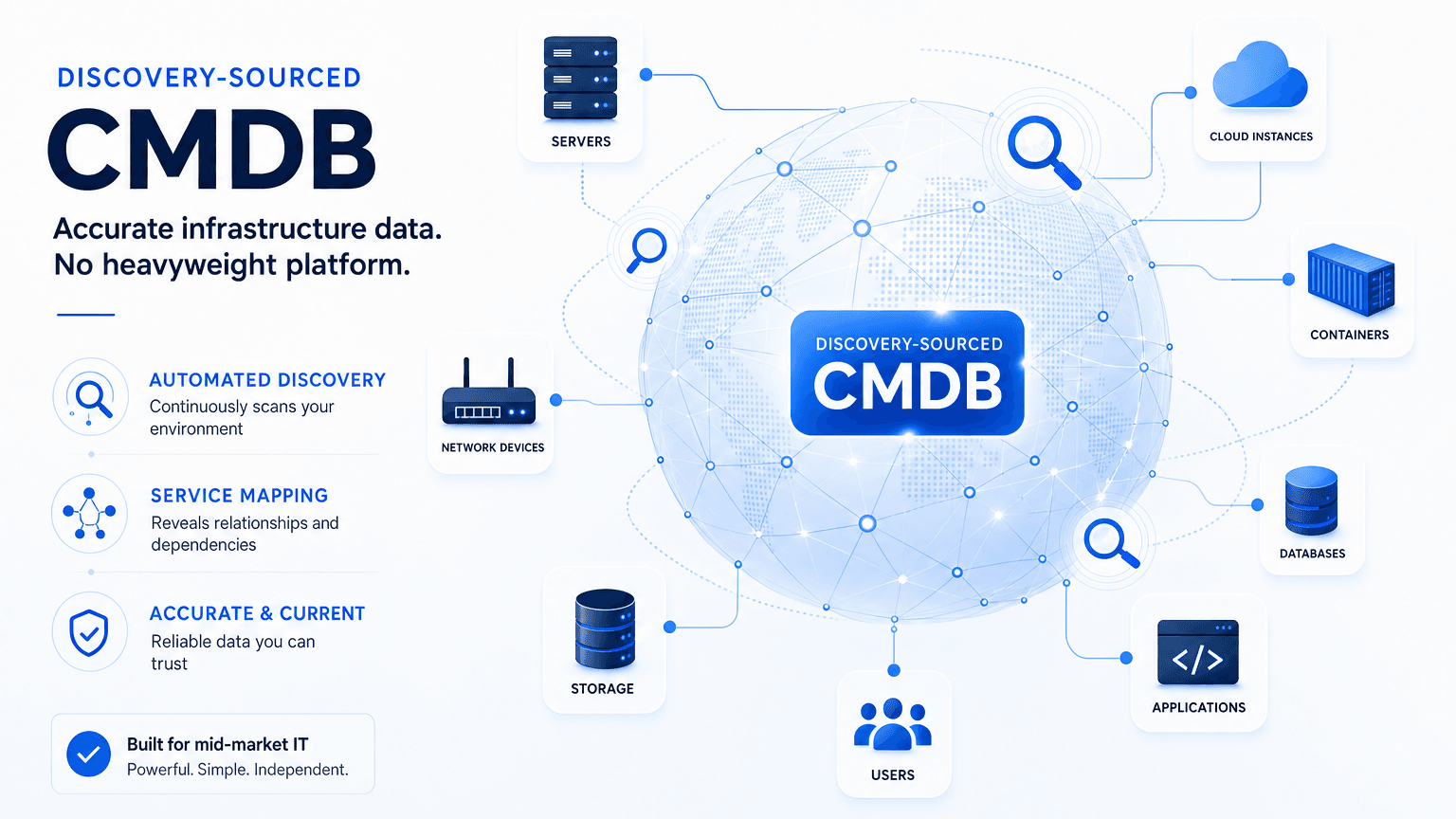
Mid-market IT teams need infrastructure truth without enterprise platform overhead. A CMDB without ServiceNow is a standalone, discovery-sourced configuration database that holds accurate CI and dependency data independent of any ITSM platform — and for growing IT teams, building one is often the practical choice.
Why mid-market IT hits the CMDB ceiling without ServiceNow
Mid-market infrastructure environments grow faster than the teams managing them. A 500-employee company often runs the same architectural complexity as an enterprise estate. Cloud instances, virtual hosts, on-premise hardware, SaaS integrations, and remote endpoints interact constantly.
Basic asset management tools record purchase dates and serial numbers. They fail when IT needs to know which application runs on a specific virtual machine. They cannot show which business unit relies on a database cluster.
According to the Flexera 2026 State of ITAM Report, only 31% of IT organizations report complete visibility into their IT assets. For mid-market teams, that visibility gap creates operational friction.
Change risk increases because technicians approve updates without seeing downstream dependencies. Incident response slows down because engineers spend hours tracing connection paths during outages. Audit preparation turns into a manual reconciliation drill.
ServiceNow built a market around solving these issues within a single connected platform. For mid-market teams not already running that platform, adopting it solely to obtain a CMDB introduces high licensing fees and heavy administrative requirements — and it means paying for the per-module and per-agent licensing tiers that make platform suites expensive to scale as node count grows. For organizations already invested in ServiceNow, Virima integrates directly with it, enriching the existing CMDB with discovery-sourced ground truth rather than asking teams to rip it out.
What holding truth requires at mid-market scale
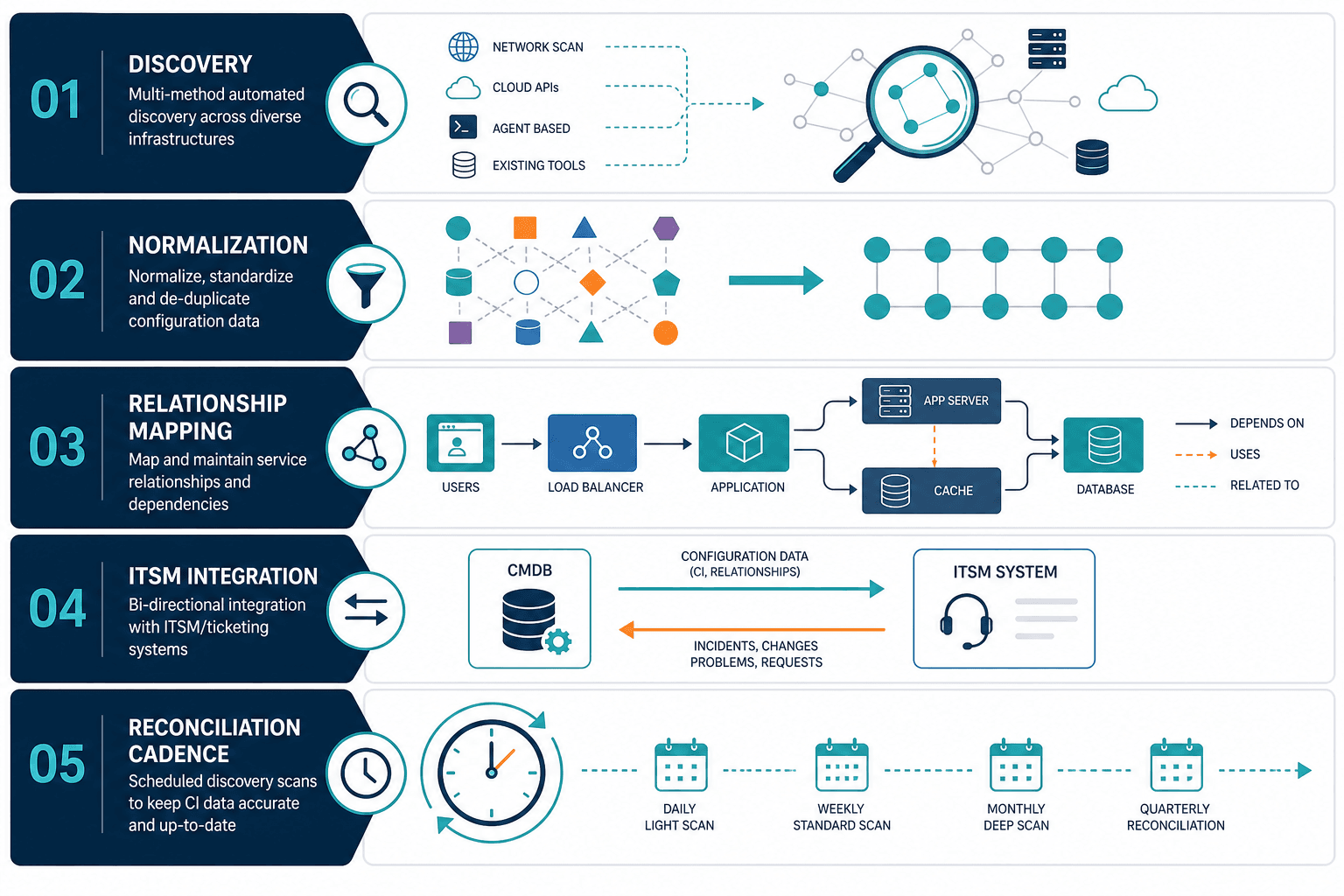
A CMDB maintains value only when its data reflects current operational reality. Five technical requirements determine whether a configuration database holds truth at mid-market scale.
- Multi-Method Automated Discovery
Manual data entry cannot keep pace with dynamic infrastructure. A mid-market CMDB requires automated discovery across on-premise servers, virtual environments, network infrastructure, and cloud accounts. Discovery must combine agentless network scans using standard management protocols (SNMP, WMI, SSH), lightweight local agents, and direct cloud API queries. - Data Normalization and De-Duplication
Multiple discovery sources often report the same physical host with minor attribute variations. The CMDB must normalize hostnames, MAC addresses, serial numbers, and IP assignments into unified configuration item (CI) records. - Service Relationship Mapping
Storing CIs in isolation provides limited operational context. The CMDB must map dependencies between physical hardware, hypervisors, operating systems, databases, and business applications. - Bi-Directional ITSM Integration
An isolated CMDB becomes a static repository. Configuration data must flow directly into ticketing systems, change management workflows, and service desks. When a technician opens an incident, configuration data must populate the ticket automatically. - Scheduled Reconciliation Cadence
Infrastructure state changes daily. According to CISA Binding Operational Directive 23-01, automated discovery scans should run on a predictable, recurring schedule to maintain accurate asset inventories. Mid-market CMDBs need that same high-frequency discovery cadence to keep CI records current.
Can mid-market IT teams run an accurate CMDB without ServiceNow?
Yes. Mid-market IT teams can run an accurate CMDB by deploying standalone discovery-sourced CMDB software. These systems combine agent, agentless, and API discovery to maintain configuration item records and service dependency maps without requiring an enterprise ITSM platform suite.
Where standalone CMDB software options break down
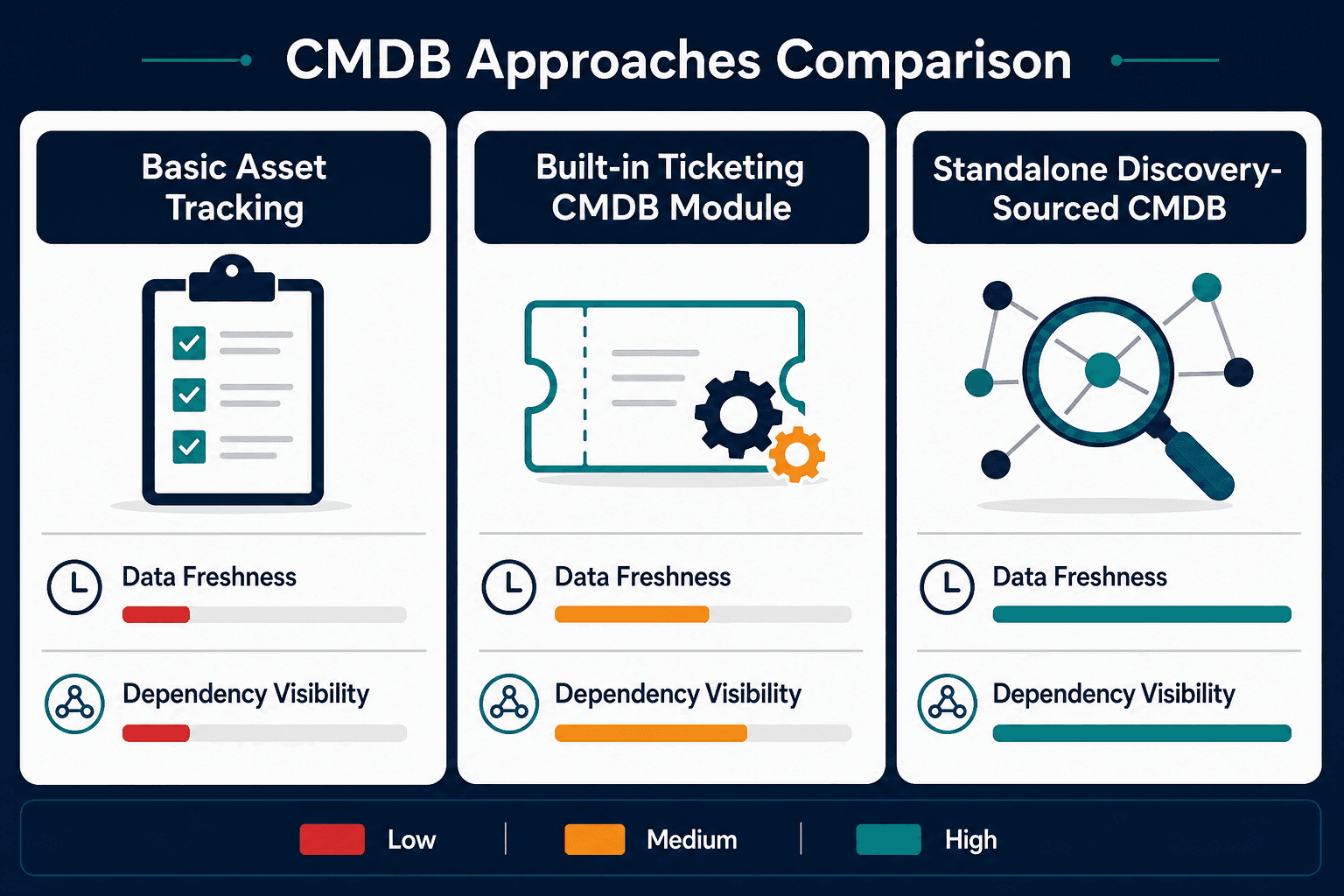
Teams evaluating a ServiceNow alternative for CMDB alone typically land on one of two lighter options: basic asset tracking tools, or manual CMDB modules built into mid-market ticketing systems. Both approaches hit specific operational limits. Teams that have already compared ServiceNow-based options for this reason can see how ten of them stack up in our breakdown of ServiceNow CMDB alternatives.
Standalone asset tracking tools
Basic inventory tools capture hardware specifications and software installations. They track serial numbers, IP addresses, and user assignments.
Their limitation is context. They record that a server exists, but cannot show which application relies on its database. When that host requires maintenance, IT cannot predict which business functions will experience downtime.
Built-in ticketing CMDB modules
Many mid-market ITSM products include a native CMDB module. These modules store configuration records, but rely heavily on manual data entry or basic CSV imports.
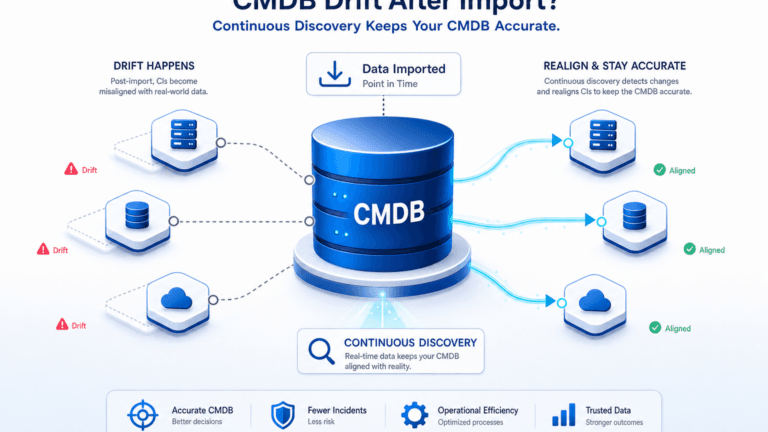
Without automated discovery feeding the database, CI records decay within weeks of initial import. Technicians update tickets, but the underlying infrastructure records reflect past states rather than current reality.
Mid-market teams need a solution between basic inventory spreadsheets and heavy enterprise platforms. The goal is automated discovery and service mapping delivered as a standalone capability.
How Virima delivers discovery-sourced CMDB truth without the platform tax
Virima provides a standalone, discovery-sourced CMDB designed to integrate with existing mid-market IT stacks. Rather than forcing platform consolidation, Virima supplies authoritative infrastructure data to the tools your team already uses.
Multi-protocol IT asset discovery
Virima deploys flexible discovery mechanisms tailored to heterogeneous infrastructure:
- Agentless Discovery: Scans network subnets using standard management protocols (SNMP, WMI, SSH) to detect servers, network switches, storage arrays, and connected endpoints.
- Agent-Based Discovery: Deploys lightweight agents to remote, off-network, or security-restricted hosts that agentless probes cannot reach.
- Cloud and API Connectors: Integrates directly with AWS, Azure, and identity providers to map virtual assets and cloud resources.
For deeper technical context on discovery methods, read our guide on the four major approaches of IT asset discovery.
Discovery, on its own, is only the first step. Turning discovered data into a CMDB your team can act on follows a consistent sequence:
- Discover — agentless, agent-based, and API scans identify every CI across on-premise, virtual, and cloud infrastructure.
- Normalize — duplicate reports of the same host are merged into a single, de-duplicated CI record.
- Map — normalized CIs are linked into service dependency maps showing what depends on what.
- Integrate — CI records, dependencies, and change history flow into your existing ticketing and service desk tools.
ViVID™ service maps
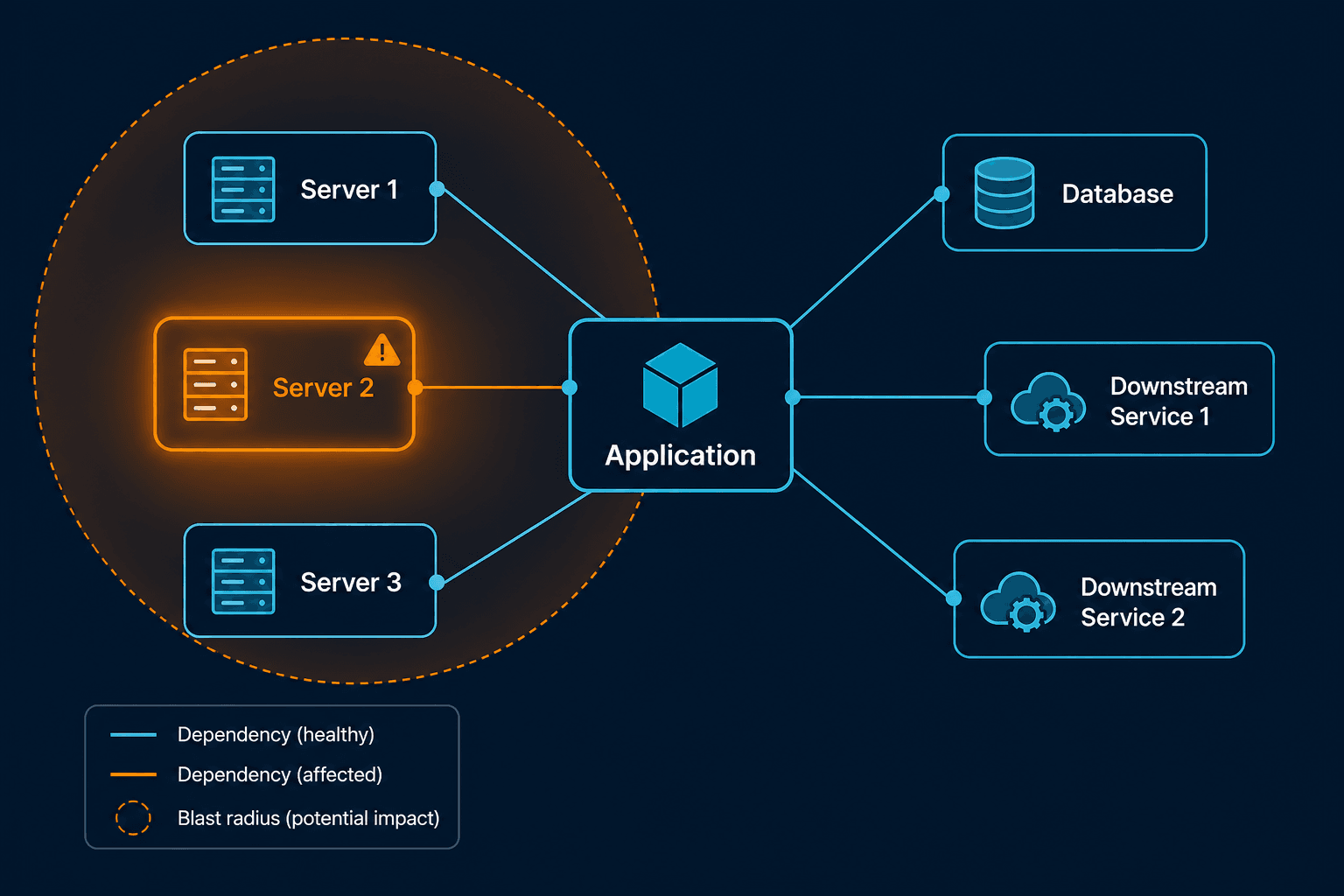
Once CIs are discovered and normalized, Virima builds visual dependency maps using ViVID™ service maps.
After IT teams define service boundaries, ViVID™ constructs dynamic relationship maps linking applications, underlying servers, network components, and database instances. Blast radius is the set of services and dependencies a single change or failure can affect — and it’s exactly what stays invisible without a service map. Technicians view blast radius projections before approving change requests, reducing unintended service disruptions.
Learn more about how Virima structures configuration data on our CMDB feature page.
Open integration hub
Virima is an infrastructure context layer between discovery and your ITSM tools. Through its integrations hub, Virima connects with mid-market ITSM platforms including Jira Service Management, Ivanti, HaloITSM, Xurrent, Hornbill, and TeamDynamix.
Configuration data, dependency maps, and change history populate directly within native ticketing screens. Technicians receive current infrastructure context without leaving their primary interface.
What discovery methods does a standalone CMDB require?
A standalone CMDB requires a combination of agentless network scanning, lightweight agent-based discovery, and direct cloud API integrations. This hybrid approach ensures complete coverage across on-premise hardware, remote endpoints, virtual environments, and cloud infrastructure.
What this looks like for growing IT estates
Growing IT estates need software that fits their operating scale without requiring dedicated administrative staff. Virima packages full enterprise-grade discovery and CMDB capabilities for mid-market IT through Virima Business Pro. Mid-market teams receive:
- Complete discovery coverage across physical, virtual, and cloud CIs
- Native ViVID™ service maps
- IT asset management
- Vulnerability data from NVD lookups
- Pre-built ITSM integrations
As node count grows from a few hundred to a few thousand, discovery capacity scales with the estate instead of forcing a re-platforming project or a new licensing negotiation.
Teams that started on a built-in ticketing CMDB module and outgrew it face a similar decision to teams evaluating ServiceNow for the same purpose. Our comparison of CMDB software for ServiceNow users walks through that migration path in more detail.
Rather than forcing complex licensing tiers or self-serve feature restrictions, Virima aligns discovery capacity directly to your estate size. To see how Virima fits your current infrastructure scale, explore our trusted runtime truth capabilities.
How does Virima integrate with existing ITSM tools?
Virima integrates with ITSM platforms through pre-built API connectors. It feeds discovery-sourced CI records, relationship dependencies, and service maps into ticket workflows across platforms like Jira Service Management, Ivanti, and HaloITSM without replacing the existing ticketing desk.
Before you build on an unstable CMDB foundation
Running an accurate CMDB does not require an enterprise platform commitment. By separating automated discovery and service mapping from the ticketing desk, mid-market IT teams gain infrastructure visibility while maintaining a lean operating model. That separation is what prevents the three-service outage from the opening scenario. When discovery runs independently of the ticketing desk, the dependency map is already current before the incident starts, not rebuilt during it.
Virima provides the discovery-sourced data foundation that closes that blind spot: it cuts change risk first, and faster incident response and stronger audit readiness follow from the same accurate CI data. That’s what a CMDB without ServiceNow for mid-market IT looks like in practice — infrastructure truth without platform overhead.
Frequently Asked Questions
What is a CMDB without ServiceNow?
A CMDB without ServiceNow is a standalone configuration management database that operates independently of the ServiceNow platform. It uses automated discovery tools to identify infrastructure assets, map dependencies, and supply accurate CI data to any ticketing desk or ITSM framework.
Can mid-market IT teams maintain CMDB accuracy without a full ITSM suite?
Yes. CMDB accuracy depends on automated discovery and reconciliation, not the ticketing suite surrounding it. Standalone discovery engines run high-frequency scheduled scans to maintain accurate CI records regardless of which ITSM platform handles incident tickets.
What discovery methods does a standalone CMDB need?
A standalone CMDB requires agentless network scanning, lightweight local agents, and direct cloud API connectors. Combining these three methods ensures complete visibility across physical servers, network hardware, remote laptops, hypervisors, and cloud environments.
How does Virima integrate with ITSM tools if we add or change one later?
Virima operates as an independent infrastructure data layer. Because CI records and service maps live in Virima, changing or upgrading your ITSM tool does not require rebuilding your discovery engine or re-mapping infrastructure dependencies.
Is Virima a ServiceNow alternative or a complement?
Virima can serve as a standalone CMDB for teams without ServiceNow, or as an authoritative discovery and service mapping complement for organizations using ServiceNow or other ITSM platforms. It augments existing workflows with discovery-sourced runtime truth.