CMDB Project Management for Non-Technical Leads | Virima

A CMDB project can meet its launch date while leaving the service desk unsure which records to trust. The project may have a configured platform and completed workshops, yet ownership and data gaps can remain unresolved.
CMDB project management for non-technical leads means owning those decisions, not the configuration. Core CMDB project lead responsibilities include defining project scope, naming accountable owners, demanding evidence of data quality, and confirming a workable handover to operations before anyone calls the project done.
Choose the decision the CMDB should support
A configuration management database, or CMDB, holds records of selected technology components and their relationships. Each component record is called a configuration item, often shortened to CI.
A CI might represent an application, server, database, or network device. Relationships describe connections such as an application depending on a server.
Start by asking the sponsor which operational decision should improve. The answer determines which records and relationships deserve attention first.
A service desk might need to identify an application owner during an incident. A change reviewer might need to inspect the infrastructure supporting a business service before maintenance.
Turn the chosen outcome into a task that someone can test:
A service desk analyst can identify the owner and supporting infrastructure for the selected application during incident triage.
Name the service, the intended users, and the teams that maintain its components. Then list what remains outside the initial release.
The project team can expand later, once the first group of users has tested the records. A defined boundary also makes it easier to explain why a requested addition needs separate review.
The NIST Cybersecurity Framework 2.0 calls for maintained inventories of managed hardware and software. Your project scope determines which information the CMDB can contribute to that wider inventory effort.
CMDB stakeholder roles: give each decision an accountable owner
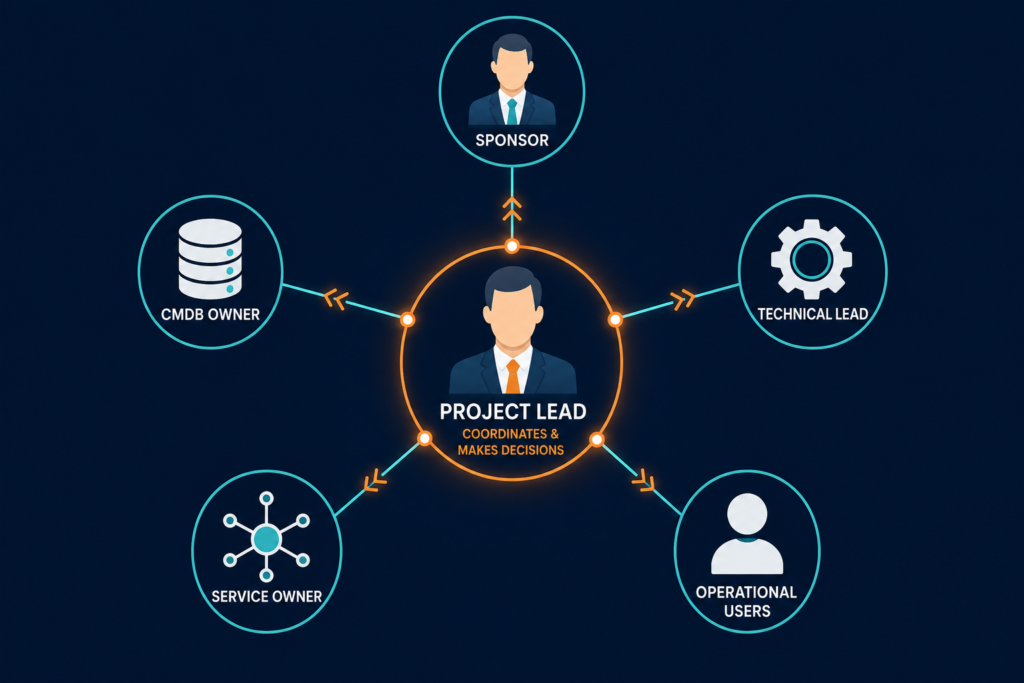
CMDB project lead responsibilities center on coordination: the lead keeps the schedule, decision log, dependencies, and escalation path moving, while technical specialists configure the systems and assess the data. Record who can approve decisions, who supplies evidence, and who accepts the result.
Defining CMDB stakeholder roles clearly up front prevents later disputes over who approves what. Use the following roles as a starting point:
- Executive sponsor — approves the outcome and resolves conflicts over resources or priorities.
- Project lead — maintains the schedule, decision log, dependencies, and escalation path.
- CMDB owner — approves data rules and accepts responsibility for ongoing maintenance.
- Technical lead — coordinates discovery access, configuration, record matching, and technical testing.
- Service owner — confirms the business service, its ownership, and relevant dependencies.
- Operational users — test whether records support an incident, change, or asset-management task.
A person may hold several roles if they have enough time and authority. Ask each owner to confirm their availability and name a backup for key reviews.
An absent service owner can delay validation even when technical configuration is complete. Raise that dependency with the sponsor before the testing milestone.
Atlassian’s 2025 State of Teams survey found that leaders and teams spend 25% of their time searching for answers. The survey covers knowledge work broadly, rather than CMDB projects specifically.
A shared decision log gives this project one place to find agreed owners, open questions, and approval dates. It also gives a new stakeholder enough context to understand why the team chose a particular scope.
Who resolves a disagreement between CMDB project owners?
A configuration management database (CMDB) project should assign an escalation owner before disagreements arise. If service and technical owners cannot agree, the project lead records the competing options and their consequences. The sponsor can then decide which outcome takes priority and document the decision for later reviews.
Write a first-release agreement
A first-release agreement gives the team a common reference when scope requests arrive. Keep it short enough for the sponsor and operational owners to review together.
The agreement should name the selected service and the business task it supports. It should also identify the record types and relationships needed for that task.
Ask the technical lead to list the environments and data sources included. Ask the service owner to confirm whether those boundaries cover the intended operational use.
Record the following items alongside the scope:
- Required owners — name the people who maintain the service and its records.
- Access dependencies — identify credentials, permissions, and approvals needed for discovery.
- Acceptance criteria — define what users must find or verify during the test.
- Known exclusions — list environments and record types deferred to later work.
- Decision authority — name the person who approves changes to the release scope.
For example, the first release could cover one customer-facing application and its supporting infrastructure. The test could ask an analyst to find the application owner and review its recorded dependencies.
If the technical lead cannot access a relevant environment, record that gap before launch. The sponsor and service owner can then decide whether the release remains useful within its documented limits.
The real CMDB benefits for ITSM and why most teams aren’t seeing them yet to work through these five items with your own sponsor and service owner before scheduling a kickoff.
Virima’s Trusted Runtime Truth describes discovery-sourced information about what exists, how it connects, and who owns it. It also includes context about changes and potential impact, subject to the information available.
Explore Trusted Runtime Truth to review how that information can support operational decisions.
CMDB project management for non-technical leads: five data questions to ask your technical team
The technical lead can explain the implementation choices without expecting the project lead to configure them.
EMA’s 2026 ITAM AI maturity benchmark found that 65.5% of organizations still populate their CMDB at least partly by hand. That gap is exactly what these five questions are meant to surface.
Which environments can the team inspect?
Ask for a list of networks, systems, and cloud accounts included in discovery. Record environments excluded by missing access, credentials, or security approval.
A discovery result reflects the areas the team could inspect. Include both covered areas and known gaps in the project status report.
Which source supplies each important field?
Several systems may hold information about the same component. An inventory system may supply a serial number, while a service owner confirms business ownership. Completeness alone is the wrong signal when two sources disagree on that value.
Ask the CMDB owner to document which source takes precedence for each required field. Record who reviews a conflict when two sources provide different values.
How will the team match records?
A matching rule helps determine whether two sources describe the same component. Ask the technical lead to explain which identifiers apply to each record type.
A hardware serial number or cloud instance ID may support matching where applicable. Hostnames can change or be reused, so they should not serve as durable join keys alone.
How often will the records be refreshed?
Agree on scheduled discovery cycles for the environments included in the release. The technical lead should identify who investigates failed cycles and access problems.
Some fields also need human input or another source. Business ownership, for example, needs an assigned maintenance process.
What happens when sources disagree?
A conflict needs an owner and a route to resolution. Ask the team to demonstrate how an exception is recorded, reviewed, and closed.
The project lead should track unresolved conflicts that affect the acceptance test. The CMDB owner can decide whether each issue blocks the release or requires a documented follow-up.
How can a project lead identify a discovery coverage gap?
For a configuration management database (CMDB) project, compare the agreed environment list with the areas discovery can access. Record missing credentials, denied permissions, and excluded networks beside their accountable owners. A discovery report without those limitations cannot show stakeholders which portions of the agreed scope remain unverified.
CMDB rollout planning: set milestones that produce reviewable evidence
CMDB rollout planning works best when each milestone produces something reviewable, not just a status update. A project plan should tell stakeholders what they can inspect at each milestone. So each milestone needs a specific piece of evidence, and dates should depend on access, available staff, technical complexity, and the selected scope — not just a date on the calendar.
| Milestone | Accountable owner | Evidence reviewed |
|---|---|---|
| Scope approval | Sponsor | Target task, selected service, exclusions, and named owners confirmed; technical lead documents access dependencies |
| Data rules approval | CMDB owner | Required fields, source priorities, matching rules, and conflict process accepted; unresolved choices recorded with decision dates |
| Initial record review | Service owners | Sample records from the agreed environment compared against systems the service owner already knows |
| Operational testing | Operational users | Agreed incident or change task performed; required ownership and dependency information confirmed available |
| Operating handover | CMDB owner, with sponsor review | Maintenance process, support contacts, and open issues accepted; exceptions reviewed before closing the project phase |
For technical detail, use the step-by-step CMDB guide. It covers discovery, reconciliation, ownership, and phased rollout.
Ask each milestone owner to bring evidence to the review. Useful examples include an access-gap list, reviewed record samples, and the result of a user test.
A milestone can remain open when the evidence does not support acceptance. Record the missing item, its owner, and the next review date.
Maintain a decision and risk log
A shared log helps the team avoid revisiting decisions without new evidence. It also shows the sponsor which issues need intervention.
For each decision, record the question, agreed outcome, approver, and date. Include any condition that could change the decision later.
Suppose two systems identify different owners for an application. The CMDB owner can select the preferred source and assign someone to review exceptions.
If neither source is reliable, record the unresolved issue and a decision deadline. The release owner can then assess whether the gap affects the operational test.
A risk entry should describe the consequence, the responsible person, and the next action. For example, missing network access may leave part of the selected service unverified.
When someone requests another service, check the effect on owners, access, testing, and handover. The sponsor can approve a change once the team has documented those effects.
Test the records with operational users
Record counts show how much information entered the CMDB. They do not show whether an analyst can find the right owner during an incident.
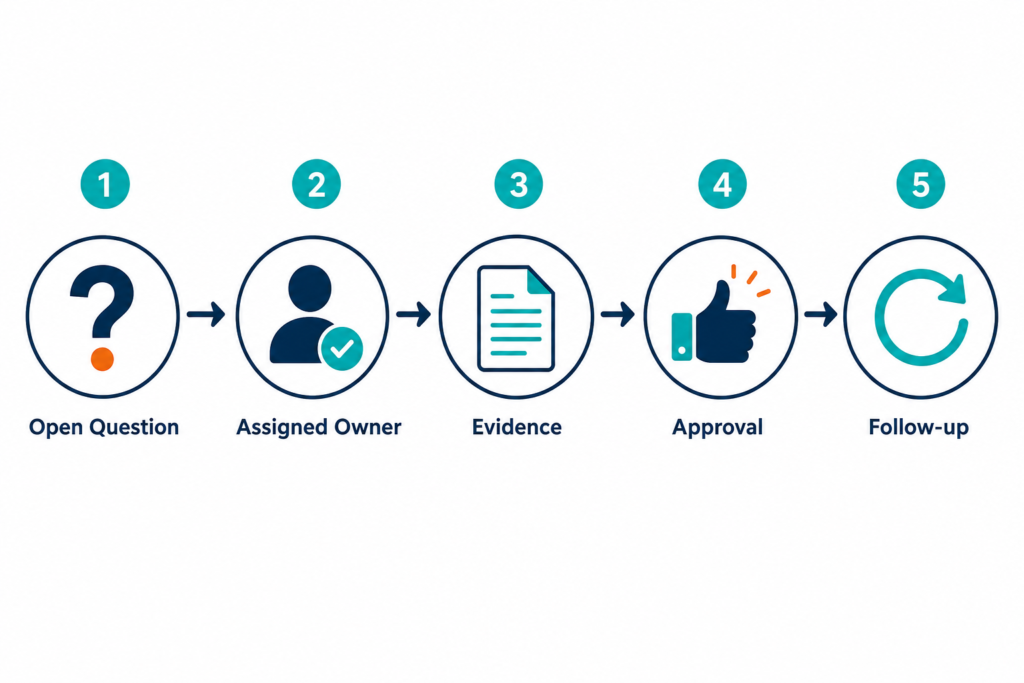
Invite operational users to perform the task from the first-release agreement. Ask the service owner to observe and verify the result.
For an incident test, an analyst can locate the application and identify its recorded owner. The analyst can then inspect the supporting components included in the agreed scope.
For a change test, a reviewer can inspect recorded dependencies before proposed maintenance. The service owner should confirm whether those relationships match the agreed service definition.
Set acceptance criteria before the session so reviewers know what to check. Criteria can cover required fields, known access gaps, reviewed relationships, and open errors. For example, the team might require that every in-scope CI has a named business owner and that at least 95% of recorded dependencies are confirmed accurate before accepting the release.
Choose thresholds with the people accountable for the result. Also agree on who can accept a known limitation and when the team will review it again.
If the test exposes an incorrect owner, assign a correction to the appropriate source owner. Repeat the affected part of the test after the correction.
What should happen when a CMDB user test fails?
A failed configuration management database (CMDB) user test should produce a specific issue and an accountable owner. Capture the task, the record examined, the expected result, and the observed gap. After the source owner corrects the information, repeat the affected task before accepting that part of the release.
Prepare the team for ownership after launch
A handover should give the CMDB owner a working process for maintaining the agreed scope. It should also identify the people who can resolve problems after the project team closes.
Document who reviews record quality and who investigates failed discovery cycles. Service owners should know how to report changes to business ownership and service definitions.
The technical lead should provide discovery schedules, access dependencies, and support contacts. The CMDB owner should accept the exception process and the list of unresolved issues.
Name the time commitment for the CMDB owner role explicitly, not just the person. A CMDB owner assigned at a nominal 10% allocation with no calendar time for reviews will fall behind the moment discovery coverage changes or a new service is added. Record the expected weekly or monthly time commitment in the decision log alongside the name, so the sponsor can see the gap if the role is under-resourced after the project team leaves.
Virima supports scheduled discovery across supported environments and reconciliation from multiple sources, working alongside the ITSM platform your team already uses rather than replacing it. Its CMDB health scoring can help teams review completeness, accuracy, and staleness.
Those capabilities still require configured access and people who review the results. The project plan should account for that work before the handover meeting.
If the team uses ViVID™ service maps, someone must provide the service definitions first. Virima can then build dependency maps from those definitions and available discovery data.
Ask service owners to validate the resulting map against the agreed release scope. Record any missing relationship as an issue with an owner and a review date.
Before closing the project, walk through one operational exception with its future owner. A failed discovery cycle is a useful test of the support route.
Confirm who receives the alert and which team can restore access. Place the answer with the other operating procedures where the support team can find it.
Use the first release to plan the next one
The sponsor should receive a concise summary of the completed operational test. Include the service covered, known limitations, open issues, and accepted maintenance responsibilities.
The CMDB owner can use that evidence to recommend the next increment. An access gap may need resolution before the team adds another environment.
Alternatively, users may need additional relationships for the same service. Review the added maintenance effort before committing those items to a new release.
Across each increment, the same test applies: a CMDB is only valuable to the business if the people who rely on it during an incident or a change can trust what it says. That’s the real work of CMDB project management for non-technical leads — not configuring the platform, but making sure every future release still passes that test.
Put this into practice: Go through the How to Build an AI-Ready CMDB Checklist for 2026 to document scope, assign owners, and track evidence against your own rollout. When you’re ready to talk through a specific environment, schedule a project-focused demo.
Frequently Asked Questions
What should a non-technical CMDB project lead do first?
Agree on the operational task the first release must support. Then name the sponsor, CMDB owner, technical lead, service owner, and user who will test that task. Document the initial scope and exclusions before setting detailed milestones.
How much technical knowledge does a CMDB project lead need?
A project lead should understand configuration items, relationships, discovery, and data sources. Technical specialists remain responsible for configuration and system-level decisions. The lead coordinates their work and asks for evidence that stakeholders can review.
Who maintains the CMDB after a project closes?
The organization should appoint a CMDB owner before the first release. That owner coordinates data rules and quality reviews. Technical teams and service owners maintain their assigned sources and records under the agreed operating process.
How can Virima help teams review CMDB data quality?
Virima provides CMDB health scoring for accuracy, completeness, and staleness. Teams can review those measures alongside record samples and operational tests. They should assign owners to investigate gaps and decide how corrections will be made.
Does Virima automatically define business services for a project?
Customers provide the definitions of their business services, including the applications or websites involved. Virima can then build dependency maps using those definitions and available discovery information. Service owners should review the maps against the agreed project scope.