Warsaw’s E-commerce Gateway Is Outgrowing Its CMDB: Here’s What That Costs You

On Cyber Monday 2025, Shopify hit an hours-long outage that locked many merchants out of admin and point-of-sale tools, even though storefronts and checkout stayed up. It took far less than a full platform blackout to leave operators unable to manage inventory, orders, or store systems at the exact moment demand peaked.
Poland’s own online peak sits in the same November–December window. The U.S. International Trade Administration notes that online shopping demand concentrates around Christmas, and Warsaw sits at the center of fulfillment, marketplace, and cross-border logistics work that serves domestic buyers and much of Central and Eastern Europe. For e-commerce and logistics IT teams here, the lesson is operational. Blind spots in configuration records surface when warehouse management, ERP, carrier APIs, and cloud burst capacity are under the most pressure.
A CMDB for e-commerce IT infrastructure in Warsaw has to keep pace with multi-site estates that change faster than quarterly spreadsheet reviews. When it does not, change boards, incident desks, and compliance leads work from maps that no longer match the floor.
What is a CMDB for E-commerce IT Infrastructure?
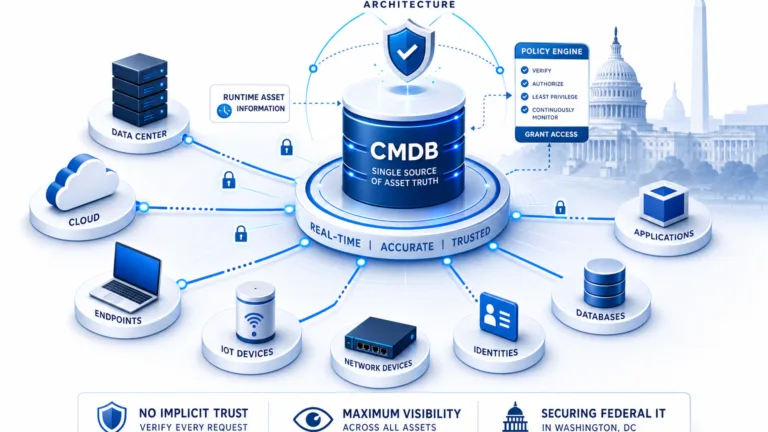
In ITIL service management, a configuration management database holds configuration items (CIs) and their relationships so teams can plan changes, diagnose incidents, and prove control of the estate. In e-commerce and logistics stacks, those CIs aren’t limited to laptops and racks. They include storefront and marketplace platforms, payment and fraud services, ERP and order management, warehouse management systems (WMS), sortation and packing lines, carrier and customs integrations, identity and access paths, and the hybrid mix of on-premises and public-cloud compute that runs them.
NIST SP 800-145 defines cloud deployment and service models that most Warsaw gateway operators already use in practice: private capacity in regional facilities, public burst for peak campaigns, and hybrid combinations that move workloads as demand shifts. A useful CMDB for that pattern needs CI classes that cover both sides of the hybrid line. It also needs ownership and environment tags that survive handoffs between warehouse and HQ teams. And it needs relationship data that shows which payment path, WMS node, or carrier API sits downstream of a given host or service.
A CMDB and a discovery tool are not the same thing: discovery finds and fingerprints what is running across the estate, while the CMDB is the governed system of record with ownership, lifecycle, and service context that discovery populates.
Core requirements for e-commerce and logistics IT look concrete on the ground:
- CI classes for storefront, ERP, WMS, network, security, and cloud resources, with owners and last-seen evidence
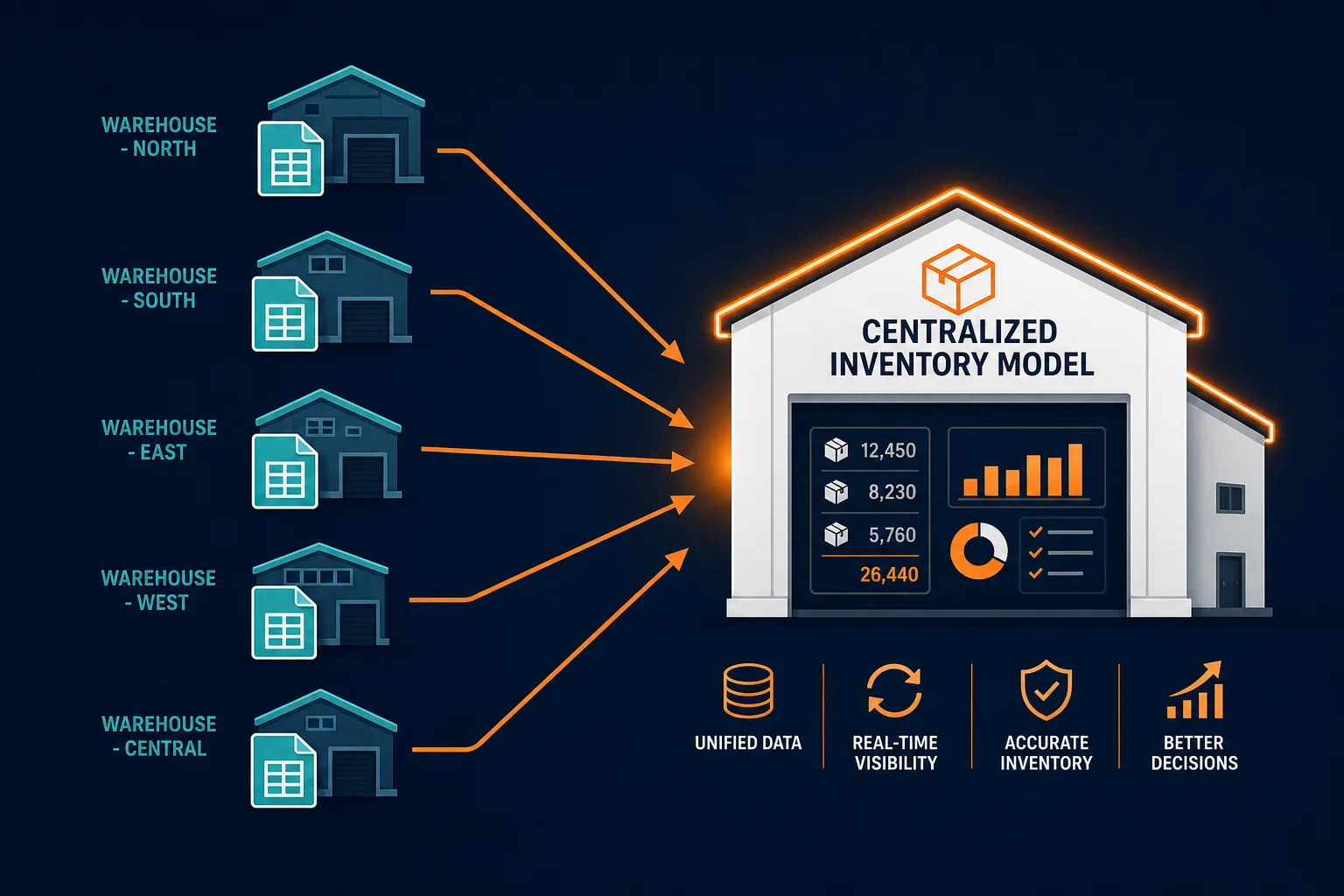
- Cross-site reconciliation so three fulfillment nodes do not mean three incompatible inventories
- Parity between on-premises and cloud records so burst capacity is not invisible to change and incident processes
- Dependency context that answers which business service fails when a database host, message queue, or edge device fails
Those requirements are not academic. Peak season, multi-warehouse ops, and regulatory inventory work often land in the same calendar week in Warsaw, and that is why a CMDB matters. Change boards, incident desks, and compliance leads all need one accurate estate record at once.
In practice, that means the pick-to-pack workflow inside a WMS instance shows up as a dependency on a specific carrier label-printing API, not as a generic “network” entry lost in a spreadsheet column.
The Hidden Problem
| Situation | What Happens |
|---|---|
| Multiple Warsaw-area fulfillment centers provisioned by different regional teams over time. | No single accurate inventory exists across the network. |
| E-commerce platforms burst onto public cloud only during Nov-Dec peak. | Cloud instances spin up and down faster than manual CMDB updates can track. |
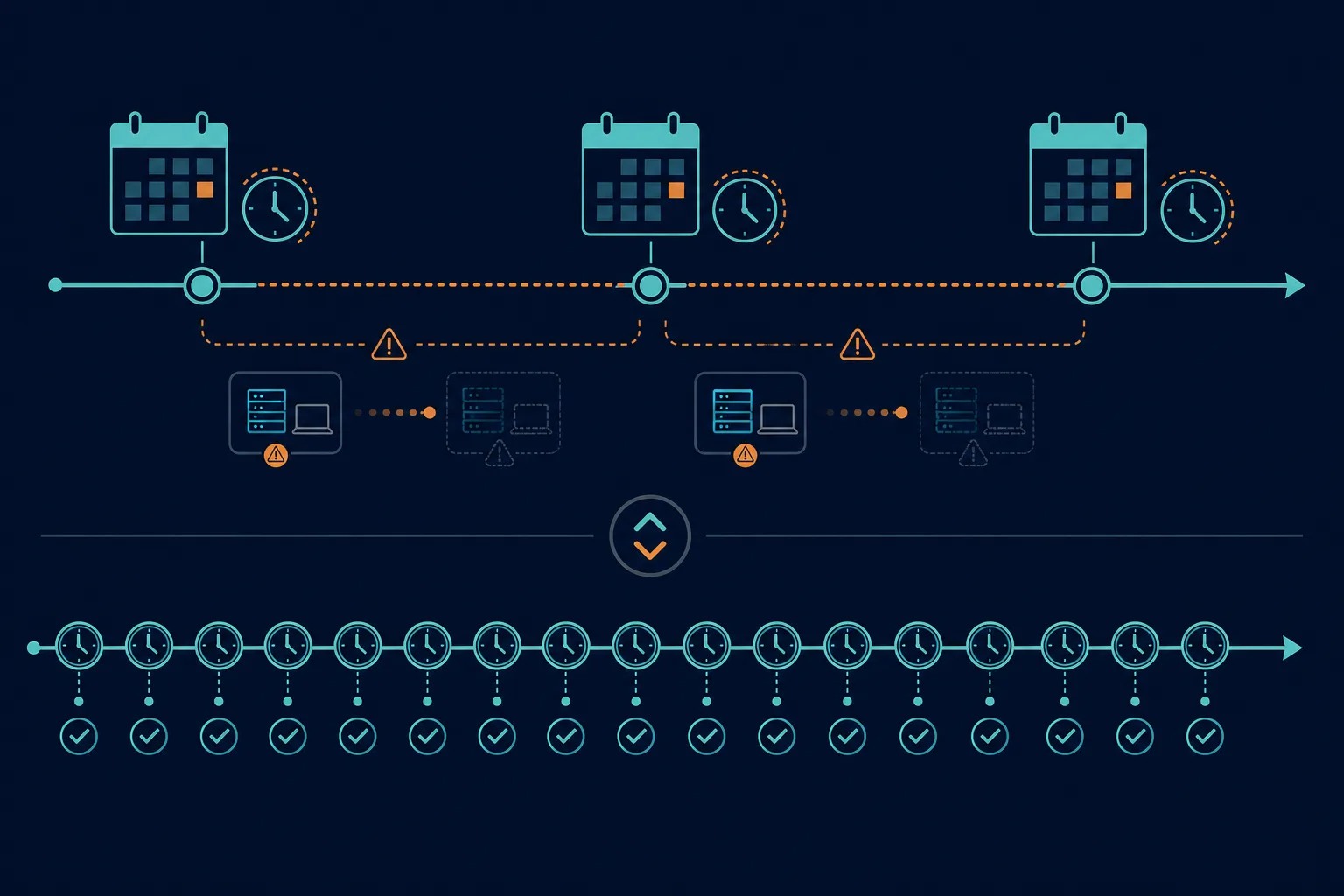
| ERP, WMS, and ITSM ticketing reconciled quarterly by hand. | Drift compounds for weeks; a change gets approved against stale dependency data. |
| Cross-border carrier integrations span EU and non-EU systems. | Nobody has a current map of which systems talk to which. |
Why CMDB Matters for Warsaw’s E-commerce and Logistics Gateway Role
Poland’s modern industrial and logistics stock is large enough that IT cannot treat each shed as an island. At the end of Q1 2026, total modern industrial and logistics stock reached 37.4 million sqm, based on figures published through the Polish Chamber of Commercial Real Estate (PINK) and advisory firms including CBRE, Colliers, Cushman & Wakefield, JLL, and others. Mazowieckie, the voivodeship that includes Warsaw, held the largest regional share at 7.48 million sqm. Gross take-up in that quarter alone reached 1.58 million sqm nationwide, with Mazowieckie again among the strongest demand centers.
That physical scale shows up as IT scale: more WMS instances, more edge devices on the floor, more carrier and customs integrations, and more hybrid cloud capacity rented for campaigns. E-commerce itself keeps growing. Trade.gov’s Poland e-commerce guide puts the market at about $25 billion in 2024, with further growth expected through the decade, and flags November-December as the seasonal peak. For teams running fulfillment and marketplace platforms out of the Warsaw metro, the CMDB is the record that is supposed to keep those systems legible while the estate expands.
Outage economics make incomplete records expensive. In Uptime Institute’s Annual Outage Analysis 2026 press release, 57% of respondents said their most recent major outage cost more than $100,000, and for the second consecutive year, one in five reported costs above $1 million. Those figures are industry-wide, not Warsaw-specific, but they map cleanly onto gateway operators whose revenue and service levels concentrate in short seasonal windows.
Four Failure Modes
- Peak-season cloud burst capacity is not captured until the next scheduled review.
Result: CAB approves changes against a dependency map that already lags the live estate. - Multi-warehouse infrastructure lives in per-site spreadsheets, not one reconciled record.
Result: IT cannot state what a single outage would take down network-wide. - NIS2 and KSC Act asset-inventory work is treated as a compliance-only exercise, disconnected from daily operations.
Result: The inventory built for a registration or audit deadline decays within weeks. - ITSM platforms run without a discovery-sourced CMDB feeding them.
Result: Incidents get resolved on institutional memory, not on what is actually running.
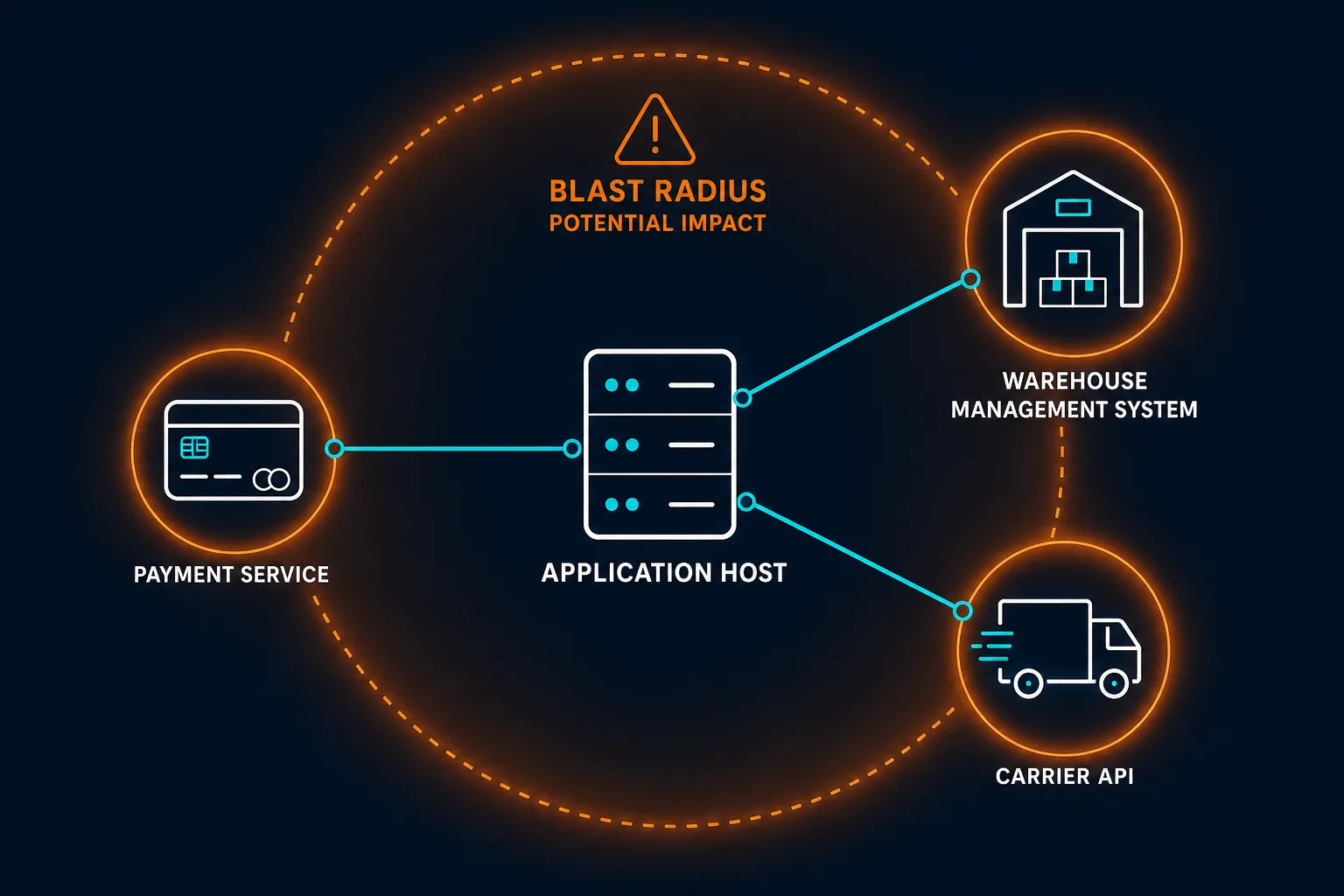
Hybrid cloud asset management and AWS and Azure CMDB discovery matter here because Warsaw gateway estates rarely sit in one place. Retail and logistics burst patterns, on-prem WMS, and public-cloud campaign capacity all have to land in the same authoritative model if change and incident work are going to stay honest.
Who Pays When Warsaw’s E-commerce Gateway Runs on an Unmapped CMDB?
For CTOs
Architecture and scale decisions assume someone can name the runtime path from storefront to pick face. When hybrid cloud, multi-warehouse WMS, and cross-border APIs drift out of the CMDB, the CTO inherits risk that looks like delivery delays, failed changes, and unexplained blast radius. ITIC’s 2024 Hourly Cost of Downtime research found that the average cost of a single hour of downtime exceeds $300,000 for over 90% of mid-size and large enterprises, excluding litigation and penalties. Gateway operators do not need a full-day outage for that math to matter during peak week.
For CMDB Owners and Configuration Managers
The day-to-day cost is quieter. It is the hours spent reconciling site exports, chasing owners for systems that no longer exist, and defending CAB packs built on last quarter’s diagram. Every new fulfillment node or peak-season cloud project widens the gap between the spreadsheet and the floor. The CMDB owner becomes the person who knows the record is wrong and still has to operate it.
For Compliance and Security Leaders
NIS2 widens EU cybersecurity duties across critical and important sectors, including postal and courier services and broader digital services such as online platforms. Poland transposed the directive by amending the Act on the National Cybersecurity System (Polish: ustawa o krajowym systemie cyberbezpieczeństwa, commonly the KSC Act). Bird & Bird reports that the amendment entered into force on 3 April 2026, with transitional periods for some obligations and material penalty risk for non-compliance.
The CMDB is the infrastructure inventory layer those risk-management and asset-control expectations assume exists. It does not replace risk assessment, encryption, incident reporting, or board accountability under NIS2 or the KSC Act. It provides the live list of systems, owners, and dependencies those programs need to stay current after the registration packet is filed.
Once the KSC Act packet is filed, growth still expands the set of systems, owners, and dependencies those programs must keep current. New fulfillment nodes, carrier paths, and peak cloud projects add inventory faster than a single-DC spreadsheet process can refresh, which is when compliance and security teams inherit an estate map that no longer matches the live stack.
How a Discovery-Sourced CMDB Fixes This
A discovery-sourced CMDB does not invent a new ITSM desk. It feeds the one you already run with evidence from the estate on a schedule the team can defend.
Discover with authority across on-premises, AWS, and Azure
Agent-based, agentless, and API collection cover warehouse floors, data center rows, and cloud accounts so CI records start from what is present, not from what last quarter’s spreadsheet claimed. See IT discovery.
Keep the CMDB current through high-frequency scheduled discovery
Peak-season instances and decommissioned hosts are reconciled on the next cycle instead of waiting for a quarterly cleanup, the practical form of peak-season scalability, since capacity is reconciled automatically rather than guessed at after the fact.
Map dependencies before changes ship
Once service definitions are provided, service maps show installed-on, runs-on, and data-exchange paths that CAB and incident teams need. See service mapping.
| Dimension | Manual / Spreadsheet | Discovery-Driven |
|---|---|---|
| Discovery cadence | Quarterly manual review | High-frequency scheduled cycles |
| Multi-site visibility | Disconnected per-warehouse spreadsheets | One normalized model across sites |
| Peak-season cloud capacity | Captured after the fact, if at all | Reconciled on the next scan cycle |
| Cross-border dependency mapping | Static diagrams, stale within weeks | Dependency maps maintained from discovery plus service definitions |
Hybrid and multi-cloud network topologies are easier to operate when the CMDB and ITOM views share the same discovery-backed CI and relationship layer instead of competing private inventories.
CMDB for Warsaw’s E-commerce and Logistics IT: Examples in Practice
The following scenarios are illustrative composites, not named customer case studies. They reflect patterns common to multi-warehouse and hybrid e-commerce estates around Warsaw.
A CTO blocks a risky WMS change before Black Friday traffic arrives.
Discovery shows a dependency from the candidate host to a payment reconciliation job and a carrier label service that the change ticket never listed. CAB rejects or redesigns the window with the real blast radius in view.
A CMDB owner reclaims several hours a week previously spent reconciling three fulfillment-center spreadsheets by hand.
Normalized CI records and scheduled discovery replace copy-paste merges. Site leads still own local exceptions, but the master inventory is no longer rebuilt every Friday afternoon.
A compliance lead builds an audit-ready asset inventory ahead of a KSC Act designation review.
Instead of a one-time export that ages immediately, the inventory is the same CMDB operations already use, with owners, last-seen timestamps, and environment tags intact.
A SecOps analyst finds an unregistered cloud instance spun up during peak-season scaling.
The instance never appeared in the procurement tracker. High-frequency scheduled discovery surfaces it before it becomes an unowned exposure on a public path.
Peak-sale outages are a known class of e-commerce pain; Virima’s incident communication guidance covers how teams brief stakeholders when the clock is already running. The quieter win is preventing the change that would have started that clock.
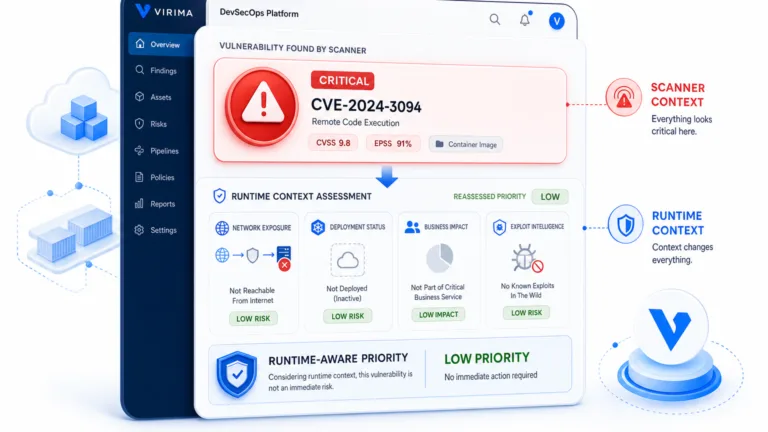
Teams that want the operational context layer behind those decisions can start with Trusted Runtime Truth: what exists, how it is connected, what changed, what will break, and who owns it.
Inside Virima’s Discovery-Sourced CMDB for Warsaw’s E-commerce and Logistics Stack
Virima CMDB is built for estates that mix warehouse floors, regional facilities, and public cloud rather than for a single clean data center diagram. For Warsaw gateway operators, that means storefront, ERP, WMS, carrier paths, and peak cloud capacity can share one discovery-sourced configuration record that feeds the ITSM desk already in use.
Immediate operational impact
Agentless scanning, lightweight agents, and API-based cloud collection cover on-premises, AWS, and Azure so storefront, ERP, WMS, and network CIs can enter the same model. High-frequency scheduled discovery keeps peak capacity and decommissioned gear from sitting invisible for months.
Long-term accuracy
Normalization and multi-source reconciliation reduce duplicate CIs. Source-tracked, timestamped records give CMDB owners something defensible when auditors or CAB chairs ask how fresh the data is. CMDB health signals highlight completeness and staleness before a peak weekend, not after.
Integration with existing workflows
Virima does not ask Warsaw teams to rip out ServiceNow, Jira Service Management, Ivanti, or other ITSM desks already in place. Bidirectional patterns push discovered CIs and relationships into the tools change and incident teams already open every morning. Partner names stay plain text; the full catalog lives on the integrations hub.
Change impact in the tools you already trust
Discovery-backed relationships support impact views before a window opens, which is the difference between a CAB vote on a diagram and a CAB vote on the estate. That pattern is covered in more depth in Virima’s work on change impact analysis with leading ITSM platforms.
ViVID™ service mapping builds dependency maps once service definitions are supplied manually, by import, or via architecture tools. The automation is map maintenance and relationship currency, not automatic invention of which applications constitute each business service.
Moving from Spreadsheet-Era Tracking to Discovery-Driven Visibility
The shift already mapped out above plays out in two places: who owns the inventory day to day, and what changes once discovery is the system of record instead of a quarterly export.
| Change | From | To |
|---|---|---|
| Inventory source of truth | Per-site spreadsheets and quarterly merges | Discovery-populated CI records with owners and timestamps |
| Peak and hybrid capacity | After-the-fact notes | Included on the next scheduled discovery cycle |
| Dependencies | Static diagrams | Service maps maintained from definitions plus discovery |
| ITSM data | Manual imports that age immediately | Ongoing sync of CIs and relationships into the existing desk |
Who benefits
- IT operations: fewer firefights started from the wrong CI, faster impact calls when a host or link fails
- Compliance and security: an inventory that matches operations instead of a parallel compliance spreadsheet
- Warehouse and logistics leaders: clearer answers when a change or outage threatens pick, pack, or carrier cutoffs
Getting started in five steps
- Baseline the current inventory and name the systems that matter for peak and cross-border flows.
- Deploy discovery across on-premises sites and cloud accounts in scope.
- Set normalization and ownership rules so multi-site duplicates collapse into one CI model.
- Sync authoritative CIs and relationships into the ITSM platform already in use.
- Set a recurring high-frequency scan schedule and review CMDB health before each major peak.
Keep the gateway’s record as fast as the gateway
Warsaw’s e-commerce and logistics role will keep adding sites, integrations, and seasonal cloud capacity. Spreadsheet-era CMDBs will not keep up with that rate of change. A discovery-sourced CMDB gives CMDB owners, CTOs, and compliance leads one record for e-commerce IT infrastructure in Warsaw that they can defend in CAB, in the war room, and when KSC Act expectations ask for current asset evidence.
See how Virima’s discovery-sourced CMDB keeps pace with peak-season scale and multi-site logistics estates. Explore Virima’s CMDB with a free demo.
Frequently Asked Questions
What is a CMDB and why does it matter for logistics IT in Eastern Europe?
A configuration management database stores configuration items and their relationships so IT can manage change and incidents against the live estate. For Eastern European logistics hubs, that record has to span multi-site WMS, carrier APIs, and hybrid cloud capacity, not only HQ servers.
Why is Warsaw specifically significant for e-commerce and logistics IT infrastructure?
Warsaw sits inside Poland’s densest modern logistics region and supports domestic and cross-border fulfillment for much of Central and Eastern Europe. Peak online demand in November and December concentrates risk on the same hybrid estates that grow with new warehouse stock.
Does NIS2 require e-commerce and logistics companies in Poland to maintain an IT asset inventory?
NIS2 and Poland’s KSC Act amendment expect in-scope entities to manage cybersecurity risk with knowledge of relevant systems and dependencies. A CMDB supplies the infrastructure inventory those measures assume; it is not itself the full compliance program.
How does Virima’s discovery cover both on-premises Warsaw warehouses and public cloud burst capacity?
Agentless scanning, lightweight agents, and API-based cloud collection cover on-premises warehouse floors alongside AWS and Azure, so storefront, ERP, WMS, and network CIs enter the same model. High-frequency scheduled discovery keeps peak-season capacity and decommissioned gear from sitting invisible for months.
What is the difference between a CMDB and IT asset discovery?
Discovery finds and fingerprints assets and relationships across the estate. The CMDB is the governed system of record that those findings populate, with ownership, lifecycle, and service context used by change, incident, and audit workflows.