Is CMDB Automation for DORA Compliance in Munich Financial Services Enough?

A Munich insurance carrier’s incident team pulls up its configuration database during a BaFin inquiry. The asset list is current, but no one in the room can say which legal entity holds the contract behind that server, or who signed off on it last quarter. That gap is exactly what Article 8 audits are built to expose. CMDB automation for DORA compliance in Munich financial services closes part of that gap, since automated discovery catalogs servers, virtual machines, and active connections on a recurring schedule. But in the EU’s joint supervisory dry run, only 6.5 percent of submitted registers passed every automated data quality check, so the real test is whether that record stands up to legal and ownership scrutiny.
Munich is Europe’s primary insurance hub and the world’s leading reinsurance center, with dozens of regional, national, and international carriers calling the city home, per the City of Munich’s own municipal economic account. These institutions run long-standing policy administration mainframes alongside private cloud clusters and distributed software vendor pipelines. Supervisory scrutiny under DORA Article 8 on ICT asset management focuses directly on this operational complexity. While automated discovery sweeps hardware assets and running operating systems, institutions must determine how operational records align with statutory reporting duties.
What DORA Asks of the Estate Record
The Digital Operational Resilience Act establishes strict technical documentation mandates across multiple core articles, requiring financial entities to record their digital infrastructure with systematic precision. Article 8 requires institutions to document all information and communication technology assets, maintain verified configuration inventories, and establish mapped interdependencies across operations. The following structured overview details the formal statutory requirements governing estate records under European financial supervision:
| Legal Provision | Statutory Mandate | Operational Meaning |
|---|---|---|
| Article 8(1) | Identify, classify, and document all ICT-supported business functions, information assets, and technical infrastructure, reviewing classifications annually. | Institutions must maintain an accurate catalog connecting physical machines and virtual hosts to business services. |
| Article 8(4) | Maintain an exhaustive inventory of all ICT assets, including remote infrastructure, and map dependencies supporting critical business functions. | Configuration managers must produce relational diagrams showing upstream components, downstream servers, and network dependencies. |
| Article 8(6) | Maintain complete inventories of digital assets, updating entries periodically and immediately following major infrastructure alterations. | Static annual audits must give way to high-frequency scheduled discovery cycles across production environments. |
| Article 8(7) | Perform dedicated, documented ICT risk assessments on all legacy information technology systems on at least an annual schedule. | Aging operational platforms must carry designated system owners who document ongoing operational exposure and mitigations. |
| Article 28(3) | Maintain and update the register of information regarding all contractual arrangements on the use of ICT services provided by third parties. | Technical infrastructure records must match legal vendor contracts, legal entity identifiers, and external supply chains. |
National competent authorities enforce these provisions during routine prudential supervision. In Germany, the Federal Financial Supervisory Authority (BaFin) oversees financial market participants through its secure digital reporting platform. Article 5 places overall accountability for digital operational resilience directly on the regulated entity’s management board. Statutory guidelines emphasize regular reviews and systematic updates to establish reliable operational records. Lessons from capital markets in our Frankfurt financial institutions analysis show that banking teams experienced significant reconciliation friction during their transition from domestic guidelines. Similarly, our Amsterdam digital banking review demonstrated that static spreadsheets pass initial policy checks while leaving configuration records unverified throughout subsequent operational cycles.
Where a Munich Insurer’s Records Split Apart
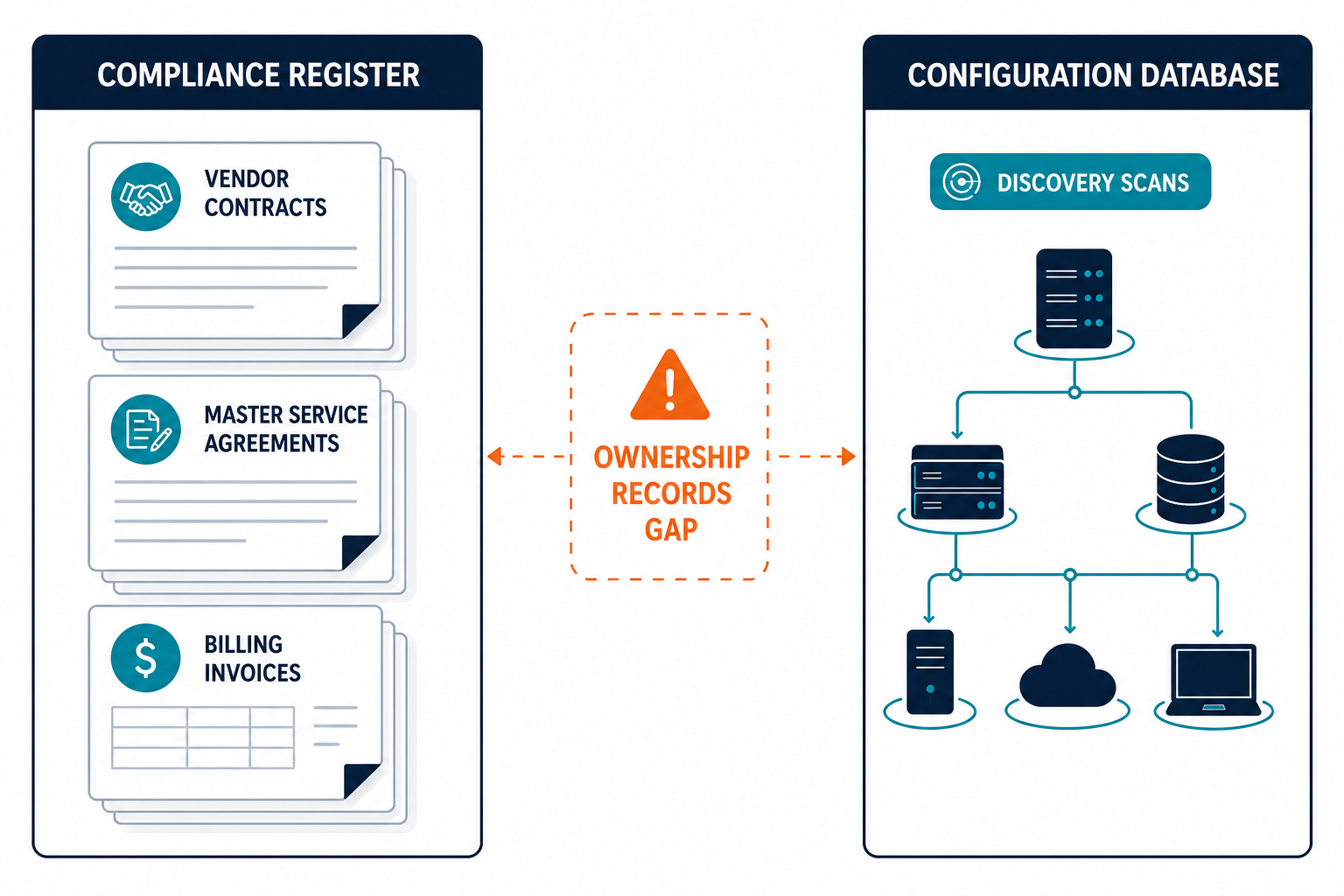
Operational friction inside Bavarian insurance enterprises typically emerges along three distinct architectural seams. When distinct functional teams maintain isolated documentation repositories, configuration management databases fail to reconcile with external regulatory submissions.
Two Lists Built from Disconnected Corporate Systems
The compliance department constructs the regulatory register of information from legal procurement agreements, master service contracts, and billing invoices. Meanwhile, the IT operations group populates the configuration management database using local infrastructure discovery probes and server administration agents. According to Advisori’s analysis of BaFin reporting workshops, supervisory evaluations revealed frequent data discrepancies across institutional filings, including inconsistent Legal Entity Identifier codes, incomplete subcontractor hierarchies, and unrecorded software components. Result: Technical infrastructure records cannot be validated against legal contract inventories during supervisory inquiries.
Complex Group Structures and Extended Subcontractor Chains
Munich insurers frequently operate within federated corporate conglomerates featuring shared service providers, regional subsidiaries, and fourth-party IT vendors. Regulatory guidelines require institutions to document internal shared services alongside external commercial suppliers. According to usd AG’s analysis of BaFin supervisory guidance, supervisory authorities expect organizations to explain operational dependencies with verifiable clarity.
Result: Configuration managers struggle to identify which physical compute nodes and network interfaces support specific third-party suppliers.
Legacy Core Platforms Operating Without Formal Ownership
Bavarian insurance institutions manage mission-critical actuarial platforms, legacy policy databases, and core accounting engines that have operated reliably across multiple decades. While Article 8(7) mandates annual risk reviews for aging software, institutional turnover often erases any record of who originally owned the platform. In an architectural analysis by KPMG on CMDB implementation under DORA, technical advisors recommended adding specific legacy tracking attributes directly within the enterprise data model.
Result: Unowned computing systems persist indefinitely within corporate data centers without assigned operational accountability.
Managing regulatory compliance across distributed operational environments requires unified hardware tracking, as outlined in our guide on IT asset management for financial compliance. Verifiable data structures are the foundation of governance: see our overview of CMDB audit essentials for enterprise environments.
What the Supervisors’ Own Data Reveals
Supervisory data shows how hard accurate asset and vendor records are to maintain at scale. In the joint dry run conducted across the European Union, the European Banking Authority, the European Insurance and Occupational Pensions Authority, and the European Securities and Markets Authority examined institutional reporting capabilities. According to supervisory findings analyzed by Post-Trade 360 on the European dry run, 1,039 financial entities submitted documentation, yielding 947 registers suitable for detailed data analysis.
The joint supervisory analysis revealed that only 6.5 percent of submitted registers satisfied all automated data quality checks across the board. Missing mandatory information fields accounted for 86 percent of all detected register errors, demonstrating that financial entities struggled to extract comprehensive technical attributes from disparate operational databases.
Cross-border market studies reflect similar operational hurdles. In the Deloitte DORA European survey, 46 percent of surveyed financial entities identified compiling the third-party register of information as their single most demanding implementation challenge. EY’s advisors on post-submission supervisory expectations note that supervisory quality validation continues long after initial filing deadlines pass, requiring institutions to maintain evergreen records that withstand iterative regulatory scrutiny.
CMDB Automation for DORA Compliance in Munich Financial Services: Scheduled Discovery, Owned Records
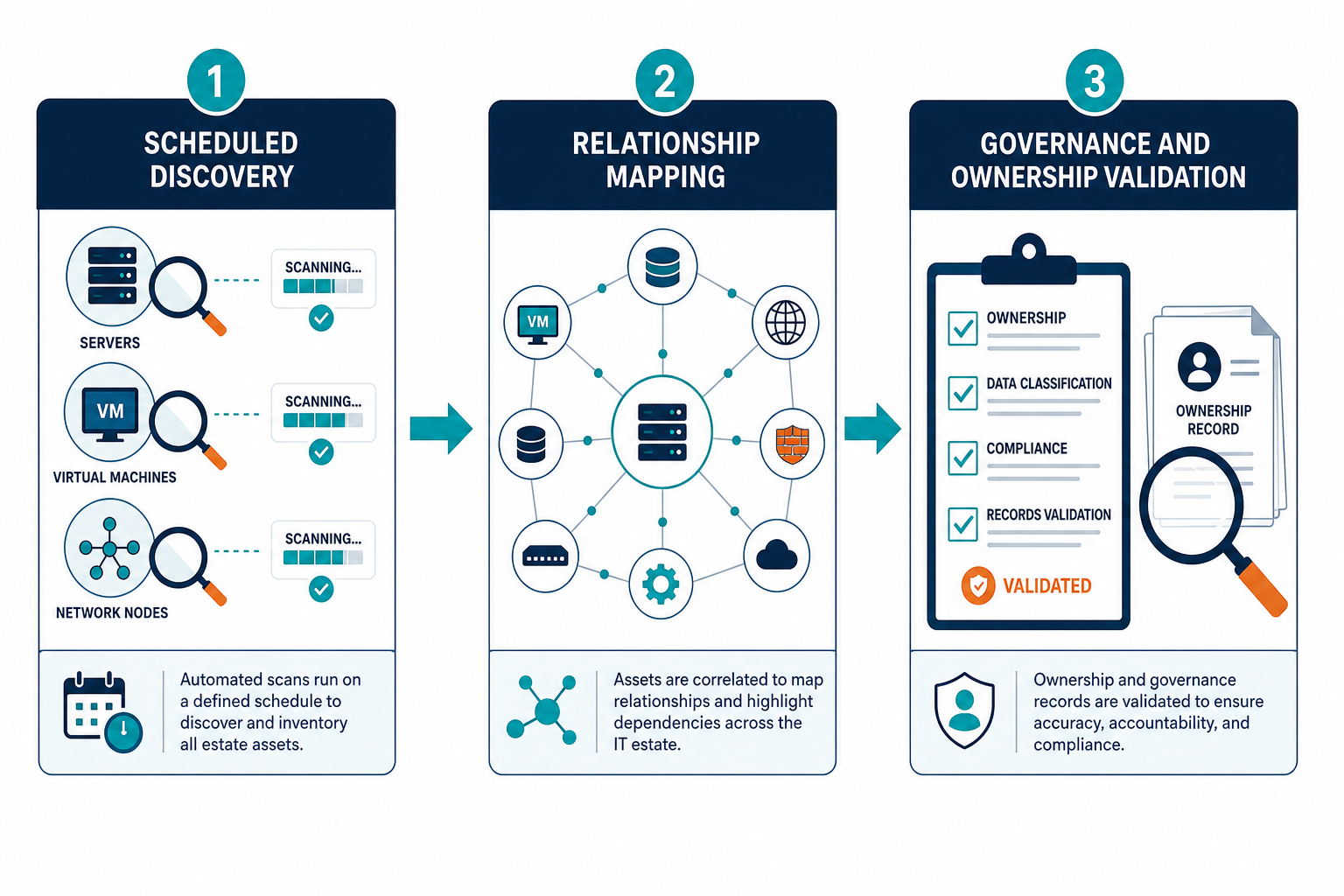
Achieving operational defensibility requires disciplined technical processes that keep configuration baselines accurate across heterogeneous corporate environments. Automated configuration management operates through three core technical mechanisms, backed by an integrated change-synchronization workflow:
| Architecture Stage | Operational Mechanism | DORA Compliance Output |
|---|---|---|
| 1. High-Frequency Discovery | Agentless network probes (SNMP, WMI, SSH), lightweight endpoint agents for remote workstations, and native cloud API connectors across AWS and Azure. | Comprehensive ICT asset inventory with scheduled baseline scans and complete visibility across hybrid infrastructure. |
| 2. Relational Mapping and Dependency Ingestion | Live network socket inspection, protocol communication flow analysis through ViVID™ service maps, and bidirectional IT service management change synchronization. | Relational dependency models tracing upstream applications, downstream databases, and third-party communication paths. |
| 3. Verified Governance and Ownership Validation | Attributed system stewardship, documented sign-off review workflows with audit timestamps, and explicit operational boundaries for external vendor services. | Statutory accountability records linking physical and virtual configuration items to designated system owners and business services. |
High-Frequency Scheduled Discovery Across Hybrid Estates
Discovery engines scan physical networks, virtual clusters, and cloud environments on regular schedules defined by configuration managers. The scanning system utilizes agentless network discovery probes for corporate data centers, deployable endpoint software for remote workforce laptops, and specialized API connectors for cloud subscriptions across Amazon Web Services and Microsoft Azure. Discovery scope operates within defined operational boundaries governed by protocol permissions, network routing policies, and platform authentication credentials.
Contextual Relationship Mapping and Communication Flows
Raw asset listings lack the operational context needed to assess technical resilience. Modern discovery solutions incorporate dynamic communication mapping to identify active port connections, running application processes, and relational dependencies. ViVID™ service maps turn those connections into a visual dependency model that synchronizes with the ServiceNow, Jira Service Management, or other ITSM instances Munich insurers already run, without requiring a rip-and-replace. Through this mapping, engineering teams trace upstream database servers, application middleware, and external network gateways supporting key insurance functions.
Attributed Asset Ownership and Verification Timestamps
Every configuration item within the operational database requires a designated human steward who confirms its functional role. Automated workflows associate discovered computing nodes with operational owners based on directory attributes, service usage patterns, and historical administration logs. System owners review and confirm their assets on scheduled review dates, producing timestamped records that satisfy statutory audit guidelines.
Change Synchronization with Enterprise IT Workflows
Infrastructure changes occur continuously across enterprise software environments. Integrating the central configuration database with service management platforms ensures that operational updates, patch cycles, and server decommissions propagate directly into the system of record. When platform engineers deploy an infrastructure modification, the change workflow automatically schedules targeted discovery scans to reconcile configuration baselines.
The operational differences between fragmented manual inventories and automated configuration platforms become clear when evaluating regulatory preparedness:
| Operational Capability | Spreadsheets and Point-in-Time Exports | Discovery-Fed Configuration Database |
|---|---|---|
| Data Compilation Method | Manual data entry combined with periodic spreadsheet merges across departments. | Automated network scanning and API ingestion running on recurring schedules. |
| Asset Ownership Assignment | Unverified email notes and static text columns that quickly become outdated. | Attributed system custodians who confirm responsibility through structured workflows. |
| Dependency Visibility | Isolated asset entries lacking documented connections to supporting infrastructure. | Relational maps connecting servers, middleware, and business services. |
| Evidence of Currency | Self-declared spreadsheet modification dates without automated technical validation. | System discovery logs, port probe records, and historical change entries. |
| Reporting Preparation Effort | Multiple weeks of manual administrative labor across distributed operational teams. | Automated export workflows extracting current infrastructure data. |
| Human Governance Role | Personnel spend time gathering basic technical facts manually. | System custodians review validated data and make authoritative operational decisions. |
Organizations evaluate these foundational capabilities through specialized platforms, including our dedicated enterprise configuration management database. Ensuring complete visibility begins with automated IT discovery tools that sweep hybrid networks. To transform raw records into actionable context, teams deploy ViVID™ service maps to visualize application architectures.
What the CMDB Settles, and What Stays Elsewhere
The central answer to whether configuration management automation satisfies regulatory expectations is straightforward: technical discovery provides indispensable operational proof, yet compliance governance extends across organizational domains that software cannot resolve independently. Discovery algorithms detect running processes and open network ports, while corporate management bodies retain legal accountability for institutional resilience.
The following division of responsibilities illustrates where operational technology functions end, and enterprise governance processes begin:
| Regulatory Question | Answered by the CMDB | Owned by Corporate Departments |
|---|---|---|
| What digital assets exist across the enterprise estate? | Discovered compute instances, hypervisors, network gear, and cloud resources. | Business justification and funding authorization for maintained assets. |
| Which external vendors supply critical services? | Network communication endpoints and cloud subscription tenants. | Legal entity identifiers, contract clauses, and procurement agreements. |
| Which business functions represent critical operations? | Application components, database connections, and server topologies. | Executive management classification based on business impact analyses. |
| Who holds operational responsibility for each system? | Assigned system owners and verified operational role classifications. | Human resource records and organizational leadership delegations. |
| When were operational baselines last validated? | Automated scan timestamps, probe confirmations, and audit logs. | Formal administrative approvals submitted to supervisory bodies. |
For chief information officers and risk directors, this boundary provides operational clarity. The configuration management database establishes an authoritative record of physical and virtual infrastructure. However, legal interpretations of DORA standards, incident notification filings, and formal register submissions to BaFin remain executive responsibilities.
Automated network discovery tracks infrastructure configurations without inspecting proprietary database contents or individual end-user communications. That boundary matters for data privacy. Organizations align technical configuration data with broader governance through systematic IT security and configuration risk management.
Where Efficiency and Measurable Savings Emerge
Implementing automated discovery workflows produces substantial operational efficiencies by eliminating manual data collection tasks across technical departments. Financial institutions replacing fragmented spreadsheets with automated configuration baselines experience measurable productivity improvements across three distinct functional disciplines:
Accelerated Regulatory Reporting Cycles
Manual compilation of the technical estate requires extensive coordination across database administrators, network engineers, and cloud specialists. According to the Flexera 2026 State of ITAM Report, technical teams in large enterprises spend hundreds of administrative hours reconciling mismatched asset inventories ahead of formal audits. Automated discovery gathers hardware configurations, operating system revisions, and active network connections systematically, allowing compliance specialists to focus their efforts on data validation.
| Operational Model | Basic Data Collection Share | Substantive Risk and Compliance Analysis Share | Operational Impact |
|---|---|---|---|
| Manual Spreadsheet Collection | 70% of staff hours spent locating physical and virtual assets manually. | 30% of staff hours remaining for risk assessment and validation. | Compliance fatigue, incomplete data registers, and elevated supervisory risk during formal inquiries. |
| Discovery-Fed CMDB Automation | 10% of staff hours required to review scheduled scan outputs and API feeds. | 90% of staff hours dedicated to substantive risk analysis and vendor governance. | Accurate configuration records, fast response during BaFin audits, and verified operational resilience. |
Rapid Blast Radius Analysis During Technical Incidents
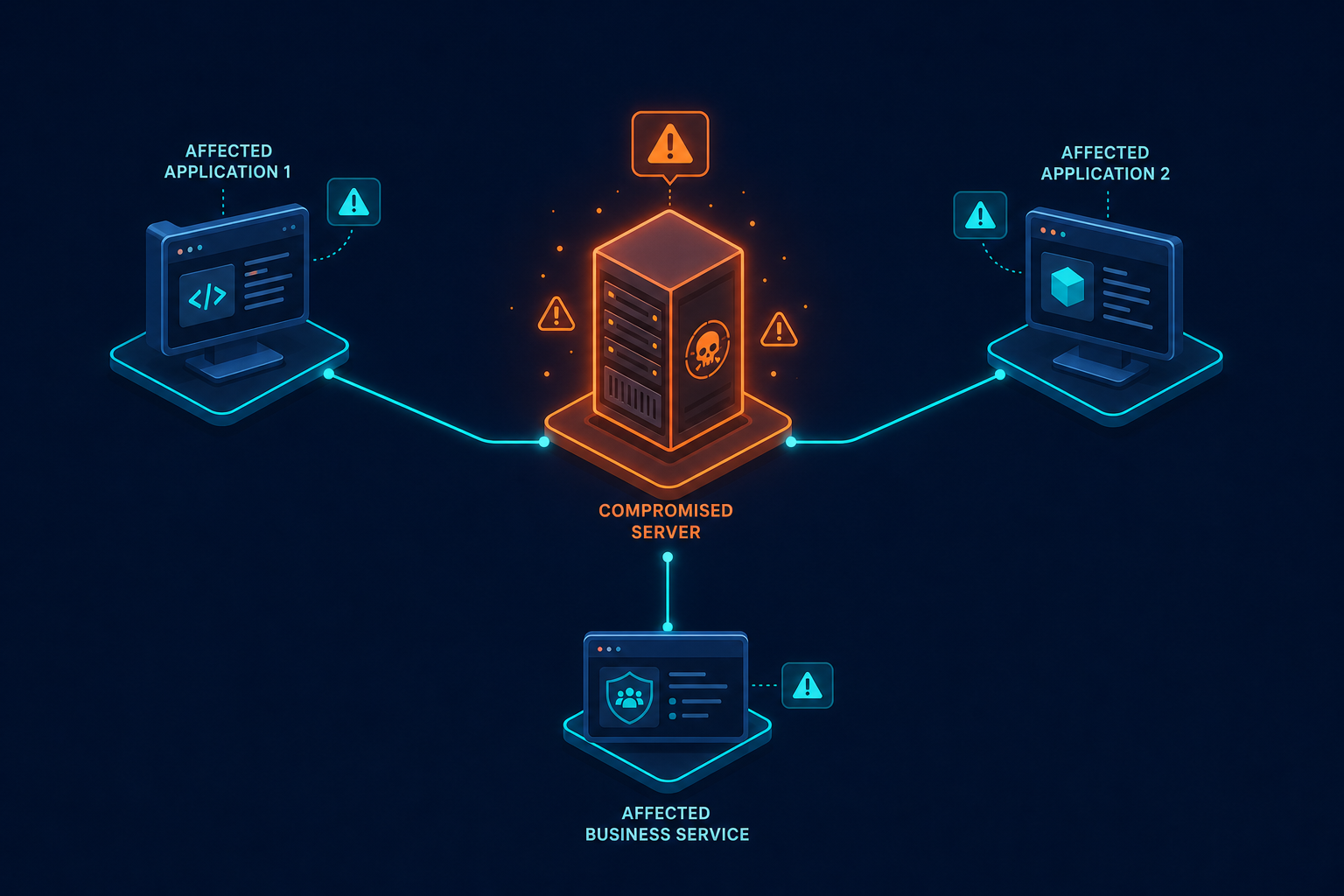
When operational outages or cybersecurity incidents affect shared infrastructure, incident response teams must determine which upstream applications depend on compromised systems. In the IBM Cost of a Data Breach Report, researchers determined that financial institutions with automated security and asset architectures resolve operational disruptions significantly faster than peers relying on static documentation. Detailed dependency mapping allows service desk personnel to identify affected underwriting engines, payment interfaces, and regulatory reporting systems within minutes.
Elimination of Redundant Infrastructure and Dormant Cloud Instances
High-frequency discovery identifies unattached storage volumes, inactive development servers, and abandoned cloud subscriptions across corporate accounts. When system custodians conduct structured reviews of aging platforms, operational leaders can safely consolidate legacy hardware and terminate unused software maintenance agreements. Coordinating these maintenance routines with structured change management configuration controls prevents unintended service interruptions.
The First 90 Days: A Pragmatic Implementation Framework
Phase 1 (Days 1 to 30): Establish Ownership and Prioritize Scope
Appoint an enterprise configuration management owner alongside designated operational leads across core insurance systems, corporate enterprise systems, cloud platforms, and end-user computing. Technical teams review the existing third-party register of information to identify external providers supporting critical or important business functions. Administrators establish technical discovery credentials and configure network access permissions for corporate data centers and cloud hosting accounts.
Phase 2 (Days 31 to 60): Deploy Scheduled Discovery and Reconcile Registers
Deploy agentless discovery probes across primary data centers and activate cloud API integrations across corporate Amazon Web Services and Microsoft Azure subscriptions. Operations personnel execute initial discovery scans to establish baseline inventories of running compute instances, database engines, and network appliances. Configuration teams compare discovered infrastructure against existing procurement contracts and register entries, documenting discrepancies under designated operational owners.
Phase 3 (Days 61 to 90): Map Dependencies and Institutionalize Reviews
Model application communication topologies and service relationships for prioritized underwriting and claims processing engines. Engineering teams conduct formal risk assessments on legacy information technology systems, requiring designated system owners to record lifecycle decisions. Program leaders establish recurring quarterly review schedules across all asset owners ahead of annual supervisory reporting windows.
Establishing a dependable configuration management baseline requires a phased approach focused on critical services first. Financial institutions can execute a structured 90-day implementation plan that delivers defensible operational records ahead of supervisory deadlines:
| Implementation Phase | Core Operational Milestones | Deliverables and Regulatory Milestones |
|---|---|---|
| Phase 1: Days 1 to 30 Foundation and Critical Scope Definition | Appoint configuration management owner and operational domain stewards across core insurance, enterprise, and cloud systems; prioritize top-tier business functions. | Established governance committee, configured discovery credentials, and third-party register priority scope aligned with business impact analyses. |
| Phase 2: Days 31 to 60 Discovery Deployment and Initial Reconciliation | Deploy agentless discovery probes across core data centers and activate cloud API integrations across corporate AWS and Azure subscriptions. | Reconciled baseline asset inventories against existing vendor registers, highlighting unrecorded components under designated stewards. |
| Phase 3: Days 61 to 90 Service Mapping and Governance Institutionalization | Model application communication topologies and service relationships for core underwriting and claims processing engines; conduct legacy system risk reviews. | ViVID™ service dependency maps, documented annual legacy IT risk assessments, and recurring quarterly review workflows ahead of supervisory audits. |
Organizations seeking to establish defensible configuration baselines can explore the foundation of Trusted Runtime Truth to maintain verified visibility of asset ownership, dependencies, and compliance risk across complex digital environments.
Frequently Asked Questions
What does DORA Article 8 require for ICT asset management?
Article 8 requires financial institutions to identify, classify, and document all digital assets and business functions. Institutions must maintain updated inventories of physical and virtual infrastructure, map operational dependencies supporting critical services, and conduct documented annual risk assessments on legacy systems.
Does a CMDB make a Munich financial entity DORA compliant?
A configuration management database supplies essential infrastructure facts and relational mapping. However, complete statutory compliance requires legal vendor classification, contractual governance, risk assessments, and executive accountability managed across corporate legal, procurement, and risk departments.
How does CMDB automation assist with the register of information?
Scheduled discovery maintains accurate technical records of servers, cloud subscriptions, and network endpoints supporting external providers. This technical validation ensures that procurement contracts and third-party registers reflect running production reality during supervisory reviews.
Who oversees DORA enforcement for financial institutions in Munich?
The Federal Financial Supervisory Authority, known as BaFin, supervises German banks, insurance carriers, and financial service entities. For significant cross-border institutions, BaFin coordinates supervisory oversight alongside relevant European Supervisory Authorities, including EIOPA and the European Central Bank.
Can Virima integrate with existing IT service management platforms?
Virima integrates bidirectionally with leading enterprise service management platforms to synchronize discovered infrastructure assets and dependency maps into existing operational workflows, as detailed on our enterprise integrations directory.