Agentic IT Operations for Austin’s AI-Native Enterprise Teams

An Austin platform team deploys an agent that restarts unhealthy services during night hours. The agent reads a service catalog that lists three API gateways behind the checkout flow. Production runs five gateways, since two were added during a migration sprint and never recorded. The agent restarts three services and reports success. The two unlisted gateways keep serving stale sessions until morning traffic exposes the gap.
Agentic IT operations for Austin AI-native enterprise teams fails exactly here, where agent autonomy outruns the record it reasons from.
Austin concentrates this exposure. Enterprise teams across the capital run cloud-native platforms, hire AI talent, and ship agents into incident response and change workflows. The national AI enterprise keeps expanding, and regional readiness varies widely, as mapped in the Brookings analysis of regional AI readiness. Austin also keeps drawing new companies, with the University of Texas noting its standing as a leading city for new business formation in its 2025 business ranking coverage.
New teams arrive fast. Their agents inherit whatever record exists. This article shows how AI-native teams build discovery-sourced runtime truth first, then grant agents scoped autonomy on top of it. See how enterprise teams establish Trusted Runtime Truth as the shared evidence layer under agent-driven operations.
Why agents need runtime truth before autonomy
An agent reasons from the inventory, service map, and ownership data it can read. When those records lag the estate, every autonomous action carries the lag forward at machine speed. A human operator might notice the extra gateways during a manual check. An agent restarts exactly what the catalog names and stops there.
Risk management frameworks recognize the same dependency. The NIST AI Risk Management Framework structures governance around mapping, measuring, and managing AI risk, as described in the NIST AI RMF overview. Mapping the system comes first. For IT operations, the map is the runtime estate: what exists, how it connects, what changed, and who owns each piece.
Three gaps open when agents ship before the map holds. Stale inventories hide infrastructure the agent cannot see. Missing service definitions leave the agent guessing which components form one business service. Unowned assets leave remediation without a named approver when the agent flags something unexpected. See a deeper breakdown of why AI agents need trusted runtime truth before they act.
Why do AI agents need CMDB truth before autonomy?
Agents act on the records they can read, so stale inventories and missing service links become wrong actions at machine speed. Discovery-sourced records with scheduled verification give agents a current map of assets, dependencies, and owners before they restart, patch, or escalate anything.
What agent-ready visibility must prove for Austin’s AI-native teams
Agent-ready visibility rests on three proofs. Prove the inventory reflects the live estate across cloud and on-prem infrastructure. Prove each business service names its full component set through explicit definitions. Prove ownership and verification dates stay current on a schedule agents can trust. An AI-native enterprise CMDB has to clear all three proofs before any agent reads from it. These three proofs line up with the baseline Virima lays out in its CMDB readiness checklist for agentic AI.
Prove completeness across cloud, containers, and supporting IT
AI-native estates span cloud accounts, Kubernetes clusters, databases, API gateways, and GPU-backed workloads. They also include identity, monitoring, and backup systems. Discovery must cover each layer on a schedule. Shared or ephemeral infrastructure needs a stated owner per record. Assets without owners need named remediation, since an agent cannot escalate to a blank field.
Prove service linkage through explicit definitions
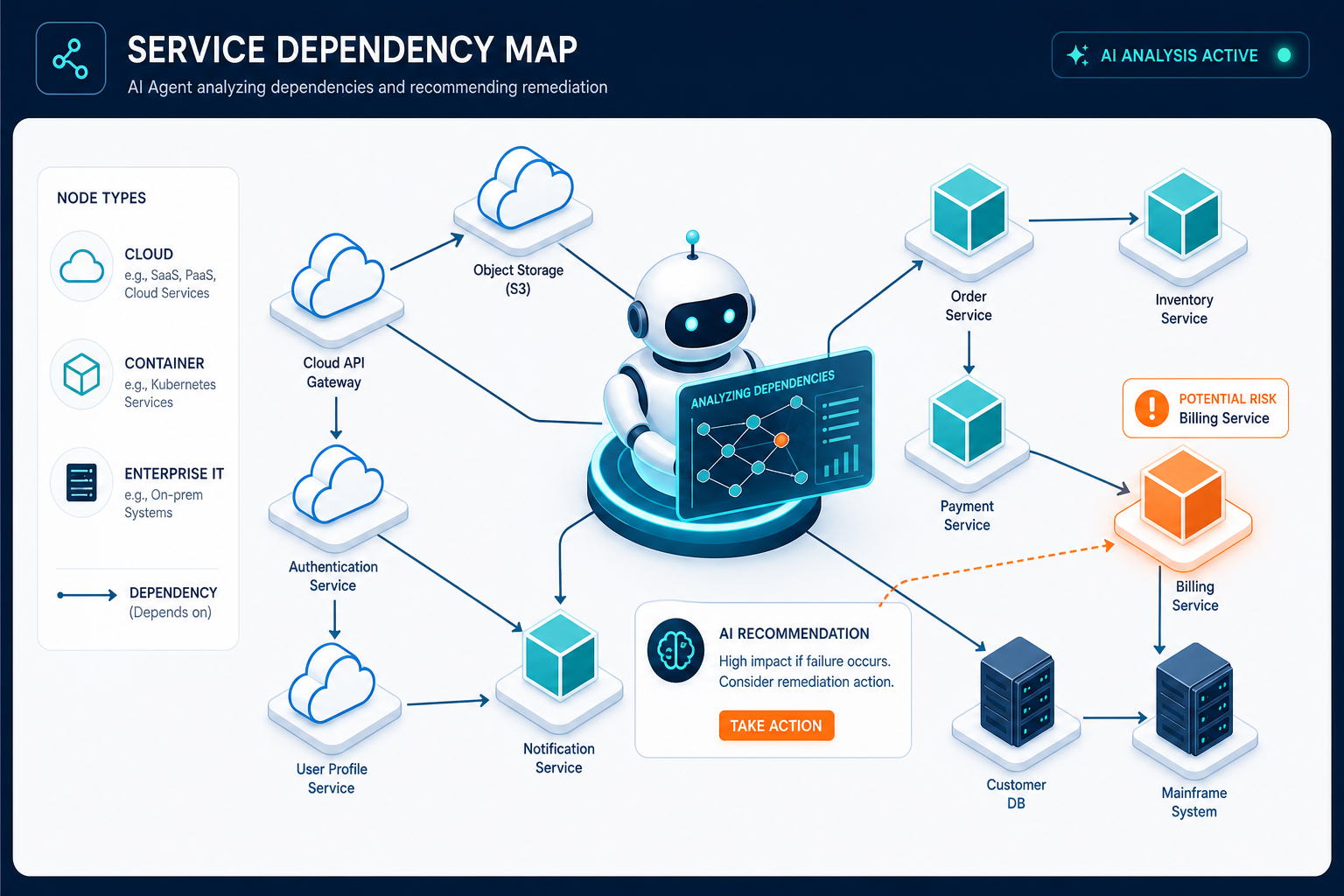
Service composition comes from manual entry, spreadsheet import, or architecture input, and the dependency map builds from those definitions. Each checkout flow, inference pipeline, and platform service needs its full component set named before agents touch it. Reports and agent logs then cite the service and its assets together.
Prove freshness agents can read
Virima reconciles multi-source discovery into one authoritative CI record with source tags and last-verified dates. Scheduled cycles refresh the record. Manual entries stay fenced behind review. Freshness becomes a timetable the agent inherits with every read.
Scope agent autonomy to what the map already holds
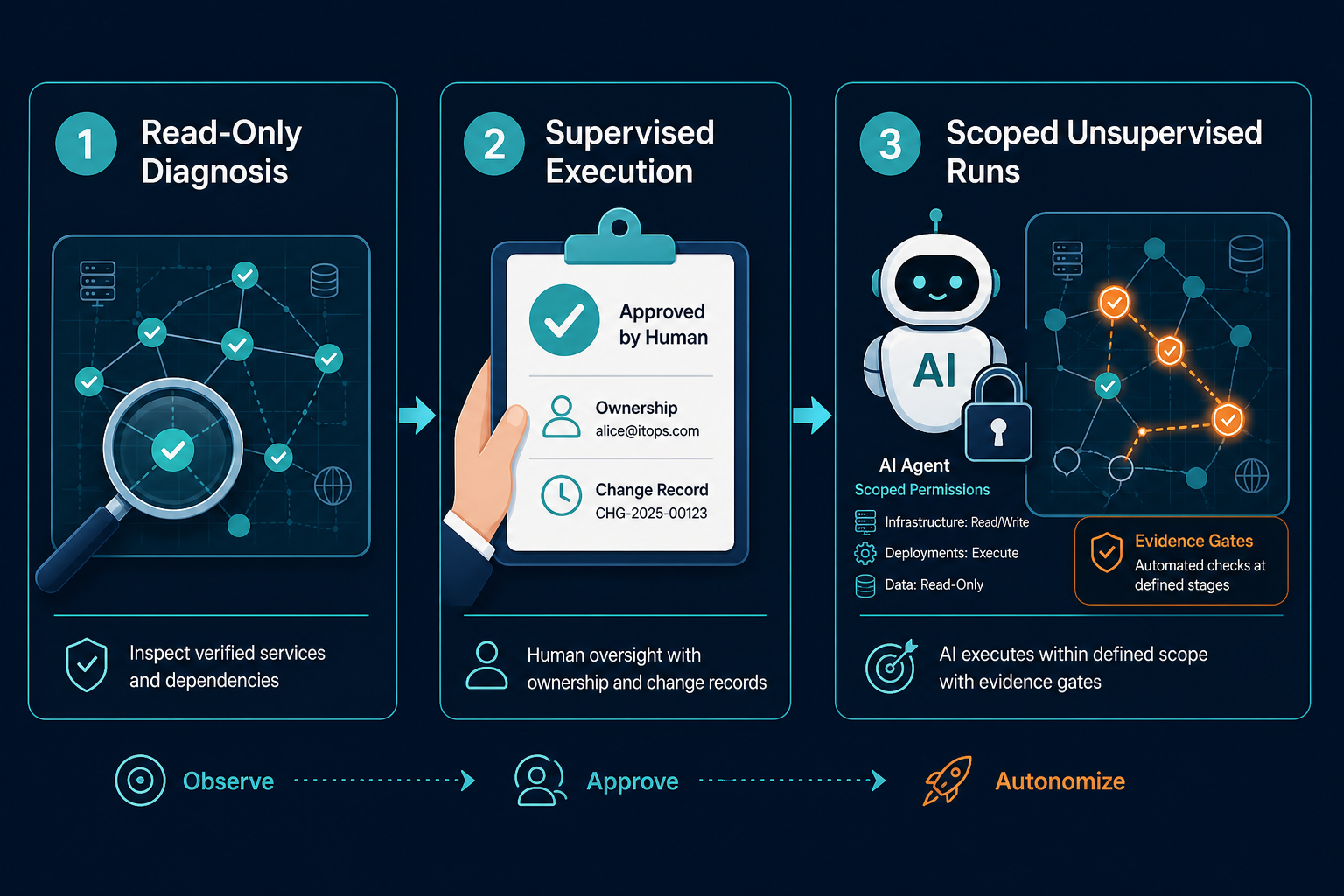
The fix is not a smarter agent. It is a narrower grant of autonomy (an evidence-gated autonomy ramp) that expands only as the map proves itself. Start agents on read-only diagnosis against verified services. Let them correlate alerts to CIs and propose actions with cited evidence. Grant execution rights service by service once diagnosis accuracy holds across a full cycle.
What each autonomy stage requires
Read-only diagnosis requires verified inventories and named service definitions for the in-scope services. Supervised execution requires ownership on every affected CI plus a change record behind each action. Unsupervised execution requires all of the above plus rollback paths mapped in advance. Each stage names its evidence before the agent advances.
How the record constrains agent behavior
When an agent proposes a restart, the IT Ops Director approving its execution rights checks the cited CI against the ViVID™ service map and its verification date. When the agent flags an unknown asset, the workflow routes to the named remediation owner instead of silent dismissal. That path from agent proposal to verified CI is the core behavior to demand from any CMDB platform sitting under agentic operations.
How should teams stage agent autonomy in IT operations?
Begin with read-only diagnosis on verified services, then supervised execution with ownership and change records, then unsupervised runs with mapped rollback paths. Each stage expands only after the underlying map proves accurate across a full operating cycle.
Feed agent context into the ITSM you already run
Agentic automation in IT operations earns trust when agent activity shows up inside daily ITSM work. Agent diagnoses link to the cited CI and its service. Agent-proposed changes enter the same approval queue as human requests. Incident timelines show agent actions alongside operator decisions with the same evidence references.
Virima supports this pattern by syncing discovered CIs and relationships into existing ITSM workflows. Platform names stay as plain references here: ServiceNow, Jira Service Management, Ivanti, HaloITSM, Xurrent, and Hornbill teams each keep their desk while agents and operators read the same CI truth. One integration reference covers the path: the integrations hub lists the supported ITSM sync options.
Keep the data flow one-directional at first. Discovery sources the CMDB, the CMDB feeds the desk and the agent layer, and manual edits stay fenced behind review. That order keeps agent reasoning anchored to observed data.
When agents already touch incident and change work across your Austin estate, walk through your service chain with the Virima team and see which assets, owners, and definitions the agent layer should read.
Schedule DemoHow should agent activity connect to ITSM workflows?
Log every agent diagnosis and action against the cited CI inside incident and change records. Route proposals through the same approvals as human requests. Shared records let operators audit agent behavior with the same evidence the agent read.
Where to start: one service, then expand
Start with one service. Pick one platform flow with clear boundaries, discover its full component set, define the service explicitly, and run the agent in read-only diagnosis for one full cycle. Measure whether diagnoses cite the right CI on first touch and whether unknown assets route to a named owner.
What to measure in the first cycle
- First-touch accuracy: does the agent cite the correct CI without a follow-up correction
- Unknown-asset routing: does every flagged asset reach a named remediation owner inside one business day
- Verification currency: does the service’s last-verified date stay inside the discovery schedule through the full cycle
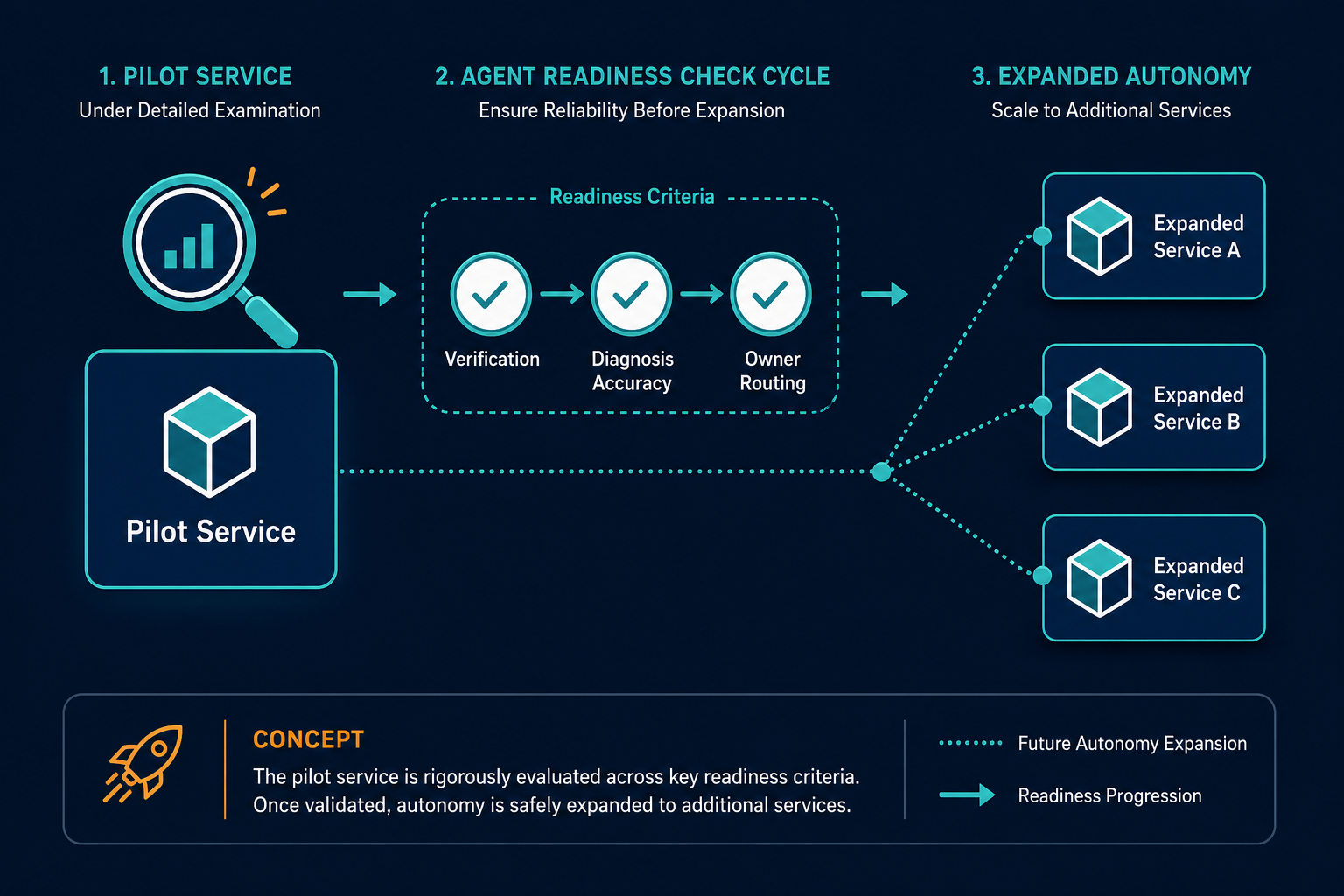
Grant supervised execution only when diagnosis accuracy holds against those three measures. Add services one at a time, keeping verification dates fresh across each addition. Expand autonomy service by service while the map stays current.
Build the map before agents scale
Agent fleets scale faster than inventory projects. Gartner projects that 40 percent of enterprise applications will carry task-specific AI agents by the end of 2026, up from under 5 percent in 2025. That projection comes from its August 2025 forecast. Austin’s AI-native teams sit inside that curve, not behind it, which raises the stakes on the record those agents read. Each new agent multiplies the cost of a stale record across every service it touches. The teams that map one service, prove diagnosis accuracy, and expand on evidence will run agents with growing confidence. The teams that grant autonomy first will debug at machine speed. Build the runtime layer now, stage autonomy on top of it, and expand while verification dates stay fresh. For a broader read on where agentic AI is headed across IT operations, see these agentic AI statistics and trends.
Frequently Asked Questions
What is agentic IT operations?
Agentic IT operations uses AI agents to diagnose incidents, propose changes, and execute scoped remediation inside ITSM workflows. Agents read inventory, service, and ownership records, so their accuracy depends on the runtime truth underneath.
Why do AI-native teams need discovery-sourced records first?
Fast-moving cloud estates drift from manual records within weeks. Scheduled discovery with verification dates keeps the map current, so agents reason from observed infrastructure instead of outdated entries.
Does Virima’s service map update automatically when infrastructure changes?
Maps stay current as discovered infrastructure changes, once service definitions are provided. Definitions come from manual entry, spreadsheet import, or architecture input, and map building runs automatically.
Can agent activity feed existing ITSM tools?
Yes. Agent diagnoses and actions log against discovered CIs inside incident and change records. Operators audit agent behavior from the same workflows they already use.
How does Virima support agentic IT operations?
Virima reconciles multi-source discovery into authoritative CI records, builds service dependency maps from provided definitions, and syncs that context into ITSM workflows where agents and operators work together.