DORA Compliance and CMDB Accuracy for Frankfurt Banks

Disclaimer: This article is for general awareness only. It is not legal, regulatory, or compliance advice. Institutions should confirm obligations with counsel and their competent authority before relying on any interpretation of DORA, BAIT, or related supervisory guidance.
Frankfurt’s financial institutions built ICT documentation practices around BAIT, a framework designed for periodic supervisory review rather than continuous operational resilience. With BAIT winding down under Germany’s DORA transition and enforcement shifting from implementation tolerance to active supervision, the gap between what regulators now expect and what many asset registers still contain keeps widening.
The Digital Operational Resilience Act (DORA) has applied across the EU since 17 January 2025. By mid-2026, national competent authorities are cross-checking Register of Information data, tying ICT findings into SREP-style reviews, and treating incomplete ICT documentation as an operational-risk issue rather than a paperwork delay. For CIOs, CTOs, and IT operations leaders at Frankfurt banks, asset managers, and capital-markets firms, the pressure shows up in a practical question. Under a 4-hour incident clock, can you show which ICT assets support a critical function, what they depend on, and which third parties sit on that path?
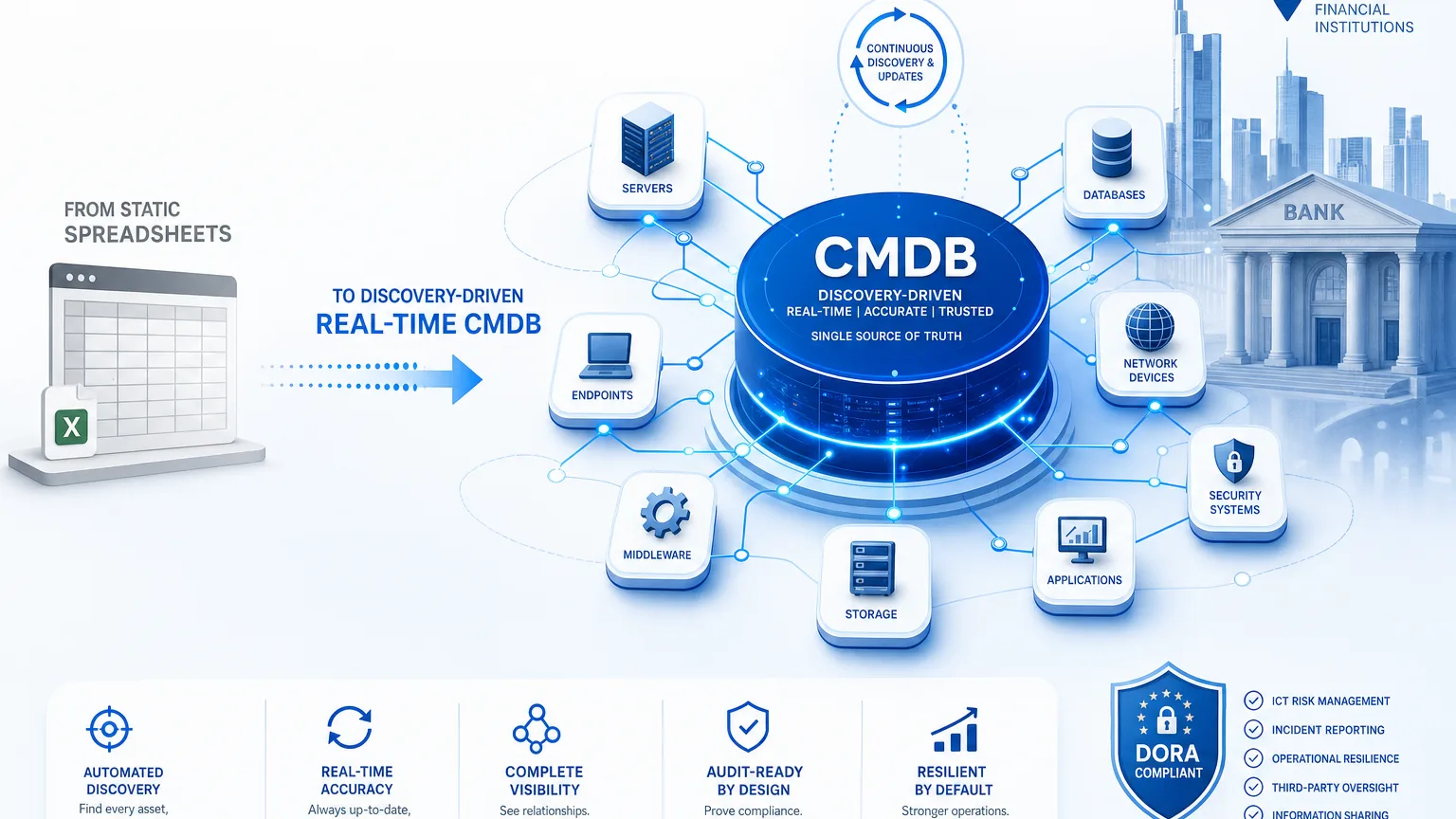
That is the DORA compliance CMDB gap: a point-in-time spreadsheet cannot answer that question. A configuration management database (CMDB) kept current by discovery can.
What DORA actually requires for ICT asset documentation
DORA is Regulation (EU) 2022/2554. Article 8 sits inside the ICT risk-management pillar and requires financial entities to identify, classify, and adequately document ICT assets supporting business functions, including configuration information and interdependencies. Reviews are expected at least annually and after major change. That language describes an ongoing documentation duty, not a once-a-year filing exercise.
What is the DORA Register of Information?
The Register of Information is the structured dataset financial entities maintain on ICT third-party arrangements, submitted to supervisors on the required cycle and format. Many teams treat it as the whole Article 8 job:
- Collect asset type, owner, location, criticality, and third-party relationships
- Export XBRL/XML
- Submit by the April cycle, then park the file until next year
The Register of Information is mandatory and highly visible. It is not the full Article 8 obligation. The regulation expects the underlying ICT inventory and dependency picture to stay usable between submissions, because incident handling and third-party oversight depend on it.
Incident reporting runs on a clock, not a calendar
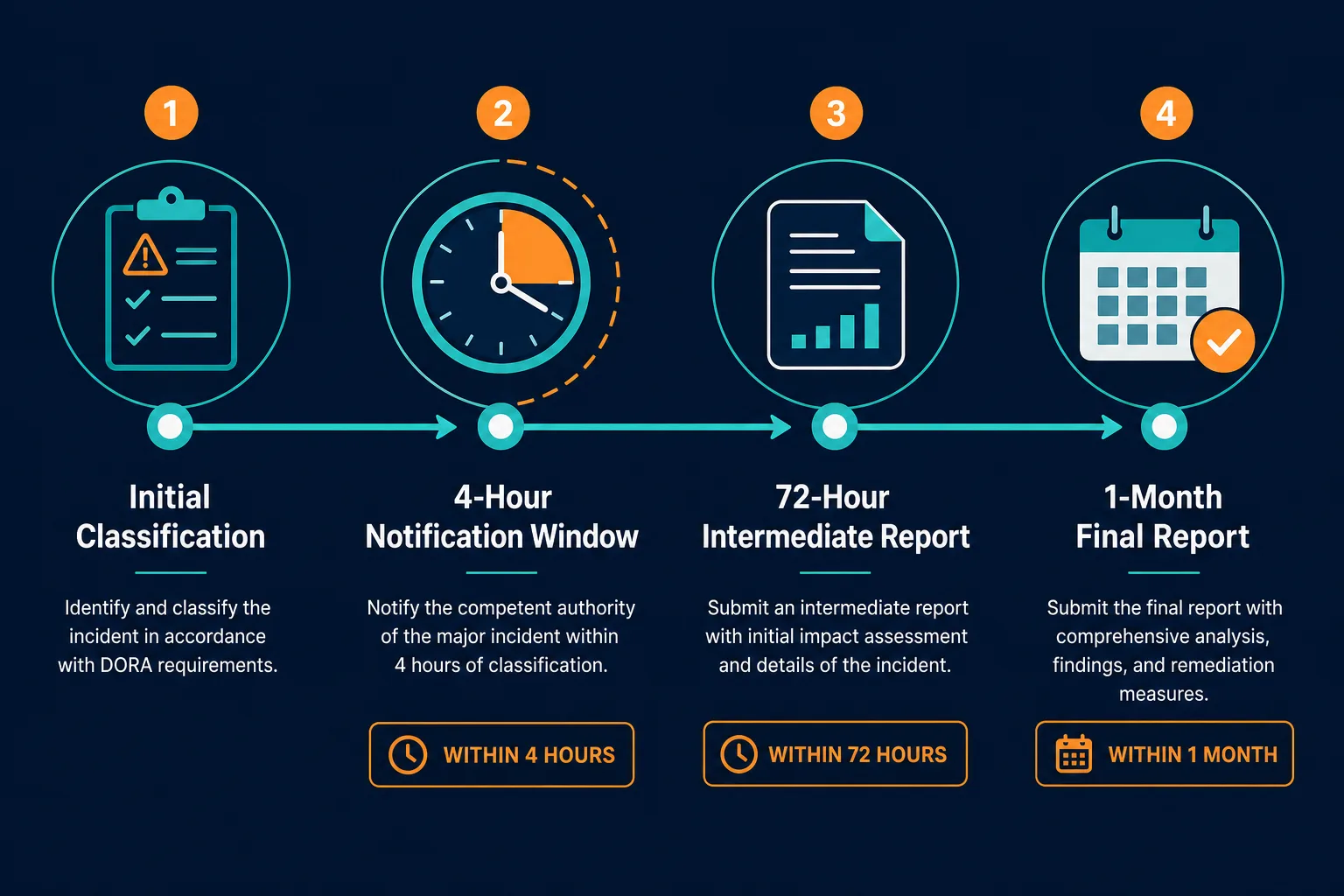
Harmonised timelines for major ICT-related incidents run on a cascade:
- Initial notification shortly after classification (commonly framed as a 4-hour window within a maximum detection-to-report bound)
- An intermediate report within 72 hours
- A final report within one month
Those clocks assume the institution already knows which systems, services, and providers sit on the affected path. If ownership, criticality, or dependency data lives only in a pre-submission workbook, the response team spends the first hours reconstructing topology instead of containing impact.
Third-party oversight runs on the same inventory
Articles 28 through 44 require structured oversight of ICT third-party arrangements, contractual content, concentration awareness, and, for designated critical providers, interaction with the EU oversight framework. The Register of Information is the structured view supervisors use to see those arrangements. If the register does not reconcile to what is actually running and contracted, GRC teams inherit a reporting artefact that cannot survive an on-site sample.
For GRC and compliance officers, the useful test is simple. Can second and third line pull a defensible population of ICT assets, owners, criticality tags, and third-party links without a multi-week data hunt? If the answer depends on last year’s RoI export, the control design is still BAIT-era even when the policy title says DORA.
What does DORA require for ICT asset documentation under Article 8?
Financial entities must identify, classify, and document ICT assets that support business functions, including configuration detail and interdependencies, and review that picture at least annually and after major change. The Register of Information is the structured supervisory extract. It does not replace the ongoing inventory duty that incident and third-party controls assume is already current.
Frankfurt’s banking landscape: why generic DORA guidance falls short
Generic DORA blogs often assume a single legal entity, a cloud-native stack, and a clean break from prior national rules. Frankfurt’s banking and capital-markets footprint rarely looks like that.
BAIT is being wound down, not modernized in place
Germany’s BAIT (Bankaufsichtliche Anforderungen an die IT) shaped how many institutions documented IT for BaFin and Bundesbank supervision. Institutions fully in scope for DORA became exempt from BAIT on 17 January 2025, and BAIT is set to be repealed entirely by 31 December 2026, with a final transition date of 1 January 2027 for remaining institutions. German banks are not maintaining two parallel ICT rulebooks long-term — DORA becomes the primary ICT operational-resilience frame, and legacy BAIT-era artefacts need uplift rather than a simple relabel. Documentation built for periodic BAIT-style review often lacks the dependency depth, third-party chain detail, and change currency DORA’s operating model assumes.
Does BAIT still apply after DORA?
Institutions fully in scope for DORA became exempt from BAIT on 17 January 2025, and BAIT is repealed entirely by 31 December 2026, with a final transition date of 1 January 2027 for remaining institutions. German banks are not maintaining two parallel ICT rulebooks long-term — DORA becomes the sole framework.
ECB consolidated supervision raises the bar for groups
ECB consolidated supervision tightens the bar for significant institutions. As of 2026, the ECB’s list of significant supervised entities counts 110 banks under the Single Supervisory Mechanism EU-wide, with a material German presence in and around Frankfurt. Group structures mean solo-entity registers and consolidated group views. Multi-brand, multi-legal-entity estates share platforms, market-data feeds, payment rails, and hyperscaler landings. A register that is accurate for one subsidiary and silent on shared settlement or KYC paths fails the consolidated picture supervisors care about.
BaFin’s Risks in Focus 2026 materials put cyber incidents and ICT outsourcing concentration, including hyperscaler dependency, among supervisory priorities, and characterise DORA’s first year as a transformation period, with stricter follow-through — including inspections and supervisory dialogue — expected next. Concentration risk is not theoretical in Frankfurt: critical functions often sit on a short list of cloud, core-banking, market-data, and identity providers. Without a live join from function to CI to provider, concentration heatmaps stay narrative.
Hybrid estates make cloud-only playbooks incomplete
Frankfurt banks still run mainframe adjacency, private data centres, VMware estates, colocation, and SaaS alongside AWS and Azure landings. Tools that only inventory public-cloud APIs miss the on-prem and shared-services half of the critical path.
The struggle is measurable. In Deloitte’s European DORA survey (2025 edition), 46% of financial entities named the register of information as their most challenging task. Practitioner write-ups of the first RoI cycle, including CloudQuery’s review of year-one ICT asset registers, describe resubmissions and portal extensions in some jurisdictions. Data-quality failures traced back to spreadsheets and siloed inventories, not missing policy text — a documentation-system problem, not an awareness problem.
Why is DORA harder for Frankfurt banks than generic EU guidance suggests?
Frankfurt estates combine BAIT-to-DORA uplift, multi-entity ECB supervision, hybrid on-prem and cloud stacks, and BaFin scrutiny of ICT outsourcing concentration. A single-entity cloud-native playbook leaves shared settlement paths, group registers, and legacy documentation gaps uncovered. Supervisors sample runtime truth, not policy titles alone.
The CMDB accuracy gap: from spreadsheets to runtime truth
Most banking ICT registers still assemble from manual inventories, CMDB rows last touched during a cleanup project, periodic scans with last-scan-wins merges, and exports from cloud consoles that never meet the on-prem CMDB. Each source can be locally useful. Together they produce a point-in-time snapshot that drifts the week after submission.
DORA’s continuous-state pressure exposes that design. Assets appear and disappear between quarterly reviews. Criticality tags lag re-platforming. Shared services gain new consumers without a relationship update. Third-party SaaS seats proliferate outside the vendor-management record. When supervisors sample, or when a major incident hits, the register and the runtime estate disagree.
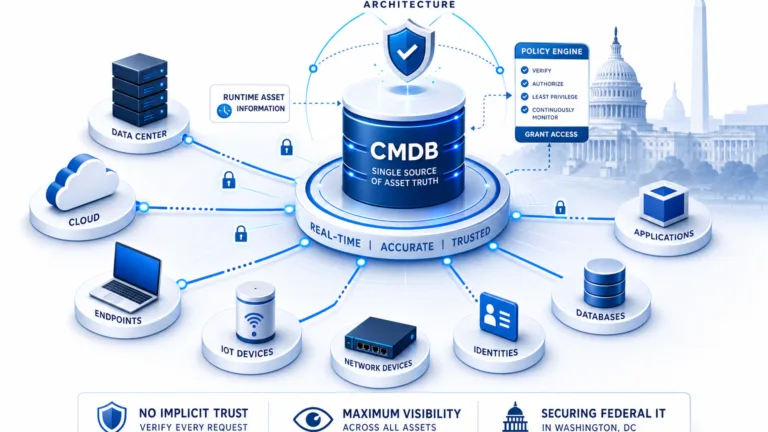
A discovery-driven CMDB addresses the structural gap. Agent-based discovery deepens endpoint and server inventory. Agentless discovery covers network devices and segments where agents are impractical. API-based discovery pulls cloud and hypervisor inventory on a schedule. Multi-source reconciliation then applies field-level authority rules so conflicting values do not silently overwrite the better source. High-frequency scheduled discovery cycles keep the CI population closer to runtime state without claiming passive event streaming the platform does not provide.
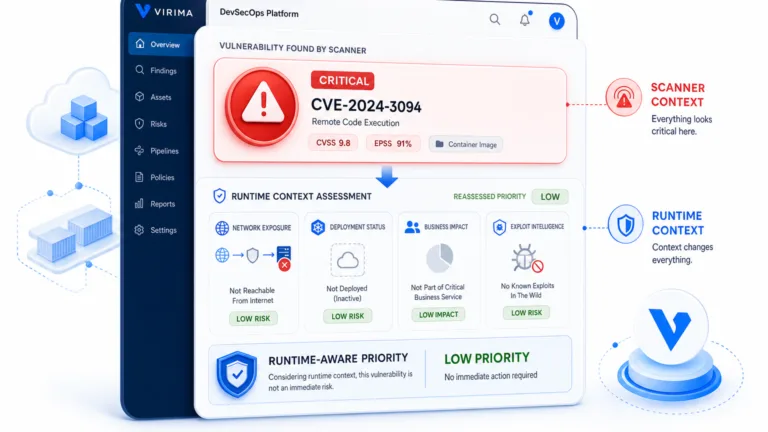
That pattern supports Trusted Runtime Truth in the sense Virima uses the term: what exists, how it is connected, what changed, what is likely to break, and who owns it, grounded in discovery rather than self-declared spreadsheets. For DORA Article 8 and RoI maintenance, the operational win is a register feed that can be regenerated from current CIs, relationships, and provider links instead of rebuilt from tribal knowledge each spring.
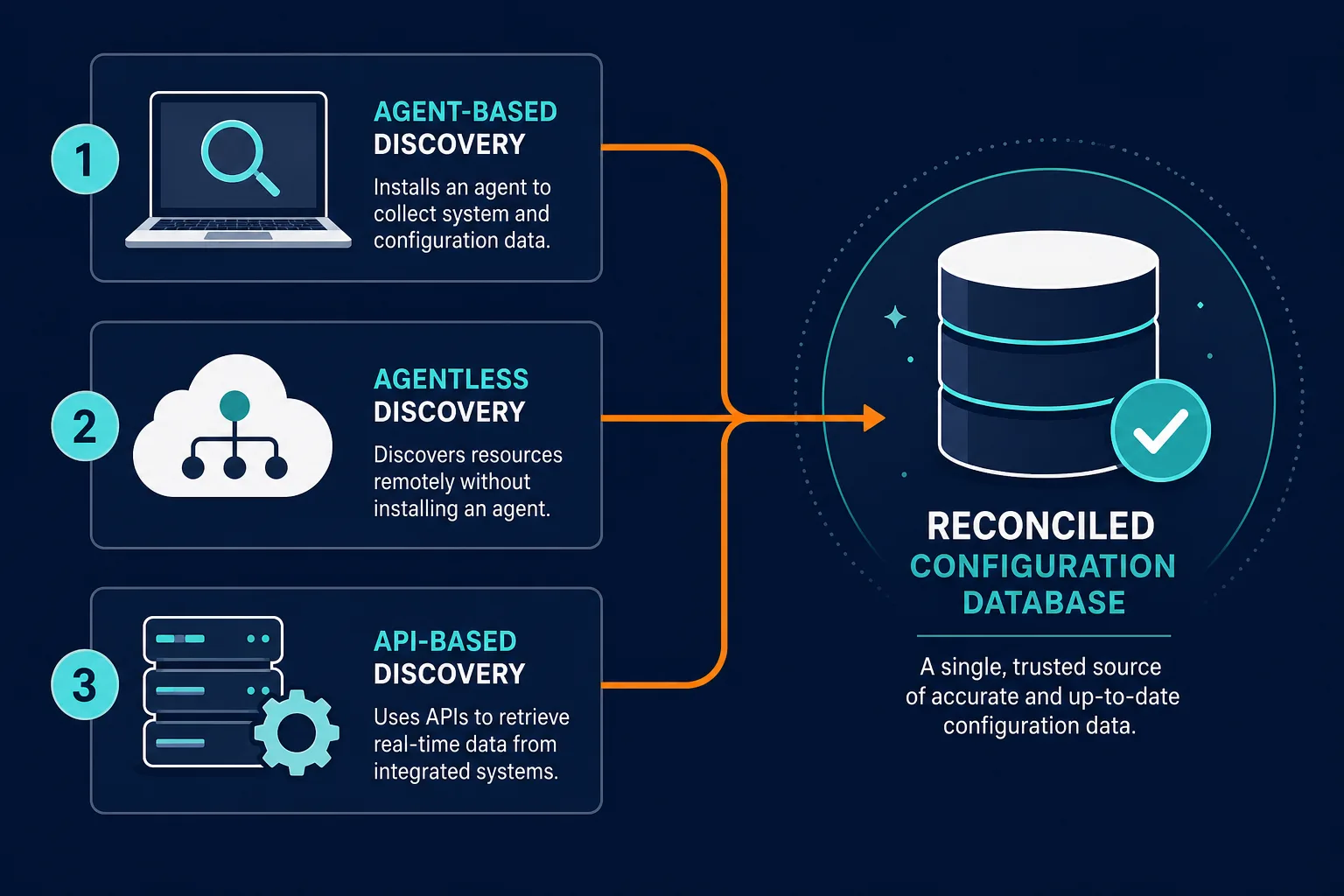
IT discovery across the full estate is the intake path. Institutions that already run ServiceNow, Jira, Ivanti, or similar ITSM platforms can keep those systems as the engagement layer. Discovery-sourced CI and relationship updates flow through integration rather than forcing a platform rip-and-replace. Virima integrates with ServiceNow, Jira, Ivanti, and many more through the integrations hub.
Explore how discovery-validated configuration data underpins a DORA-ready ICT picture on Trusted Runtime Truth.
Mapping dependencies before the regulator asks
Article 8’s interdependency language, third-party oversight, change enablement, and incident triage all collapse without dependency maps. A flat asset list tells you a server exists. It does not tell you which payment, trading, or client-onboarding function fails when that server, database, or SaaS connector fails.
ViVID™ service mapping builds application-to-infrastructure dependency views once service definitions are supplied (manually, by spreadsheet import, or via architecture integrations). Map generation and refresh then follow infrastructure change on discovery cadence. That is map building from defined services, not automatic invention of business-service catalogues. For Frankfurt multi-entity groups, the useful output is a shared view of which legal entities and critical functions consume the same platforms and providers.
Third-party and concentration use cases follow directly. When a KYC, market-data, or identity provider suffers a major breach or outage, institutions need the consumer list and the critical-function impact path within the incident window. Public incidents that fan out across many banks show the pattern: the institutions that already hold provider-to-service joins move faster than those opening SharePoint trackers under the 4-hour clock. BaFin’s focus on ICT outsourcing concentration makes that join a supervisory topic as well as an ops topic.
Change risk is the everyday version of the same map. CAB packets that list only the target CI understate blast radius when shared middleware or network paths are missing. How a CMDB supports change management covers the general mechanism. Under DORA, the same mechanism feeds evidence that changes to ICT supporting critical functions were assessed against current dependencies, not last year’s Visio.
Live dependency maps for operations and resilience work sit beside discovery and CMDB. Together they turn “we have a register” into “we can show the path.”
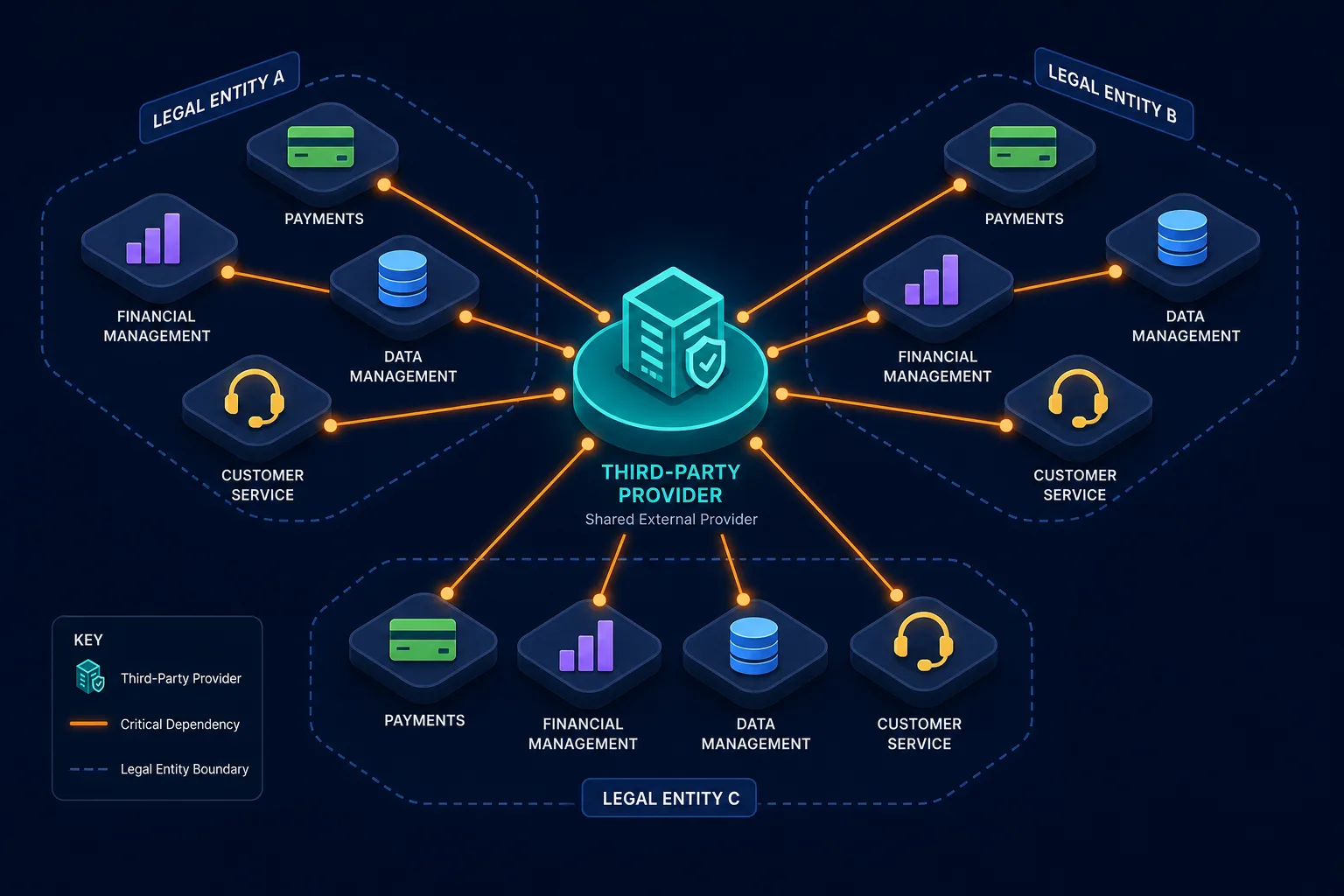
How do dependency maps support DORA third-party and incident duties?
Maps join critical functions to configuration items and ICT providers so concentration heatmaps and blast-radius paths are queryable before a breach or outage. Flat asset lists cannot answer which legal entities and services fail when a shared KYC or market-data path fails inside DORA incident clocks.
Audit trails, change history, and the compliance proof chain
Supervisors and internal audit also ask whether the institution can show how ICT supporting critical functions changed, who approved related changes, and whether incident and testing records reconcile to the same population.
A CMDB with durable CI history, relationship history, and discovery timestamps creates a technical proof chain. Configuration baselines, drift between scans, and ownership changes become queryable. That evidence supports:
- Supervisory and internal-audit samples of ICT asset populations
- Reconciliation between RoI extracts and runtime inventory
- Incident timelines that name affected CIs and services without reconstructing from chat logs
- Preparation and closure for digital operational resilience testing, including threat-led penetration testing (TLPT), where designated institutions must run advanced tests on a multi-year cycle
TLPT and broader resilience testing still need skilled testers, scenarios, and governance. Accurate configuration and dependency data shortens scoping, reduces blind spots in the target set, and helps prove which findings map to which critical functions during remediation close-out.
CMDB compliance in security and risk management frames the broader control story. Configuration management use cases describe how disciplined CI lifecycle and automation reduce manual rebuilds before each review. For GRC owners, the CMDB is not the policy library. It is the population and history source those controls sample.
Penalties under DORA remain material: institutional fines can reach a percentage of worldwide turnover (commonly summarised up to 2%), with separate regimes for critical ICT third-party providers and possible personal exposure under national enforcement. Exact application is fact-specific and jurisdiction-specific. The operational lesson is clearer than the fine table: weak ICT documentation is now a first-class supervisory finding, not a side comment on an IT audit memo.
IT operations management built on discovery-sourced truth is where ops and risk teams consume health, change risk, and correlation views that reuse the same CI and dependency base. The same discovery-driven accuracy that steadies Article 8 documentation and RoI maintenance also shortens incident triage and clarifies vendor concentration before renewal or exit planning — spending on discovery, dependency maps, and a shared evidence trail fixes currency in a way spreadsheet consolidation does not. Virima’s role in that stack stays bounded: discovery-sourced CMDB and ViVID™ dependency context across hybrid estates, feeding the ITSM platforms teams already run — not a GRC platform, not a BaFin filing engine, and not a replacement for legal interpretation of DORA articles.
See how Virima maps the dependencies behind your DORA ICT register and walk a hybrid estate view with the team by booking a demo.
Frequently Asked Questions
What does DORA require for ICT asset management?
DORA expects financial entities to identify, classify, and document ICT assets that support business functions, including configuration detail and interdependencies, and to keep that documentation current through periodic review and after major change. The Register of Information is the structured supervisory extract for ICT third-party arrangements; it sits on top of that ongoing inventory duty rather than replacing it.
Does Virima’s CMDB work alongside our existing ITSM platform for DORA evidence?
Yes. Virima’s discovery-sourced CMDB and ViVID™ dependency maps integrate with ServiceNow, Jira Service Management, Ivanti, and other ITSM platforms banks already run, rather than requiring a rip-and-replace. CI, relationship, and ownership data flow into the existing engagement layer, so the same platform GRC and ops use for tickets and change records also carries the discovery-sourced evidence DORA documentation depends on.
What are the penalties for DORA non-compliance?
DORA enables significant administrative measures and fines, commonly described as up to a percentage of worldwide annual turnover for financial entities, with additional regimes for critical ICT third-party providers and possible personal sanctions under national law. Competent authorities also use supervisory tools such as inspections, capital and governance findings, and remediation orders. Treat published maxima as upper bounds; actual outcomes depend on facts and jurisdiction.
Does discovery cover both on-prem and cloud estates for a German banking group’s DORA documentation?
Yes. Agent-based and agentless discovery cover on-prem servers, network devices, and segments where agents are impractical, while API-based discovery pulls cloud and hypervisor inventory from providers such as AWS and Azure. For Frankfurt banking groups running mainframe adjacency, private data centres, and SaaS alongside public cloud, that combination is what keeps a consolidated register from going stale on the on-prem half of the estate.
What is the DORA Register of Information?
The Register of Information is the structured dataset financial entities maintain on ICT third-party arrangements and related ICT information, submitted to supervisors on the required cycle and format. Deloitte’s 2025 European DORA survey found 46% of entities ranked it as their hardest implementation task, largely because underlying asset and contract data were fragmented. Keeping the register accurate year-round depends on inventory and dependency currency, not only on the annual export.