CMDB Authoritative Source: Why Wrong CI Records Survive

A CMDB authoritative source is the designated discovery method assigned final write authority over a specific CI (Configuration Item) attribute when two or more sources disagree. Without this designation, most CMDB reconciliation engines default to a recency rule: whichever source scanned most recently sets the attribute value. That default silently overwrites accurate data with incorrect values — no conflict flag, no review queue — until a downstream incident makes the error visible. Gartner estimates that 75% of CMDB deployments fail to deliver on their intended goals, with source conflicts and ownership gaps among the most frequently cited root causes (Gartner, 2024).
For IT operations teams managing hybrid environments with two or more discovery sources simultaneously — agent-based, agentless, and API — this failure mode is systematic and largely invisible until a production incident surfaces it.
Why most-recent-wins CMDB reconciliation fails
Multi-source CMDB reconciliation resolves conflicts between discovery sources by applying a priority rule. In most default configurations, that rule is recency: whichever source scanned most recently sets the CI attribute value. That rule sounds reasonable until you trace what it actually authorizes.
Recency does not correlate with data fidelity. Only 25% of organizations achieve meaningful value from their CMDB investment, per Gartner (2024) — and that gap traces directly to data quality failures, not implementation problems. An agentless scanner may have run 30 minutes ago and still have no authority over the hostname or environment tag of a managed server. Those attributes require an agent running on the device itself. When reconciliation logic treats timestamp as authority, lower-fidelity sources systematically overwrite higher-fidelity data. When two sources disagree and most-recent-wins picks one, the CI record conflict disappears from view entirely — no exception queue, no conflict flag. The CMDB looks current and clean — which is precisely why the failure goes undetected.
Identification rules vs. reconciliation rules
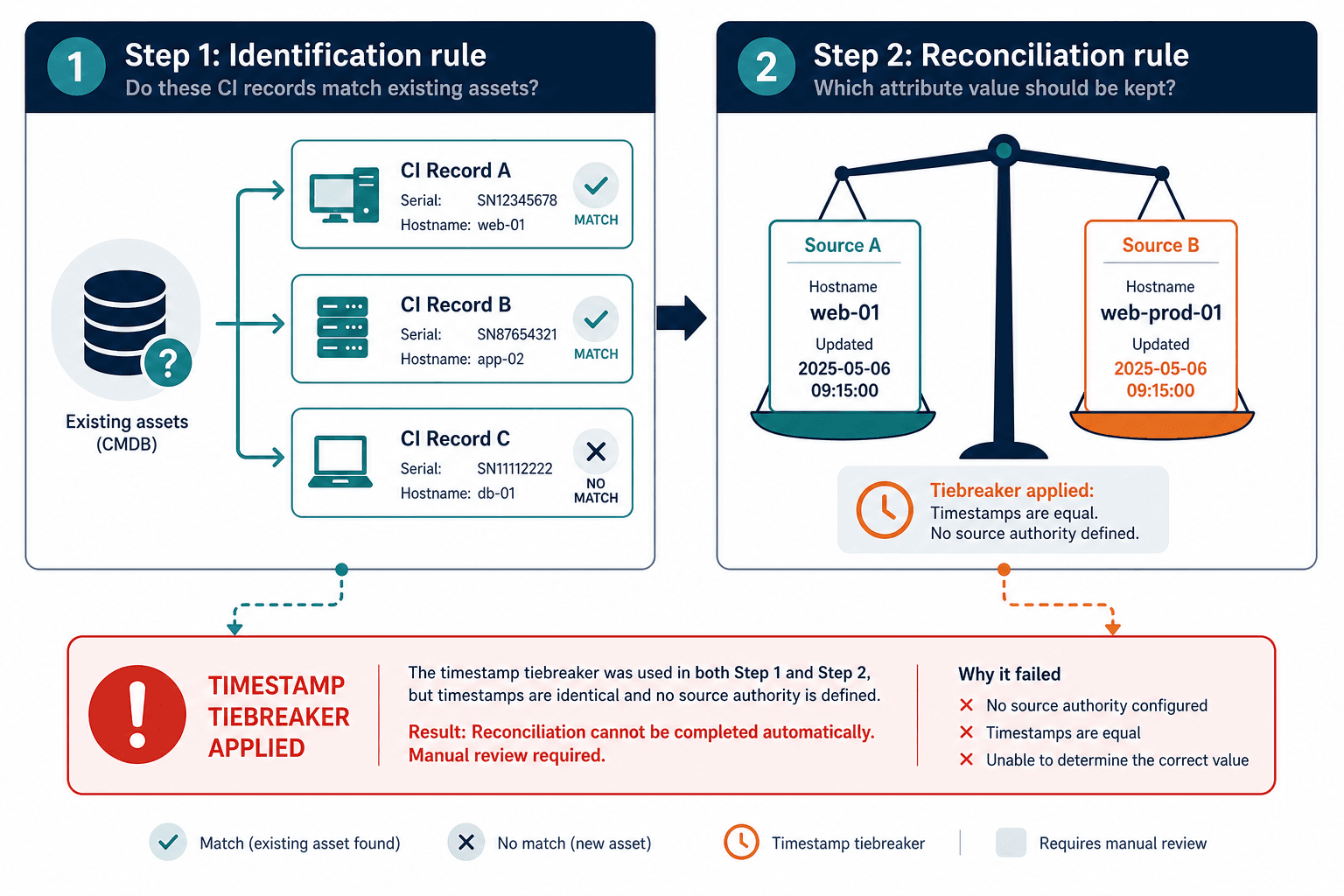
Most CMDB platforms conflate two distinct rule types. Identification rules determine which CI a discovery record matches — they answer “is this the same asset I’ve seen before?” Reconciliation rules determine which source wins when two records match the same CI — they answer “whose data do I trust?” Applying one recency rule across both decisions is where most default configurations break down, and where change management failures begin. The two rule types require separate governance: identification depends on stable CI keys — serial number, hostname, MAC address — while reconciliation depends on per-attribute source authority defined by discovery method and CI class.
Three sources, no authority — and a production P2
The scenario below illustrates a failure pattern that repeats across multi-source CMDB environments. The details are illustrative; the failure mode is not.
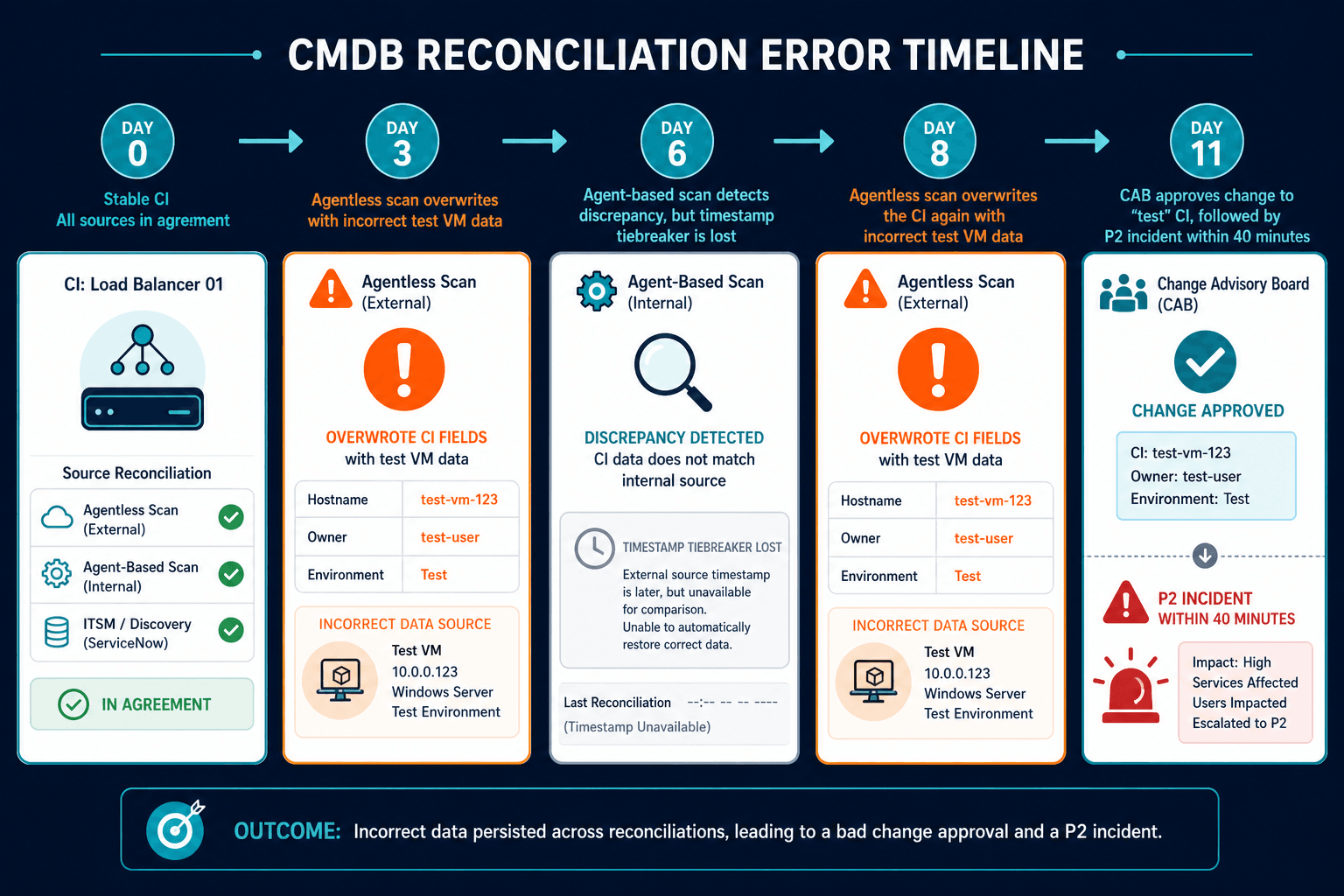
A production load balancer had a stable CI record for eight months: correct hostname, correct owner assignment, environment tag set to “production.” When the network team provisioned test VMs using a subnet that partially overlapped with the production DHCP range, one test VM received an IP address the agentless scanner had previously associated with the load balancer.
Three discovery sources fed this CMDB — agent-based scanning on managed endpoints, agentless network scanning, and manual ITSM imports — each with a different scope, a different refresh cadence, and no ranked priority when they disagreed. The agentless scan ran nightly. It found a device responding at the overlapping IP, read its attributes from the test VM, and overwrote the load balancer’s CI record: hostname, owner field, environment designation. Reconciliation logic had one rule: most-recent-wins. The CI looked current. The CMDB showed no conflict. The data was wrong.
On Day 6, the agent-based scan detected the discrepancy. Its managed-device scan produced the correct hostname and environment tag — but the reconciliation logic had no source priority ranking between agent and agentless types. The timestamp tiebreaker kept the agentless scan’s result in place because it had run more recently. On Day 8, the agentless scan ran again and overwrote the CI a second time.
On Day 11, the Change Advisory Board reviewed the load balancer’s CI record. The environment field read “test.” The change was categorized as low-risk and approved. A P2 incident followed within 40 minutes.
This is not a process failure. The CAB did exactly what it was designed to do: read the CMDB and assess risk based on what the CMDB said. The CMDB said the CI was a test asset. That designation came from an agentless scanner with no authority over the environment attribute. Average CMDB accuracy is approximately 60%, per Gartner (2024) — source fidelity mismatches are a primary driver.
What CMDB source authority requires in practice
CMDB source authority must be defined at three levels: CI class, attribute category, and source type. One global recency rule cannot replace this model.
| CI class | Hostname | Owner | Environment | Network location | Installed software |
|---|---|---|---|---|---|
| Managed servers | Agent | Manual import | Agent | Agentless | Agent |
| Unmanaged network devices | Agentless | Manual import | Manual import | Agentless | — |
| VMs (cloud) | API | Manual import | API | API | Agent / API |
| Cloud instances | API | Manual import | API | API | API |
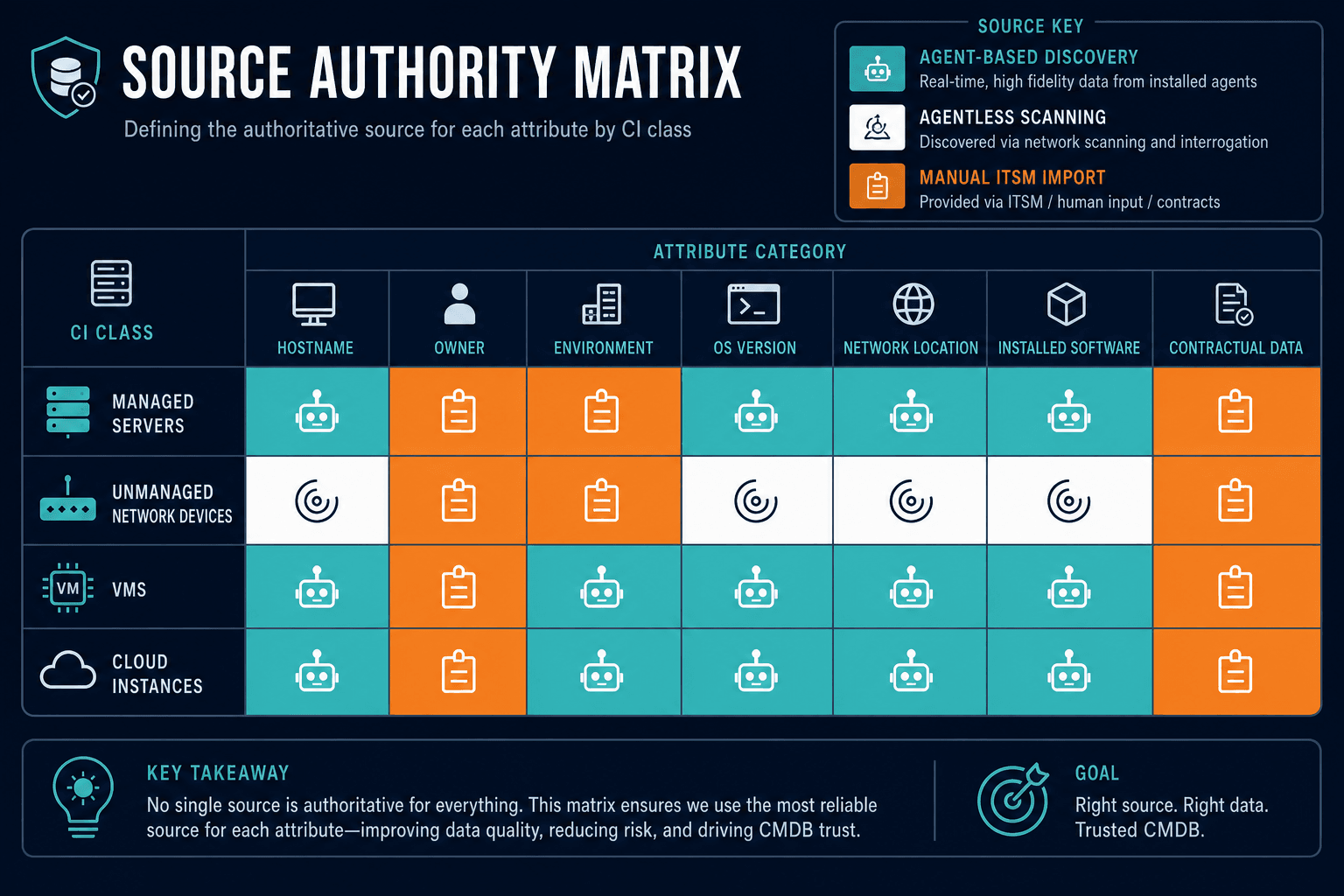
ITIL 4’s Service Configuration Management practice specifies that source precedence should be defined per attribute category, not applied as a single global timestamp rule. A manual import may be weeks old and still be authoritative for contractual owner assignment. An agentless scan may be hours old and still have no business overwriting OS-level attributes that only an agent can reliably capture. Gartner (2024) estimates that 83% of enterprises have blind spots covering at least 20% of their IT assets — and in multi-source environments, those blind spots compound when the assets an organization can see carry attributes written by the wrong source.
Three targeted changes resolved the load balancer failure, and they represent the practical minimum for any multi-source CMDB environment:
- Establishing discovery source priority before timestamp. Agent-based discovery was designated authoritative for hostname, owner, environment, and installed software on managed assets — the agent runs on the device itself, so its data is definitive. Agentless scanning retained authority for network-layer attributes — MAC address, open ports, network location — on unmanaged devices.
- Validation rule on environment-tier changes. Any promotion or demotion between “production” and “test” requires human review before committing to the CMDB. This is a targeted rule on the attribute category most likely to produce downstream change risk — not a general review gate for all CI updates.
- Network isolation. The test VM was reassigned to a dedicated test VLAN, removing the IP overlap that made the initial misidentification possible. This is an infrastructure fix, not a CMDB fix, but it closes the discovery ambiguity at the source.
Some CMDB platforms offer trust-score-weighted reconciliation — assigning a dynamic reliability score to each source based on historical accuracy — as an alternative or complement to static type-based priority. In practice, trust scores require calibration data most environments lack and still don’t address the root problem: a single global rule cannot replace per-attribute authority.
Maintaining these rules requires ongoing governance as the environment evolves. When new CI classes enter scope — containers, SaaS endpoints, cloud-native services — the source authority mapping for those classes should be defined before their discovery records begin populating the CMDB.
Source authority and AI-driven IT operations
The load balancer scenario above was caught within two weeks. At the scale of AI-driven IT operations, the same source authority gap produces errors at a faster cadence — and with less opportunity for human review before the wrong action executes.
Gartner’s 2025 research identifies a governed, discovery-sourced CMDB as the foundational infrastructure for safe IT automation — noting that AI agents acting on unverified CI records introduce automation risk that no guardrail layer fully compensates for. An AI agent needs to know not just what a CI record says, but which source wrote each attribute and whether that source had authority to do so.
Source lineage — the documented origin of each CI attribute, including which discovery method wrote it, when, and with what authority — is what makes CI data trustworthy enough to act on without human review. A hostname discovered by agent-based scan carries different authority than one entered manually three years ago. A cloud instance record written by API-based discovery carries different confidence than one populated from a DHCP scan. When AI agents cannot distinguish between these authority levels, automated remediation can target the wrong asset: remediating a test system instead of the production device, routing an incident to an owner who transferred responsibility months ago, or approving a change based on an environment tag written by a scanner with no authority over that field.
The CI record conflicts that resolve silently today become automated errors at scale tomorrow. Without source authority defined at the attribute level, the CMDB does not meet the governance standard that safe automation requires. Virima CMDB and discovery governance features
How Virima handles multi-source CMDB reconciliation
Virima’s discovery model assigns source authority at the attribute level. Agentless, agent-based, and API-based discovery methods each operate with defined scope, and the reconciliation layer assigns authority based on source type and CI class — not scan timestamp. When a CI attribute conflict is detected between sources, Virima surfaces it rather than silently applying a most-recent-wins resolution.
Each attribute on a CI record carries source attribution — which discovery method wrote it and when — giving change managers and incident teams the context they need before acting on CI information in a change workflow or incident response. That visibility is what makes ViVID™ service maps reliable: dependency relationships are built on CI data where source authority is defined, not just the most recent scanner’s output. Virima ViVID service maps
For ITSM teams using ServiceNow or Jira Service Management, this matters downstream: a change workflow pulling CI data from a CMDB where source authority is undefined inherits whatever the most recent scanner wrote — including data written by a source with no authority over that attribute. Virima integrates with ServiceNow and Jira Service Management to enrich CMDB records with discovery-sourced data, not as a replacement for your existing ITSM, but as the authoritative discovery layer that keeps CI attributes accurate before they flow into change workflows.
For a deeper look at how last-scan-wins destroys CMDB data quality, read Multi-Source CMDB Reconciliation: Why Last-Scan-Wins Destroys Data Quality.
See how Virima assigns source authority at the attribute level and surfaces CI record conflicts before they reach your change workflow — or your AI agents. Schedule a demo